第17章電気化学
17.6 Corrosion17.6 腐食
Learning Objectives学習目標
By the end of this section, you will be able to:
この節を学び終えると、次のことができるようになる。
- Define corrosion腐食を定義する。
- List some of the methods used to prevent or slow corrosion腐食を防ぐ、または遅らせるために使う方法をいくつか挙げる。
Corrosion is usually defined as the degradation of metals by a naturally occurring electrochemical process. The formation of rust on iron, tarnish on silver, and the blue-green patina that develops on copper are all examples of corrosion. The total cost of corrosion remediation in the United States is significant, with estimates in excess of half a trillion dollars a year.
英語のヒント
腐食は通常、自然に起こる電気化学的過程による金属の劣化と定義される。鉄にさびができること、銀が変色すること、銅に青緑色の緑青が生じることは、いずれも腐食の例である。米国での腐食対策にかかる総費用は莫大で、年間5000億ドルを超えると推定されている。
Perhaps the most familiar example of corrosion is the formation of rust on iron. Iron will rust when it is exposed to oxygen and water. Rust formation involves the creation of a galvanic cell at an iron surface, as illustrated in Figure 17.15. The relevant redox reactions are described by the following equations:
腐食の最も身近な例は、おそらく鉄のさびの形成である。鉄は酸素と水にさらされるとさびる。図17.15に示すように、さびの形成には鉄表面でのガルバニ電池の形成が関与する。関係する酸化還元反応は、次の式で表される。
Further reaction of the iron(II) product in humid air results in the production of an iron(III) oxide hydrate known as rust:
生成した鉄(II)が湿った空気中でさらに反応すると、さびとして知られる酸化鉄(III)の水和物を生じる。
The stoichiometry of the hydrate varies, as indicated by the use of x in the compound formula. Unlike the patina on copper, the formation of rust does not create a protective layer and so corrosion of the iron continues as the rust flakes off and exposes fresh iron to the atmosphere.
英語のヒント
化合物の式にxが使われていることが示すように、この水和物の化学量論は変化する。銅の緑青とは異なり、さびができても保護層は形成されないため、さびが薄片となって剥がれ落ち、新しい鉄が大気にさらされるにつれて、鉄の腐食は進み続ける。
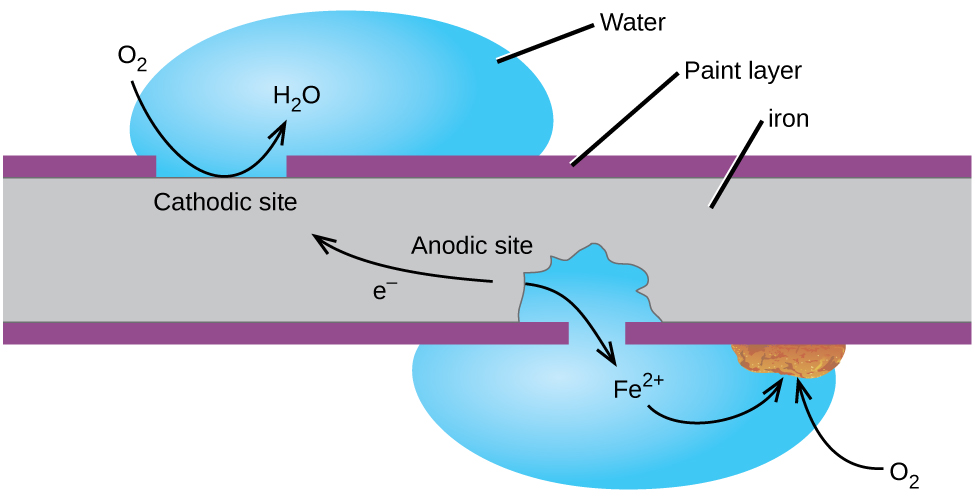
Figure 17.16図 17.16
Corrosion can occur when a painted iron or steel surface is exposed to the environment by a scratch through the paint. A galvanic cell results that may be approximated by the simplified cell schematic Fe(s) | Fe2+(aq) ||O2(aq), H2O(l) | Fe(s).
塗装された鉄や鋼の表面が、塗膜を貫く傷によって環境にさらされると、腐食が起こることがある。ガルバニ電池が形成され、簡略な電池の模式表記Fe(s) | Fe2+(aq) ||O2(aq), H2O(l) | Fe(s)で近似的に表せる。
One way to keep iron from corroding is to keep it painted. The layer of paint prevents the water and oxygen necessary for rust formation from coming into contact with the iron. As long as the paint remains intact, the iron is protected from corrosion.
英語のヒント
鉄の腐食を防ぐ方法の一つは、塗装を保つことである。塗膜は、さびの形成に必要な水と酸素が鉄に接触するのを防ぐ。塗膜が損なわれずに保たれる限り、鉄は腐食から守られる。
Other strategies include alloying the iron with other metals. For example, stainless steel is an alloy of iron containing a small amount of chromium. The chromium tends to collect near the surface, where it corrodes and forms a passivating an oxide layer that protects the iron.
英語のヒント
別の方法には、鉄を他の金属と合金にすることがある。たとえば、ステンレス鋼は少量のクロムを含む鉄の合金である。クロムは表面近くに集まる傾向があり、そこで腐食して、鉄を保護する不動態化の酸化物層を形成する。
Iron and other metals may also be protected from corrosion by galvanization, a process in which the metal to be protected is coated with a layer of a more readily oxidized metal, usually zinc. When the zinc layer is intact, it prevents air from contacting the underlying iron and thus prevents corrosion. If the zinc layer is breached by either corrosion or mechanical abrasion, the iron may still be protected from corrosion by a cathodic protection process, which is described in the next paragraph.
英語のヒント
鉄などの金属は、亜鉛めっきによっても腐食から守ることができる。これは、守る金属を、より酸化されやすい金属、通常は亜鉛の層で覆う過程である。亜鉛層が損なわれていないときは、その下の鉄に空気が接触するのを防ぎ、それによって腐食を防ぐ。亜鉛層が腐食や機械的な摩耗によって破られても、次の段落で説明するカソード防食の過程によって、鉄は引き続き腐食から守られることがある。
Another important way to protect metal is to make it the cathode in a galvanic cell. This is cathodic protection and can be used for metals other than just iron. For example, the rusting of underground iron storage tanks and pipes can be prevented or greatly reduced by connecting them to a more active metal such as zinc or magnesium (Figure 17.17). This is also used to protect the metal parts in water heaters. The more active metals (lower reduction potential) are called sacrificial anodes because as they get used up as they corrode (oxidize) at the anode. The metal being protected serves as the cathode for the reduction of oxygen in air, and so it simply serves to conduct (not react with) the electrons being transferred. When the anodes are properly monitored and periodically replaced, the useful lifetime of the iron storage tank can be greatly extended.
英語のヒント
金属を保護するもう一つの重要な方法は、その金属をガルバニ電池のカソードにすることである。これがカソード防食で、鉄以外の金属にも使える。たとえば、地下の鉄製貯蔵タンクや配管のさびは、亜鉛やマグネシウムなど、より活性な金属につなぐことで防止したり、大幅に減らしたりできる(図17.17)。この方法は、給湯器の金属部分の保護にも使われる。より活性な金属(還元電位が低いもの)は、アノードで腐食(酸化)して消費されるため、犠牲アノードと呼ばれる。保護される金属は、空気中の酸素が還元されるカソードとして働き、そのため移動する電子を伝導するだけで、電子と反応することはない。アノードを適切に監視し、定期的に交換すれば、鉄製貯蔵タンクの使用可能な寿命を大幅に延ばせる。
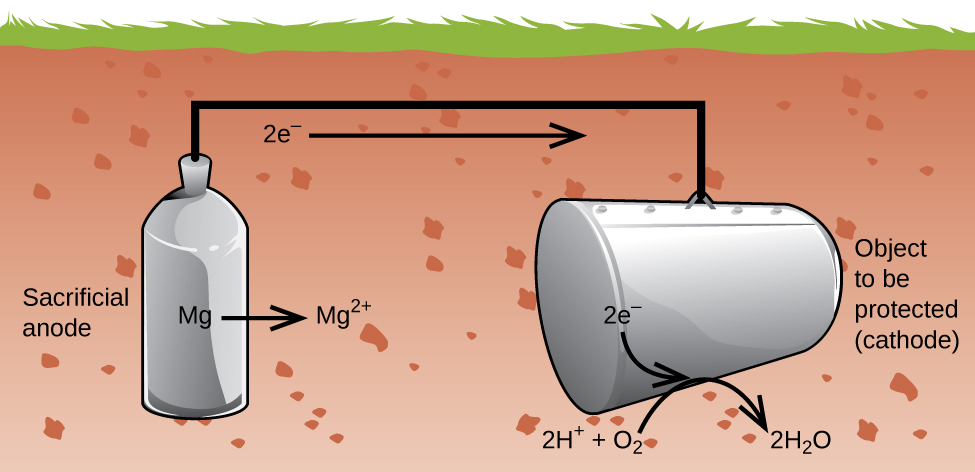


Figure 17.17図 17.17
Cathodic protection is a useful approach to electrochemically preventing corrosion of underground storage tanks.
カソード防食は、地下貯蔵タンクの腐食を電気化学的に防ぐための有用な方法である。