第4章化学反応の量的関係
4.5 Quantitative Chemical Analysis4.5 定量化学分析
Learning Objectives学習目標
By the end of this section, you will be able to:
この節を終えると、次のことができるようになる。
- Describe the fundamental aspects of titrations and gravimetric analysis.滴定と重量分析の基本的な特徴を説明する。
- Perform stoichiometric calculations using typical titration and gravimetric data.典型的な滴定や重量分析のデータを使って、化学量論計算を行う。
In the 18th century, the strength (actually the concentration) of vinegar samples was determined by noting the amount of potassium carbonate, K2CO3, which had to be added, a little at a time, before bubbling ceased. The greater the weight of potassium carbonate added to reach the point where the bubbling ended, the more concentrated the vinegar.
英語のヒント
18世紀には、酢の試料の強さ(実際には濃度)は、泡立ちが止まるまで炭酸カリウムK2CO3を少しずつ加え、その必要量を調べて求めていた。泡立ちが止まる点までに加えた炭酸カリウムの重量が大きいほど、酢の濃度も高いというわけである。
We now know that the effervescence that occurred during this process was due to reaction with acetic acid, CH3CO2H, the compound primarily responsible for the odor and taste of vinegar. Acetic acid reacts with potassium carbonate according to the following equation:
英語のヒント
現在では、この過程で起こる発泡は、酢のにおいと味の主な原因物質である酢酸CH3CO2Hとの反応によるものだと分かっている。酢酸は炭酸カリウムと、次の式に従って反応する。
The bubbling was due to the production of CO2.
泡立ちは、CO2の発生によるものであった。
The test of vinegar with potassium carbonate is one type of quantitative analysis—the determination of the amount or concentration of a substance in a sample. In the analysis of vinegar, the concentration of the solute (acetic acid) was determined from the amount of reactant that combined with the solute present in a known volume of the solution. In other types of chemical analyses, the amount of a substance present in a sample is determined by measuring the amount of product that results.
英語のヒント
炭酸カリウムによる酢の試験は、定量分析、すなわち試料中の物質の量や濃度を求める方法の一種である。酢の分析では、既知の体積の溶液中にある溶質と結合した反応物の量から、溶質(酢酸)の濃度を求めた。ほかの種類の化学分析では、生じる生成物の量を測定して、試料中に存在する物質の量を求める。
Titration滴定
The described approach to measuring vinegar strength was an early version of the analytical technique known as titration analysis. A typical titration analysis involves the use of a buret (Figure 4.16) to make incremental additions of a solution containing a known concentration of some substance (the titrant) to a sample solution containing the substance whose concentration is to be measured (the analyte). The titrant and analyte undergo a chemical reaction of known stoichiometry, and so measuring the volume of titrant solution required for complete reaction with the analyte (the equivalence point of the titration) allows calculation of the analyte concentration. The equivalence point of a titration may be detected visually if a distinct change in the appearance of the sample solution accompanies the completion of the reaction. The halt of bubble formation in the classic vinegar analysis is one such example, though, more commonly, special dyes called indicators are added to the sample solutions to impart a change in color at or very near the equivalence point of the titration. Equivalence points may also be detected by measuring some solution property that changes in a predictable way during the course of the titration. Regardless of the approach taken to detect a titration’s equivalence point, the volume of titrant actually measured is called the end point. Properly designed titration methods typically ensure that the difference between the equivalence and end points is negligible. Though any type of chemical reaction may serve as the basis for a titration analysis, the three described in this chapter (precipitation, acid-base, and redox) are most common. Additional details regarding titration analysis are provided in the chapter on acid-base equilibria.
英語のヒント
ここで述べた酢の強さを測る方法は、滴定分析として知られる分析技術の初期の形であった。典型的な滴定分析では、ビュレット(図4.16)を使い、濃度を測定する物質(分析対象物)を含む試料溶液に、ある物質を既知の濃度で含む溶液(滴定液)を少しずつ加える。滴定液と分析対象物は、既知の化学量論に従って反応する。そのため、分析対象物が完全に反応するのに必要な滴定液の体積(滴定の当量点)を測れば、分析対象物の濃度を計算できる。反応の完了に伴って試料溶液の外観がはっきり変われば、当量点を目で検出できる。古典的な酢の分析で泡の発生が止まるのは、その一例である。ただし、もっと一般的には、指示薬という特別な色素を試料溶液に加え、当量点またはそのごく近くで色が変わるようにする。滴定の進行に伴って予測できる形で変化する溶液の性質を測ることでも、当量点を検出できる。当量点の検出方法が何であれ、実際に測った滴定液の体積を終点と呼ぶ。適切に設計された滴定法では、通常、当量点と終点の違いを無視できるほど小さくする。どの種類の化学反応も滴定分析の基礎にできるが、最もよく使われるのは本章で述べた三つ、沈殿反応、酸塩基反応、酸化還元反応である。滴定分析の詳細は、酸塩基平衡の章で説明する。
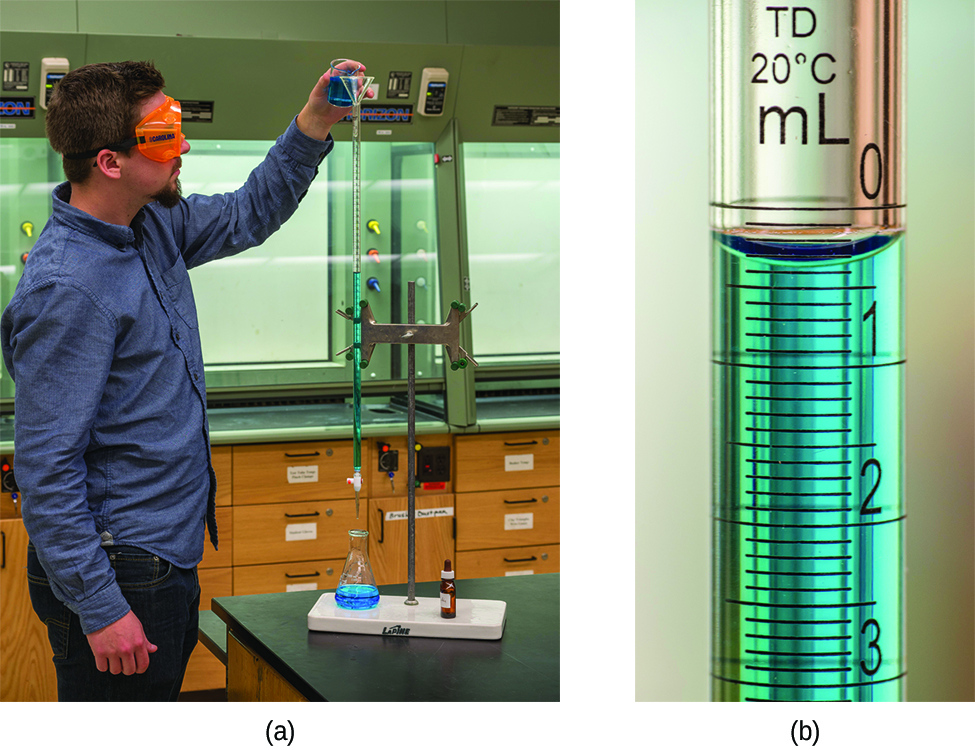
(credit a: modification of work by Mark Blaser and Matt Evans; credit b: modification of work by Mark Blaser and Matt Evans) · CC BY 4.0 · Source出典
Figure 4.16図 4.16
(a) A student fills a buret in preparation for a titration analysis. (b) A typical buret permits volume measurements to the nearest 0.01 mL. (credit a: modification of work by Mark Blaser and Matt Evans; credit b: modification of work by Mark Blaser and Matt Evans)
(a) 滴定分析の準備として、ビュレットに液を入れる学生。(b) 一般的なビュレットでは、体積を0.01 mLの位まで測れる。(出典a:Mark BlaserとMatt Evansの作品を改変、出典b:Mark BlaserとMatt Evansの作品を改変)
Example 4.14例題 4.14
Titration Analysis滴定分析
The end point in a titration of a 50.00-mL sample of aqueous HCl was reached by addition of 35.23 mL of 0.250 M NaOH titrant. The titration reaction is:
HCl水溶液50.00 mLを滴定したところ、0.250 MのNaOH滴定液を35.23 mL加えたときに終点に達した。滴定反応は次のとおりである。
What is the molarity of the HCl?
HClのモル濃度はいくらか。
Solution解答
As for all reaction stoichiometry calculations, the key issue is the relation between the molar amounts of the chemical species of interest as depicted in the balanced chemical equation. The approach outlined in previous modules of this chapter is followed, with additional considerations required, since the amounts of reactants provided and requested are expressed as solution concentrations.
すべての反応の化学量論計算と同様に、鍵になるのは、つり合った化学反応式が示す対象化学種どうしの物質量の関係である。本章の前の各節で示した方法を使うが、与えられた量と求める量が溶液の濃度で表されているため、追加の考慮が必要である。
For this exercise, the calculation will follow the following outlined steps:
この問題では、次に示す手順で計算する。
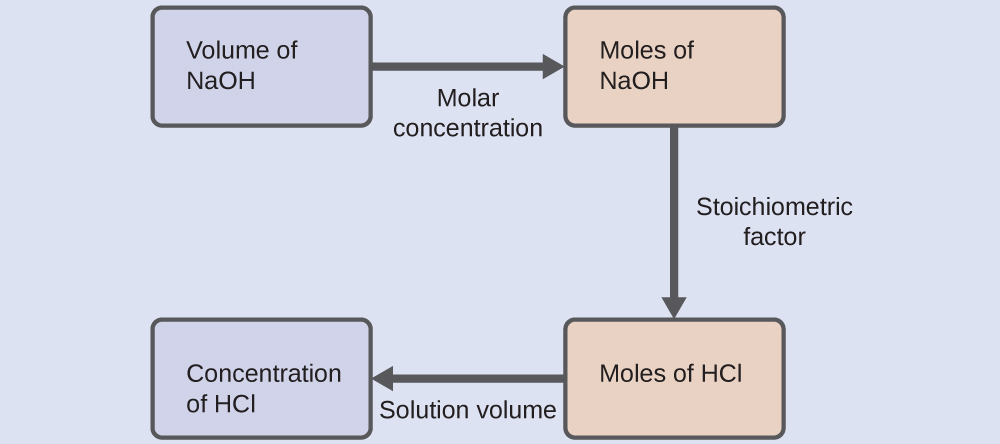

The molar amount of HCl is calculated to be:
HClの物質量は、次のように計算される。
Using the provided volume of HCl solution and the definition of molarity, the HCl concentration is:
与えられたHCl水溶液の体積とモル濃度の定義を使うと、HClの濃度は次のとおりである。
Note: For these types of titration calculations, it is convenient to recognize that solution molarity is also equal to the number of millimoles of solute per milliliter of solution:
注:この種の滴定計算では、溶液のモル濃度が、溶液1ミリリットル当たりの溶質のミリモル数にも等しいと理解しておくと便利である。
Using this version of the molarity unit will shorten the calculation by eliminating two conversion factors:
英語のヒント
モル濃度の単位をこの形で使えば、二つの換算因子が不要になり、計算を短くできる。
Check Your Learning理解度を確認
A 20.00-mL sample of aqueous oxalic acid, H2C2O4, was titrated with a 0.09113-M solution of potassium permanganate, KMnO4 (see net ionic equation below).
シュウ酸H2C2O4の水溶液20.00 mLを、0.09113 Mの過マンガン酸カリウムKMnO4水溶液で滴定した(下の正味のイオン反応式を参照)。
A volume of 23.24 mL was required to reach the end point. What is the oxalic acid molarity?
終点に達するのに23.24 mL必要であった。シュウ酸のモル濃度はいくらか。