第4章化学反応の量的関係
4.4 Reaction Yields4.4 反応の収率
Learning Objectives学習目標
By the end of this section, you will be able to:
この節を終えると、次のことができるようになる。
- Explain the concepts of theoretical yield and limiting reactants/reagents.理論収量と限定反応物・限界試薬の概念を説明する。
- Derive the theoretical yield for a reaction under specified conditions.指定した条件における反応の理論収量を求める。
- Calculate the percent yield for a reaction.反応の百分率収率を計算する。
The relative amounts of reactants and products represented in a balanced chemical equation are often referred to as stoichiometric amounts. All the exercises of the preceding module involved stoichiometric amounts of reactants. For example, when calculating the amount of product generated from a given amount of reactant, it was assumed that any other reactants required were available in stoichiometric amounts (or greater). In this module, more realistic situations are considered, in which reactants are not present in stoichiometric amounts.
英語のヒント
係数のつり合った化学反応式に示される反応物と生成物の相対量は、化学量論的な量と呼ばれることがよくある。前の節の練習問題では、すべて化学量論的な量の反応物を扱った。たとえば、ある量の反応物から生じる生成物の量を計算するとき、必要なほかの反応物は、化学量論的な量またはそれ以上の量があると仮定した。この節では、反応物が化学量論的な量では存在しない、より現実的な状況を考える。
Limiting Reactant限定反応物
Consider another food analogy, making grilled cheese sandwiches (Figure 4.13):
食べ物のたとえをもう一つ、チーズのホットサンドづくりで考えてみよう(図4.13)。
Stoichiometric amounts of sandwich ingredients for this recipe are bread and cheese slices in a 2:1 ratio. Provided with 28 slices of bread and 11 slices of cheese, one may prepare 11 sandwiches per the provided recipe, using all the provided cheese and having six slices of bread left over. In this scenario, the number of sandwiches prepared has been limited by the number of cheese slices, and the bread slices have been provided in excess.
英語のヒント
このレシピでの材料の化学量論的な量は、パンとチーズの薄切りが2:1の比である。パン28枚とチーズ11枚があれば、レシピに従ってサンドイッチを11個つくれる。チーズはすべて使い切り、パンが6枚残る。この場合、つくれるサンドイッチの数はチーズの枚数によって制限され、パンは過剰に用意されていたことになる。
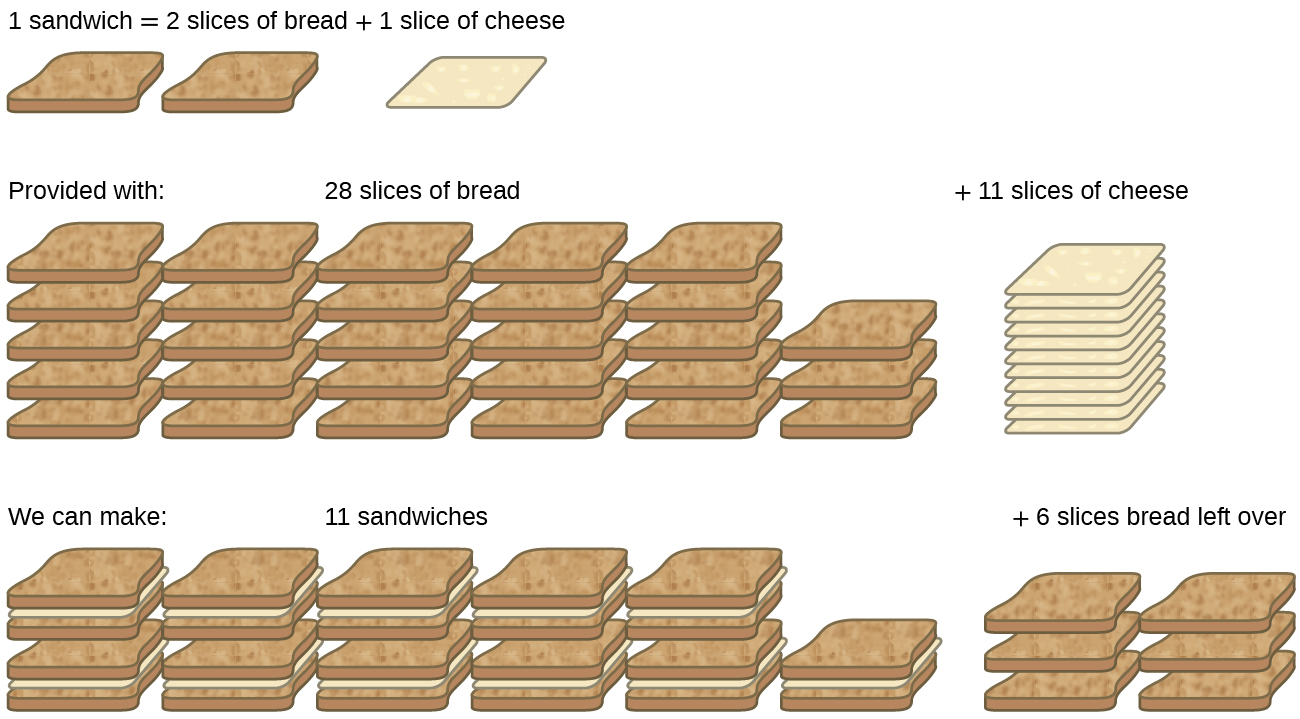
Figure 4.13図 4.13
Sandwich making can illustrate the concepts of limiting and excess reactants.
サンドイッチづくりは、限定反応物と過剰反応物の概念を説明するのに使える。
Consider this concept now with regard to a chemical process, the reaction of hydrogen with chlorine to yield hydrogen chloride:
今度はこの概念を、水素と塩素が反応して塩化水素になる化学過程について考えよう。
The balanced equation shows the hydrogen and chlorine react in a 1:1 stoichiometric ratio. If these reactants are provided in any other amounts, one of the reactants will nearly always be entirely consumed, thus limiting the amount of product that may be generated. This substance is the limiting reactant, and the other substance is the excess reactant. Identifying the limiting and excess reactants for a given situation requires computing the molar amounts of each reactant provided and comparing them to the stoichiometric amounts represented in the balanced chemical equation. For example, imagine combining 3 moles of H2 and 2 moles of Cl2. This represents a 3:2 (or 1.5:1) ratio of hydrogen to chlorine present for reaction, which is greater than the stoichiometric ratio of 1:1. Hydrogen, therefore, is present in excess, and chlorine is the limiting reactant. Reaction of all the provided chlorine (2 mol) will consume 2 mol of the 3 mol of hydrogen provided, leaving 1 mol of hydrogen unreacted.
英語のヒント
つり合った反応式は、水素と塩素が1:1の化学量論比で反応することを示している。これらの反応物をそれ以外の量で用意すると、ほぼ必ず一方の反応物が完全に消費され、生じ得る生成物の量を制限する。この物質を限定反応物、もう一方を過剰反応物と呼ぶ。ある状況で限定反応物と過剰反応物を判定するには、与えられた各反応物の物質量を計算し、つり合った化学反応式が表す化学量論的な量と比較する。たとえば、H2 3 molとCl2 2 molを合わせる場合を考える。反応する水素と塩素の比は3:2(または1.5:1)で、化学量論比の1:1より大きくなっている。したがって、水素は過剰に存在し、塩素が限定反応物である。用意した塩素2 molがすべて反応すると、水素は3 molのうち2 molが消費され、1 molが未反応で残る。
An alternative approach to identifying the limiting reactant involves comparing the amount of product expected for the complete reaction of each reactant. Each reactant amount is used to separately calculate the amount of product that would be formed per the reaction’s stoichiometry. The reactant yielding the lesser amount of product is the limiting reactant. For the example in the previous paragraph, complete reaction of the hydrogen would yield
英語のヒント
限定反応物を判定する別の方法は、各反応物が完全に反応すると仮定したときの生成物の予想量を比較することである。各反応物の量から、反応の化学量論に従って生じるはずの生成物の量を、それぞれ別々に計算する。生成物の量が少なくなるほうの反応物が、限定反応物である。前段落の例では、水素が完全に反応すると、次の量が生じる。
Complete reaction of the provided chlorine would produce
用意した塩素が完全に反応すると、次の量が生じる。
The chlorine will be completely consumed once 4 moles of HCl have been produced. Since enough hydrogen was provided to yield 6 moles of HCl, there will be unreacted hydrogen remaining once this reaction is complete. Chlorine, therefore, is the limiting reactant and hydrogen is the excess reactant (Figure 4.14).
HClが4 molできた時点で、塩素は完全に消費される。水素はHClを6 molつくるのに十分な量が用意されていたので、反応が終わった後にも未反応の水素が残る。したがって、塩素が限定反応物、水素が過剰反応物である(図4.14)。
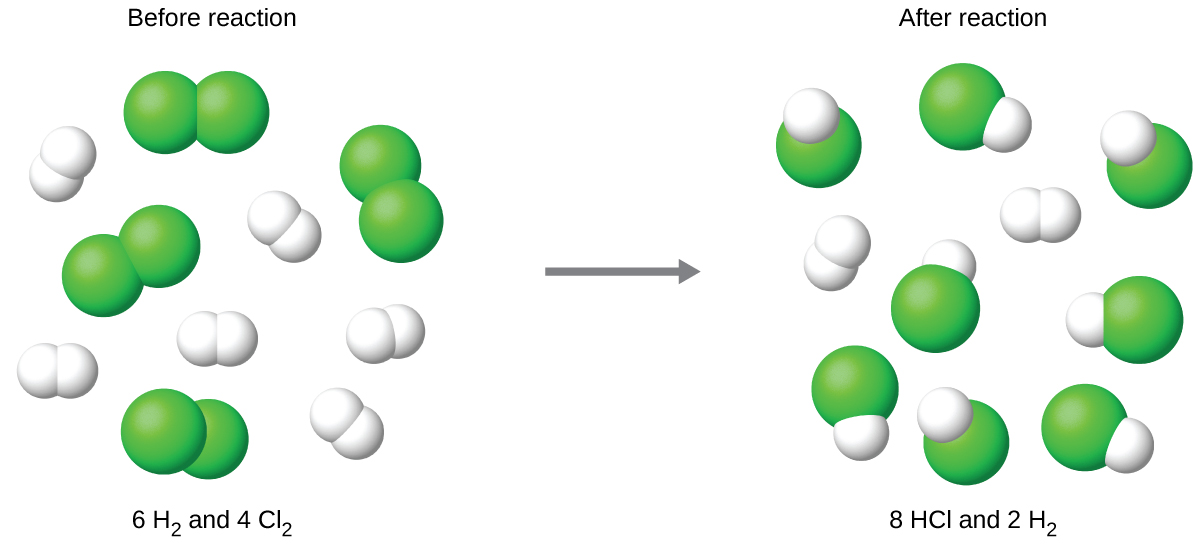


Figure 4.14図 4.14
When H2 and Cl2 are combined in nonstoichiometric amounts, one of these reactants will limit the amount of HCl that can be produced. This illustration shows a reaction in which hydrogen is present in excess and chlorine is the limiting reactant.
H2とCl2を化学量論比でない量で合わせると、一方の反応物が、生成できるHClの量を制限する。この図では水素が過剰に存在し、塩素が限定反応物になっている。
Example 4.12例題 4.12
Identifying the Limiting Reactant限定反応物を判定する
Silicon nitride is a very hard, high-temperature-resistant ceramic used as a component of turbine blades in jet engines. It is prepared according to the following equation:
英語のヒント
窒化ケイ素は非常に硬く、耐熱性の高いセラミックスで、ジェットエンジンのタービン翼の構成材料として使われる。次の反応式に従って調製する。
Which is the limiting reactant when 2.00 g of Si and 1.50 g of N2 react?
Si 2.00 gとN2 1.50 gを反応させるとき、どちらが限定反応物か。
Solution解答
Compute the provided molar amounts of reactants, and then compare these amounts to the balanced equation to identify the limiting reactant.
与えられた反応物の物質量を計算し、その量をつり合った反応式と比較して、限定反応物を判定する。
The provided Si:N2 molar ratio is:
与えられたSi:N2のモル比は、次のとおりである。
The stoichiometric Si:N2 ratio is:
Si:N2の化学量論比は、次のとおりである。
Comparing these ratios shows that Si is provided in a less-than-stoichiometric amount, and so is the limiting reactant.
これらの比を比較すると、Siは化学量論的に必要な量より少ないので、限定反応物であると分かる。
Alternatively, compute the amount of product expected for complete reaction of each of the provided reactants. The 0.0712 moles of silicon would yield
別の方法として、与えられた各反応物が完全に反応するときに予想される生成物の量を計算する。ケイ素0.0712 molからは、次の量が生じる。
while the 0.0535 moles of nitrogen would produce
一方、窒素0.0535 molからは、次の量が生じる。
Since silicon yields the lesser amount of product, it is the limiting reactant.
ケイ素から生じる生成物の量のほうが少ないので、ケイ素が限定反応物である。
Check Your Learning理解度を確認
Which is the limiting reactant when 5.00 g of H2 and 10.0 g of O2 react and form water?
H2 5.00 gとO2 10.0 gが反応して水をつくるとき、どちらが限定反応物か。