第4章化学反応の量的関係
Acid-Base Reactions酸塩基反応
An acid-base reaction is one in which a hydrogen ion, H+, is transferred from one chemical species to another. Such reactions are of central importance to numerous natural and technological processes, ranging from the chemical transformations that take place within cells and the lakes and oceans, to the industrial-scale production of fertilizers, pharmaceuticals, and other substances essential to society. The subject of acid-base chemistry, therefore, is worthy of thorough discussion, and a full chapter is devoted to this topic later in the text.
英語のヒント
酸塩基反応とは、水素イオンH+がある化学種から別の化学種へ移る反応である。こうした反応は、数多くの自然の過程や技術的な工程で中心的な重要性をもつ。細胞内や湖・海で起こる化学変化から、肥料、医薬品、その他社会に不可欠な物質の工業規模の製造まで、その範囲は広がっている。したがって、酸塩基の化学は十分に論じる価値がある主題であり、本書の後半では一つの章全体をこの主題に当てている。
For purposes of this brief introduction, we will consider only the more common types of acid-base reactions that take place in aqueous solutions. In this context, an acid is a substance that will dissolve in water to yield hydronium ions, H3O+. As an example, consider the equation shown here:
英語のヒント
ここでの簡単な紹介では、水溶液中で起こる比較的一般的な酸塩基反応だけを考える。この文脈では、酸とは水に溶けてヒドロニウムイオンH3O+を生じる物質である。一例として、次の反応式を考えよう。
The process represented by this equation confirms that hydrogen chloride is an acid. When dissolved in water, H3O+ ions are produced by a chemical reaction in which H+ ions are transferred from HCl molecules to H2O molecules (Figure 4.5).
この反応式が表す過程から、塩化水素が酸であることを確認できる。水に溶けると、H+イオンがHCl分子からH2O分子へ移る化学反応によって、H3O+イオンが生じる(図4.5)。
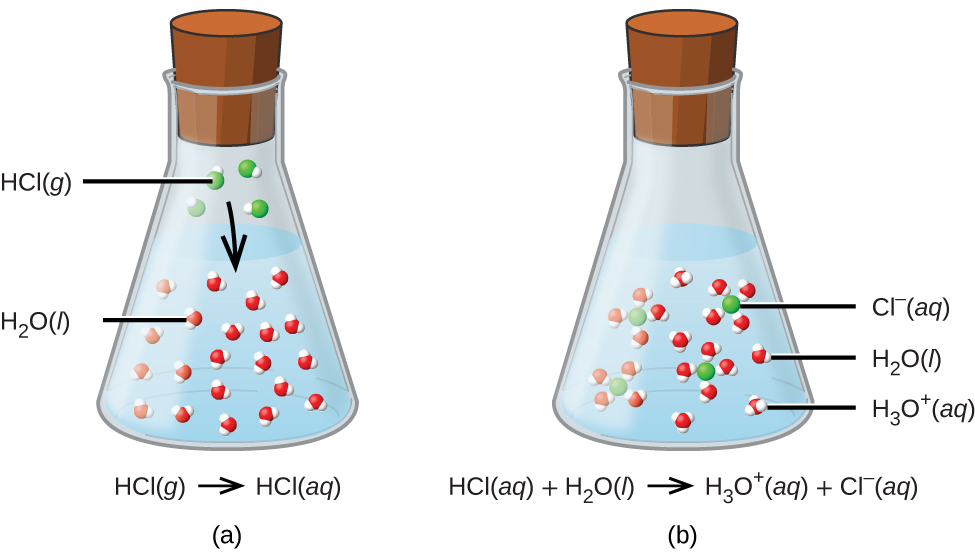

Figure 4.5図 4.5
When hydrogen chloride gas dissolves in water, (a) it reacts as an acid, transferring protons to water molecules to yield (b) hydronium ions (and solvated chloride ions).
塩化水素気体が水に溶けると、(a) 酸として反応し、水分子に陽子を渡して、(b) ヒドロニウムイオン(および溶媒和した塩化物イオン)を生じる。
The nature of HCl is such that its reaction with water as just described is essentially 100% efficient: Virtually every HCl molecule that dissolves in water will undergo this reaction. Acids that completely react in this fashion are called strong acids, and HCl is one among just a handful of common acid compounds that are classified as strong (Table 4.2). A far greater number of compounds behave as weak acids and only partially react with water, leaving a large majority of dissolved molecules in their original form and generating a relatively small amount of hydronium ions. Weak acids are commonly encountered in nature, being the substances partly responsible for the tangy taste of citrus fruits, the stinging sensation of insect bites, and the unpleasant smells associated with body odor. A familiar example of a weak acid is acetic acid, the main ingredient in food vinegars:
英語のヒント
HClは、いま述べた水との反応が実質的に100%進むという性質をもつ。水に溶けたHCl分子は、ほとんどすべてがこの反応を起こす。このように完全に反応する酸を強酸と呼ぶ。HClは、強酸に分類される、ごく少数の一般的な酸性化合物の一つである(表4.2)。はるかに多くの化合物は弱酸として振る舞い、水と一部だけ反応する。溶けた分子の大部分はもとの形のまま残り、ヒドロニウムイオンは比較的少量しか生じない。弱酸は自然界でよく見られ、柑橘類の刺激的な酸味、虫に刺されたときのひりひりする感覚、体臭に伴う不快なにおいの原因の一部になっている。身近な弱酸の例は、食酢の主成分である酢酸である。
When dissolved in water under typical conditions, only about 1% of acetic acid molecules are present in the ionized form, (Figure 4.6). (The use of a double-arrow in the equation above denotes the partial reaction aspect of this process, a concept addressed fully in the chapters on chemical equilibrium.)
英語のヒント
通常の条件で水に溶けたとき、酢酸分子のうち電離した形で存在するのは、約1%だけである(図4.6)。(上の反応式に使った両向き矢印は、この過程では一部だけが反応することを示している。この概念は、化学平衡の章で詳しく扱う。)
Image omitted because its reuse rights could not be verified.権利の確認ができないため画像を割愛。
Figure 4.6図 4.6
(a) Fruits such as oranges, lemons, and grapefruit contain the weak acid citric acid. (b) Vinegars contain the weak acid acetic acid. (credit a: modification of work by Scott Bauer; credit b: modification of work by Brücke-Osteuropa/Wikimedia Commons)
(a) オレンジ、レモン、グレープフルーツなどの果物には、弱酸であるクエン酸が含まれる。(b) 酢には、弱酸である酢酸が含まれる。(出典a:Scott Bauerの作品を改変、出典b:Brücke-Osteuropa/Wikimedia Commonsの作品を改変)
Common Strong Acids 代表的な強酸 |
||
|---|---|---|
Compound Formula 化合物の化学式 |
Name in Aqueous Solution 水溶液での名称 |
|
HBr |
hydrobromic acid 臭化水素酸 |
|
HCl |
hydrochloric acid 塩酸 |
|
HI |
hydroiodic acid ヨウ化水素酸 |
|
HNO3 |
nitric acid 硝酸 |
|
HClO4 |
perchloric acid 過塩素酸 |
|
H2SO4 |
sulfuric acid 硫酸 |
|
A base is a substance that will dissolve in water to yield hydroxide ions, OH−. The most common bases are ionic compounds composed of alkali or alkaline earth metal cations (groups 1 and 2) combined with the hydroxide ion—for example, NaOH and Ca(OH)2. Unlike the acid compounds discussed previously, these compounds do not react chemically with water; instead they dissolve and dissociate, releasing hydroxide ions directly into the solution. For example, KOH and Ba(OH)2 dissolve in water and dissociate completely to produce cations (K+ and Ba2+, respectively) and hydroxide ions, OH−. These bases, along with other hydroxides that completely dissociate in water, are considered strong bases.
英語のヒント
塩基とは、水に溶けて水酸化物イオンOH−を生じる物質である。最も一般的な塩基は、アルカリ金属またはアルカリ土類金属(1族、2族)の陽イオンと水酸化物イオンが結びついたイオン化合物で、NaOHやCa(OH)2がその例である。先ほどの酸性化合物とは異なり、これらは水と化学反応するのではなく、溶解して解離し、水酸化物イオンを直接溶液中に放出する。たとえば、KOHとBa(OH)2は水に溶けて完全に解離し、陽イオン(それぞれK+とBa2+)と水酸化物イオンOH−を生じる。これらの塩基は、水中で完全に解離するほかの水酸化物とともに、強塩基とみなされる。
Consider as an example the dissolution of lye (sodium hydroxide) in water:
英語のヒント
例として、灰汁(水酸化ナトリウム)が水に溶ける場合を考えよう。
This equation confirms that sodium hydroxide is a base. When dissolved in water, NaOH dissociates to yield Na+ and OH− ions. This is also true for any other ionic compound containing hydroxide ions. Since the dissociation process is essentially complete when ionic compounds dissolve in water under typical conditions, NaOH and other ionic hydroxides are all classified as strong bases.
この反応式から、水酸化ナトリウムが塩基であることを確認できる。水に溶けるとNaOHは解離して、Na+とOH−のイオンを生じる。これは、水酸化物イオンを含むほかのイオン化合物にも当てはまる。通常の条件でイオン化合物が水に溶けると、解離は実質的に完全に進むため、NaOHやその他のイオン性水酸化物はすべて強塩基に分類される。
Unlike ionic hydroxides, some compounds produce hydroxide ions when dissolved by chemically reacting with water molecules. In all cases, these compounds react only partially and so are classified as weak bases. These types of compounds are also abundant in nature and important commodities in various technologies. For example, global production of the weak base ammonia is typically well over 100 million metric tons annually, being widely used as an agricultural fertilizer, a raw material for chemical synthesis of other compounds, and an active ingredient in household cleaners (Figure 4.7). When dissolved in water, ammonia reacts partially to yield hydroxide ions, as shown here:
英語のヒント
イオン性水酸化物とは異なり、溶けたときに水分子と化学反応して水酸化物イオンを生じる化合物もある。これらの化合物はいずれも一部しか反応しないので、弱塩基に分類される。この種の化合物も自然界に豊富にあり、さまざまな技術で重要な製品となっている。たとえば、弱塩基であるアンモニアの世界の生産量は、通常、年間1億メートルトンを大きく上回る。農業用肥料、ほかの化合物を化学合成する原料、家庭用洗浄剤の有効成分として広く使われている(図4.7)。アンモニアは水に溶けると、次のように一部が反応して水酸化物イオンを生じる。
This is, by definition, an acid-base reaction, in this case involving the transfer of H+ ions from water molecules to ammonia molecules. Under typical conditions, only about 1% of the dissolved ammonia is present as ions.
これは定義どおり酸塩基反応であり、この場合はH+イオンが水分子からアンモニア分子へ移る。通常の条件では、溶けたアンモニアのうちイオンとして存在するのは約1%だけである。
Image omitted because its reuse rights could not be verified.権利の確認ができないため画像を割愛。
Figure 4.7図 4.7
Ammonia is a weak base used in a variety of applications. (a) Pure ammonia is commonly applied as an agricultural fertilizer. (b) Dilute solutions of ammonia are effective household cleansers. (credit a: modification of work by National Resources Conservation Service; credit b: modification of work by pat00139)
アンモニアはさまざまな用途に使われる弱塩基である。(a) 純粋なアンモニアは、農業用肥料として一般に施用される。(b) 薄いアンモニア水溶液は、家庭用洗浄剤として効果的である。(出典a:National Resources Conservation Serviceの作品を改変、出典b:pat00139の作品を改変)
A neutralization reaction is a specific type of acid-base reaction in which the reactants are an acid and a base (but not water), and the products are often a salt and water
英語のヒント
中和反応は酸塩基反応の一種で、反応物が酸と塩基(水ではない)であり、生成物は多くの場合、塩と水である。
To illustrate a neutralization reaction, consider what happens when a typical antacid such as milk of magnesia (an aqueous suspension of solid Mg(OH)2) is ingested to ease symptoms associated with excess stomach acid (HCl):
英語のヒント
中和反応の例として、過剰な胃酸(HCl)に伴う症状を和らげるため、マグネシア乳(固体Mg(OH)2の水性懸濁液)のような一般的な制酸剤を服用すると何が起こるかを考えよう。
Note that in addition to water, this reaction produces a salt, magnesium chloride.
この反応では水に加え、塩である塩化マグネシウムも生じることに注意せよ。
Example 4.4例題 4.4
Writing Equations for Acid-Base Reactions酸塩基反応の反応式を書く
Write balanced chemical equations for the acid-base reactions described here:
次に述べる酸塩基反応について、係数のつり合った化学反応式を書きなさい。
(a) the weak acid hydrogen hypochlorite reacts with water
(a) 弱酸である次亜塩素酸が水と反応する。
(b) a solution of barium hydroxide is neutralized with a solution of nitric acid
(b) 水酸化バリウム水溶液を硝酸水溶液で中和する。
Solution解答
(a) The two reactants are provided, HOCl and H2O. Since the substance is reported to be an acid, its reaction with water will involve the transfer of H+ from HOCl to H2O to generate hydronium ions, H3O+ and hypochlorite ions, OCl−.
(a) 二つの反応物として、HOClとH2Oが与えられている。この物質は酸とされているので、水との反応ではH+がHOClからH2Oへ移り、ヒドロニウムイオンH3O+と次亜塩素酸イオンOCl−が生じる。
A double-arrow is appropriate in this equation because it indicates the HOCl is a weak acid that has not reacted completely.
HOClが完全には反応しない弱酸であることを示すので、この反応式には両向き矢印が適切である。
(b) The two reactants are provided, Ba(OH)2 and HNO3. Since this is a neutralization reaction, the two products will be water and a salt composed of the cation of the ionic hydroxide (Ba2+) and the anion generated when the acid transfers its hydrogen ion
(b) 二つの反応物として、Ba(OH)2とHNO3が与えられている。これは中和反応なので、二つの生成物は、水と、イオン性水酸化物の陽イオン(Ba2+)および酸が水素イオンを渡したときに生じる陰イオンからなる塩である。
Check Your Learning理解度を確認
Write the net ionic equation representing the neutralization of any strong acid with an ionic hydroxide. (Hint: Consider the ions produced when a strong acid is dissolved in water.)
任意の強酸とイオン性水酸化物との中和を表す、正味のイオン反応式を書きなさい。(ヒント:強酸が水に溶けたときに生じるイオンを考えなさい。)