第4章化学反応の量的関係
4.2 Classifying Chemical Reactions4.2 化学反応の分類
Learning Objectives学習目標
By the end of this section, you will be able to:
この節を終えると、次のことができるようになる。
- Define three common types of chemical reactions (precipitation, acid-base, and oxidation-reduction)三つの一般的な化学反応(沈殿反応、酸塩基反応、酸化還元反応)を定義する。
- Classify chemical reactions as one of these three types given appropriate descriptions or chemical equations適切な説明や化学反応式が与えられたとき、化学反応をこの三種類のいずれかに分類する。
- Identify common acids and bases一般的な酸と塩基を見分ける。
- Predict the solubility of common inorganic compounds by using solubility rules溶解性の規則を使い、一般的な無機化合物の溶解性を予測する。
- Compute the oxidation states for elements in compounds化合物中の元素の酸化状態を計算する。
Humans interact with one another in various and complex ways, and we classify these interactions according to common patterns of behavior. When two humans exchange information, we say they are communicating. When they exchange blows with their fists or feet, we say they are fighting. Faced with a wide range of varied interactions between chemical substances, scientists have likewise found it convenient (or even necessary) to classify chemical interactions by identifying common patterns of reactivity. This module will provide an introduction to three of the most prevalent types of chemical reactions: precipitation, acid-base, and oxidation-reduction.
英語のヒント
人間はさまざまな複雑な形で互いに関わり合い、私たちはその関わりを共通する行動の型に従って分類している。二人の人間が情報を交換すれば、意思疎通をしていると言う。拳や足で打撃を応酬すれば、けんかをしていると言う。化学物質間の多種多様な相互作用を前に、科学者も同様に、反応性に共通する型を見いだして化学的な相互作用を分類することが便利であること、さらには必要でさえあることに気づいた。この節では、最もよく見られる化学反応のうち、沈殿反応、酸塩基反応、酸化還元反応の三つを紹介する。
Precipitation Reactions and Solubility Rules沈殿反応と溶解性の規則
A precipitation reaction is one in which dissolved substances react to form one (or more) solid products. Many reactions of this type involve the exchange of ions between ionic compounds in aqueous solution and are sometimes referred to as double displacement, double replacement, or metathesis reactions. These reactions are common in nature and are responsible for the formation of coral reefs in ocean waters and kidney stones in animals. They are used widely in industry for production of a number of commodity and specialty chemicals. Precipitation reactions also play a central role in many chemical analysis techniques, including spot tests used to identify metal ions and gravimetric methods for determining the composition of matter (see the last module of this chapter).
英語のヒント
沈殿反応とは、溶けている物質が反応して、一つ以上の固体生成物を生じる反応である。この種の反応の多くは、水溶液中のイオン化合物の間でイオンが交換されるもので、複置換反応、二重置換反応、またはメタセシス反応と呼ばれることもある。こうした反応は自然界でよく起こり、海水中のサンゴ礁や動物の腎臓結石の形成を引き起こす。工業では、さまざまな汎用化学品や特殊化学品の製造に広く用いられている。沈殿反応は多くの化学分析法でも中心的な役割を果たす。たとえば、金属イオンを同定する点滴試験や、物質の組成を求める重量分析法がある(本章最後の節を参照)。
The extent to which a substance may be dissolved in water, or any solvent, is quantitatively expressed as its solubility, defined as the maximum concentration of a substance that can be achieved under specified conditions. Substances with relatively large solubilities are said to be soluble. A substance will precipitate when solution conditions are such that its concentration exceeds its solubility. Substances with relatively low solubilities are said to be insoluble, and these are the substances that readily precipitate from solution. More information on these important concepts is provided in a later chapter on solutions. For purposes of predicting the identities of solids formed by precipitation reactions, one may simply refer to patterns of solubility that have been observed for many ionic compounds (Table 4.1).
英語のヒント
物質が水やその他の溶媒にどの程度溶けるかは、溶解度によって定量的に表される。溶解度は、指定した条件で到達できるその物質の最大濃度と定義される。溶解度が比較的大きい物質は、可溶性であると言う。溶液中の濃度が溶解度を超えるような条件になると、物質は沈殿する。溶解度が比較的小さい物質は、不溶性であると言う。これらは、溶液から容易に沈殿する物質である。これらの重要な概念については、後の溶液の章で詳しく説明する。沈殿反応で生じる固体の種類を予測する目的なら、多くのイオン化合物について観察されている溶解性の傾向を参照するだけでよいだろう(表4.1)。
Soluble Ionic Compounds 可溶性のイオン化合物 |
contain these ions 含まれるイオン |
exceptions 例外 |
NH4+ NH4+ group I cations: 第I族の陽イオン: Li+ Li+ Na+ Na+ K+ K+ Rb+ Rb+ Cs+ Cs+ |
none なし |
|
Cl- Cl- Br- Br- I- I- |
compounds with Ag+, Hg22+, and Pb2+ Ag+、Hg22+、Pb2+を含む化合物 |
|
F- |
compounds with group 2 metal cations, Pb2+, and Fe3+ 2族金属の陽イオン、Pb2+、Fe3+を含む化合物 |
|
C2H3O2- C2H3O2- HCO3- HCO3- NO3- NO3- ClO3- ClO3- |
none なし |
|
SO42- |
compounds with Ag+, Ba2+, Ca2+, Hg22+, Pb2+ and Sr2+ Ag+、Ba2+、Ca2+、Hg22+、Pb2+、Sr2+を含む化合物 |
|
Insoluble Ionic Compounds 不溶性のイオン化合物 |
contain these ions 含まれるイオン |
exceptions 例外 |
CO32- CO32- CrO42- CrO42- PO43- PO43- S2- S2- |
compounds with group 1 cations and NH4+ 1族の陽イオンおよびNH4+を含む化合物 |
|
OH- |
compounds with group 1 cations and Ba2+ 1族の陽イオンおよびBa2+を含む化合物 |
A vivid example of precipitation is observed when solutions of potassium iodide and lead nitrate are mixed, resulting in the formation of solid lead iodide:
沈殿の鮮やかな例は、ヨウ化カリウム水溶液と硝酸鉛水溶液を混ぜ、固体のヨウ化鉛が生じるときに観察できる。
This observation is consistent with the solubility guidelines: The only insoluble compound among all those involved is lead iodide, one of the exceptions to the general solubility of iodide salts.
この観察結果は溶解性の指針と一致する。関係するすべての化合物のうち、不溶性なのはヨウ化鉛だけである。これは、ヨウ化物塩が一般に可溶性であるという規則の例外の一つである。
The net ionic equation representing this reaction is:
この反応を表す正味のイオン反応式は次のとおりである。
Lead iodide is a bright yellow solid that was formerly used as an artist’s pigment known as iodine yellow (Figure 4.4). The properties of pure PbI2 crystals make them useful for fabrication of X-ray and gamma ray detectors.
英語のヒント
ヨウ化鉛は鮮やかな黄色の固体で、かつてはヨードイエローという絵画用顔料として使われていた(図4.4)。純粋なPbI2結晶は、その性質からX線やガンマ線の検出器の製作に役立つ。
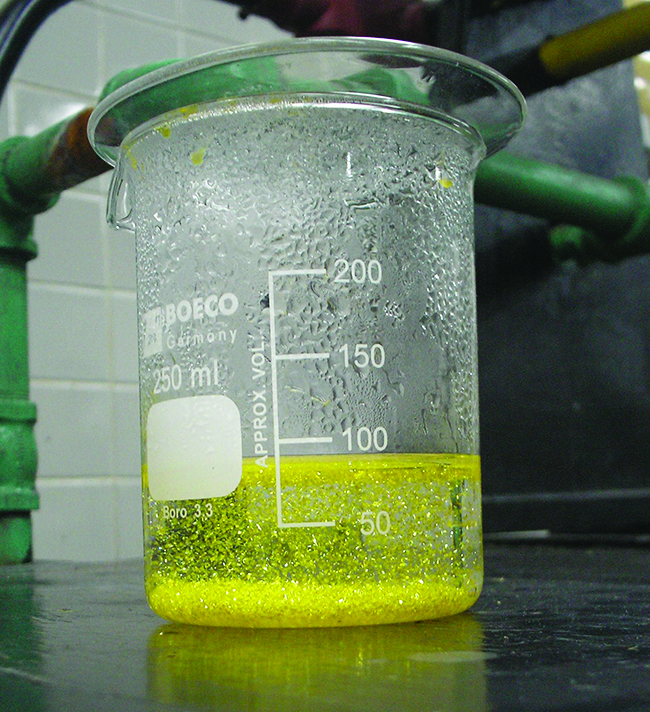

Figure 4.4図 4.4
A precipitate of PbI2 forms when solutions containing Pb2+ and I− are mixed. (credit: Der Kreole/Wikimedia Commons)
Pb2+とI−を含む溶液を混ぜると、PbI2の沈殿が生じる。(出典:Der Kreole/Wikimedia Commons)
The solubility guidelines in Table 4.1 may be used to predict whether a precipitation reaction will occur when solutions of soluble ionic compounds are mixed together. One merely needs to identify all the ions present in the solution and then consider if possible cation/anion pairing could result in an insoluble compound. For example, mixing solutions of silver nitrate and sodium chloride will yield a solution containing Ag+, Na+, and Cl− ions. Aside from the two ionic compounds originally present in the solutions, AgNO3 and NaCl, two additional ionic compounds may be derived from this collection of ions: NaNO3 and AgCl. The solubility guidelines indicate all nitrate salts are soluble but that AgCl is one of insoluble. A precipitation reaction, therefore, is predicted to occur, as described by the following equations:
英語のヒント
表4.1の溶解性の指針を使うと、可溶性のイオン化合物の水溶液を混ぜたときに沈殿反応が起こるかどうかを予測できる。溶液中にあるすべてのイオンを確認し、可能な陽イオンと陰イオンの組合せが不溶性の化合物を生じるかを考えればよいのである。たとえば、硝酸銀水溶液と塩化ナトリウム水溶液を混ぜると、Ag+、、Na+、Cl−の各イオンを含む溶液になる。もとの溶液に含まれていた二つのイオン化合物、AgNO3とNaClのほかに、このイオンの組からはNaNO3とAgClという二つのイオン化合物も考えられる。溶解性の指針によれば、硝酸塩はすべて可溶性であるが、AgClは不溶性である。したがって、次の反応式で示す沈殿反応が起こると予測される。
Example 4.3例題 4.3
Predicting Precipitation Reactions沈殿反応の予測
Predict the result of mixing reasonably concentrated solutions of the following ionic compounds. If precipitation is expected, write a balanced net ionic equation for the reaction.
次のイオン化合物の、適度に濃い水溶液を混ぜるとどうなるか予測しなさい。沈殿が生じると予想される場合は、係数のつり合った正味のイオン反応式を書きなさい。
(a) potassium sulfate and barium nitrate
(a) 硫酸カリウムと硝酸バリウム
(b) lithium chloride and silver acetate
(b) 塩化リチウムと酢酸銀
(c) lead (II) nitrate and ammonium carbonate
(c) 硝酸鉛(II)と炭酸アンモニウム
Solution解答
(a) The two possible products for this combination are KNO3 and BaSO4. The solubility guidelines indicate BaSO4 is insoluble, and so a precipitation reaction is expected. The net ionic equation for this reaction, derived in the manner detailed in the previous module, is
(a) この組合せで考えられる二つの生成物は、KNO3とBaSO4である。溶解性の指針によればBaSO4は不溶性なので、沈殿反応が予想される。前の節で詳しく説明した方法で導かれる、この反応の正味のイオン反応式は次のとおりである。
(b) The two possible products for this combination are LiC2H3O2 and AgCl. The solubility guidelines indicate AgCl is insoluble, and so a precipitation reaction is expected. The net ionic equation for this reaction, derived in the manner detailed in the previous module, is
(b) この組合せで考えられる二つの生成物は、LiC2H3O2とAgClである。溶解性の指針によればAgClは不溶性なので、沈殿反応が予想される。前の節で詳しく説明した方法で導かれる、この反応の正味のイオン反応式は次のとおりである。
(c) The two possible products for this combination are PbCO3 and NH4NO3. The solubility guidelines indicate PbCO3 is insoluble, and so a precipitation reaction is expected. The net ionic equation for this reaction, derived in the manner detailed in the previous module, is
(c) この組合せで考えられる二つの生成物は、PbCO3とNH4NO3である。溶解性の指針によればPbCO3は不溶性なので、沈殿反応が予想される。前の節で詳しく説明した方法で導かれる、この反応の正味のイオン反応式は次のとおりである。
Check Your Learning理解度を確認
Which solution could be used to precipitate the barium ion, Ba2+, in a water sample: sodium chloride, sodium hydroxide, or sodium sulfate? What is the formula for the expected precipitate?
水の試料中のバリウムイオンBa2+を沈殿させるには、塩化ナトリウム、水酸化ナトリウム、硫酸ナトリウムのどの水溶液を使えるか。予想される沈殿の化学式は何か。