第4章化学反応の量的関係
4.1 Writing and Balancing Chemical Equations4.1 化学反応式の書き方と係数合わせ
Learning Objectives学習目標
By the end of this section, you will be able to:
この節を終えると、次のことができるようになる。
- Derive chemical equations from narrative descriptions of chemical reactions.化学反応を文章で説明したものから、化学反応式を導く。
- Write and balance chemical equations in molecular, total ionic, and net ionic formats.分子反応式、完全イオン反応式、正味のイオン反応式を書き、係数を合わせる。
An earlier chapter of this text introduced the use of element symbols to represent individual atoms. When atoms gain or lose electrons to yield ions, or combine with other atoms to form molecules, their symbols are modified or combined to generate chemical formulas that appropriately represent these species. Extending this symbolism to represent both the identities and the relative quantities of substances undergoing a chemical (or physical) change involves writing and balancing a chemical equation. Consider as an example the reaction between one methane molecule (CH4) and two diatomic oxygen molecules (O2) to produce one carbon dioxide molecule (CO2) and two water molecules (H2O). The chemical equation representing this process is provided in the upper half of Figure 4.2, with space-filling molecular models shown in the lower half of the figure.
英語のヒント
前の章では、元素記号で個々の原子を表す方法を紹介した。原子が電子を受け取ったり失ったりしてイオンになる場合や、ほかの原子と結びついて分子になる場合には、記号を変えたり組み合わせたりして、それらを適切に表す化学式を作る。この記号表現を拡張して、化学的または物理的変化を受ける物質の種類と相対量の両方を示すのが、化学反応式を書き、係数を合わせることである。たとえば、メタン分子(CH4)1個と二原子分子の酸素(O2)2個が反応し、二酸化炭素分子(CO2)1個と水分子(H2O)2個を生じる反応を考えよう。この過程を表す化学反応式を図4.2の上半分に、空間充填模型を下半分に示す。
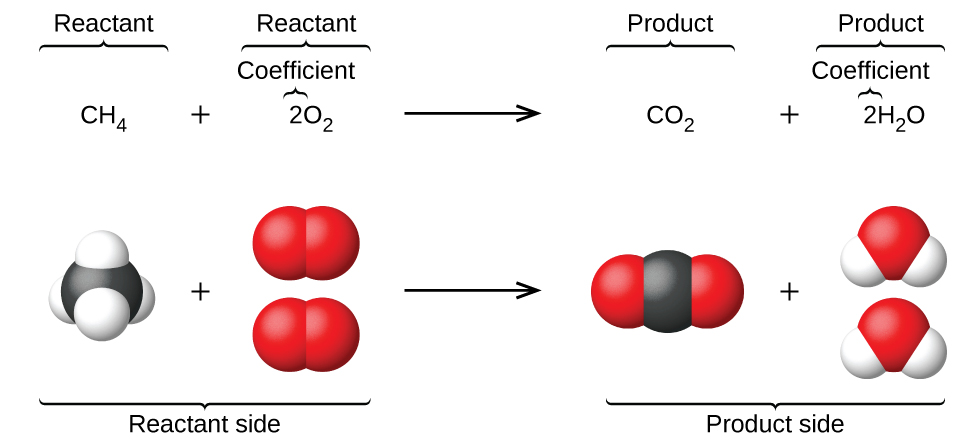
Figure 4.2図 4.2
The reaction between methane and oxygen to yield carbon dioxide and water (shown at bottom) may be represented by a chemical equation using formulas (top).
メタンと酸素が反応して二酸化炭素と水を生じる過程(下)は、化学式を使った化学反応式(上)で表せる。
This example illustrates the fundamental aspects of any chemical equation:
この例は、どの化学反応式にも共通する基本事項を示している。
- The substances undergoing reaction are called reactants, and their formulas are placed on the left side of the equation.反応する物質を反応物と呼び、その化学式を反応式の左辺に置く。
- The substances generated by the reaction are called products, and their formulas are placed on the right side of the equation.反応によって生じる物質を生成物と呼び、その化学式を右辺に置く。
- Plus signs (+) separate individual reactant and product formulas, and an arrow separates the reactant and product (left and right) sides of the equation.個々の反応物や生成物の化学式はプラス記号(+)で区切り、反応物側(左)と生成物側(右)を矢印で区切る。
- The relative numbers of reactant and product species are represented by coefficients (numbers placed immediately to the left of each formula). A coefficient of 1 is typically omitted.各反応物・生成物の相対的な個数は、化学式のすぐ左に置く数である係数で表す。係数1は通常省略する。
It is common practice to use the smallest possible whole-number coefficients in a chemical equation, as is done in this example. Realize, however, that these coefficients represent the relative numbers of reactants and products, and, therefore, they may be correctly interpreted as ratios. Methane and oxygen react to yield carbon dioxide and water in a 1:2:1:2 ratio. This ratio is satisfied if the numbers of these molecules are, respectively, 1-2-1-2, or 2-4-2-4, or 3-6-3-6, and so on (Figure 4.3). Likewise, these coefficients may be interpreted with regard to any amount (number) unit, and so this equation may be correctly read in many ways, including:
英語のヒント
この例のように、化学反応式の係数には、可能な最小の整数を使うのが普通である。ただし、係数が表すのは反応物と生成物の相対的な個数なので、比として解釈できることを理解せよ。メタンと酸素が反応して二酸化炭素と水を生じる比は1:2:1:2である。分子数がそれぞれ1-2-1-2でも、2-4-2-4でも、3-6-3-6でも、この比率を満たす(図4.3)。同様に、量や個数を表すどの単位で係数を解釈してもよいので、反応式には次のようなさまざまな正しい読み方がある。
- One methane molecule and two oxygen molecules react to yield one carbon dioxide molecule and two water molecules.メタン分子1個と酸素分子2個が反応し、二酸化炭素分子1個と水分子2個を生じる。
- One dozen methane molecules and two dozen oxygen molecules react to yield one dozen carbon dioxide molecules and two dozen water molecules.メタン分子1ダースと酸素分子2ダースが反応し、二酸化炭素分子1ダースと水分子2ダースを生じる。
- One mole of methane molecules and 2 moles of oxygen molecules react to yield 1 mole of carbon dioxide molecules and 2 moles of water molecules.メタン分子1モルと酸素分子2モルが反応し、二酸化炭素分子1モルと水分子2モルを生じる。
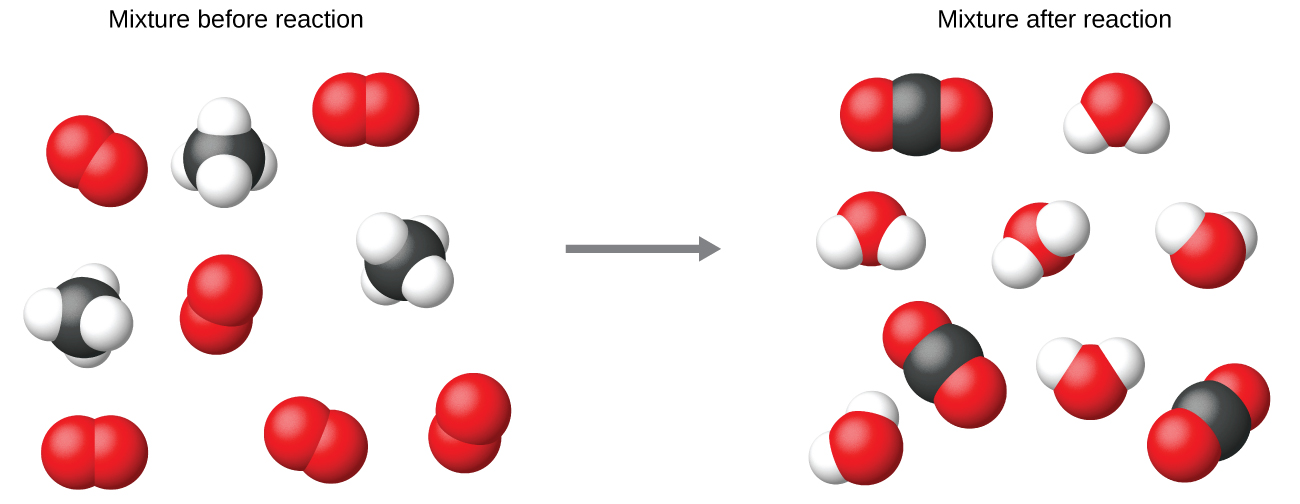


Figure 4.3図 4.3
Regardless of the absolute numbers of molecules involved, the ratios between numbers of molecules of each species that react (the reactants) and molecules of each species that form (the products) are the same and are given by the chemical reaction equation.
実際に関わる分子の絶対数にかかわらず、反応する各化学種(反応物)の分子数と、生じる各化学種(生成物)の分子数の比は同じで、化学反応式がその比を示す。
Balancing Equations反応式の係数を合わせる
The chemical equation described in section 4.1 is balanced, meaning that equal numbers of atoms for each element involved in the reaction are represented on the reactant and product sides. This is a requirement the equation must satisfy to be consistent with the law of conservation of matter. It may be confirmed by simply summing the numbers of atoms on either side of the arrow and comparing these sums to ensure they are equal. Note that the number of atoms for a given element is calculated by multiplying the coefficient of any formula containing that element by the element’s subscript in the formula. If an element appears in more than one formula on a given side of the equation, the number of atoms represented in each must be computed and then added together. For example, both product species in the example reaction, CO2 and H2O, contain the element oxygen, and so the number of oxygen atoms on the product side of the equation is
英語のヒント
4.1節で示した化学反応式はつり合っている。これは、反応に関わる各元素の原子数が、反応物側と生成物側で等しいことを意味する。物質保存の法則と一致するために、反応式はこの条件を満たさなければならない。矢印の両側でそれぞれ原子数を合計し、同じかどうかを比較すれば確認できる。ある元素の原子数は、その元素を含む化学式の係数と、化学式中のその元素の添字を掛けて求める。同じ側で複数の化学式にその元素が現れるなら、各化学式の原子数を計算して合計する。たとえば、この例の生成物CO2とH2Oはどちらも酸素を含むので、生成物側の酸素原子の数は次のようになる。
The equation for the reaction between methane and oxygen to yield carbon dioxide and water is confirmed to be balanced per this approach, as shown here:
この方法で、メタンと酸素から二酸化炭素と水を生じる反応式がつり合っていることを、次のように確認できる。
Element 元素 |
Reactants 反応物 |
Products 生成物 |
Balanced? つり合っているか |
|---|---|---|---|
C |
1 1 = 1 |
1 1 = 1 |
1 = 1, yes 1 = 1、はい |
H |
4 1 = 4 |
2 2 = 4 |
4 = 4, yes 4 = 4、はい |
O |
2 2 = 4 |
(1 2) + (2 1) = 4 |
4 = 4, yes 4 = 4、はい |
A balanced chemical equation often may be derived from a qualitative description of some chemical reaction by a fairly simple approach known as balancing by inspection. Consider as an example the decomposition of water to yield molecular hydrogen and oxygen. This process is represented qualitatively by an unbalanced chemical equation:
英語のヒント
反応の定性的な説明から、観察による係数合わせという比較的簡単な方法で、つり合った反応式を得られることがよくある。例として、水が分解して水素分子と酸素分子を生じる反応を考えよう。定性的には、次の未調整の反応式で表せる。
Comparing the number of H and O atoms on either side of this equation confirms its imbalance:
両辺のH原子とO原子の数を比較すると、つり合っていないことがわかる。
Element 元素 |
Reactants 反応物 |
Products 生成物 |
Balanced? つり合っているか |
|---|---|---|---|
H |
1 2 = 2 |
1 2 = 2 |
2 = 2, yes 2 = 2、はい |
O |
1 1 = 1 |
1 2 = 2 |
1 ≠ 2, no 1 ≠ 2、いいえ |
The numbers of H atoms on the reactant and product sides of the equation are equal, but the numbers of O atoms are not. To achieve balance, the coefficients of the equation may be changed as needed. Keep in mind, of course, that the formula subscripts define, in part, the identity of the substance, and so these cannot be changed without altering the qualitative meaning of the equation. For example, changing the reactant formula from H2O to H2O2 would yield balance in the number of atoms, but doing so also changes the reactant’s identity (it’s now hydrogen peroxide and not water). The O atom balance may be achieved by changing the coefficient for H2O to 2.
英語のヒント
反応物側と生成物側のH原子数は同じであるが、O原子数は同じではない。つり合わせるには、必要に応じて係数を変える。ただし、化学式の添字はその物質が何であるかを決める要素なので、添字を変えると反応式が表す反応の意味自体が変わってしまう。たとえば、反応物の式H2OをH2O2に変えれば原子数はつり合うが、反応物は水ではなく過酸化水素に変わる。O原子数を合わせるには、H2Oの係数を2にすればよいのである。
Element 元素 |
Reactants 反応物 |
Products 生成物 |
Balanced? つり合っているか |
|---|---|---|---|
H |
2 2 = 4 |
1 2 = 2 |
4 ≠ 2, no 4 ≠ 2、いいえ |
O |
2 1 = 2 |
1 2 = 2 |
2 = 2, yes 2 = 2、はい |
The H atom balance was upset by this change, but it is easily reestablished by changing the coefficient for the H2 product to 2.
英語のヒント
この変更でH原子数のつり合いが崩れたが、生成物H2の係数を2にすれば、簡単に合わせ直せる。
Element 元素 |
Reactants 反応物 |
Products 生成物 |
Balanced? つり合っているか |
|---|---|---|---|
H |
2 2 = 4 |
2 2 = 4 |
4 = 4, yes 4 = 4、はい |
O |
2 1 = 2 |
1 2 = 2 |
2 = 2, yes 2 = 2、はい |
These coefficients yield equal numbers of both H and O atoms on the reactant and product sides, and the balanced equation is, therefore:
この係数ならH原子もO原子も両辺で同数になり、つり合った反応式は次のとおりである。
Example 4.1例題 4.1
Balancing Chemical Equations化学反応式の係数合わせ
Write a balanced equation for the reaction of molecular nitrogen (N2) and oxygen (O2) to form dinitrogen pentoxide.
窒素分子(N2)と酸素分子(O2)が反応して五酸化二窒素を生じる、つり合った反応式を書きなさい。
Solution解答
First, write the unbalanced equation.
まず、係数を合わせる前の反応式を書く。
Next, count the number of each type of atom present in the unbalanced equation.
次に、未調整の反応式に含まれる各種類の原子の数を数える。
Element 元素 |
Reactants 反応物 |
Products 生成物 |
Balanced? つり合っているか |
|---|---|---|---|
N |
1 2 = 2 |
1 2 = 2 |
2 = 2, yes 2 = 2、はい |
O |
1 2 = 2 |
1 5 = 5 |
2 ≠ 5, no 2 ≠ 5、いいえ |
Though nitrogen is balanced, changes in coefficients are needed to balance the number of oxygen atoms. To balance the number of oxygen atoms, a reasonable first attempt would be to change the coefficients for the O2 and N2O5 to integers that will yield 10 O atoms (the least common multiple for the O atom subscripts in these two formulas).
英語のヒント
窒素原子数はつり合っているが、酸素原子数を合わせるには係数を変える必要がある。最初の試みとして、O2とN2O5の係数を、それぞれO原子が10個になる整数へ変えるとよいだろう。10は、この二つの化学式のOの添字の最小公倍数である。
Element 元素 |
Reactants 反応物 |
Products 生成物 |
Balanced? つり合っているか |
|---|---|---|---|
N |
1 2 = 2 |
2 2 = 4 |
2 ≠ 4, no 2 ≠ 4、いいえ |
O |
5 2 = 10 |
2 5 = 10 |
10 = 10, yes 10 = 10、はい |
The N atom balance has been upset by this change; it is restored by changing the coefficient for the reactant N2 to 2.
この変更でN原子数のつり合いが崩れたが、反応物N2の係数を2に変えると元に戻る。
Element 元素 |
Reactants 反応物 |
Products 生成物 |
Balanced? つり合っているか |
|---|---|---|---|
N |
2 2 = 4 |
2 2 = 4 |
4 = 4, yes 4 = 4、はい |
O |
5 2 = 10 |
2 5 = 10 |
10 = 10, yes 10 = 10、はい |
The numbers of N and O atoms on either side of the equation are now equal, and so the equation is balanced.
これでN原子とO原子の数が両辺で等しくなり、反応式がつり合った。
Check Your Learning理解度を確認
Write a balanced equation for the decomposition of ammonium nitrate to form molecular nitrogen, molecular oxygen, and water. (Hint: Balance oxygen last, since it is present in more than one molecule on the right side of the equation.)
硝酸アンモニウムが分解して窒素分子、酸素分子、水を生じる反応の、つり合った反応式を書きなさい。(ヒント:酸素は右辺の複数の分子に含まれるので、最後に合わせる。)
It is sometimes convenient to use fractions instead of integers as intermediate coefficients in the process of balancing a chemical equation. When balance is achieved, all the equation’s coefficients may then be multiplied by a whole number to convert the fractional coefficients to integers without upsetting the atom balance. For example, consider the reaction of ethane (C2H6) with oxygen to yield H2O and CO2, represented by the unbalanced equation:
英語のヒント
化学反応式の係数を合わせる途中では、整数の代わりに分数を使うと便利なことがある。つり合ったら、すべての係数に同じ整数を掛ければ、原子数のつり合いを崩さずに分数を整数へ変えられる。たとえば、エタンC2H6が酸素と反応してH2OとCO2を生じる反応を考えよう。未調整の式は次のとおりである。
Following the usual inspection approach, one might first balance C and H atoms by changing the coefficients for the two product species, as shown:
通常の観察による方法に従い、まず二つの生成物の係数を変えてCとHの原子数を合わせると、次のようになる。
This results in seven O atoms on the product side of the equation, an odd number—no integer coefficient can be used with the O2 reactant to yield an odd number, so a fractional coefficient, is used instead to yield a provisional balanced equation:
英語のヒント
すると生成物側のO原子は7個という奇数になる。反応物O2にどの整数の係数を付けても奇数にはならないので、代わりに分数の係数を使って、ひとまずつり合った反応式を得る。
A conventional balanced equation with integer-only coefficients is derived by multiplying each coefficient by 2:
各係数を2倍すれば、整数の係数だけを使う通常のつり合った反応式が得られる。
Finally with regard to balanced equations, recall that convention dictates use of the smallest whole-number coefficients. Although the equation for the reaction between molecular nitrogen and molecular hydrogen to produce ammonia is, indeed, balanced,
英語のヒント
つり合った反応式について最後に、係数には最小の整数を使うのが慣例であることを思い出せ。窒素分子と水素分子からアンモニアを生じる次の反応式は、確かにつり合っているが、
the coefficients are not the smallest possible integers representing the relative numbers of reactant and product molecules. Dividing each coefficient by the greatest common factor, 3, gives the preferred equation:
英語のヒント
その係数は、反応物と生成物の分子数の比を表す最小の整数ではない。各係数を最大公約数3で割れば、望ましい形の反応式が得られる。