第4章化学反応の量的関係
Gravimetric Analysis重量分析
A gravimetric analysis is one in which a sample is subjected to some treatment that causes a change in the physical state of the analyte that permits its separation from the other components of the sample. Mass measurements of the sample, the isolated analyte, or some other component of the analysis system, used along with the known stoichiometry of the compounds involved, permit calculation of the analyte concentration. Gravimetric methods were the first techniques used for quantitative chemical analysis, and they remain important tools in the modern chemistry laboratory.
英語のヒント
重量分析では、分析対象物の物理的状態を変え、試料中のほかの成分から分離できるようにする処理を試料に施す。試料、単離した分析対象物、または分析系のほかの成分の質量測定値を、関係する化合物の既知の化学量論とともに使うと、分析対象物の濃度を計算できる。重量分析法は、定量化学分析に最初に使われた技術で、現代の化学実験室でも重要な手法であり続けている。
The required change of state in a gravimetric analysis may be achieved by various physical and chemical processes. For example, the moisture (water) content of a sample is routinely determined by measuring the mass of a sample before and after it is subjected to a controlled heating process that evaporates the water. Also common are gravimetric techniques in which the analyte is subjected to a precipitation reaction of the sort described earlier in this chapter. The precipitate is typically isolated from the reaction mixture by filtration, carefully dried, and then weighed (Figure 4.17). The mass of the precipitate may then be used, along with relevant stoichiometric relationships, to calculate analyte concentration.
英語のヒント
重量分析に必要な状態変化は、さまざまな物理的・化学的過程によって実現できる。たとえば、試料の水分含有量は、水を蒸発させるよう制御された加熱処理の前後で試料の質量を測る方法で、日常的に求められている。本章で先に述べたような沈殿反応を分析対象物に起こさせる重量分析法も、よく使われる。沈殿は通常、ろ過によって反応混合物から分離し、注意深く乾燥させてから秤量する(図4.17)。この沈殿の質量と関連する化学量論的関係を使って、分析対象物の濃度を計算できる。
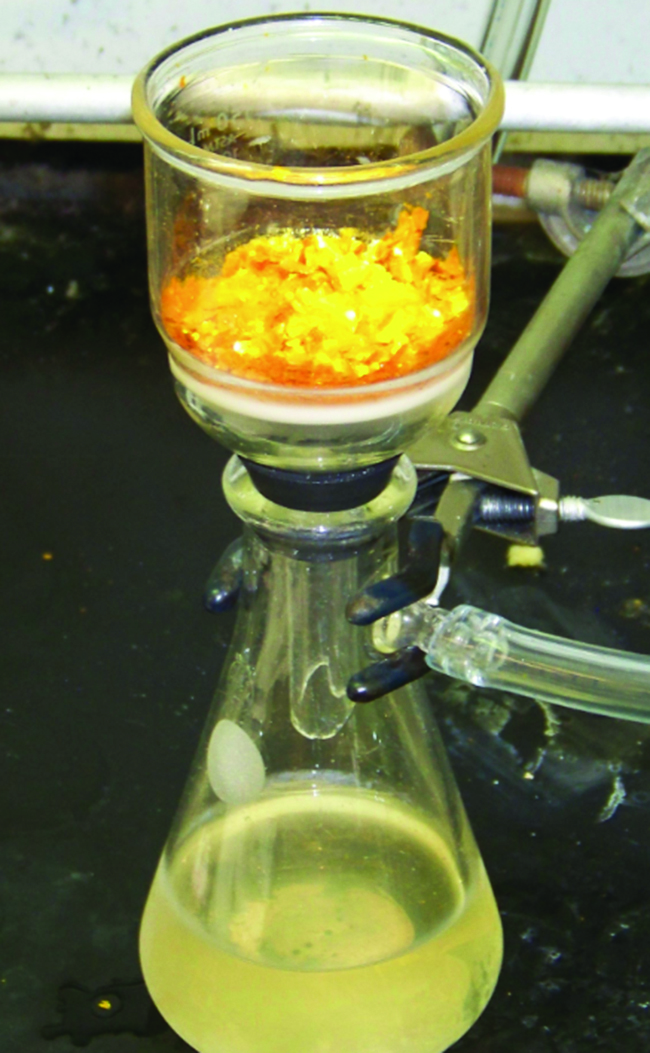
Figure 4.17図 4.17
Precipitate may be removed from a reaction mixture by filtration.
沈殿は、ろ過によって反応混合物から取り除ける。
Example 4.15例題 4.15
Gravimetric Analysis重量分析
A 0.4550-g solid mixture containing MgSO4 is dissolved in water and treated with an excess of Ba(NO3)2, resulting in the precipitation of 0.6168 g of BaSO4.
MgSO4を含む固体混合物0.4550 gを水に溶かし、過剰のBa(NO3)2で処理したところ、BaSO4が0.6168 g沈殿した。
What is the concentration (mass percent) of MgSO4 in the mixture?
混合物中のMgSO4の濃度(質量百分率)はいくらか。
Solution解答
The plan for this calculation is similar to others used in stoichiometric calculations, the central step being the connection between the moles of BaSO4 and MgSO4 through their stoichiometric factor. Once the mass of MgSO4 is computed, it may be used along with the mass of the sample mixture to calculate the requested percentage concentration.
英語のヒント
計算の方針はほかの化学量論計算と似ており、中心となるのは、化学量論因子を通してBaSO4とMgSO4の物質量を結びつける手順である。MgSO4の質量が計算できれば、混合物試料の質量とともに使って、求める百分率濃度を計算できる。
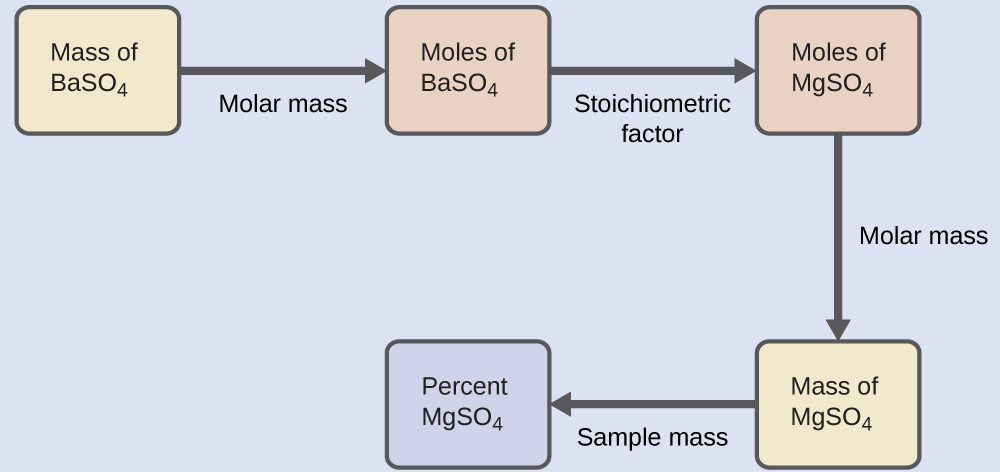
The mass of MgSO4 that would yield the provided precipitate mass is
与えられた質量の沈殿を生じるMgSO4の質量は、次のとおりである。
The concentration of MgSO4 in the sample mixture is then calculated to be
したがって、混合物試料中のMgSO4の濃度は、次のように計算される。
Check Your Learning理解度を確認
What is the percent of chloride ion in a sample if 1.1324 g of the sample produces 1.0881 g of AgCl when treated with excess Ag+?
試料1.1324 gを過剰のAg+で処理してAgCl 1.0881 gを得た場合、試料中の塩化物イオンの百分率はいくらか。
The elemental composition of hydrocarbons and related compounds may be determined via a gravimetric method known as combustion analysis. In a combustion analysis, a weighed sample of the compound is heated to a high temperature under a stream of oxygen gas, resulting in its complete combustion to yield gaseous products of known identities. The complete combustion of hydrocarbons, for example, will yield carbon dioxide and water as the only products. The gaseous combustion products are swept through separate, preweighed collection devices containing compounds that selectively absorb each product (Figure 4.18). The mass increase of each device corresponds to the mass of the absorbed product and may be used in an appropriate stoichiometric calculation to derive the mass of the relevant element.
英語のヒント
炭化水素や関連化合物の元素組成は、燃焼分析という重量分析法で求められる。燃焼分析では、秤量した化合物試料を酸素気流中で高温に加熱し、完全燃焼させて、種類の分かっている気体生成物にする。たとえば炭化水素の完全燃焼では、二酸化炭素と水だけが生じる。燃焼で生じた気体は、各生成物を選択的に吸収する化合物を入れ、あらかじめ秤量しておいた個別の捕集装置に通す(図4.18)。各装置の質量増加は、吸収した生成物の質量に対応する。これを適切な化学量論計算に使えば、該当する元素の質量を求められる。
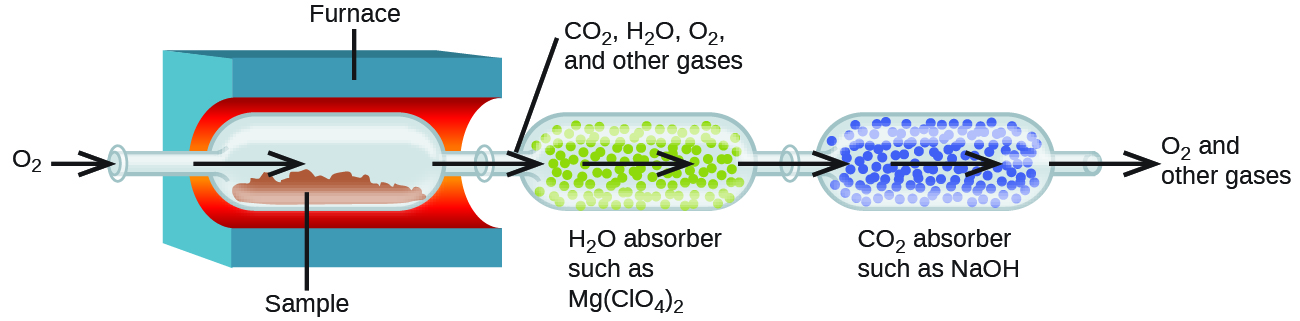
Figure 4.18図 4.18
This schematic diagram illustrates the basic components of a combustion analysis device for determining the carbon and hydrogen content of a sample.
この模式図は、試料の炭素と水素の含有量を求める燃焼分析装置の基本構成を示している。
Example 4.16例題 4.16
Combustion Analysis燃焼分析
Polyethylene is a hydrocarbon polymer used to produce food-storage bags and many other flexible plastic items. A combustion analysis of a 0.00126-g sample of polyethylene yields 0.00394 g of CO2 and 0.00161 g of H2O. What is the empirical formula of polyethylene?
ポリエチレンは、食品保存袋など、多くの柔軟なプラスチック製品の製造に使われる炭化水素の重合体である。ポリエチレンの試料0.00126 gを燃焼分析したところ、CO2 0.00394 gとH2O 0.00161 gが得られた。ポリエチレンの組成式は何か。
Solution解答
The primary assumption in this exercise is that all the carbon in the sample combusted is converted to carbon dioxide, and all the hydrogen in the sample is converted to water:
この問題の主な仮定は、燃焼した試料中の炭素がすべて二酸化炭素に、水素がすべて水に変わることである。
Note that a balanced equation is not necessary for the task at hand. To derive the empirical formula of the compound, only the subscripts x and y are needed.
英語のヒント
ここでの目的には、係数のつり合った反応式が必要ないことに注意せよ。化合物の組成式を求めるには、添字xとyだけが必要である。
First, calculate the molar amounts of carbon and hydrogen in the sample, using the provided masses of the carbon dioxide and water, respectively. With these molar amounts, the empirical formula for the compound may be written as described in the previous chapter of this text. An outline of this approach is given in the following flow chart:
まず、与えられた二酸化炭素と水の質量をそれぞれ使って、試料中の炭素と水素の物質量を計算する。この物質量から、前章で述べた方法で化合物の組成式を書ける。考え方の概要を、次の流れ図に示す。
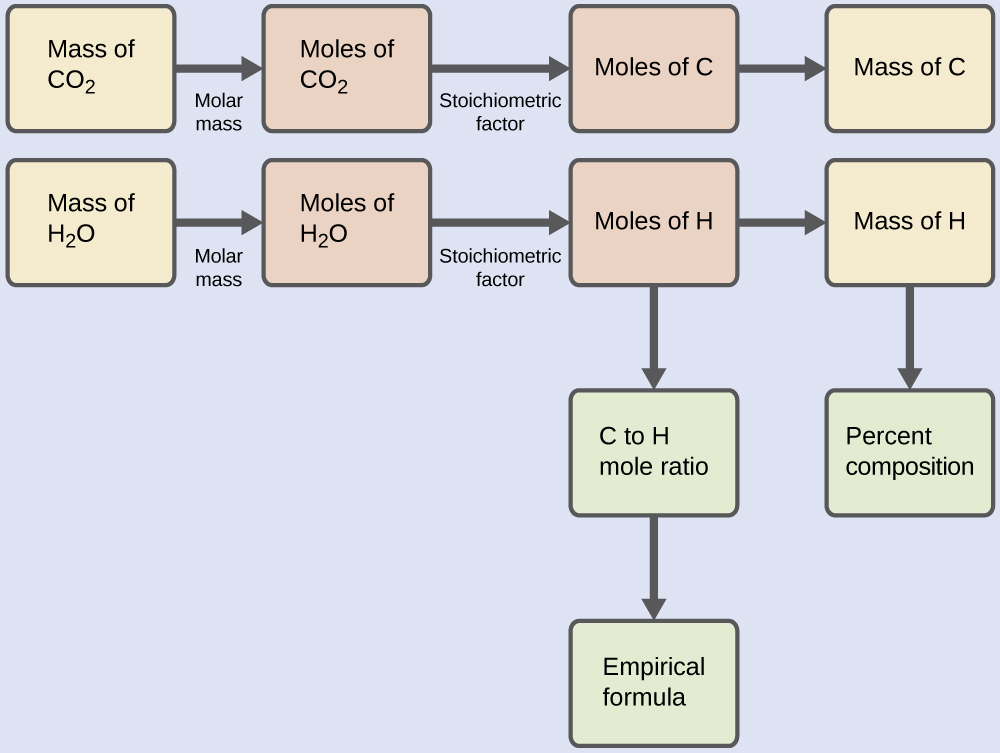


The empirical formula for the compound is then derived by identifying the smallest whole-number multiples for these molar amounts. The H-to-C molar ratio is
次に、これらの物質量が最小の整数の倍数となる関係を求めて、化合物の組成式を導く。HとCのモル比は次のとおりである。
and the empirical formula for polyethylene is CH2.
したがって、ポリエチレンの組成式はCH2である。
Check Your Learning理解度を確認
A 0.00215-g sample of polystyrene, a polymer composed of carbon and hydrogen, produced 0.00726 g of CO2 and 0.00148 g of H2O in a combustion analysis. What is the empirical formula for polystyrene?
炭素と水素からなる重合体ポリスチレンの試料0.00215 gを燃焼分析したところ、CO2 0.00726 gとH2O 0.00148 gが生じた。ポリスチレンの組成式は何か。