第4章化学反応の量的関係
Oxidation-Reduction Reactions酸化還元反応
Earth’s atmosphere contains about 20% molecular oxygen, O2, a chemically reactive gas that plays an essential role in the metabolism of aerobic organisms and in many environmental processes that shape the world. The term oxidation was originally used to describe chemical reactions involving O2, but its meaning has evolved to refer to a broad and important reaction class known as oxidation-reduction (redox) reactions. A few examples of such reactions will be used to develop a clear picture of this classification.
英語のヒント
地球の大気は、約20%の分子状酸素O2を含んでいる。酸素は化学反応性の高い気体で、好気性生物の代謝や、世界の姿を形づくる多くの環境過程で不可欠な役割を果たす。酸化という語は、もともとO2が関与する化学反応を表すために使われたが、その意味は発展し、酸化還元反応(レドックス反応)という広範で重要な反応の分類を指すようになった。この分類を明確に理解するため、いくつかの反応例を使う。
Some redox reactions involve the transfer of electrons between reactant entities to yield ionic products, such as the reaction between sodium and chlorine to yield sodium chloride:
英語のヒント
酸化還元反応の中には、反応物の構成粒子の間で電子が移動してイオン性生成物を生じるものがある。ナトリウムと塩素が反応して塩化ナトリウムを生じる反応が、その一例である。
It is helpful to view the process with regard to each individual reactant, that is, to represent the fate of each reactant in the form of an equation called a half-reaction:
英語のヒント
それぞれの反応物に着目して過程を見ると役立つ。つまり、各反応物がどうなるかを、半反応式という式で表す。
These equations show that Na atoms lose electrons while Cl atoms (in the Cl2 molecule) gain electrons, the “s” subscripts for the resulting ions signifying they are present in the form of a solid ionic compound. For redox reactions of this sort, the loss and gain of electrons define the complementary processes that occur:
英語のヒント
これらの式は、Na原子が電子を失う一方、Cl2分子内のCl原子は電子を受け取ることを示す。生成イオンの添字「s」は、それらが固体のイオン化合物として存在することを示している。この種の酸化還元反応では、電子の喪失と獲得によって、互いに補い合う次の過程が定義される。
In this reaction, then, sodium is oxidized and chlorine undergoes reduction. Viewed from a more active perspective, sodium functions as a reducing agent (reductant), since it provides electrons to (or reduces) chlorine. Likewise, chlorine functions as an oxidizing agent (oxidant), as it effectively removes electrons from (oxidizes) sodium.
英語のヒント
したがって、この反応ではナトリウムが酸化され、塩素が還元される。作用する側から見ると、ナトリウムは塩素に電子を与える(塩素を還元する)ので、還元剤として働く。同様に、塩素はナトリウムから電子を取り去る(ナトリウムを酸化する)ので、酸化剤として働く。
Some redox processes, however, do not involve the transfer of electrons. Consider, for example, a reaction similar to the one yielding NaCl:
しかし、電子の移動を伴わない酸化還元過程もある。たとえば、NaClが生じる反応に似た、次の反応を考えよう。
The product of this reaction is a covalent compound, so transfer of electrons in the explicit sense is not involved. To clarify the similarity of this reaction to the previous one and permit an unambiguous definition of redox reactions, a property called oxidation number has been defined. The oxidation number (or oxidation state) of an element in a compound is the charge its atoms would possess if the compound were ionic. The following guidelines are used to assign oxidation numbers to each element in a molecule or ion.
英語のヒント
この反応の生成物は共有結合性化合物なので、明確な意味での電子の移動は伴わない。この反応と先ほどの反応の類似性を明らかにし、酸化還元反応を曖昧さなく定義できるようにするため、酸化数という性質が定義された。化合物中の元素の酸化数(または酸化状態)は、もしその化合物がイオン性であったなら、その原子がもつであろう電荷である。分子やイオンに含まれる各元素の酸化数は、次の指針に従って決める。
- The oxidation number of an atom in an elemental substance is zero.単体中の原子の酸化数は0である。
- The oxidation number of a monatomic ion is equal to the ion’s charge.単原子イオンの酸化数は、そのイオンの電荷に等しくなる。
- Oxidation numbers for common nonmetals are usually assigned as follows:一般的な非金属の酸化数は、通常、次のように割り当てる。
- Hydrogen: +1 when combined with nonmetals, −1 when combined with metals水素:非金属と結合しているときは+1、金属と結合しているときは−1。
- Oxygen: −2 in most compounds, sometimes −1 (so-called peroxides, very rarely (so-called superoxides, positive values when combined with F (values vary)酸素:ほとんどの化合物では−2、ときに−1(いわゆる過酸化物、)、ごくまれに(いわゆる超酸化物、)。Fと結合しているときは正の値(値は場合による)。
- Halogens: −1 for F always, −1 for other halogens except when combined with oxygen or other halogens (positive oxidation numbers in these cases, varying values)ハロゲン:Fでは常に−1。その他のハロゲンでは、酸素や別のハロゲンと結合している場合を除き−1(例外の場合の酸化数は正で、値は場合による)。
- The sum of oxidation numbers for all atoms in a molecule or polyatomic ion equals the charge on the molecule or ion.分子や多原子イオンに含まれる全原子の酸化数の合計は、その分子やイオンの電荷に等しくなる。
Note: The proper convention for reporting charge is to write the number first, followed by the sign (e.g., 2+), while oxidation number is written with the reversed sequence, sign followed by number (e.g., +2). This convention aims to emphasize the distinction between these two related properties.
英語のヒント
注:電荷を表す正式な慣例では、数字を先に、符号を後に書く(例:2+)。一方、酸化数は順序を逆にし、符号の後に数字を書く(例:+2)。この慣例は、関連するこの二つの性質の違いを強調するためのものである。
Example 4.5例題 4.5
Assigning Oxidation Numbers酸化数を割り当てる
Follow the guidelines in this section of the text to assign oxidation numbers to all the elements in the following species:
この節の指針に従い、次の化学種に含まれる全元素の酸化数を割り当てなさい。
(a) H2S
(a) H2S
(b)
(b)
(c) Na2SO4
(c) Na2SO4
Solution解答
(a) According to guideline 3, the oxidation number for H is +1.
(a) 指針3により、Hの酸化数は+1である。
Using this oxidation number and the compound’s formula, guideline 4 may then be used to calculate the oxidation number for sulfur:
この酸化数と化合物の化学式を使えば、指針4から硫黄の酸化数を計算できる。
(b) Guideline 3 suggests the oxidation number for oxygen is −2.
(b) 指針3によれば、酸素の酸化数は−2である。
Using this oxidation number and the ion’s formula, guideline 4 may then be used to calculate the oxidation number for sulfur:
この酸化数とイオンの化学式を使えば、指針4から硫黄の酸化数を計算できる。
(c) For ionic compounds, it’s convenient to assign oxidation numbers for the cation and anion separately.
(c) イオン化合物では、陽イオンと陰イオンについて別々に酸化数を割り当てると便利である。
According to guideline 2, the oxidation number for sodium is +1.
指針2により、ナトリウムの酸化数は+1である。
Assuming the usual oxidation number for oxygen (−2 per guideline 3), the oxidation number for sulfur is calculated as directed by guideline 4:
酸素の酸化数を通常の値(指針3による−2)とすると、指針4に従って硫黄の酸化数を計算できる。
Check Your Learning理解度を確認
Assign oxidation states to the elements whose atoms are underlined in each of the following compounds or ions:
次の化合物やイオンそれぞれについて、下線を引いた原子の元素に酸化状態を割り当てなさい。
(a) KNO3
(a) KNO3
(b) AlH3
(b) AlH3
(c)
(c)
(d)
(d)
Using the oxidation number concept, an all-inclusive definition of redox reaction has been established. Oxidation-reduction (redox) reactions are those in which one or more elements involved undergo a change in oxidation number. (While the vast majority of redox reactions involve changes in oxidation number for two or more elements, a few interesting exceptions to this rule do exist Example 4.6.) Definitions for the complementary processes of this reaction class are correspondingly revised as shown here:
英語のヒント
酸化数の概念を使い、酸化還元反応をすべて含む定義が確立された。酸化還元反応(レドックス反応)とは、関与する一種類以上の元素の酸化数が変化する反応である。(大多数の酸化還元反応では二種類以上の元素の酸化数が変化するが、この規則には興味深い例外もいくつかある。例題4.6を参照。)この反応分類を構成する、互いに補い合う過程の定義も、それに対応して次のように改められる。
Returning to the reactions used to introduce this topic, they may now both be identified as redox processes. In the reaction between sodium and chlorine to yield sodium chloride, sodium is oxidized (its oxidation number increases from 0 in Na to +1 in NaCl) and chlorine is reduced (its oxidation number decreases from 0 in Cl2 to −1 in NaCl). In the reaction between molecular hydrogen and chlorine, hydrogen is oxidized (its oxidation number increases from 0 in H2 to +1 in HCl) and chlorine is reduced (its oxidation number decreases from 0 in Cl2 to −1 in HCl).
この話題の導入に使った反応に戻ると、いまや両方を酸化還元過程と判定できる。ナトリウムと塩素から塩化ナトリウムを生じる反応では、ナトリウムが酸化され(酸化数がNaの0からNaClの+1へ増加)、塩素が還元される(酸化数がCl2の0からNaClの−1へ減少)。水素分子と塩素の反応では、水素が酸化され(酸化数がH2の0からHClの+1へ増加)、塩素が還元される(酸化数がCl2の0からHClの−1へ減少)。
Several subclasses of redox reactions are recognized, including combustion reactions in which the reductant (also called a fuel) and oxidant (often, but not necessarily, molecular oxygen) react vigorously and produce significant amounts of heat, and often light, in the form of a flame. Solid rocket-fuel reactions such as the one depicted in Figure 4.1 are combustion processes. A typical propellant reaction in which solid aluminum is oxidized by ammonium perchlorate is represented by this equation:
英語のヒント
酸化還元反応はいくつかの下位分類に分けられる。その一つが燃焼反応である。燃焼反応では、還元剤(燃料とも呼ぶ)と酸化剤(多くの場合は分子状酸素であるが、必ずしもそうではない)が激しく反応し、多量の熱を生じ、しばしば炎という形で光も生じる。図4.1に示したような固体ロケット燃料の反応は燃焼過程である。固体アルミニウムが過塩素酸アンモニウムによって酸化される、典型的な推進剤の反応は次の式で表される。
Single-displacement (replacement) reactions are redox reactions in which an ion in solution is displaced (or replaced) via the oxidation of a metallic element. One common example of this type of reaction is the acid oxidation of certain metals:
英語のヒント
単置換反応(置換反応)は、金属元素が酸化されることで溶液中のイオンが置き換わる酸化還元反応である。この種の反応の一般的な例として、酸によるある種の金属の酸化がある。
Metallic elements may also be oxidized by solutions of other metal salts; for example:
金属元素は、ほかの金属塩の水溶液によって酸化される場合もある。たとえば、次の反応である。
This reaction may be observed by placing copper wire in a solution containing a dissolved silver salt. Silver ions in solution are reduced to elemental silver at the surface of the copper wire, and the resulting Cu2+ ions dissolve in the solution to yield a characteristic blue color (Figure 4.9).
英語のヒント
この反応は、銀塩が溶けた溶液に銅線を入れると観察できる。溶液中の銀イオンは銅線表面で単体の銀に還元され、生成したCu2+イオンは溶液に溶けて特徴的な青色を示す(図4.9)。
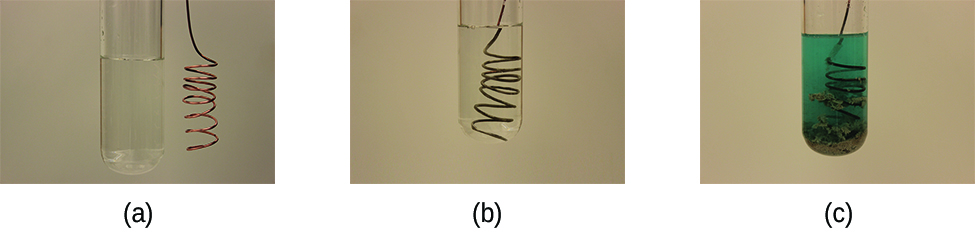
Figure 4.9図 4.9
(a) A copper wire is shown next to a solution containing silver(I) ions. (b) Displacement of dissolved silver ions by copper ions results in (c) accumulation of gray-colored silver metal on the wire and development of a blue color in the solution, due to dissolved copper ions. (credit: modification of work by Mark Ott)
(a) 銀(I)イオンを含む溶液の横に置かれた銅線。(b) 溶けている銀イオンが銅イオンに置き換わると、(c) 銅線上に灰色の金属銀が堆積し、溶液は溶けた銅イオンによって青色になる。(出典:Mark Ottの作品を改変)
Example 4.6例題 4.6
Describing Redox Reactions酸化還元反応を説明する
Identify which equations represent redox reactions, providing a name for the reaction if appropriate. For those reactions identified as redox, name the oxidant and reductant.
どの式が酸化還元反応を表すかを判定し、適切であれば反応の名称も示しなさい。酸化還元反応と判定したものについて、酸化剤と還元剤の名称を挙げなさい。
(a)
(a)
(b)
(b)
(c)
(c)
(d)
(d)
(e)
(e)
Solution解答
Redox reactions are identified per definition if one or more elements undergo a change in oxidation number.
定義により、一種類以上の元素の酸化数が変化すれば酸化還元反応と判定する。
(a) This is not a redox reaction, since oxidation numbers remain unchanged for all elements.
(a) どの元素の酸化数も変化しないので、これは酸化還元反応ではない。
(b) This is a redox reaction. Gallium is oxidized, its oxidation number increasing from 0 in Ga(l) to +3 in GaBr3(s). The reducing agent is Ga(l). Bromine is reduced, its oxidation number decreasing from 0 in Br2(l) to −1 in GaBr3(s). The oxidizing agent is Br2(l).
英語のヒント
(b) これは酸化還元反応である。ガリウムは酸化され、酸化数はGa(l)の0からGaBr3(s)の+3へ増加する。還元剤はGa(l)である。臭素は還元され、酸化数はBr2(l)の0からGaBr3(s)の−1へ減少する。酸化剤はBr2(l)である。
(c) This is a redox reaction. It is a particularly interesting process, as it involves the same element, oxygen, undergoing both oxidation and reduction (a so-called disproportionation reaction). Oxygen is oxidized, its oxidation number increasing from −1 in H2O2(aq) to 0 in O2(g). Oxygen is also reduced, its oxidation number decreasing from −1 in H2O2(aq) to −2 in H2O(l). For disproportionation reactions, the same substance functions as an oxidant and a reductant.
英語のヒント
(c) これは酸化還元反応である。同じ元素である酸素が酸化と還元の両方を受けるため、特に興味深い過程である(いわゆる不均化反応)。酸素は酸化され、酸化数はH2O2(aq)の−1からO2(g)の0へ増加する。同時に酸素は還元もされ、酸化数はH2O2(aq)の−1からH2O(l)の−2へ減少する。不均化反応では、同じ物質が酸化剤と還元剤の両方として働く。
(d) This is not a redox reaction, since oxidation numbers remain unchanged for all elements.
(d) どの元素の酸化数も変化しないので、これは酸化還元反応ではない。
(e) This is a redox reaction (combustion). Carbon is oxidized, its oxidation number increasing from −2 in C2H4(g) to +4 in CO2(g). The reducing agent (fuel) is C2H4(g). Oxygen is reduced, its oxidation number decreasing from 0 in O2(g) to −2 in H2O(l). The oxidizing agent is O2(g).
(e) これは酸化還元反応(燃焼)である。炭素は酸化され、酸化数はC2H4(g)の−2からCO2(g)の+4へ増加する。還元剤(燃料)はC2H4(g)である。酸素は還元され、酸化数はO2(g)の0からH2O(l)の−2へ減少する。酸化剤はO2(g)である。
Check Your Learning理解度を確認
This equation describes the production of tin(II) chloride:
次の式は塩化スズ(II)の生成を表す。
Is this a redox reaction? If so, provide a more specific name for the reaction if appropriate, and identify the oxidant and reductant.
これは酸化還元反応か。そうであれば、適切な場合にはより具体的な反応名を示し、酸化剤と還元剤を挙げなさい。