第4章化学反応の量的関係
4.3 Reaction Stoichiometry4.3 反応の化学量論
Learning Objectives学習目標
By the end of this section, you will be able to:
この節を終えると、次のことができるようになる。
- Explain the concept of stoichiometry as it pertains to chemical reactions化学反応に関する化学量論の概念を説明する。
- Use balanced chemical equations to derive stoichiometric factors relating amounts of reactants and products係数のつり合った化学反応式を使って、反応物と生成物の量を関係づける化学量論因子を導く。
- Perform stoichiometric calculations involving mass, moles, and solution molarity質量、物質量、溶液のモル濃度に関わる化学量論計算を行う。
A balanced chemical equation provides a great deal of information in a very succinct format. Chemical formulas provide the identities of the reactants and products involved in the chemical change, allowing classification of the reaction. Coefficients provide the relative numbers of these chemical species, allowing a quantitative assessment of the relationships between the amounts of substances consumed and produced by the reaction. These quantitative relationships are known as the reaction’s stoichiometry, a term derived from the Greek words stoicheion (meaning “element”) and metron (meaning “measure”). In this module, the use of balanced chemical equations for various stoichiometric applications is explored.
英語のヒント
係数のつり合った化学反応式は、非常に簡潔な形で多くの情報を与える。化学式は化学変化に関わる反応物と生成物の種類を示し、反応を分類できるようにする。係数はそれらの化学種の相対的な数を示し、反応によって消費・生成される物質の量の関係を定量的に評価できるようにする。この定量的な関係を、反応の化学量論と呼ぶ。英語のstoichiometryは、ギリシャ語のstoicheion(「元素」の意味)とmetron(「測定」の意味)から生まれた語である。この節では、係数のつり合った化学反応式をさまざまな化学量論の問題に使う方法を探る。
The general approach to using stoichiometric relationships is similar in concept to the way people go about many common activities. Food preparation, for example, offers an appropriate comparison. A recipe for making eight pancakes calls for 1 cup pancake mix, cup milk, and one egg. The “equation” representing the preparation of pancakes per this recipe is
英語のヒント
化学量論的な関係を使う基本的な考え方は、人々が日常の多くの活動を進める方法に似ている。たとえば、料理はよい比較対象になる。パンケーキ8枚のレシピには、パンケーキミックス1カップ、牛乳カップ、卵1個が必要である。このレシピに従うパンケーキづくりを表す「式」は、次のようになる。
If two dozen pancakes are needed for a big family breakfast, the ingredient amounts must be increased proportionally according to the amounts given in the recipe. For example, the number of eggs required to make 24 pancakes is
英語のヒント
大家族の朝食にパンケーキが2ダース必要なら、レシピの分量に合わせて材料を比例的に増やさなければならない。たとえば、パンケーキ24枚をつくるのに必要な卵の数は、次のようになる。
Balanced chemical equations are used in much the same fashion to determine the amount of one reactant required to react with a given amount of another reactant, or to yield a given amount of product, and so forth. The coefficients in the balanced equation are used to derive stoichiometric factors that permit computation of the desired quantity. To illustrate this idea, consider the production of ammonia by reaction of hydrogen and nitrogen:
英語のヒント
係数のつり合った化学反応式もほぼ同じように使い、ある量の反応物と反応するのに必要な別の反応物の量や、ある量の生成物を得るために必要な反応物の量などを求める。つり合った反応式の係数から化学量論因子を導くと、求めたい量を計算できる。この考えを説明するため、水素と窒素の反応によるアンモニアの生成を考えよう。
This equation shows ammonia molecules are produced from hydrogen molecules in a 2:3 ratio, and stoichiometric factors may be derived using any amount (number) unit:
この式から、水素分子に対して2:3の比でアンモニア分子ができることが分かる。量(数)のどの単位を使っても、化学量論因子を導ける。
These stoichiometric factors can be used to compute the number of ammonia molecules produced from a given number of hydrogen molecules, or the number of hydrogen molecules required to produce a given number of ammonia molecules. Similar factors may be derived for any pair of substances in any chemical equation.
これらの化学量論因子を使えば、ある数の水素分子からできるアンモニア分子の数や、ある数のアンモニア分子をつくるために必要な水素分子の数を計算できる。どの化学反応式でも、任意の二つの物質について同様の因子を導ける。
Example 4.8例題 4.8
Moles of Reactant Required in a Reaction反応に必要な反応物の物質量
How many moles of I2 are required to react with 0.429 mol of Al according to the following equation (see Figure 4.10)?
次の反応式に従って0.429 molのAlと反応するには、I2が何mol必要か(図4.10参照)。

Figure 4.10図 4.10
Aluminum and iodine react to produce aluminum iodide. The heat of the reaction vaporizes some of the solid iodine as a purple vapor. (credit: modification of work by Mark Ott)
アルミニウムとヨウ素が反応して、ヨウ化アルミニウムができる。反応熱によって固体ヨウ素の一部が気化し、紫色の蒸気になる。(出典:Mark Ottの作品を改変)
Solution解答
Referring to the balanced chemical equation, the stoichiometric factor relating the two substances of interest is The molar amount of iodine is derived by multiplying the provided molar amount of aluminum by this factor:
英語のヒント
つり合った化学反応式を見ると、対象とする二つの物質を関係づける化学量論因子はである。与えられたアルミニウムの物質量にこの因子を掛けて、ヨウ素の物質量を求める。

Check Your Learning理解度を確認
How many moles of Ca(OH)2 are required to react with 1.36 mol of H3PO4 to produce Ca3(PO4)2 according to the equation
反応式に従って、1.36 molのH3PO4と反応してCa3(PO4)2をつくるには、Ca(OH)2が何mol必要か。
Example 4.9例題 4.9
Number of Product Molecules Generated by a Reaction反応で生じる生成物分子の数
How many carbon dioxide molecules are produced when 0.75 mol of propane is combusted according to this equation?
次の式に従って0.75 molのプロパンが燃焼すると、二酸化炭素分子はいくつ生じるか。
Solution解答
The approach here is the same as for Example 4.8, though the absolute number of molecules is requested, not the number of moles of molecules. This will simply require use of the moles-to-numbers conversion factor, Avogadro’s number.
英語のヒント
考え方は例題4.8と同じであるが、求めるのは分子の物質量ではなく、分子の実際の個数である。そのため、物質量を個数に換算する因子であるアボガドロ数を使うだけである。
The balanced equation shows that carbon dioxide is produced from propane in a 3:1 ratio:
つり合った反応式は、プロパンに対して3:1の比で二酸化炭素が生じることを示す。
Using this stoichiometric factor, the provided molar amount of propane, and Avogadro’s number,
この化学量論因子、与えられたプロパンの物質量、アボガドロ数を使うと、次のようになる。

Check Your Learning理解度を確認
How many NH3 molecules are produced by the reaction of 4.0 mol of Ca(OH)2 according to the following equation:
次の式に従って4.0 molのCa(OH)2が反応すると、NH3分子はいくつ生じるか。
These examples illustrate the ease with which the amounts of substances involved in a chemical reaction of known stoichiometry may be related. Directly measuring numbers of atoms and molecules is, however, not an easy task, and the practical application of stoichiometry requires that we use the more readily measured property of mass.
英語のヒント
これらの例から、化学量論が分かっている化学反応では、関与する物質の量を簡単に関係づけられることが分かる。しかし、原子や分子の数を直接測定することは容易ではない。化学量論を実際に応用するには、より簡単に測定できる性質である質量を使う必要がある。
Example 4.10例題 4.10
Relating Masses of Reactants and Products反応物と生成物の質量を関係づける
What mass of sodium hydroxide, NaOH, would be required to produce 16 g of the antacid milk of magnesia [magnesium hydroxide, Mg(OH)2] by the following reaction?
次の反応によって、制酸剤であるマグネシア乳[水酸化マグネシウムMg(OH)2]を16 gつくるには、水酸化ナトリウムNaOHが何g必要か。
Solution解答
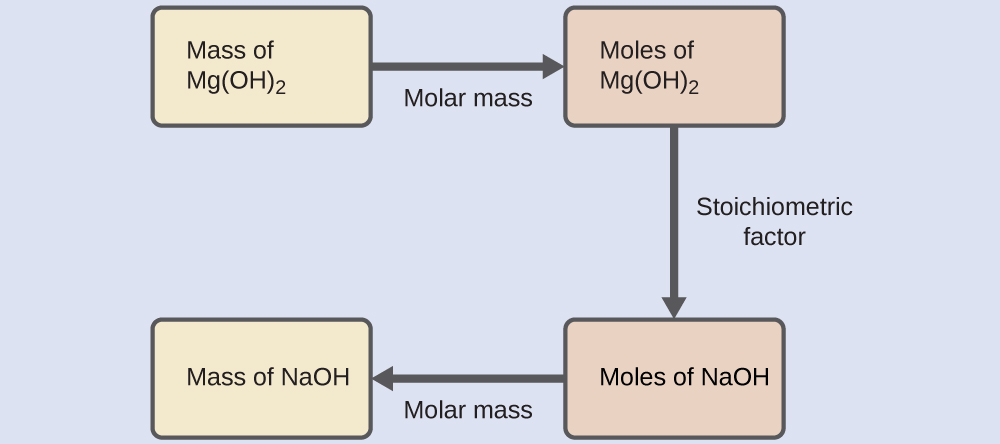
The approach used previously in Example 4.8 and Example 4.9 is likewise used here; that is, we must derive an appropriate stoichiometric factor from the balanced chemical equation and use it to relate the amounts of the two substances of interest. In this case, however, masses (not molar amounts) are provided and requested, so additional steps of the sort learned in the previous chapter are required. The calculations required are outlined in this flowchart:
英語のヒント
Check Your Learning理解度を確認
What mass of gallium oxide, Ga2O3, can be prepared from 29.0 g of gallium metal? The equation for the reaction is
金属ガリウム29.0 gから、酸化ガリウムGa2O3を何g調製できるか。反応式はである。
Example 4.11例題 4.11
Relating Masses of Reactants反応物同士の質量を関係づける
What mass of oxygen gas, O2, from the air is consumed in the combustion of 702 g of octane, C8H18, one of the principal components of gasoline?
ガソリンの主成分の一つであるオクタンC8H18 702 gの燃焼では、空気中の酸素気体O2が何g消費されるか。
Solution解答
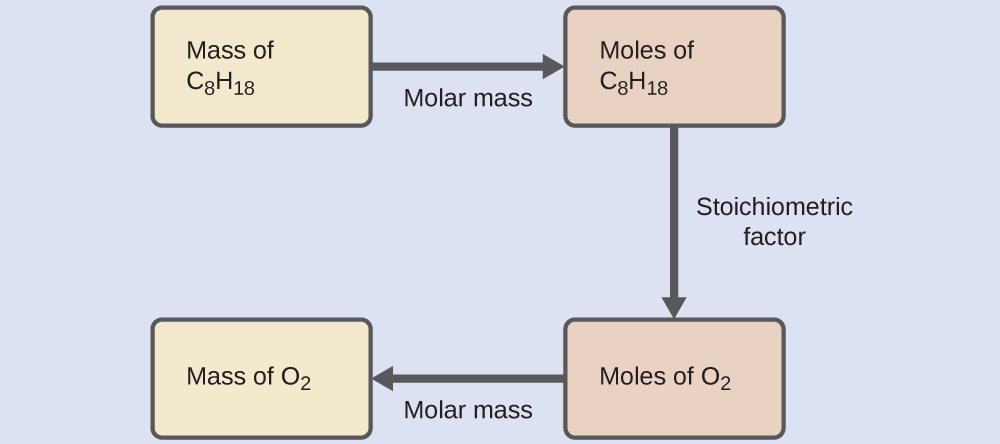
The approach required here is the same as for the Example 4.10, differing only in that the provided and requested masses are both for reactant species.
英語のヒント
ここで必要な方法は例題4.10と同じで、与えられた質量と求める質量が両方とも反応物のものである点だけが異なる。
Check Your Learning理解度を確認
What mass of CO is required to react with 25.13 g of Fe2O3 according to the equation
反応式に従って25.13 gのFe2O3と反応するには、COが何g必要か。
These examples illustrate just a few instances of reaction stoichiometry calculations. Numerous variations on the beginning and ending computational steps are possible depending upon what particular quantities are provided and sought (volumes, solution concentrations, and so forth). Regardless of the details, all these calculations share a common essential component: the use of stoichiometric factors derived from balanced chemical equations. Figure 4.11 provides a general outline of the various computational steps associated with many reaction stoichiometry calculations.
英語のヒント
これらの例は、反応の化学量論計算のほんの一部である。与えられる量と求める量が具体的に何か(体積、溶液濃度など)によって、計算の最初と最後の手順には多くの変形が考えられる。細部がどうであれ、これらの計算には共通の重要な要素がある。それは、つり合った化学反応式から導いた化学量論因子を使うことである。図4.11に、多くの反応の化学量論計算に伴う、さまざまな計算手順の全体像を示す。
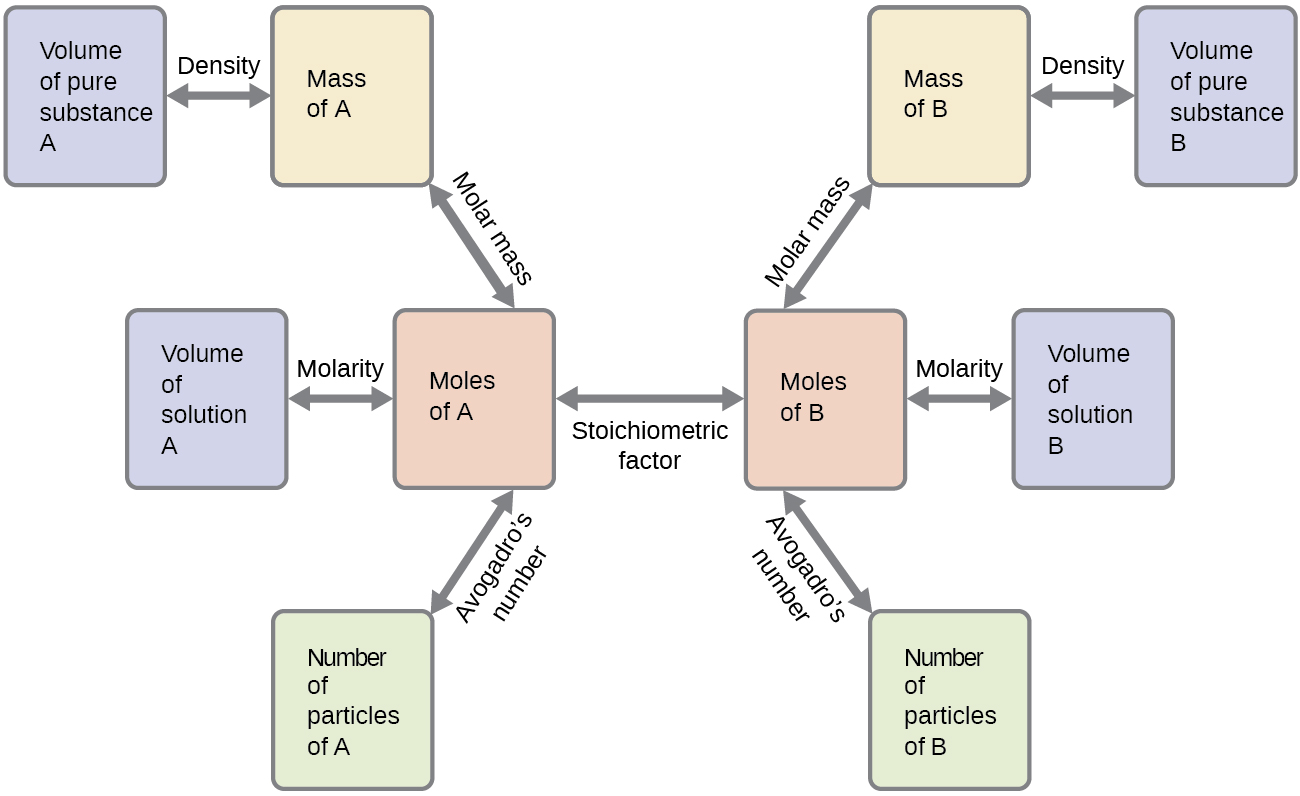


Figure 4.11図 4.11
The flowchart depicts the various computational steps involved in most reaction stoichiometry calculations.
この流れ図は、反応の化学量論計算の多くに含まれる、さまざまな計算手順を示している。