第3章物質と溶液の組成
3.3 Molarity3.3 モル濃度
Learning Objectives学習目標
By the end of this section, you will be able to:
この節を終えると、次のことができるようになる。
- Describe the fundamental properties of solutions溶液の基本的な性質を説明する
- Calculate solution concentrations using molarityモル濃度を用いて溶液の濃度を計算する
- Perform dilution calculations using the dilution equation希釈の式を使って希釈の計算を行う
Preceding sections of this chapter focused on the composition of substances: samples of matter that contain only one type of element or compound. However, mixtures—samples of matter containing two or more substances physically combined—are more commonly encountered in nature than are pure substances. Similar to a pure substance, the relative composition of a mixture plays an important role in determining its properties. The relative amount of oxygen in a planet’s atmosphere determines its ability to sustain aerobic life. The relative amounts of iron, carbon, nickel, and other elements in steel (a mixture known as an “alloy”) determine its physical strength and resistance to corrosion. The relative amount of the active ingredient in a medicine determines its effectiveness in achieving the desired pharmacological effect. The relative amount of sugar in a beverage determines its sweetness (see Figure 3.14). This section will describe one of the most common ways in which the relative compositions of mixtures may be quantified.
英語のヒント
この章のこれまでの節では、1種類の元素または化合物だけを含む物質の組成を扱った。しかし自然界でよりよく見られるのは、純物質よりも、2種類以上の物質が物理的に混ざった混合物である。純物質と同様に、混合物の相対的な組成は、その性質を決めるうえで重要である。惑星の大気中の酸素の割合は、酸素を使う生命を支えられるかどうかを決める。鋼という「合金」と呼ばれる混合物では、鉄、炭素、ニッケルなどの元素の割合が、強度や耐食性を決める。薬の有効成分の割合は、目的の薬理作用をどれだけ発揮するかを決める。飲み物の砂糖の割合は、甘さを決める(図3.14参照)。この節では、混合物の相対的な組成を定量化する最も一般的な方法の一つを説明する。
Image omitted because its reuse rights could not be verified.権利の確認ができないため画像を割愛。
Figure 3.14図 3.14
Sugar is one of many components in the complex mixture known as coffee. The amount of sugar in a given amount of coffee is an important determinant of the beverage’s sweetness. (credit: Jane Whitney)
砂糖は、コーヒーという複雑な混合物を構成する多くの成分の一つである。一定量のコーヒーに含まれる砂糖の量は、飲み物の甘さを決める重要な要因である。(出典:Jane Whitney)
Solutions溶液
Solutions have previously been defined as homogeneous mixtures, meaning that the composition of the mixture (and therefore its properties) is uniform throughout its entire volume. Solutions occur frequently in nature and have also been implemented in many forms of manmade technology. A more thorough treatment of solution properties is provided in the chapter on solutions and colloids, but provided here is an introduction to some of the basic properties of solutions.
英語のヒント
溶液は均一混合物と定義した。これは、混合物の組成、したがってその性質が、体積全体にわたって一様であることを意味する。溶液は自然界に広く存在し、人間のさまざまな技術にも使われている。溶液の性質は、溶液とコロイドの章でさらに詳しく扱うが、ここではいくつかの基本的性質を紹介する。
The relative amount of a given solution component is known as its concentration. Often, though not always, a solution contains one component with a concentration that is significantly greater than that of all other components. This component is called the solvent and may be viewed as the medium in which the other components are dispersed, or dissolved. Solutions in which water is the solvent are, of course, very common on our planet. A solution in which water is the solvent is called an aqueous solution.
英語のヒント
溶液のある成分の相対的な量を、その成分の濃度という。必ずしもそうとは限らないが、多くの溶液には、ほかのすべての成分より濃度がはるかに高い成分が一つある。この成分を溶媒と呼び、ほかの成分が分散したり溶けたりする媒体と考えられる。もちろん、地球上には水を溶媒とする溶液が非常に多くある。水を溶媒とする溶液を水溶液と呼ぶ。
A solute is a component of a solution that is typically present at a much lower concentration than the solvent. Solute concentrations are often described with qualitative terms such as dilute (of relatively low concentration) and concentrated (of relatively high concentration).
英語のヒント
溶質は、通常、溶媒よりはるかに低い濃度で存在する溶液の成分である。溶質の濃度は、「希薄」(濃度が比較的低い)や「濃厚」(濃度が比較的高い)といった定性的な語で表すこともよくある。
Concentrations may be quantitatively assessed using a wide variety of measurement units, each convenient for particular applications. Molarity (M) is a useful concentration unit for many applications in chemistry. Molarity is defined as the number of moles of solute in exactly 1 liter (1 L) of the solution:
英語のヒント
濃度はさまざまな測定単位を使って定量的に評価でき、各単位はそれぞれの用途に適している。モル濃度(M)は、化学の多くの用途で便利な濃度の単位である。溶液ちょうど1リットル(1 L)に含まれる溶質のモル数として定義される。
Example 3.14例題 3.14
Calculating Molar Concentrationsモル濃度を計算する
A 355-mL soft drink sample contains 0.133 mol of sucrose (table sugar). What is the molar concentration of sucrose in the beverage?
清涼飲料水355 mLに、スクロース(砂糖)が0.133 mol含まれている。この飲料中のスクロースのモル濃度はいくらか。
Solution解答
Since the molar amount of solute and the volume of solution are both given, the molarity can be calculated using the definition of molarity. Per this definition, the solution volume must be converted from mL to L:
溶質のモル数と溶液の体積が両方与えられているので、定義からモル濃度を計算できる。その定義に従い、溶液の体積をmLからLへ換算する。
Check Your Learning理解度を確認
A teaspoon of table sugar contains about 0.01 mol sucrose. What is the molarity of sucrose if a teaspoon of sugar has been dissolved in a cup of tea with a volume of 200 mL?
小さじ1杯の砂糖には、スクロースが約0.01 mol含まれる。小さじ1杯の砂糖を、体積200 mLのお茶に溶かした場合、スクロースのモル濃度はいくらか。
Example 3.15例題 3.15
Deriving Moles and Volumes from Molar Concentrationsモル濃度からモル数と体積を求める
How much sugar (mol) is contained in a modest sip (~10 mL) of the soft drink from Example 3.14?
英語のヒント
例題3.14の清涼飲料水の少量の一口(約10 mL)には、何molの砂糖が含まれているか。
Solution解答
Rearrange the definition of molarity to isolate the quantity sought, moles of sugar, then substitute the value for molarity derived in Example 3.14, 0.375 M:
英語のヒント
モル濃度の定義式を、求める量である砂糖のモル数について解き、例題3.14で求めたモル濃度0.375 Mを代入する。
Check Your Learning理解度を確認
What volume (mL) of the sweetened tea described in Example 3.14 contains the same amount of sugar (mol) as 10 mL of the soft drink in this example?
例題3.14で述べた砂糖入りのお茶を何mL用意すれば、この例の清涼飲料水10 mLと同じモル数の砂糖が含まれるか。
Example 3.16例題 3.16
Calculating Molar Concentrations from the Mass of Solute溶質の質量からモル濃度を計算する
Distilled white vinegar (Figure 3.15) is a solution of acetic acid, CH3CO2H, in water. A 0.500-L vinegar solution contains 25.2 g of acetic acid. What is the concentration of the acetic acid solution in units of molarity?
蒸留ホワイトビネガー(図3.15)は、酢酸CH3CO2Hの水溶液である。この酢0.500 Lに酢酸が25.2 g含まれている。酢酸溶液のモル濃度はいくらか。
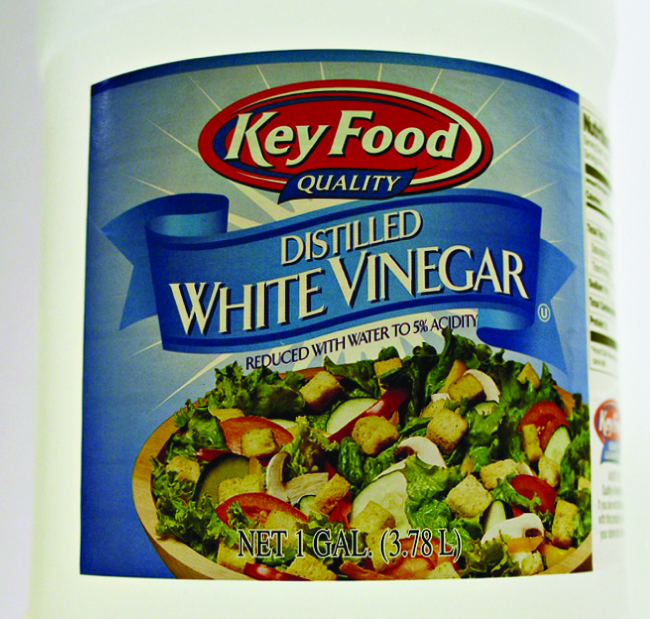

Figure 3.15図 3.15
Distilled white vinegar is a solution of acetic acid in water.
蒸留ホワイトビネガーは、酢酸を水に溶かした溶液である。
Solution解答
As in previous examples, the definition of molarity is the primary equation used to calculate the quantity sought. Since the mass of solute is provided instead of its molar amount, use the solute’s molar mass to obtain the amount of solute in moles:
前の例と同じく、求める量の計算にはモル濃度の定義式を基本として使う。溶質についてモル数ではなく質量が与えられているため、モル質量を使ってモル数を求める。
Check Your Learning理解度を確認
Calculate the molarity of 6.52 g of CoCl2 (128.9 g/mol) dissolved in an aqueous solution with a total volume of 75.0 mL.
CoCl2(128.9 g/mol)6.52 gを溶かした、全体積75.0 mLの水溶液のモル濃度を計算しなさい。
Example 3.17例題 3.17
Determining the Mass of Solute in a Given Volume of Solution一定体積の溶液中の溶質の質量を求める
How many grams of NaCl are contained in 0.250 L of a 5.30-M solution?
5.30 MのNaCl溶液0.250 Lには、NaClが何グラム含まれているか。
Solution解答
The volume and molarity of the solution are specified, so the amount (mol) of solute is easily computed as demonstrated in Example 3.15:
溶液の体積とモル濃度が指定されているので、例題3.15のように溶質のモル数を簡単に計算できる。
Finally, this molar amount is used to derive the mass of NaCl:
最後に、このモル数からNaClの質量を求める。
Check Your Learning理解度を確認
How many grams of CaCl2 (110.98 g/mol) are contained in 250.0 mL of a 0.200-M solution of calcium chloride?
0.200 Mの塩化カルシウム溶液250.0 mLには、CaCl2(110.98 g/mol)が何グラム含まれているか。
When performing calculations stepwise, as in Example 3.17, it is important to refrain from rounding any intermediate calculation results, which can lead to rounding errors in the final result. In Example 3.17, the molar amount of NaCl computed in the first step, 1.325 mol, would be properly rounded to 1.32 mol if it were to be reported; however, although the last digit (5) is not significant, it must be retained as a guard digit in the intermediate calculation. If the guard digit had not been retained, the final calculation for the mass of NaCl would have been 77.1 g, a difference of 0.3 g.
英語のヒント
In addition to retaining a guard digit for intermediate calculations, rounding errors may also be avoided by performing computations in a single step (see Example 3.18). This eliminates intermediate steps so that only the final result is rounded.
英語のヒント
途中の計算で保護桁を残すほかに、計算を1段階にまとめることでも丸め誤差を避けられる(例題3.18参照)。こうすれば中間段階がなくなり、最後の結果だけを丸めれば済む。
Example 3.18例題 3.18
Determining the Volume of Solution Containing a Given Mass of Solute一定質量の溶質を含む溶液の体積を求める
In Example 3.16, the concentration of acetic acid in white vinegar was determined to be 0.839 M. What volume of vinegar contains 75.6 g of acetic acid?
例題3.16では、ホワイトビネガーの酢酸濃度は0.839 Mと求められた。酢酸75.6 gを含む酢の体積はいくらか。
Solution解答
First, use the molar mass to calculate moles of acetic acid from the given mass:
まずモル質量を使い、与えられた質量から酢酸のモル数を計算する。
Then, use the molarity of the solution to calculate the volume of solution containing this molar amount of solute:
次に溶液のモル濃度を使い、このモル数の溶質を含む溶液の体積を計算する。
Combining these two steps into one yields:
2段階の計算を1段階にまとめると、次のようになる。
Check Your Learning理解度を確認
What volume of a 1.50-M KBr solution contains 66.0 g KBr?
KBrを66.0 g含む1.50 M KBr溶液の体積はいくらか。