第3章物質と溶液の組成
Dilution of Solutions溶液の希釈
Dilution is the process whereby the concentration of a solution is lessened by the addition of solvent. For example, a glass of iced tea becomes increasingly diluted as the ice melts. The water from the melting ice increases the volume of the solvent (water) and the overall volume of the solution (iced tea), thereby reducing the relative concentrations of the solutes that give the beverage its taste (Figure 3.16).
英語のヒント
希釈とは、溶媒を加えることで溶液の濃度を下げる操作である。たとえば、グラスのアイスティーは氷が溶けるにつれて薄くなる。溶けた氷から生じる水が溶媒(水)の体積と溶液(アイスティー)全体の体積を増やし、その結果、飲み物の味を生み出す溶質の相対的な濃度を下げる(図3.16)。
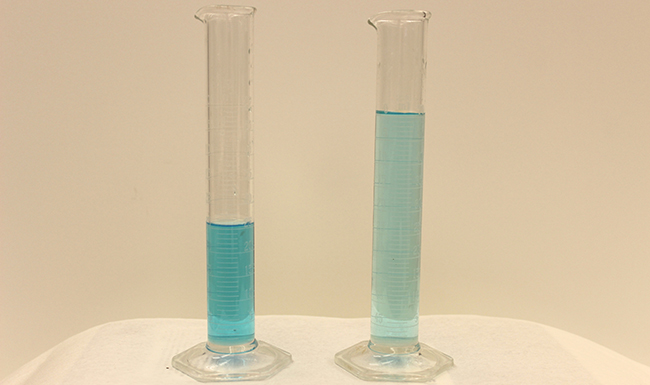
Figure 3.16図 3.16
Both solutions contain the same mass of copper nitrate. The solution on the right is more dilute because the copper nitrate is dissolved in more solvent. (credit: Mark Ott)
どちらの溶液にも同じ質量の硝酸銅が含まれる。右の方が希薄なのは、硝酸銅がより多くの溶媒に溶けているためである。(出典:Mark Ott)
Dilution is also a common means of preparing solutions of a desired concentration. By adding solvent to a measured portion of a more concentrated stock solution, a solution of lesser concentration may be prepared. For example, commercial pesticides are typically sold as solutions in which the active ingredients are far more concentrated than is appropriate for their application. Before they can be used on crops, the pesticides must be diluted. This is also a very common practice for the preparation of a number of common laboratory reagents.
英語のヒント
希釈は、目的の濃度の溶液を調製する一般的な方法でもある。濃い原液から一定量を量り取り、溶媒を加えれば、より低い濃度の溶液を作れる。たとえば、市販の農薬は、実際の使用に適した濃度よりはるかに濃い有効成分の溶液として売られるのが普通である。作物に使う前に希釈する必要がある。これは、実験室でよく使う多くの試薬を調製する際にも、非常に一般的な方法である。
A simple mathematical relationship can be used to relate the volumes and concentrations of a solution before and after the dilution process. According to the definition of molarity, the number of moles of solute in a solution (n) is equal to the product of the solution’s molarity (M) and its volume in liters (L):
希釈前後の溶液の体積と濃度は、簡単な数学的関係で結びつけられる。モル濃度の定義によれば、溶液中の溶質のモル数nは、溶液のモル濃度Mと、リットルで表した体積Lの積である。
Expressions like these may be written for a solution before and after it is diluted:
希釈前と希釈後の溶液について、それぞれ次のような式を書ける。
where the subscripts “1” and “2” refer to the solution before and after the dilution, respectively. Since the dilution process does not change the amount of solute in the solution, n1 = n2. Thus, these two equations may be set equal to one another:
ここで添字1と2は、それぞれ希釈前と希釈後の溶液を表す。希釈しても溶質の量は変わらないため、n1 = n2である。したがって、二つの式を等しいと置くことができる。
This relation is commonly referred to as the dilution equation. Although this equation uses molarity as the unit of concentration and liters as the unit of volume, other units of concentration and volume may be used as long as the units properly cancel per the factor-label method. Reflecting this versatility, the dilution equation is often written in the more general form:
英語のヒント
この関係は一般に希釈の式と呼ばれる。ここでは濃度の単位にモル濃度、体積の単位にリットルを使ったが、換算係数法で正しく単位が消えるなら、ほかの濃度・体積の単位も使える。この汎用性を反映し、希釈の式は次のより一般的な形で書くことがよくある。
where C and V are concentration and volume, respectively.
ここでCは濃度、Vは体積である。
Example 3.19例題 3.19
Determining the Concentration of a Diluted Solution希釈後の溶液の濃度を求める
If 0.850 L of a 5.00-M solution of copper nitrate, Cu(NO3)2, is diluted to a volume of 1.80 L by the addition of water, what is the molarity of the diluted solution?
5.00 Mの硝酸銅Cu(NO3)2溶液0.850 Lに水を加え、体積1.80 Lまで希釈した。希釈後のモル濃度はいくらか。
Solution解答
The stock concentration, C1, and volume, V1, are provided as well as the volume of the diluted solution, V2. Rearrange the dilution equation to isolate the unknown property, the concentration of the diluted solution, C2:
原液の濃度C1と体積V1、および希釈後の体積V2が与えられている。希釈の式を、未知の量である希釈後の濃度C2について解く。
Since the stock solution is being diluted by more than two-fold (volume is increased from 0.85 L to 1.80 L), the diluted solution’s concentration is expected to be less than one-half 5 M. This ballpark estimate will be compared to the calculated result to check for any gross errors in computation (for example, such as an improper substitution of the given quantities). Substituting the given values for the terms on the right side of this equation yields:
英語のヒント
原液は2倍を超えて希釈されるので(体積が0.85 Lから1.80 Lへ増える)、希釈後の濃度は5 Mの半分より小さくなるはずである。この大まかな見積もりと計算結果を比べ、与えられた量の代入を誤るなどの大きな計算ミスがないか確認する。式の右辺に与えられた値を代入すると、次のようになる。
This result compares well to our ballpark estimate (it’s a bit less than one-half the stock concentration, 5 M).
この結果は、大まかな見積もりとよく合う。原液の濃度5 Mの半分より少し小さい値である。
Check Your Learning理解度を確認
What is the concentration of the solution that results from diluting 25.0 mL of a 2.04-M solution of CH3OH to 500.0 mL?
2.04 MのCH3OH溶液25.0 mLを500.0 mLまで希釈すると、濃度はいくらになるか。
Example 3.20例題 3.20
Volume of a Diluted Solution希釈後の溶液の体積
What volume of 0.12 M HBr can be prepared from 11 mL (0.011 L) of 0.45 M HBr?
0.45 M HBrを11 mL(0.011 L)使うと、0.12 M HBrをどれだけの体積作れるか。
Solution解答
Provided are the volume and concentration of a stock solution, V1 and C1, and the concentration of the resultant diluted solution, C2. Find the volume of the diluted solution, V2 by rearranging the dilution equation to isolate V2:
英語のヒント
原液の体積V1と濃度C1、および希釈後の濃度C2が与えられている。希釈の式をV2について解き、希釈後の体積V2を求める。
Since the diluted concentration (0.12 M) is slightly more than one-fourth the original concentration (0.45 M), the volume of the diluted solution is expected to be roughly four times the original volume, or around 44 mL. Substituting the given values and solving for the unknown volume yields:
希釈後の濃度0.12 Mは元の濃度0.45 Mの4分の1より少し大きいため、希釈後の体積は元の約4倍、すなわち約44 mLと予想できる。値を代入して未知の体積について解くと、次のようになる。
The volume of the 0.12-M solution is 0.041 L (41 mL). The result is reasonable and compares well with the rough estimate.
0.12 M溶液の体積は0.041 L(41 mL)である。これは妥当で、大まかな見積もりともよく合う。
Check Your Learning理解度を確認
A laboratory experiment calls for 0.125 M HNO3. What volume of 0.125 M HNO3 can be prepared from 0.250 L of 1.88 M HNO3?
英語のヒント
ある実験で0.125 M HNO3が必要である。1.88 M HNO3を0.250 L使うと、0.125 M HNO3をどれだけの体積作れるか。
Example 3.21例題 3.21
Volume of a Concentrated Solution Needed for Dilution希釈に必要な濃い溶液の体積
What volume of 1.59 M KOH is required to prepare 5.00 L of 0.100 M KOH?
0.100 M KOHを5.00 L作るには、1.59 M KOHがどれだけの体積必要か。
Solution解答
Given are the concentration of a stock solution, C1, and the volume and concentration of the resultant diluted solution, V2 and C2. Find the volume of the stock solution, V1 by rearranging the dilution equation to isolate V1:
原液の濃度C1と、希釈後の体積V2および濃度C2が与えられている。希釈の式をV1について解き、原液の体積V1を求める。
Since the concentration of the diluted solution 0.100 M is roughly one-sixteenth that of the stock solution (1.59 M), the volume of the stock solution is expected to be about one-sixteenth that of the diluted solution, or around 0.3 liters. Substituting the given values and solving for the unknown volume yields:
希釈後の濃度0.100 Mは原液の濃度1.59 Mの約16分の1なので、必要な原液の体積は希釈後の体積の約16分の1、つまり約0.3 Lになるはずである。値を代入して未知の体積について解くと、次のようになる。
Thus, 0.314 L of the 1.59-M solution is needed to prepare the desired solution. This result is consistent with the rough estimate.
したがって、目的の溶液を作るには1.59 M溶液が0.314 L必要である。この結果は大まかな見積もりと一致する。
Check Your Learning理解度を確認
What volume of a 0.575-M solution of glucose, C6H12O6, can be prepared from 50.00 mL of a 3.00-M glucose solution?
3.00 Mのグルコース溶液50.00 mLから、0.575 MのグルコースC6H12O6溶液をどれだけの体積作れるか。