第3章物質と溶液の組成
3.1 Formula Mass and the Mole Concept3.1 式量とモルの概念
Learning Objectives学習目標
By the end of this section, you will be able to:
この節を終えると、次のことができるようになる。
- Calculate formula masses for covalent and ionic compounds共有結合化合物とイオン化合物の式量を計算する
- Define the amount unit mole and the related quantity Avogadro’s number量の単位モルと、関連する量であるアボガドロ数を定義する
- Explain the relation between mass, moles, and numbers of atoms or molecules, and perform calculations deriving these quantities from one another質量、モル数、原子数または分子数の関係を説明し、それらを互いに求める計算を行う
Many argue that modern chemical science began when scientists started exploring the quantitative as well as the qualitative aspects of chemistry. For example, Dalton’s atomic theory was an attempt to explain the results of measurements that allowed him to calculate the relative masses of elements combined in various compounds. Understanding the relationship between the masses of atoms and the chemical formulas of compounds allows us to quantitatively describe the composition of substances.
英語のヒント
現代の化学は、科学者が化学の定性的な側面だけでなく定量的な側面も調べ始めたときに生まれた、と多くの人が考えている。たとえば、ドルトンの原子説は、さまざまな化合物中で結びついている元素の相対質量を計算できるようにした測定結果を説明する試みであった。原子の質量と化合物の化学式の関係を理解すると、物質の組成を定量的に記述できる。
Formula Mass式量
An earlier chapter of this text described the development of the atomic mass unit, the concept of average atomic masses, and the use of chemical formulas to represent the elemental makeup of substances. These ideas can be extended to calculate the formula mass of a substance by summing the average atomic masses of all the atoms represented in the substance’s formula.
英語のヒント
前の章では、原子質量単位の成立、平均原子質量の概念、そして物質の元素組成を化学式で表す方法を説明した。これらの考え方を広げ、物質の化学式に示されるすべての原子の平均原子質量を合計すれば、その物質の式量を計算できる。
Formula Mass for Covalent Substances共有結合物質の式量
For covalent substances, the formula represents the numbers and types of atoms composing a single molecule of the substance; therefore, the formula mass may be correctly referred to as a molecular mass. Consider chloroform (CHCl3), a covalent compound once used as a surgical anesthetic and now primarily used in the production of tetrafluoroethylene, the building block for the "anti-stick" polymer, Teflon. The molecular formula of chloroform indicates that a single molecule contains one carbon atom, one hydrogen atom, and three chlorine atoms. The average molecular mass of a chloroform molecule is therefore equal to the sum of the average atomic masses of these atoms. Figure 3.2 outlines the calculations used to derive the molecular mass of chloroform, which is 119.37 amu.
英語のヒント
共有結合物質では、化学式はその物質の1分子を構成する原子の数と種類を表すため、式量を分子質量と呼ぶことができる。かつて外科手術の麻酔薬として用いられ、現在は主に「こびりつき防止」高分子テフロンの原料となるテトラフルオロエチレンの製造に使われる共有結合化合物、クロロホルム(CHCl3)を考えよう。クロロホルムの分子式は、1分子に炭素原子1個、水素原子1個、塩素原子3個が含まれることを示す。したがって、クロロホルムの平均分子質量は、それらの原子の平均原子質量の合計である。図3.2には、クロロホルムの分子質量119.37 amuを求める計算の概要を示している。
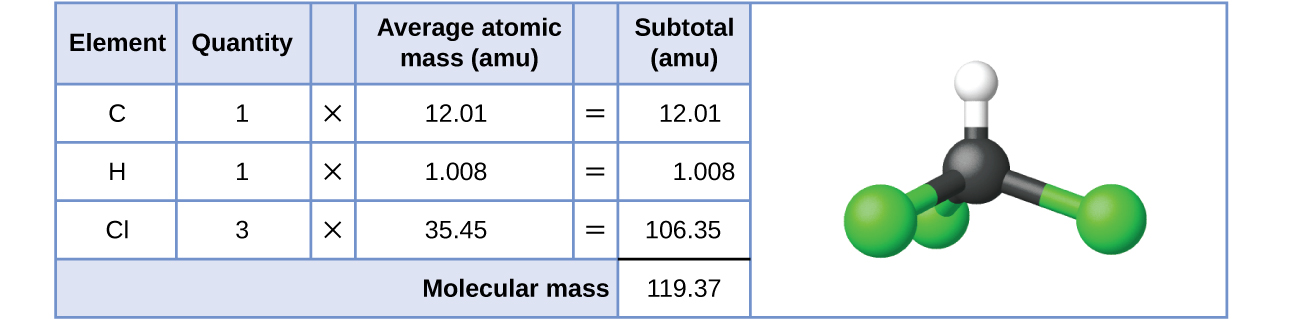
Figure 3.2図 3.2
The average mass of a chloroform molecule, CHCl3, is 119.37 amu, which is the sum of the average atomic masses of each of its constituent atoms. The model shows the molecular structure of chloroform.
クロロホルム分子CHCl3の平均質量は119.37 amuで、構成する各原子の平均原子質量を合計した値である。模型はクロロホルムの分子構造を示している。
Likewise, the molecular mass of an aspirin molecule, C9H8O4, is the sum of the atomic masses of nine carbon atoms, eight hydrogen atoms, and four oxygen atoms, which amounts to 180.15 amu (Figure 3.3).
英語のヒント
同様に、アスピリン分子C9H8O4の分子質量は、炭素原子9個、水素原子8個、酸素原子4個の原子質量の合計で、180.15 amuになる(図3.3)。
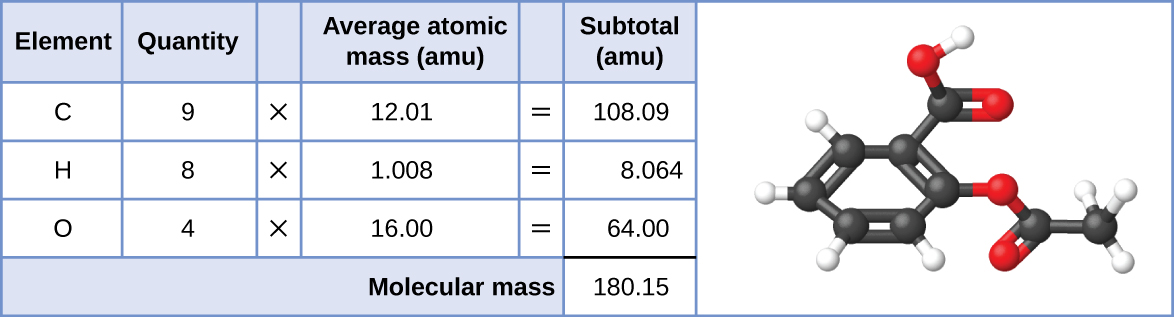
Figure 3.3図 3.3
The average mass of an aspirin molecule is 180.15 amu. The model shows the molecular structure of aspirin, C9H8O4.
アスピリン分子の平均質量は180.15 amuである。模型はアスピリンC9H8O4の分子構造を示している。
Example 3.1例題 3.1
Computing Molecular Mass for a Covalent Compound共有結合化合物の分子質量を計算する
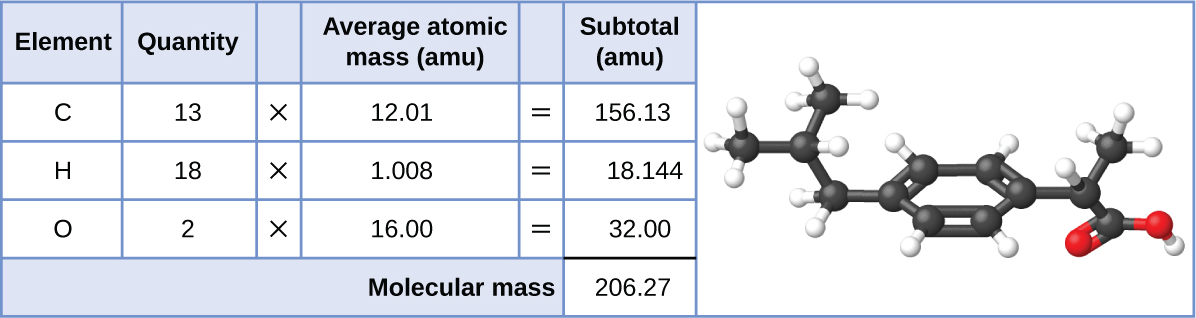
Ibuprofen, C13H18O2, is a covalent compound and the active ingredient in several popular nonprescription pain medications, such as Advil and Motrin. What is the molecular mass (amu) for this compound?
英語のヒント
イブプロフェンC13H18O2は共有結合化合物で、AdvilやMotrinなど、よく使われるいくつかの市販鎮痛薬の有効成分である。この化合物の分子質量(amu)はいくらか。
Solution解答
Molecules of this compound are composed of 13 carbon atoms, 18 hydrogen atoms, and 2 oxygen atoms. Following the approach described above, the average molecular mass for this compound is therefore:
この化合物の分子は、炭素原子13個、水素原子18個、酸素原子2個からなる。上で説明した方法に従うと、平均分子質量は次のようになる。
Check Your Learning理解度を確認
Acetaminophen, C8H9NO2, is a covalent compound and the active ingredient in several popular nonprescription pain medications, such as Tylenol. What is the molecular mass (amu) for this compound?
アセトアミノフェンC8H9NO2は共有結合化合物で、Tylenolなど、よく使われるいくつかの市販鎮痛薬の有効成分である。この化合物の分子質量(amu)はいくらか。
Formula Mass for Ionic Compoundsイオン化合物の式量
Ionic compounds are composed of discrete cations and anions combined in ratios to yield electrically neutral bulk matter. The formula mass for an ionic compound is calculated in the same way as the formula mass for covalent compounds: by summing the average atomic masses of all the atoms in the compound’s formula. Keep in mind, however, that the formula for an ionic compound does not represent the composition of a discrete molecule, so it may not correctly be referred to as the “molecular mass.”
英語のヒント
イオン化合物は、個々の陽イオンと陰イオンが、全体として電気的に中性になる比率で結びついた物質である。式量は共有結合化合物と同じく、化学式中のすべての原子の平均原子質量を合計して計算する。ただし、イオン化合物の化学式は独立した1分子の組成を表しているわけではないので、「分子質量」と呼ぶのは適切ではないことを覚えておけ。
As an example, consider sodium chloride, NaCl, the chemical name for common table salt. Sodium chloride is an ionic compound composed of sodium cations, Na+, and chloride anions, Cl−, combined in a 1:1 ratio. The formula mass for this compound is computed as 58.44 amu (see Figure 3.4).
例として、普通の食塩の化学名である塩化ナトリウムNaClを考えよう。塩化ナトリウムは、ナトリウム陽イオンNa+と塩化物陰イオンCl−が1:1で結びついたイオン化合物である。その式量は58.44 amuと計算される(図3.4参照)。
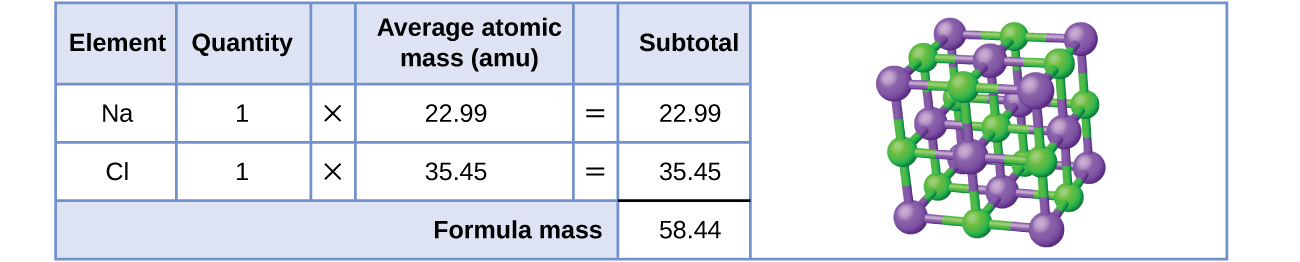
Figure 3.4図 3.4
Table salt, NaCl, contains an array of sodium and chloride ions combined in a 1:1 ratio. Its formula mass is 58.44 amu.
食塩NaClは、ナトリウムイオンと塩化物イオンが1:1の比率で配列したものである。その式量は58.44 amuである。
Note that the average masses of neutral sodium and chlorine atoms were used in this computation, rather than the masses for sodium cations and chlorine anions. This approach is perfectly acceptable when computing the formula mass of an ionic compound. Even though a sodium cation has a slightly smaller mass than a sodium atom (since it is missing an electron), this difference will be offset by the fact that a chloride anion is slightly more massive than a chloride atom (due to the extra electron). Moreover, the mass of an electron is negligibly small with respect to the mass of a typical atom. Even when calculating the mass of an isolated ion, the missing or additional electrons can generally be ignored, since their contribution to the overall mass is negligible, reflected only in the nonsignificant digits that will be lost when the computed mass is properly rounded. The few exceptions to this guideline are very light ions derived from elements with precisely known atomic masses.
英語のヒント
この計算では、ナトリウム陽イオンや塩化物陰イオンの質量ではなく、中性のナトリウム原子と塩素原子の平均質量を使っていることに注目せよ。イオン化合物の式量を計算するうえで、この方法にはまったく問題ない。ナトリウム陽イオンは電子を1個失っているためナトリウム原子よりわずかに軽いものの、その差は、塩化物陰イオンが余分な電子1個のため塩素原子よりわずかに重いことで相殺される。さらに、電子の質量は普通の原子の質量に比べて無視できるほど小さいものである。単独のイオンの質量を求める場合でも、失われた電子や加わった電子は、全質量への寄与が無視できるため、一般に考慮しなくてかまわない。その寄与は、有効数字に含まれず、計算した質量を正しく丸めると失われる桁にしか現れない。この目安の数少ない例外は、原子質量が精密にわかっている元素からできた、非常に軽いイオンである。
Example 3.2例題 3.2
Computing Formula Mass for an Ionic Compoundイオン化合物の式量を計算する
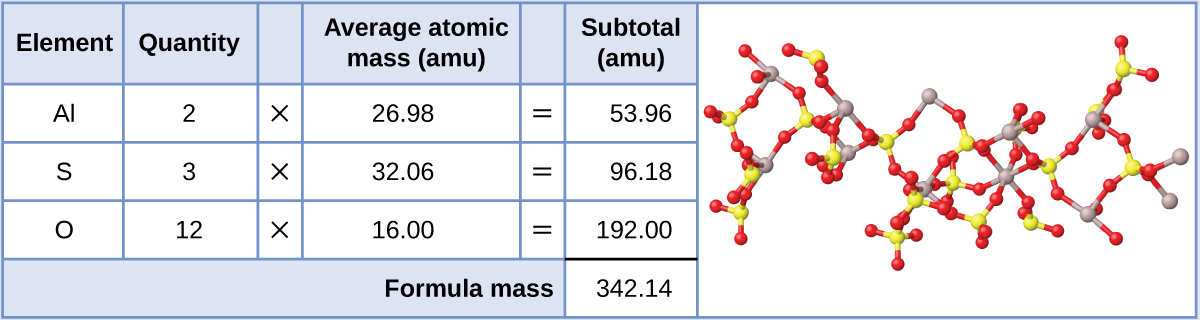
Aluminum sulfate, Al2(SO4)3, is an ionic compound that is used in the manufacture of paper and in various water purification processes. What is the formula mass (amu) of this compound?
英語のヒント
硫酸アルミニウムAl2(SO4)3は、製紙やさまざまな水の浄化処理に使われるイオン化合物である。この化合物の式量(amu)はいくらか。
Solution解答
The formula for this compound indicates it contains Al3+ and SO42− ions combined in a 2:3 ratio. For purposes of computing a formula mass, it is helpful to rewrite the formula in the simpler format, Al2S3O12. Following the approach outlined above, the formula mass for this compound is calculated as follows:
この化学式は、Al3+とSO42−のイオンを2:3の比で含むことを示している。式量を計算する際には、より単純なAl2S3O12という形に書き直すと便利である。上で説明した方法に従い、式量を次のように計算する。


Check Your Learning理解度を確認
Calcium phosphate, Ca3(PO4)2, is an ionic compound and a common anti-caking agent added to food products. What is the formula mass (amu) of calcium phosphate?
リン酸カルシウムCa3(PO4)2はイオン化合物で、食品によく加えられる固結防止剤である。その式量(amu)はいくらか。