第3章物質と溶液の組成
Determination of Empirical Formulas組成式の決定
As previously mentioned, the most common approach to determining a compound’s chemical formula is to first measure the masses of its constituent elements. However, keep in mind that chemical formulas represent the relative numbers, not masses, of atoms in the substance. Therefore, any experimentally derived data involving mass must be used to derive the corresponding numbers of atoms in the compound. This is accomplished using molar masses to convert the mass of each element to a number of moles. These molar amounts are used to compute whole-number ratios that can be used to derive the empirical formula of the substance. Consider a sample of compound determined to contain 1.71 g C and 0.287 g H. The corresponding numbers of atoms (in moles) are:
英語のヒント
先に述べたように、化合物の化学式を決める最も一般的な方法は、まず構成元素の質量を測ることである。ただし、化学式が表すのは原子の相対的な質量ではなく、個数であることを忘れるな。したがって、質量に関する実験データは、化合物中の対応する原子数を求めるために用いる必要がある。そのために、モル質量を使って各元素の質量をモル数へ換算する。得られたモル数から整数比を計算し、物質の組成式を求める。Cを1.71 g、Hを0.287 g含むとわかった化合物の試料を考えよう。対応する原子数をモルで示すと、次のようになる。
Thus, this compound may be represented by the formula C0.142H0.284. Per convention, formulas contain whole-number subscripts, which can be achieved by dividing each subscript by the smaller subscript:
英語のヒント
したがって、この化合物はC0.142H0.284と表せる。慣例として化学式の添字は整数にするので、各添字を小さい方の添字で割る。
(Recall that subscripts of “1” are not written but rather assumed if no other number is present.)
(添字1は書かず、ほかの数がなければ1とみなすことを思い出せ。)
The empirical formula for this compound is thus CH2. This may or may not be the compound’s molecular formula as well; however, additional information is needed to make that determination (as discussed later in this section).
したがって、この化合物の組成式はCH2である。これは分子式でもあるかもしれないし、そうでないかもしれない。それを判断するには、この節の後半で説明するように、追加の情報が必要である。
Consider as another example a sample of compound determined to contain 5.31 g Cl and 8.40 g O. Following the same approach yields a tentative empirical formula of:
英語のヒント
別の例として、Clを5.31 g、Oを8.40 g含むとわかった化合物の試料を考える。同じ方法で、仮の組成式が次のように得られる。
In this case, dividing by the smallest subscript still leaves us with a decimal subscript in the empirical formula. To convert this into a whole number, multiply each of the subscripts by two, retaining the same atom ratio and yielding Cl2O7 as the final empirical formula.
英語のヒント
この場合は最小の添字で割っても、組成式の添字に小数が残る。整数にするため、原子数比を保ったまま、各添字を2倍する。すると、最終的な組成式Cl2O7が得られる。
In summary, empirical formulas are derived from experimentally measured element masses by:
まとめると、実験で測定した元素の質量から組成式を求める手順は次のとおりである。
- Deriving the number of moles of each element from its mass各元素の質量からモル数を求める
- Dividing each element’s molar amount by the smallest molar amount to yield subscripts for a tentative empirical formula各元素のモル数を最小のモル数で割り、仮の組成式の添字を得る
- Multiplying all coefficients by an integer, if necessary, to ensure that the smallest whole-number ratio of subscripts is obtained必要ならすべての係数に整数を掛け、添字が最小の整数比になるようにする
Figure 3.11 outlines this procedure in flow chart fashion for a substance containing elements A and X.
図3.11は、元素AとXを含む物質について、この手順をフローチャートで示したものである。
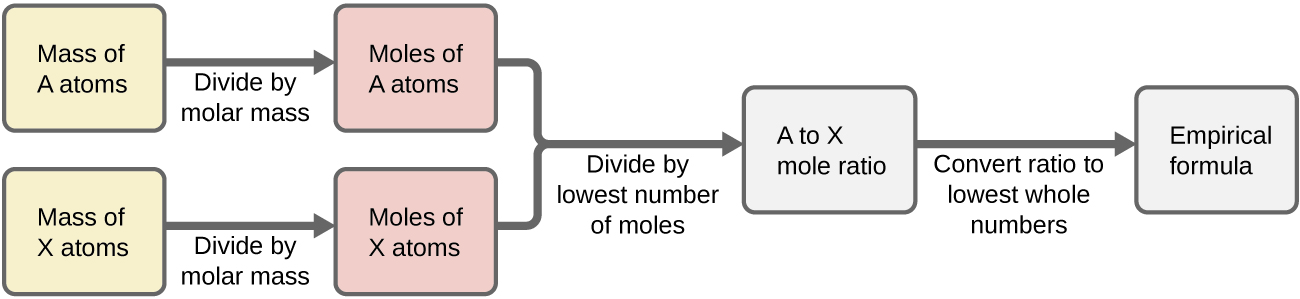

Figure 3.11図 3.11
The empirical formula of a compound can be derived from the masses of all elements in the sample.
化合物の組成式は、試料中のすべての元素の質量から求められる。
Example 3.11例題 3.11
Determining a Compound’s Empirical Formula from the Masses of Its Elements構成元素の質量から化合物の組成式を求める
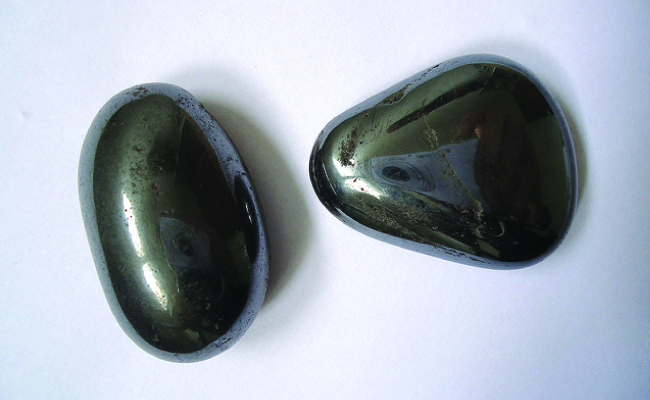
A sample of the black mineral hematite (Figure 3.12), an oxide of iron found in many iron ores, contains 34.97 g of iron and 15.03 g of oxygen. What is the empirical formula of hematite?
英語のヒント
多くの鉄鉱石に見られる酸化鉄で、黒い鉱物である赤鉄鉱(図3.12)の試料に、鉄34.97 gと酸素15.03 gが含まれている。赤鉄鉱の組成式は何か。
Mauro Cateb; modified by OpenStax. · CC BY-SA 3.0 · Source出典

Figure 3.12図 3.12
Hematite is an iron oxide that is used in jewelry. (credit: Mauro Cateb)
赤鉄鉱は、宝飾品にも使われる酸化鉄である。(出典:Mauro Cateb)
Solution解答
This problem provides the mass in grams of each element. Begin by finding the moles of each:
この問題では、各元素の質量がグラムで与えられている。まず、それぞれのモル数を求める。
Next, derive the iron-to-oxygen molar ratio by dividing by the lesser number of moles:
次に、小さい方のモル数で割って、鉄と酸素のモル比を求める。
The ratio is 1.000 mol of iron to 1.500 mol of oxygen (Fe1O1.5). Finally, multiply the ratio by two to get the smallest possible whole number subscripts while still maintaining the correct iron-to-oxygen ratio:
比は鉄1.000 molに対して酸素1.500 mol(Fe1O1.5)である。最後に両方を2倍し、鉄と酸素の比率を正しく保ちながら、可能な最小の整数の添字にする。
The empirical formula is Fe2O3.
組成式はFe2O3である。
Check Your Learning理解度を確認
What is the empirical formula of a compound if a sample contains 0.130 g of nitrogen and 0.370 g of oxygen?
試料に窒素0.130 gと酸素0.370 gが含まれる化合物の組成式は何か。
Deriving Empirical Formulas from Percent Composition百分率組成から組成式を求める
Finally, with regard to deriving empirical formulas, consider instances in which a compound’s percent composition is available rather than the absolute masses of the compound’s constituent elements. In such cases, the percent composition can be used to calculate the masses of elements present in any convenient mass of compound; these masses can then be used to derive the empirical formula in the usual fashion.
英語のヒント
組成式の求め方の最後に、構成元素の絶対的な質量ではなく、化合物の百分率組成がわかっている場合を考えよう。この場合は、扱いやすい量の化合物を想定し、百分率組成を使ってそこに含まれる各元素の質量を計算できる。あとは、その質量から通常の方法で組成式を求められる。
Example 3.12例題 3.12
Determining an Empirical Formula from Percent Composition百分率組成から組成式を決定する
The bacterial fermentation of grain to produce ethanol forms a gas with a percent composition of 27.29% C and 72.71% O (Figure 3.13). What is the empirical formula for this gas?
英語のヒント
穀物を細菌で発酵させてエタノールをつくると、百分率組成がC 27.29%、O 72.71%の気体が発生する(図3.13)。この気体の組成式は何か。
Image omitted because its reuse rights could not be verified.権利の確認ができないため画像を割愛。
Figure 3.13図 3.13
An oxide of carbon is removed from these fermentation tanks through the large copper pipes at the top. (credit: “Dual Freq”/Wikimedia Commons)
これらの発酵タンクから、上部の大きな銅管を通って炭素の酸化物が排出される。(出典:「Dual Freq」/Wikimedia Commons)
Solution解答
Since the scale for percentages is 100, it is most convenient to calculate the mass of elements present in a sample weighing 100 g. The calculation is “most convenient” because, per the definition for percent composition, the mass of a given element in grams is numerically equivalent to the element’s mass percentage. This numerical equivalence results from the definition of the “percentage” unit, whose name is derived from the Latin phrase per centum meaning “by the hundred.” Considering this definition, the mass percentages provided may be more conveniently expressed as fractions:
英語のヒント
百分率は100を基準にするので、100 gの試料に含まれる各元素の質量を計算すると最も便利である。百分率組成の定義に従えば、ある元素の質量をグラムで表した数値が、その元素の質量百分率の数値と等しくなるためである。この数値の一致は、「百分率」という単位の定義によるものである。その英語名percentageは、「100につき」を意味するラテン語per centumに由来する。この定義から、与えられた質量百分率は、次のように分数で表すと扱いやすくなる。
The molar amounts of carbon and oxygen in a 100-g sample are calculated by dividing each element’s mass by its molar mass:
100 gの試料中の炭素と酸素のモル数は、それぞれの元素の質量をモル質量で割って求める。
Coefficients for the tentative empirical formula are derived by dividing each molar amount by the lesser of the two:
各モル数を小さい方で割り、仮の組成式の係数を求める。
Since the resulting ratio is one carbon to two oxygen atoms, the empirical formula is CO2.
得られた比率は炭素原子1個に対して酸素原子2個なので、組成式はCO2である。
Check Your Learning理解度を確認
What is the empirical formula of a compound containing 40.0% C, 6.71% H, and 53.28% O?
C 40.0%、H 6.71%、O 53.28%を含む化合物の組成式は何か。