第3章物質と溶液の組成
The Moleモル
The identity of a substance is defined not only by the types of atoms or ions it contains, but by the quantity of each type of atom or ion. For example, water, H2O, and hydrogen peroxide, H2O2, are alike in that their respective molecules are composed of hydrogen and oxygen atoms. However, because a hydrogen peroxide molecule contains two oxygen atoms, as opposed to the water molecule, which has only one, the two substances exhibit very different properties. Today, sophisticated instruments allow the direct measurement of these defining microscopic traits; however, the same traits were originally derived from the measurement of macroscopic properties (the masses and volumes of bulk quantities of matter) using relatively simple tools (balances and volumetric glassware). This experimental approach required the introduction of a new unit for amount of substances, the mole, which remains indispensable in modern chemical science.
英語のヒント
ある物質が何であるかは、含まれる原子やイオンの種類だけでなく、それぞれの種類の数によっても決まる。たとえば水H2Oと過酸化水素H2O2は、分子が水素原子と酸素原子からなる点では似ている。しかし、過酸化水素分子には酸素原子が2個あるのに対し、水分子には1個しかないため、両者の性質は大きく異なる。現在では、高度な機器で、こうした物質を特徴づける微視的性質を直接測定できる。しかし当初は、比較的単純な道具(天秤や体積測定用のガラス器具)を使って、巨視的性質(まとまった量の物質の質量や体積)を測定し、そこから同じ特徴を導き出した。この実験的手法には、物質の量を表す新しい単位「モル」を導入する必要があり、モルは現代の化学でも欠かせない。
The mole is an amount unit similar to familiar units like pair, dozen, gross, etc. It provides a specific measure of the number of atoms or molecules in a sample of matter. One Latin connotation for the word “mole” is “large mass” or “bulk,” which is consistent with its use as the name for this unit. The mole provides a link between an easily measured macroscopic property, bulk mass, and an extremely important fundamental property, number of atoms, molecules, and so forth. A mole of substance is that amount in which there are 6.02214076 1023 discrete entities (atoms or molecules). This large number is a fundamental constant known as Avogadro’s number (NA) or the Avogadro constant in honor of Italian scientist Amedeo Avogadro. This constant is properly reported with an explicit unit of “per mole,” a conveniently rounded version being 6.022 1023/mol.
英語のヒント
モルは、組、ダース、グロスなどのなじみのある単位と同様に、量を表す単位である。物質の試料に含まれる原子や分子の個数を具体的に示す。moleという語のラテン語での含意の一つは「大きな塊」または「まとまった量」で、この単位名としての使い方と合っている。モルは、容易に測定できる巨視的性質であるまとまった量の質量と、きわめて重要な基本的性質である原子や分子などの個数を結びつける。1モルの物質とは、独立した構成粒子(原子や分子)が6.02214076 1023個ある量である。この大きな数は、イタリアの科学者アメデオ・アボガドロにちなんで、アボガドロ数(NA)またはアボガドロ定数と呼ばれる基本定数である。この定数は、正しくは「毎モル」という単位を明記して示し、使いやすく丸めた値は6.022 1023/molである。
Consistent with its definition as an amount unit, 1 mole of any element contains the same number of atoms as 1 mole of any other element. The masses of 1 mole of different elements, however, are different, since the masses of the individual atoms are drastically different. The molar mass of an element (or compound) is the mass in grams of 1 mole of that substance, a property expressed in units of grams per mole (g/mol) (see Figure 3.5).
英語のヒント
量の単位という定義に従い、どの元素の1モルにも、ほかのどの元素の1モルとも同じ個数の原子が含まれる。しかし、個々の原子の質量が大きく異なるため、元素が異なれば1モルの質量も異なる。元素(または化合物)のモル質量とは、その物質1モルの質量をグラムで表したもので、単位はグラム毎モル(g/mol)である(図3.5参照)。
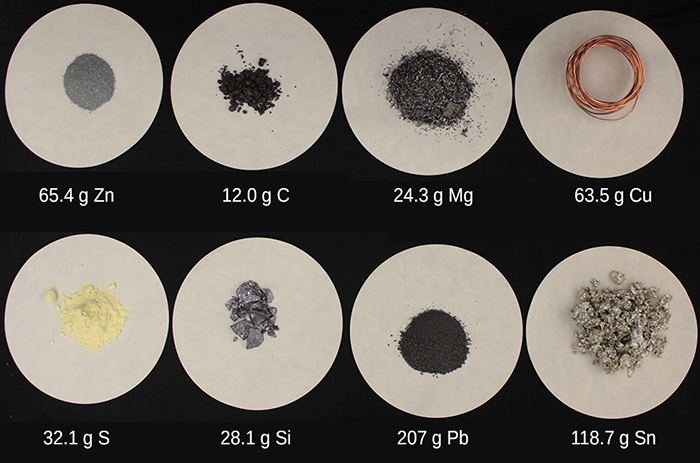
Figure 3.5図 3.5
Each sample contains 6.022 1023 atoms —1.00 mol of atoms. From left to right (top row): 65.4 g zinc, 12.0 g carbon, 24.3 g magnesium, and 63.5 g copper. From left to right (bottom row): 32.1 g sulfur, 28.1 g silicon, 207 g lead, and 118.7 g tin. (credit: modification of work by Mark Ott)
各試料には6.022 1023個、すなわち1.00 molの原子が含まれる。上段は左から亜鉛65.4 g、炭素12.0 g、マグネシウム24.3 g、銅63.5 g、下段は左から硫黄32.1 g、ケイ素28.1 g、鉛207 g、スズ118.7 gである。(出典:Mark Ottの作品を改変)
The molar mass of any substance is numerically equivalent to its atomic or formula weight in amu. Per the amu definition, a single 12C atom weighs 12 amu (its atomic mass is 12 amu). A mole of 12C weighs 12 g (its molar mass is 12 g/mol). This relationship holds for all elements, since their atomic masses are measured relative to that of the amu-reference substance, 12C. Extending this principle, the molar mass of a compound in grams is likewise numerically equivalent to its formula mass in amu (Figure 3.6).
英語のヒント
どの物質のモル質量も、amuで表した原子量または式量と数値が一致する。amuの定義によれば、12C原子1個の質量は12 amu(原子質量12 amu)である。12Cの1モルの質量は12 g(モル質量12 g/mol)である。原子質量はamuの基準物質である12Cに対する相対値として測定するので、この関係はすべての元素に当てはまる。さらにこの原理を拡張すると、化合物のモル質量のグラムでの数値も、amuで表した式量の数値と一致する(図3.6)。
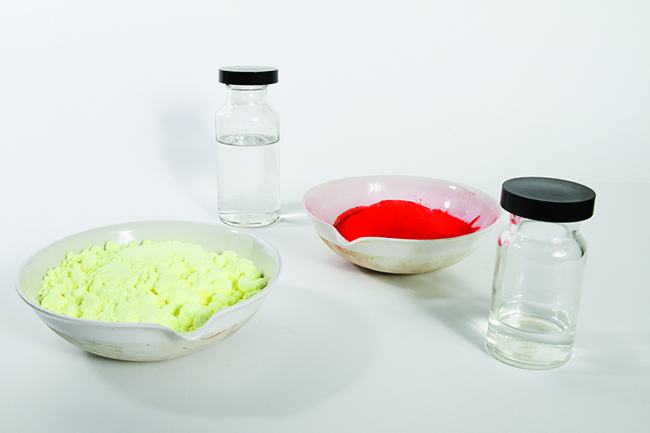
Figure 3.6図 3.6
Each sample contains 6.02 1023 molecules or formula units—1.00 mol of the compound or element. Clock-wise from the upper left: 130.2 g of C8H17OH (1-octanol, formula mass 130.2 amu), 454.4 g of HgI2 (mercury(II) iodide, formula mass 454.4 amu), 32.0 g of CH3OH (methanol, formula mass 32.0 amu) and 256.5 g of S8 (sulfur, formula mass 256.5 amu). (credit: Sahar Atwa)
各試料には6.02 1023個の分子または式単位、すなわち1.00 molの化合物または元素が含まれる。左上から時計回りに、C8H17OH(1-オクタノール、式量130.2 amu)130.2 g、HgI2(ヨウ化水銀(II)、式量454.4 amu)454.4 g、CH3OH(メタノール、式量32.0 amu)32.0 g、S8(硫黄、式量256.5 amu)256.5 gである。(出典:Sahar Atwa)
Element 元素 |
Average Atomic Mass (amu) 平均原子質量(amu) |
Molar Mass (g/mol) モル質量(g/mol) |
Atoms/Mole 1モル当たりの原子数 |
|---|---|---|---|
C |
12.01 |
12.01 |
6.022 1023 |
H |
1.008 |
1.008 |
6.022 1023 |
O |
16.00 |
16.00 |
6.022 1023 |
Na |
22.99 |
22.99 |
6.022 1023 |
Cl |
35.45 |
35.45 |
6.022 1023 |
While atomic mass and molar mass are numerically equivalent, keep in mind that they are vastly different in terms of scale, as represented by the vast difference in the magnitudes of their respective units (amu versus g). To appreciate the enormity of the mole, consider a small drop of water weighing about 0.03 g (see Figure 3.7). Although this represents just a tiny fraction of 1 mole of water (~18 g), it contains more water molecules than can be clearly imagined. If the molecules were distributed equally among the roughly seven billion people on earth, each person would receive more than 100 billion molecules.
英語のヒント
原子質量とモル質量は数値こそ等しいものの、それぞれの単位(amuとg)の大きさがまったく異なることからわかるように、尺度は大きく違うことを覚えておけ。モルという量の巨大さを実感するため、約0.03 gの小さな水滴を考えよう(図3.7参照)。これは水1モル(約18 g)のごく一部であるが、はっきり想像できないほど多くの水分子を含む。その分子を地球上の約70億人に均等に分ければ、1人当たり1000億個以上の分子を受け取ることになる。
Image omitted because its reuse rights could not be verified.権利の確認ができないため画像を割愛。
Figure 3.7図 3.7
The number of molecules in a single droplet of water is roughly 100 billion times greater than the number of people on earth. (credit: “tanakawho”/Wikimedia commons)
水滴1滴の分子数は、地球の人口のおよそ1000億倍である。(出典:「tanakawho」/Wikimedia commons)
The relationships between formula mass, the mole, and Avogadro’s number can be applied to compute various quantities that describe the composition of substances and compounds, as demonstrated in the next several example problems.
式量、モル、アボガドロ数の関係は、物質や化合物の組成を表すさまざまな量の計算に応用できる。続くいくつかの例題で、その方法を示す。
Example 3.3例題 3.3
Deriving Moles from Grams for an Element元素の質量(グラム)からモル数を求める
According to nutritional guidelines from the US Department of Agriculture, the estimated average requirement for dietary potassium is 4.7 g. What is the estimated average requirement of potassium in moles?
英語のヒント
米国農務省の栄養指針によると、食事から摂取するカリウムの推定平均必要量は4.7 gである。これをモルで表すといくらか。
Solution解答
The mass of K is provided, and the corresponding amount of K in moles is requested. Referring to the periodic table, the atomic mass of K is 39.10 amu, and so its molar mass is 39.10 g/mol. The given mass of K (4.7 g) is a bit more than one-tenth the molar mass (39.10 g), so a reasonable “ballpark” estimate of the number of moles would be slightly greater than 0.1 mol.
英語のヒント
Kの質量が与えられており、それに対応するKの量をモルで求める。周期表を見ると、Kの原子質量は39.10 amuなので、モル質量は39.10 g/molである。与えられたKの質量4.7 gは、1モルの質量39.10 gの10分の1より少し大きいため、モル数を大まかに見積もれば0.1 molより少し大きい値になるはずである。
The molar amount of a substance may be calculated by dividing its mass (g) by its molar mass (g/mol):
物質のモル数は、質量(g)をモル質量(g/mol)で割って求められる。
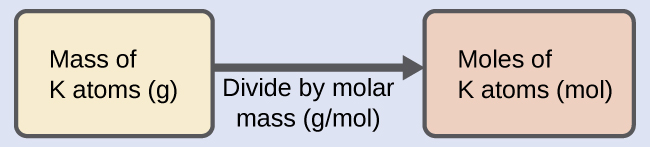
The factor-label method supports this mathematical approach since the unit “g” cancels and the answer has units of “mol:”
換算係数法でも、単位gが消えて答えの単位がmolになるため、この計算法が確かめられる。
The calculated magnitude (0.12 mol K) is consistent with our ballpark expectation, since it is a bit greater than 0.1 mol.
計算した値0.12 mol Kは0.1 molより少し大きく、大まかな予想と一致する。
Check Your Learning理解度を確認
Beryllium is a light metal used to fabricate transparent X-ray windows for medical imaging instruments. How many moles of Be are in a thin-foil window weighing 3.24 g?
英語のヒント
ベリリウムは軽い金属で、医療用画像装置のX線を透過する窓を作るのに使われる。質量3.24 gの薄い箔の窓には、Beが何モル含まれているか。
Example 3.4例題 3.4
Deriving Grams from Moles for an Element元素のモル数から質量(グラム)を求める
A liter of air contains 9.2 10−4 mol argon. What is the mass of Ar in a liter of air?
空気1リットルには、アルゴンが9.2 10−4 mol含まれる。この空気1リットル中のArの質量はいくらか。
Solution解答
The molar amount of Ar is provided and must be used to derive the corresponding mass in grams. Since the amount of Ar is less than 1 mole, the mass will be less than the mass of 1 mole of Ar, approximately 40 g. The molar amount in question is approximately one-one thousandth (~10−3) of a mole, and so the corresponding mass should be roughly one-one thousandth of the molar mass (~0.04 g):
Arのモル数が与えられており、それを使って対応する質量をグラムで求める。Arの量は1モルより少ないので、質量もArの1モルの質量である約40 gより小さくなる。問題のモル数は約1000分の1モル(約10−3 mol)なので、対応する質量も1モルの質量の約1000分の1、つまり約0.04 gになるはずである。
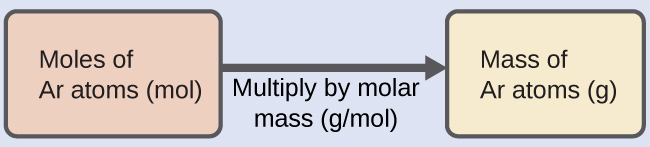
In this case, logic dictates (and the factor-label method supports) multiplying the provided amount (mol) by the molar mass (g/mol):
英語のヒント
この場合は、論理的に考えても、換算係数法で確認しても、与えられた量(mol)にモル質量(g/mol)を掛ければよいことがわかる。
The result is in agreement with our expectations, around 0.04 g Ar.
結果は、約0.04 g Arという予想と一致する。
Check Your Learning理解度を確認
What is the mass of 2.561 mol of gold?
金2.561 molの質量はいくらか。
Example 3.5例題 3.5
Deriving Number of Atoms from Mass for an Element元素の質量から原子数を求める
Copper is commonly used to fabricate electrical wire (Figure 3.8). How many copper atoms are in 5.00 g of copper wire?
銅は電線を作るためによく使われる(図3.8)。銅線5.00 gには銅原子が何個含まれているか。
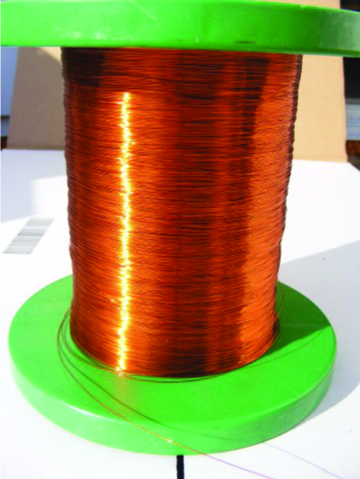
Figure 3.8図 3.8
Copper wire is composed of many, many atoms of Cu. (credit: Emilian Robert Vicol)
銅線は、きわめて多数のCu原子からできている。(出典:Emilian Robert Vicol)
Solution解答
The number of Cu atoms in the wire may be conveniently derived from its mass by a two-step computation: first calculating the molar amount of Cu, and then using Avogadro’s number (NA) to convert this molar amount to number of Cu atoms:
銅線中のCu原子の数は、質量から2段階の計算で簡単に求められる。まずCuのモル数を計算し、次にアボガドロ数(NA)を使って、そのモル数をCu原子の個数へ換算する。

Considering that the provided sample mass (5.00 g) is a little less than one-tenth the mass of 1 mole of Cu (~64 g), a reasonable estimate for the number of atoms in the sample would be on the order of one-tenth NA, or approximately 1022 Cu atoms. Carrying out the two-step computation yields:
英語のヒント
与えられた試料の質量5.00 gは、Cuの1モルの質量(約64 g)の10分の1より少し小さいので、試料の原子数はNAの10分の1程度、つまり約1022個と見積もれる。2段階の計算を行うと、次のようになる。
The factor-label method yields the desired cancellation of units, and the computed result is on the order of 1022 as expected.
換算係数法で意図したとおりに単位が消え、計算結果も予想どおり1022程度になる。
Check Your Learning理解度を確認
A prospector panning for gold in a river collects 15.00 g of pure gold. How many Au atoms are in this quantity of gold?
英語のヒント
川で砂金を採る探鉱者が、純金15.00 gを集めた。この金にはAu原子が何個含まれているか。
Example 3.6例題 3.6
Deriving Moles from Grams for a Compound化合物の質量(グラム)からモル数を求める
Our bodies synthesize protein from amino acids. One of these amino acids is glycine, which has the molecular formula C2H5O2N. How many moles of glycine molecules are contained in 28.35 g of glycine?
英語のヒント
私たちの体はアミノ酸からタンパク質を合成する。アミノ酸の一つであるグリシンの分子式はC2H5O2Nである。グリシン28.35 gには、グリシン分子が何モル含まれているか。
Solution解答
Derive the number of moles of a compound from its mass following the same procedure used for an element in Example 3.3:
例題3.3で元素について使ったのと同じ手順で、化合物の質量からモル数を求める。
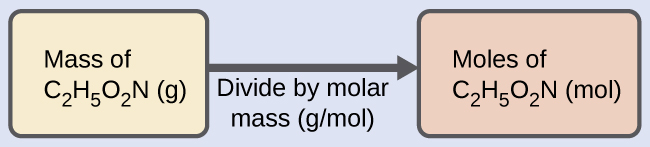
The molar mass of glycine is required for this calculation, and it is computed in the same fashion as its molecular mass. One mole of glycine, C2H5O2N, contains 2 moles of carbon, 5 moles of hydrogen, 2 moles of oxygen, and 1 mole of nitrogen:
英語のヒント
この計算にはグリシンのモル質量が必要で、分子質量と同じ方法で計算できる。グリシンC2H5O2Nの1モルには、炭素2モル、水素5モル、酸素2モル、窒素1モルが含まれる。
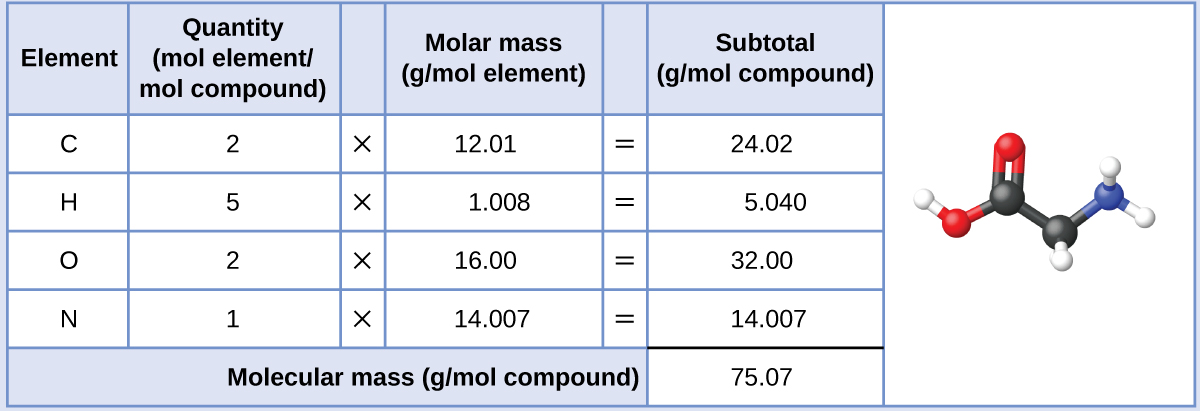
The provided mass of glycine (~28 g) is a bit more than one-third the molar mass (~75 g/mol), so the computed result is expected to be a bit greater than one-third of a mole (~0.33 mol). Dividing the compound’s mass by its molar mass yields:
与えられたグリシンの質量約28 gは、1モルの質量約75 gの3分の1より少し大きいので、計算結果は3分の1モル(約0.33 mol)より少し大きくなると予想できる。化合物の質量をモル質量で割ると、次のようになる。
This result is consistent with the rough estimate.
この結果は、大まかな見積もりと一致する。
Check Your Learning理解度を確認
How many moles of sucrose, C12H22O11, are in a 25-g sample of sucrose?
スクロースC12H22O11の試料25 gには、スクロースが何モル含まれているか。
Example 3.7例題 3.7
Deriving Grams from Moles for a Compound化合物のモル数から質量(グラム)を求める
Vitamin C is a covalent compound with the molecular formula C6H8O6. The recommended daily dietary allowance of vitamin C for children aged 4–8 years is 1.42 10−4 mol. What is the mass of this allowance in grams?
英語のヒント
ビタミンCは、分子式C6H8O6の共有結合化合物である。4~8歳の子どもの1日当たりの推奨摂取量は1.42 10−4 molである。この量の質量をグラムで表すといくらか。
Solution解答
As for elements, the mass of a compound can be derived from its molar amount as shown:
元素の場合と同様に、化合物の質量はモル数から次のように求められる。

The molar mass for this compound is computed to be 176.124 g/mol. The given number of moles is a very small fraction of a mole (~10−4 or one-ten thousandth); therefore, the corresponding mass is expected to be about one-ten thousandth of the molar mass (~0.02 g). Performing the calculation yields:
この化合物のモル質量は176.124 g/molと計算される。与えられたモル数は1モルのごく一部(約10−4、すなわち1万分の1)なので、対応する質量も1モルの質量の約1万分の1、つまり約0.02 gと予想できる。計算すると、次のようになる。
This is consistent with the anticipated result.
これは予想した結果と一致する。
Check Your Learning理解度を確認
What is the mass of 0.443 mol of hydrazine, N2H4?
ヒドラジンN2H4の0.443 molの質量はいくらか。
Example 3.8例題 3.8
Deriving the Number of Atoms and Molecules from the Mass of a Compound化合物の質量から原子数と分子数を求める
A packet of an artificial sweetener contains 40.0 mg of saccharin (C7H5NO3S), which has the structural formula:
英語のヒント
人工甘味料1袋には、サッカリン(C7H5NO3S)が40.0 mg含まれている。その構造式は次のとおりである。
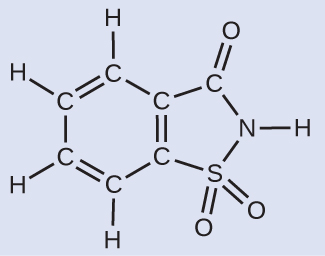
Given that saccharin has a molar mass of 183.18 g/mol, how many saccharin molecules are in a 40.0-mg (0.0400-g) sample of saccharin? How many carbon atoms are in the same sample?
英語のヒント
サッカリンのモル質量が183.18 g/molであるとすると、40.0 mg(0.0400 g)の試料にはサッカリン分子が何個含まれるか。同じ試料には炭素原子が何個含まれるか。
Solution解答
The number of molecules in a given mass of compound is computed by first deriving the number of moles, as demonstrated in Example 3.6, and then multiplying by Avogadro’s number:
ある質量の化合物に含まれる分子数は、まず例題3.6のようにモル数を求め、次にアボガドロ数を掛けて計算する。



Using the provided mass and molar mass for saccharin yields:
与えられたサッカリンの質量とモル質量を使うと、次のようになる。
The compound’s formula shows that each molecule contains seven carbon atoms, and so the number of C atoms in the provided sample is:
化学式から、1分子に炭素原子が7個含まれるとわかるので、試料中のC原子数は次のようになる。
Check Your Learning理解度を確認
How many C4H10 molecules are contained in 9.213 g of this compound? How many hydrogen atoms?
C4H10の試料9.213 gには、この化合物の分子が何個含まれるか。水素原子は何個か。