第6章指数関数と対数関数Exponential and Logarithmic Functions
6.3 Logarithmic Functions6.3 対数関数
Learning Objectives 学習目標
In this section, you will:
この節を終えると、次のことができるようになる。
• Convert from logarithmic to exponential form.• Convert from exponential to logarithmic form.• Evaluate logarithms.• Use common logarithms.• Use natural logarithms.
・対数の形から指数の形に直す。・指数の形から対数の形に直す。・対数の値を求める。・常用対数を使う。・自然対数を使う。
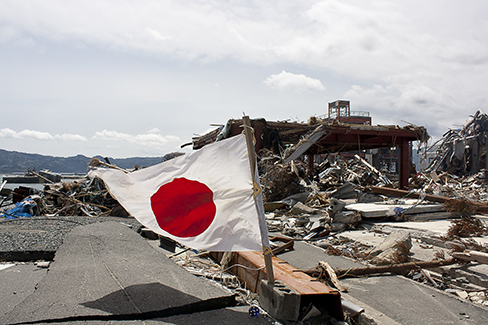
In 2010, a major earthquake struck Haiti, destroying or damaging over 285,000 homes4. One year later, another, stronger earthquake devastated Honshu, Japan, destroying or damaging over 332,000 buildings,5 like those shown in Figure 1. Even though both caused substantial damage, the earthquake in 2011 was 100 times stronger than the earthquake in Haiti. How do we know? The magnitudes of earthquakes are measured on a scale known as the Richter Scale. The Haitian earthquake registered a 7.0 on the Richter Scale6 whereas the Japanese earthquake registered a 9.0.7
2010年、ハイチを大地震が襲い、285,000戸を超える家屋が壊れるか傷ついた。4 その1年後、さらに強い地震が日本の本州を破壊し、図1に示すような332,000棟を超える建物が壊れるか傷ついた。5 どちらも大きな被害をもたらしたが、2011年の地震はハイチの地震の100倍の強さだった。なぜそう分かるのか。地震の規模はリヒター尺度と呼ばれる尺度で測られる。ハイチの地震はリヒター尺度で7.0を記録し、6 日本の地震は9.0を記録した。7
. Accessed 3/4/2013.
閲覧日:2013年3月4日。
. Accessed 3/4/2013.
閲覧日:2013年3月4日。
. Accessed 3/4/2013.
閲覧日:2013年3月4日。
. Accessed 3/4/2013.
閲覧日:2013年3月4日。
The Richter Scale is a base-ten logarithmic scale. In other words, an earthquake of magnitude 8 is not twice as great as an earthquake of magnitude 4. It is times as great! In this lesson, we will investigate the nature of the Richter Scale and the base-ten function upon which it depends.
リヒター尺度は底が10の対数の尺度である。言い換えれば、規模8の地震は規模4の地震の2倍の大きさではない。 倍の大きさである。この節では、リヒター尺度の性質と、それが依る底10の関数を調べる。
Converting from Logarithmic to Exponential Form対数の形から指数の形に直す
In order to analyze the magnitude of earthquakes or compare the magnitudes of two different earthquakes, we need to be able to convert between logarithmic and exponential form. For example, suppose the amount of energy released from one earthquake were 500 times greater than the amount of energy released from another. We want to calculate the difference in magnitude. The equation that represents this problem is where represents the difference in magnitudes on the Richter Scale. How would we solve for
地震の規模を調べたり、二つの違う地震の規模を比べたりするには、対数の形と指数の形を行き来できる必要がある。たとえば、ある地震が放ったエネルギーの量が、別の地震が放った量の500倍だったとしよう。規模の差を計算したい。この問題を表す式は である。ここで はリヒター尺度での規模の差を表す。 についてどう解けばよいか。
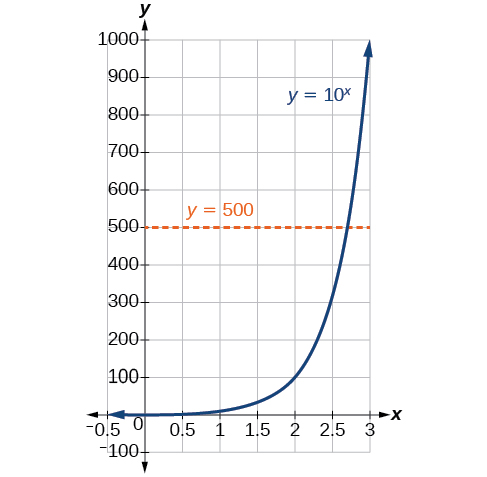
We have not yet learned a method for solving exponential equations. None of the algebraic tools discussed so far is sufficient to solve We know that and so it is clear that must be some value between 2 and 3, since is increasing. We can examine a graph, as in Figure 2, to better estimate the solution.
指数の方程式を解く方法はまだ学んでいない。ここまでに論じた代数の道具のどれも、 を解くには足りない。 と は分かっており、 は増加するので、 が2と3のあいだのどこかの値であるのは明らかである。図2のようにグラフを調べれば、解をもっとよく見積もれる。
Estimating from a graph, however, is imprecise. To find an algebraic solution, we must introduce a new function. Observe that the graph in Figure 2 passes the horizontal line test. The exponential function is one-to-one, so its inverse, is also a function. As is the case with all inverse functions, we simply interchange and and solve for to find the inverse function. To represent as a function of we use a logarithmic function of the form The base logarithm of a number is the exponent by which we must raise to get that number.
だがグラフからの見積もりは精しくない。代数的な解を求めるには、新しい関数を導入しなければならない。図2のグラフが横の直線の判定に通ることに注目しよう。指数関数 は一対一なので、その逆 もまた関数である。すべての逆関数と同じく、 と を入れ替えて について解けば逆関数が求まる。 を の関数として表すには、 の形の対数関数を使う。ある数の底 の対数とは、その数を得るために を累乗しなければならない指数のことである。
We read a logarithmic expression as, “The logarithm with base of is equal to ” or, simplified, “log base of is ” We can also say, “ raised to the power of is ” because logs are exponents. For example, the base 2 logarithm of 32 is 5, because 5 is the exponent we must apply to 2 to get 32. Since we can write We read this as “log base 2 of 32 is 5.”
対数の式は「 の底 の対数は に等しい」、あるいは縮めて「 の log 底 は 」と読む。対数は指数なので、「 を 乗すると 」とも言える。たとえば32の底2の対数は5である。32を得るために2に当てなければならない指数が5だからである。 なので と書ける。これを「32の log 底2は5」と読む。
We can express the relationship between logarithmic form and its corresponding exponential form as follows:
対数の形と、それに対応する指数の形の関係は、次のように表せる。
Note that the base is always positive.
底 はつねに正であることに注意せよ。

Because logarithm is a function, it is most correctly written as using parentheses to denote function evaluation, just as we would with However, when the input is a single variable or number, it is common to see the parentheses dropped and the expression written without parentheses, as Note that many calculators require parentheses around the
対数は関数なので、 と同じように、関数の値を求めることを示す括弧を使って と書くのが最も正しい。だが入力が変数一つや数一つのときは、括弧を落として のように括弧無しで書かれるのがふつうである。多くの電卓は を括弧で囲むことを求めるので注意せよ。
We can illustrate the notation of logarithms as follows:
対数の記法は次のように図示できる。

Notice that, comparing the logarithm function and the exponential function, the input and the output are switched. This means and are inverse functions.
対数関数と指数関数を比べると、入力と出力が入れ替わっているのに注目しよう。つまり と は互いに逆関数である。
Definition of the Logarithmic Function 対数関数の定義
A logarithm base of a positive number satisfies the following definition.
正の数 の底 の対数は、次の定義を満たす。
For
について、
where,
ここで、
• we read as, “the logarithm with base of ” or the “log base of • the logarithm is the exponent to which must be raised to get
・ を「 の底 の対数」、あるいは「 の log 底 」と読む。・対数 は、 を得るために を累乗しなければならない指数である。
Also, since the logarithmic and exponential functions switch the and values, the domain and range of the exponential function are interchanged for the logarithmic function. Therefore,
また、対数関数と指数関数は と の値を入れ替えるので、指数関数の定義域と値域は対数関数では入れ替わる。したがって、次のようになる。
• the domain of the logarithm function with base • the range of the logarithm function with base
・底 の対数関数の定義域・底 の対数関数の値域
Q&A 疑問と答え
Can we take the logarithm of a negative number?
負の数の対数はとれるか。
No. Because the base of an exponential function is always positive, no power of that base can ever be negative. We can never take the logarithm of a negative number. Also, we cannot take the logarithm of zero. Calculators may output a log of a negative number when in complex mode, but the log of a negative number is not a real number.
いいえ。指数関数の底はつねに正なので、その底の累乗が負になることは決して無い。負の数の対数は決してとれない。0の対数もとれない。電卓は複素数のモードでは負の数の対数を出すことがあるが、負の数の対数は実数ではない。
How To 手順
Given an equation in logarithmic form convert it to exponential form.
対数の形の式 が与えられたとき、それを指数の形に直す。
1. Examine the equation and identify 2. Rewrite as
1. 式 を調べ、 を見分ける。2. を と書き直す。
Example 1例1
Converting from Logarithmic Form to Exponential Form対数の形から指数の形に直す
Write the following logarithmic equations in exponential form.
次の対数の式を指数の形で書け。
Solution 解答
First, identify the values of Then, write the equation in the form
まず の値を見分ける。そして式を の形で書く。
ⓐ Here, Therefore, the equation is equivalent to ⓑ Here, Therefore, the equation is equivalent to
ⓐ。ここで である。したがって、式 は と同値である。ⓑ。ここで である。したがって、式 は と同値である。
Try It #1やってみよう1
Write the following logarithmic equations in exponential form.
次の対数の式を指数の形で書け。
Converting from Exponential to Logarithmic Form指数の形から対数の形に直す
To convert from exponents to logarithms, we follow the same steps in reverse. We identify the base exponent and output Then we write
指数から対数に直すには、同じ手順を逆にたどる。底 、指数 、出力 を見分ける。そして と書く。
Example 2例2
Converting from Exponential Form to Logarithmic Form指数の形から対数の形に直す
Write the following exponential equations in logarithmic form.
次の指数の式を対数の形で書け。
Solution 解答
First, identify the values of Then, write the equation in the form
まず の値を見分ける。そして式を の形で書く。
a. Here, and Therefore, the equation is equivalent to b. Here, and Therefore, the equation is equivalent to c. Here, and Therefore, the equation is equivalent to
a. 。ここで 、、 である。したがって、式 は と同値である。b. 。ここで 、、 である。したがって、式 は と同値である。c. 。ここで 、、 である。したがって、式 は と同値である。
Try It #2やってみよう2
Write the following exponential equations in logarithmic form.
次の指数の式を対数の形で書け。
Evaluating Logarithms対数の値を求める
Knowing the squares, cubes, and roots of numbers allows us to evaluate many logarithms mentally. For example, consider We ask, “To what exponent must be raised in order to get 8?” Because we already know it follows that
数の2乗、3乗、根を知っていれば、多くの対数を暗算で求められる。たとえば を考えよう。「8を得るには を何乗しなければならないか」と問う。 はすでに知っているので、 となる。
Now consider solving and mentally.
次に と を暗算で解くことを考えよう。
• We ask, “To what exponent must 7 be raised in order to get 49?” We know Therefore, • We ask, “To what exponent must 3 be raised in order to get 27?” We know Therefore,
・「49を得るには7を何乗しなければならないか」と問う。 と分かっている。したがって である。・「27を得るには3を何乗しなければならないか」と問う。 と分かっている。したがって である。
Even some seemingly more complicated logarithms can be evaluated without a calculator. For example, let’s evaluate mentally.
一見もっと込み入って見える対数でさえ、電卓を使わずに求められることがある。たとえば を暗算で求めよう。
• We ask, “To what exponent must be raised in order to get ” We know and so Therefore,
・「 を得るには を何乗しなければならないか」と問う。 と が分かっているので である。したがって である。
How To 手順
Given a logarithm of the form evaluate it mentally.
の形の対数が与えられたとき、それを暗算で求める。
1. Rewrite the argument as a power of 2. Use previous knowledge of powers of identify by asking, “To what exponent should be raised in order to get ”
1. 真数 を の累乗 として書き直す。2. の累乗についてすでに知っていることを使い、「 を得るには を何乗すればよいか」と問うて を見分ける。
Example 3例3
Solving Logarithms Mentally対数を暗算で解く
Solve without using a calculator.
電卓を使わずに を解け。
Solution 解答
First we rewrite the logarithm in exponential form: Next, we ask, “To what exponent must 4 be raised in order to get 64?”
まず対数を指数の形に書き直す: 。次に「64を得るには4を何乗しなければならないか」と問う。
We know
次が分かっている。
Therefore,
したがって、
Try It #3やってみよう3
Solve without using a calculator.
電卓を使わずに を解け。
Example 4例4
Evaluating the Logarithm of a Reciprocal逆数の対数の値を求める
Evaluate without using a calculator.
電卓を使わずに の値を求めよ。
Solution 解答
First we rewrite the logarithm in exponential form: Next, we ask, “To what exponent must 3 be raised in order to get ”
まず対数を指数の形に書き直す: 。次に「 を得るには3を何乗しなければならないか」と問う。
We know but what must we do to get the reciprocal, Recall from working with exponents that We use this information to write
は分かっているが、逆数 を得るにはどうすればよいか。指数を扱ったときの を思い出そう。これを使って次のように書く。
Therefore,
したがって である。
Try It #4やってみよう4
Evaluate without using a calculator.
電卓を使わずに の値を求めよ。
Using Common Logarithms常用対数を使う
Sometimes you may see a logarithm written without a base. When you see one written this way, you need to look at the expression before evaluating it. It may be that the base you use doesn't matter. If you find it in computer science, it often means . However, in mathematics it almost always means the common logarithm of 10. In other words, the expression often means
底を書かない対数を見かけることがある。そう書かれたものを見たら、値を求める前にその式を見る必要がある。使う底が何であれ関係ないこともある。計算機科学で見かけるなら、しばしば を意味する。だが数学では、ほとんどつねに底10の常用対数を意味する。言い換えれば、式 はしばしば を意味する。
Definition of the Common Logarithm 常用対数の定義
A common logarithm is a logarithm with base We can also write simply as The common logarithm of a positive number satisfies the following definition.
常用対数とは、底が の対数である。 を単に とも書ける。正の数 の常用対数は、次の定義を満たす。
For
について、
We read as, “the logarithm with base of ” or “log base 10 of ”
を「 の底 の対数」、あるいは「 の log 底10」と読む。
The logarithm is the exponent to which must be raised to get
対数 は、 を得るために を累乗しなければならない指数である。
Currently, we use as the common logarithm, as the binary logarithm, and as the natural logarithm. Writing without specifying a base is now considered bad form, despite being frequently found in older materials.
今日では、常用対数に 、二進対数に 、自然対数に を使う。底を明記せずに と書くのは、古い資料にはよく見られるが、今では良くない書き方とされる。
How To 手順
Given a common logarithm of the form evaluate it mentally.
の形の常用対数が与えられたとき、それを暗算で求める。
1. Rewrite the argument as a power of 2. Use previous knowledge of powers of to identify by asking, “To what exponent must be raised in order to get ”
1. 真数 を の累乗 として書き直す。2. の累乗についてすでに知っていることを使い、「 を得るには を何乗しなければならないか」と問うて を見分ける。
Example 5例5
Finding the Value of a Common Logarithm Mentally常用対数の値を暗算で求める
Evaluate without using a calculator.
電卓を使わずに の値を求めよ。
Solution 解答
First we rewrite the logarithm in exponential form: Next, we ask, “To what exponent must be raised in order to get 1000?” We know
まず対数を指数の形に書き直す: 。次に「1000を得るには を何乗しなければならないか」と問う。次が分かっている。
Therefore,
したがって である。
Try It #5やってみよう5
Evaluate
の値を求めよ。
How To 手順
Given a common logarithm with the form evaluate it using a calculator.
の形の常用対数が与えられたとき、電卓を使ってその値を求める。
1. Press [LOG].2. Enter the value given for followed by [ ) ].3. Press [ENTER].
1. [LOG] を押す。2. 与えられた の値を入れ、続けて [ ) ] を押す。3. [ENTER] を押す。
Example 6例6
Finding the Value of a Common Logarithm Using a Calculator電卓を使って常用対数の値を求める
Evaluate to four decimal places using a calculator.
電卓を使って の値を小数第四位まで求めよ。
Solution 解答
• Press [LOG].• Enter 321, followed by [ ) ].• Press [ENTER].
・[LOG] を押す。・321 を入れ、続けて [ ) ] を押す。・[ENTER] を押す。
Rounding to four decimal places,
小数第四位まで丸めると である。
Analysis 考察
Note that and that Since 321 is between 100 and 1000, we know that must be between and This gives us the following:
であり であることに注意しよう。321 は100と1000のあいだなので、 は と のあいだでなければならないと分かる。ここから次が得られる。
Try It #6やってみよう6
Evaluate to four decimal places using a calculator.
電卓を使って の値を小数第四位まで求めよ。
Example 7例7
Rewriting and Solving a Real-World Exponential Model現実の指数のモデルを書き直して解く
The amount of energy released from one earthquake was 500 times greater than the amount of energy released from another. The equation represents this situation, where is the difference in magnitudes on the Richter Scale. To the nearest thousandth, what was the difference in magnitudes?
ある地震が放ったエネルギーの量は、別の地震が放った量の500倍だった。式 がこの状況を表す。ここで はリヒター尺度での規模の差である。小数第三位まで求めると、規模の差はいくらだったか。
Solution 解答
We begin by rewriting the exponential equation in logarithmic form.
まず、この指数の式を対数の形に書き直す。
Next we evaluate the logarithm using a calculator:
次に、電卓を使ってこの対数の値を求める。
• Press [LOG].• Enter followed by [ ) ].• Press [ENTER].• To the nearest thousandth,
・[LOG] を押す。・ を入れ、続けて [ ) ] を押す。・[ENTER] を押す。・小数第三位まで求めると である。
The difference in magnitudes was about
規模の差はおよそ だった。
Try It #7やってみよう7
The amount of energy released from one earthquake was times greater than the amount of energy released from another. The equation represents this situation, where is the difference in magnitudes on the Richter Scale. To the nearest thousandth, what was the difference in magnitudes?
ある地震が放ったエネルギーの量は、別の地震が放った量の 倍だった。式 がこの状況を表す。ここで はリヒター尺度での規模の差である。小数第三位まで求めると、規模の差はいくらだったか。
Using Natural Logarithms自然対数を使う
The most frequently used base for logarithms is the value of which is approximately . Base logarithms are important in calculus and some scientific applications; they are called natural logarithms. The base logarithm, has its own notation,
対数の底として最も頻繁に使われるのは で、その値はおよそ である。底 の対数は微積分といくつかの科学の応用で大切であり、自然対数と呼ばれる。底 の対数 にはそれ自身の記法 がある。
Most values of can be found only using a calculator. The major exception is that, because the logarithm of 1 is always 0 in any base, For other natural logarithms, we can use the key that can be found on most scientific calculators. We can also find the natural logarithm of any power of using the inverse property of logarithms.
の値はほとんど、電卓を使わなければ求められない。大きな例外は、どの底でも1の対数はつねに0なので となることである。ほかの自然対数には、ほとんどの関数電卓にある キーが使える。対数の逆の性質を使えば、 のどの累乗の自然対数も求められる。
Definition of the Natural Logarithm 自然対数の定義
A natural logarithm is a logarithm with base We write simply as The natural logarithm of a positive number satisfies the following definition.
自然対数とは、底が の対数である。 を単に と書く。正の数 の自然対数は、次の定義を満たす。
For
について、
We read as, “the logarithm with base of ” or “the natural logarithm of ”
を「 の底 の対数」、あるいは「 の自然対数」と読む。
The logarithm is the exponent to which must be raised to get
対数 は、 を得るために を累乗しなければならない指数である。
Since the functions and are inverse functions, for all and for
関数 と は互いに逆関数なので、すべての について であり、 について である。
How To 手順
Given a natural logarithm with the form evaluate it using a calculator.
の形の自然対数が与えられたとき、電卓を使ってその値を求める。
1. Press [LN].2. Enter the value given for followed by [ ) ].3. Press [ENTER].
1. [LN] を押す。2. 与えられた の値を入れ、続けて [ ) ] を押す。3. [ENTER] を押す。
Example 8例8
Evaluating a Natural Logarithm Using a Calculator電卓を使って自然対数の値を求める
Evaluate to four decimal places using a calculator.
電卓を使って の値を小数第四位まで求めよ。
Solution 解答
• Press [LN].• Enter followed by [ ) ].• Press [ENTER].
・[LN] を押す。・ を入れ、続けて [ ) ] を押す。・[ENTER] を押す。
Rounding to four decimal places,
小数第四位まで丸めると である。
Try It #8やってみよう8
Evaluate
の値を求めよ。
Media 教材
Access this online resource for additional instruction and practice with logarithms.
対数についての説明と練習をさらに求めるなら、次のオンライン教材にあたるとよい。
・対数への導入
Verbal言葉で答える問題
2. How is the logarithmic function related to the exponential function What is the result of composing these two functions?
2. 対数関数 は指数関数 とどう関わるか。この二つの関数を合成すると何が得られるか。
4. Discuss the meaning of the common logarithm. What is its relationship to a logarithm with base and how does the notation differ?
4. 常用対数の意味を論じよ。底 の対数とどう関わるか。また記法はどう違うか。
Algebraic代数の問題
For the following exercises, rewrite each equation in exponential form.
次の各問について、各式を指数の形に書き直せ。
For the following exercises, rewrite each equation in logarithmic form.
次の各問について、各式を対数の形に書き直せ。
For the following exercises, solve for by converting the logarithmic equation to exponential form.
次の各問について、対数の式を指数の形に直して について解け。
For the following exercises, use the definition of common and natural logarithms to simplify.
次の各問について、常用対数と自然対数の定義を使って簡単にせよ。
Numeric数値の問題
For the following exercises, evaluate the base logarithmic expression without using a calculator.
次の各問について、電卓を使わずに底 の対数の式の値を求めよ。
For the following exercises, evaluate the common logarithmic expression without using a calculator.
次の各問について、電卓を使わずに常用対数の式の値を求めよ。
For the following exercises, evaluate the natural logarithmic expression without using a calculator.
次の各問について、電卓を使わずに自然対数の式の値を求めよ。
Technology機器を使う問題
For the following exercises, evaluate each expression using a calculator. Round to the nearest thousandth.
次の各問について、電卓を使って各式の値を求めよ。小数第三位まで丸めよ。
Extensions発展問題
60. Is in the range of the function If so, for what value of Verify the result.
60. は関数 の値域に入るか。入るなら、 のどの値のときか。結果を確かめよ。
62. Is the following true: Verify the result.
62. 次は正しいか: 。結果を確かめよ。
Real-World Applications応用問題
64. The exposure index for a camera is a measurement of the amount of light that hits the image receptor. It is determined by the equation where is the “f-stop” setting on the camera, and is the exposure time in seconds. Suppose the f-stop setting is and the desired exposure time is seconds. What will the resulting exposure index be?
64. カメラの露出指数 は、撮像素子に当たる光の量を測ったものである。これは式 で決まる。ここで はカメラの「f値」の設定、 は秒で表した露出時間である。f値の設定が 、望む露出時間が 秒だとする。得られる露出指数はいくらになるか。
66. The intensity levels I of two earthquakes measured on a seismograph can be compared by the formula where is the magnitude given by the Richter Scale. In August 2009, an earthquake of magnitude 6.1 hit Honshu, Japan. In March 2011, that same region experienced yet another, more devastating earthquake, this time with a magnitude of 9.0.8 How many times greater was the intensity of the 2011 earthquake? Round to the nearest whole number.
66. 地震計で測った二つの地震の強さ I は、公式 で比べられる。ここで はリヒター尺度で与えられる規模である。2009年8月、規模6.1の地震が日本の本州を襲った。2011年3月、同じ地域はさらに壊滅的な地震に見舞われ、そのときの規模は9.0だった。8 2011年の地震の強さは何倍だったか。整数に丸めよ。
. Accessed 3/4/2014.
閲覧日:2014年3月4日。