第6章指数関数と対数関数Exponential and Logarithmic Functions
Evaluating Exponential Functions指数関数の値を求める
Recall that the base of an exponential function must be a positive real number other than Why do we limit the base to positive values? To ensure that the outputs will be real numbers. Observe what happens if the base is not positive:
指数関数の底は、 以外の正の実数でなければならないのを思い出そう。なぜ底 を正の値に限るのか。出力が実数になるようにするためである。底が正でないと何が起こるかを見よう。
• Let and Then which is not a real number.
・、 とする。すると となり、これは実数ではない。
Why do we limit the base to positive values other than Because base results in the constant function. Observe what happens if the base is
なぜ底を 以外の正の値に限るのか。底が だと定数関数になるからである。底が のとき何が起こるかを見よう。
• Let Then for any value of
・ とする。すると のどんな値についても となる。
To evaluate an exponential function with the form we simply substitute with the given value, and calculate the resulting power. For example:
の形の指数関数の値を求めるには、 を与えられた値に置き換えて、その累乗を計算するだけでよい。たとえば次のとおりである。
Let What is
とする。 はいくらか。
To evaluate an exponential function with a form other than the basic form, it is important to follow the order of operations. For example:
基本の形以外の形をした指数関数の値を求めるには、計算の順序に従うことが大切である。たとえば次のとおりである。
Let What is
とする。 はいくらか。
Note that if the order of operations were not followed, the result would be incorrect:
計算の順序に従わないと、結果が間違うことに注意しよう。
Example 2例2
Evaluating Exponential Functions指数関数の値を求める
Let Evaluate without using a calculator.
とする。電卓を使わずに の値を求めよ。
Solution 解答
Follow the order of operations. Be sure to pay attention to the parentheses.
計算の順序に従う。括弧に必ず気をつけること。
Try It #2やってみよう2
Let Evaluate using a calculator. Round to four decimal places.
とする。電卓を使って の値を求めよ。小数第四位まで丸めよ。
Defining Exponential Growth指数的な増加を定める
Because the output of exponential functions increases very rapidly, the term “exponential growth” is often used in everyday language to describe anything that grows or increases rapidly. However, exponential growth can be defined more precisely in a mathematical sense. If the growth rate is proportional to the amount present, the function models exponential growth.
指数関数の出力はとても速く増えるので、「指数的な増加」という言葉は、速く育つもの・増えるものを述べるのに日常の言葉でしばしば使われる。だが指数的な増加は、数学の意味ではもっと精しく定められる。増加の割合が現在の量に比例するなら、その関数は指数的な増加のモデルになる。
Exponential Growth 指数的増加
A function that models exponential growth grows by a rate proportional to the amount present. For any real number and any positive real numbers and such that an exponential growth function has the form
指数的な増加のモデルになる関数は、現在の量に比例する割合で増える。任意の実数 と、 を満たす任意の正の実数 、 について、指数的な増加の関数は次の形をとる。
where
ここで
• is the initial or starting value of the function.• is the growth factor or growth multiplier per unit .
・ はこの関数の初期値、すなわち出発点の値である。・ は 1単位あたりの増加因子、すなわち増加の倍率である。
In more general terms, we have an exponential function, in which a constant base is raised to a variable exponent. To differentiate between linear and exponential functions, let’s consider two companies, A and B. Company A has 100 stores and expands by opening 50 new stores a year, so its growth can be represented by the function Company B has 100 stores and expands by increasing the number of stores by 50% each year, so its growth can be represented by the function
より一般には、定数の底を変数の指数で累乗した指数関数がある。一次関数と指数関数を見分けるために、二つの会社AとBを考えよう。会社Aは100店舗を持ち、年に50店ずつ新しく開いて広がるので、その成長は関数 で表せる。会社Bは100店舗を持ち、毎年店舗数を50%ずつ増やして広がるので、その成長は関数 で表せる。
A few years of growth for these companies are illustrated in Table 3.
この二つの会社の数年分の成長を表3に示す。
| Year, 年 | Stores, Company A店舗数、会社A | Stores, Company B店舗数、会社B |
|---|---|---|
The graphs comparing the number of stores for each company over a five-year period are shown in Figure 2. We can see that, with exponential growth, the number of stores increases much more rapidly than with linear growth.
5年間の各社の店舗数を比べたグラフを図2に示す。指数的な増加では、一次の増加よりずっと速く店舗数が増えるのが見てとれる。
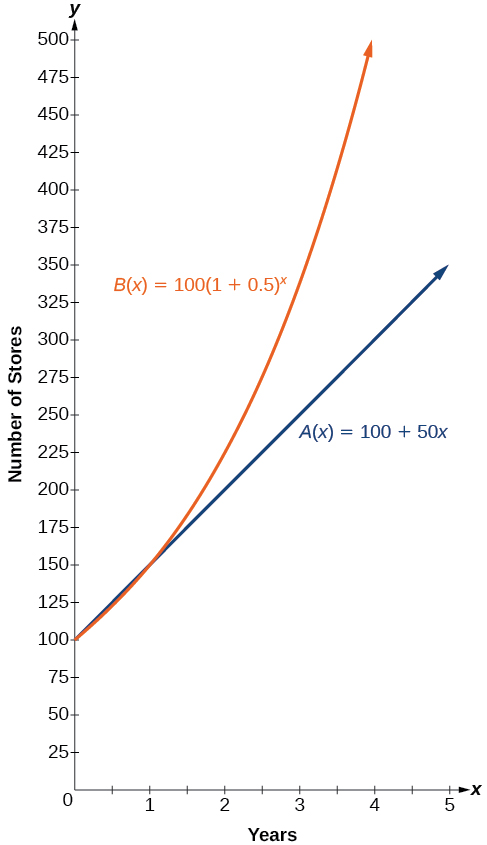
Notice that the domain for both functions is and the range for both functions is After year 1, Company B always has more stores than Company A.
どちらの関数も定義域は 、値域は であることに注目しよう。1年目より後は、会社Bの店舗数がつねに会社Aより多い。
Now we will turn our attention to the function representing the number of stores for Company B, In this exponential function, 100 represents the initial number of stores, 0.50 represents the growth rate, and represents the growth factor. Generalizing further, we can write this function as where 100 is the initial value, is called the base, and is called the exponent.
次に、会社Bの店舗数を表す関数 に目を向ける。この指数関数で、100は初めの店舗数、0.50は増加の割合、 は増加因子を表す。さらに一般化すれば、この関数は と書ける。100が初期値、 が底、 が指数と呼ばれる。
Example 3例3
Evaluating a Real-World Exponential Model現実の指数のモデルの値を求める
At the beginning of this section, we learned that the population of India was about billion in the year 2013, with an annual growth rate of about This situation is represented by the growth function where is the number of years since To the nearest thousandth, what will the population of India be in
この節の初めに、インドの人口が2013年におよそ 十億人で、年ごとの増加の割合がおよそ だと学んだ。この状況は増加の関数 で表される。ここで は 年からの年数である。小数第三位まで求めると、 年のインドの人口はいくらになるか。
Solution 解答
To estimate the population in 2031, we evaluate the models for because 2031 is years after 2013. Rounding to the nearest thousandth,
2031年は2013年の 年後なので、2031年の人口を見積もるには でモデルの値を求める。小数第三位まで丸めると、次のようになる。
There will be about 1.549 billion people in India in the year 2031.
2031年のインドの人口はおよそ15.49億人になる。
Try It #3やってみよう3
The population of China was about 1.39 billion in the year 2013, with an annual growth rate of about This situation is represented by the growth function where is the number of years since To the nearest thousandth, what will the population of China be for the year 2031? How does this compare to the population prediction we made for India in Example 3?
中国の人口は2013年におよそ13.9億人で、年ごとの増加の割合はおよそ だった。この状況は増加の関数 で表される。ここで は 年からの年数である。小数第三位まで求めると、2031年の中国の人口はいくらになるか。これは例3で立てたインドの人口の予測とどう比べられるか。