第6章指数関数と対数関数Exponential and Logarithmic Functions
6.6 Exponential and Logarithmic Equations6.6 指数方程式と対数方程式
Learning Objectives 学習目標
In this section, you will:
この節を終えると、次のことができるようになる。
• Use like bases to solve exponential equations.• Use logarithms to solve exponential equations.• Use the definition of a logarithm to solve logarithmic equations.• Use the one-to-one property of logarithms to solve logarithmic equations.• Solve applied problems involving exponential and logarithmic equations.
・同じ底を使って指数の方程式を解く。・対数を使って指数の方程式を解く。・対数の定義を使って対数の方程式を解く。・対数の一対一の性質を使って対数の方程式を解く。・指数方程式と対数方程式を含む応用問題を解く。
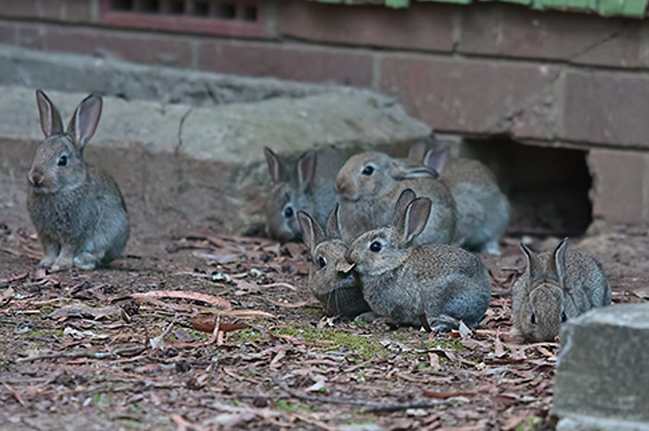
In 1859, an Australian landowner named Thomas Austin released 24 rabbits into the wild for hunting. Because Australia had few predators and ample food, the rabbit population exploded. In fewer than ten years, the rabbit population numbered in the millions.
1859年、Thomas Austin というオーストラリアの地主が、狩りのために24羽の兎を野に放った。オーストラリアには捕食者が少なく餌が豊富だったので、兎の個体数は爆発した。10年足らずで、兎の個体数は数百万羽に達した。
Uncontrolled population growth, as in the wild rabbits in Australia, can be modeled with exponential functions. Equations resulting from those exponential functions can be solved to analyze and make predictions about exponential growth. In this section, we will learn techniques for solving exponential functions.
オーストラリアの野生の兎のように、抑えられない個体数の増加は指数関数でモデルが作れる。その指数関数から得られる方程式を解けば、指数的な増加を調べて予測を立てられる。この節では、指数関数を解く手法を学ぶ。
Using Like Bases to Solve Exponential Equations同じ底を使って指数の方程式を解く
The first technique involves two functions with like bases. Recall that the one-to-one property of exponential functions tells us that, for any real numbers and where if and only if
一つ目の手法は、底が同じ二つの関数を使う。指数関数の一対一の性質は、 を満たす任意の実数 、、 について、 であるのは であるとき、かつそのときに限ると教えていたのを思い出そう。
In other words, when an exponential equation has the same base on each side, the exponents must be equal. This also applies when the exponents are algebraic expressions. Therefore, we can solve many exponential equations by using the rules of exponents to rewrite each side as a power with the same base. Then, we use the fact that exponential functions are one-to-one to set the exponents equal to one another, and solve for the unknown.
言い換えれば、指数の方程式の両辺の底が同じなら、指数どうしが等しくなければならない。これは指数が代数の式のときにも当てはまる。したがって、指数の法則を使って両辺を同じ底の累乗に書き直せば、多くの指数の方程式が解ける。そして、指数関数が一対一であることを使って指数どうしを等しいとおき、未知の値について解く。
For example, consider the equation To solve for we use the division property of exponents to rewrite the right side so that both sides have the common base, Then we apply the one-to-one property of exponents by setting the exponents equal to one another and solving for :
たとえば方程式 を考えよう。 について解くために、指数の割り算の性質を使って右辺を書き直し、両辺の底を共通の にする。そして指数の一対一の性質を当てはめ、指数どうしを等しいとおいて について解く。
Using the One-to-One Property of Exponential Functions to Solve Exponential Equations 指数関数が一対一であることを使う解法
For any algebraic expressions and any positive real number
任意の代数の式 と任意の正の実数 について、
How To 手順
Given an exponential equation with the form where and are algebraic expressions with an unknown, solve for the unknown.
と が未知数を含む代数の式である の形の指数の方程式が与えられたとき、その未知数について解く。
1. Use the rules of exponents to simplify, if necessary, so that the resulting equation has the form 2. Use the one-to-one property to set the exponents equal.3. Solve the resulting equation, for the unknown.
1. 必要なら指数の法則を使って簡単にし、できあがった方程式が の形になるようにする。2. 一対一の性質を使って、指数どうしを等しいとおく。3. できあがった方程式 を未知数について解く。
Example 1例1
Solving an Exponential Equation with a Common Base底が同じ指数の方程式を解く
Solve
を解け。
Solution 解答
Try It #1やってみよう1
Solve
を解け。
Rewriting Equations So All Powers Have the Same Baseすべての累乗の底が同じになるように方程式を書き直す
Sometimes the common base for an exponential equation is not explicitly shown. In these cases, we simply rewrite the terms in the equation as powers with a common base, and solve using the one-to-one property.
指数の方程式の共通の底が、はっきり示されていないこともある。その場合は、方程式の項を単に共通の底の累乗に書き直し、一対一の性質を使って解けばよい。
For example, consider the equation We can rewrite both sides of this equation as a power of Then we apply the rules of exponents, along with the one-to-one property, to solve for
たとえば方程式 を考えよう。この方程式の両辺は の累乗に書き直せる。そして指数の法則と一対一の性質を当てはめて について解く。
How To 手順
Given an exponential equation with unlike bases, use the one-to-one property to solve it.
底が違う指数の方程式が与えられたとき、一対一の性質を使って解く。
1. Rewrite each side in the equation as a power with a common base.2. Use the rules of exponents to simplify, if necessary, so that the resulting equation has the form 3. Use the one-to-one property to set the exponents equal.4. Solve the resulting equation, for the unknown.
1. 方程式の両辺を共通の底の累乗に書き直す。2. 必要なら指数の法則を使って簡単にし、できあがった方程式が の形になるようにする。3. 一対一の性質を使って、指数どうしを等しいとおく。4. できあがった方程式 を未知数について解く。
Example 2例2
Solving Equations by Rewriting Them to Have a Common Base共通の底になるよう書き直して方程式を解く
Solve
を解け。
Solution 解答
Try It #2やってみよう2
Solve
を解け。
Example 3例3
Solving Equations by Rewriting Roots with Fractional Exponents to Have a Common Base根を分数の指数に書き直して共通の底にし、方程式を解く
Solve
を解け。
Solution 解答
Try It #3やってみよう3
Solve
を解け。
Q&A 疑問と答え
Do all exponential equations have a solution? If not, how can we tell if there is a solution during the problem-solving process?
指数の方程式には、どれも解があるか。無いなら、解く途中で解があるかどうかをどう見分けられるか。
No. Recall that the range of an exponential function is always positive. While solving the equation, we may obtain an expression that is undefined.
いいえ。指数関数の値域はつねに正であることを思い出そう。方程式を解く途中で、定義されない式が出てくることがある。
Example 4例4
Solving an Equation with Positive and Negative Powers正と負の累乗を含む方程式を解く
Solve
を解け。
Solution 解答
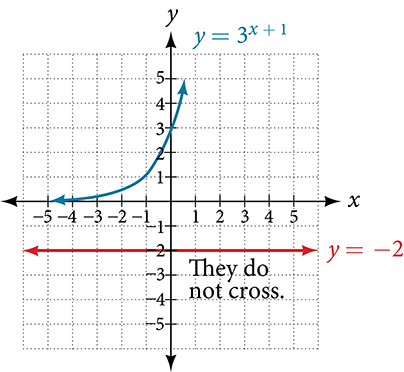
This equation has no solution. There is no real value of that will make the equation a true statement because any power of a positive number is positive.
この方程式に解は無い。正の数のどの累乗も正なので、この方程式を真にする実数の は無い。
Analysis 考察
Figure 2 shows that the two graphs do not cross so the left side is never equal to the right side. Thus the equation has no solution.
図2は、二つのグラフが交わらないので左辺が右辺と等しくなることが決して無いのを示している。よってこの方程式に解は無い。
Try It #4やってみよう4
Solve
を解け。
Solving Exponential Equations Using Logarithms対数を使って指数の方程式を解く
Sometimes the terms of an exponential equation cannot be rewritten with a common base. In these cases, we solve by taking the logarithm of each side. Recall, since is equivalent to we may apply logarithms with the same base on both sides of an exponential equation.
指数の方程式の項を共通の底に書き直せないこともある。その場合は、両辺の対数をとって解く。 が と同値であることから、指数の方程式の両辺に同じ底の対数を当てはめられることを思い出そう。
How To 手順
Given an exponential equation in which a common base cannot be found, solve for the unknown.
共通の底が見つけられない指数の方程式が与えられたとき、未知数について解く。
1. Apply the logarithm of both sides of the equation. If one of the terms in the equation has base 10, use the common logarithm. If none of the terms in the equation has base 10, use the natural logarithm.2. Use the rules of logarithms to solve for the unknown.
1. 方程式の両辺に対数を当てはめる。方程式の項の一つの底が10なら、常用対数を使う。方程式のどの項の底も10でないなら、自然対数を使う。2. 対数の法則を使って未知数について解く。
Example 5例5
Solving an Equation Containing Powers of Different Bases底が違う累乗を含む方程式を解く
Solve
を解け。
Solution 解答
Try It #5やってみよう5
Solve
を解け。
Q&A 疑問と答え
Is there any way to solve
を解く方法はあるか。
Yes. The solution is
ある。解は である。
Equations Containing ee を含む方程式
One common type of exponential equations are those with base This constant occurs again and again in nature, in mathematics, in science, in engineering, and in finance. When we have an equation with a base on either side, we can use the natural logarithm to solve it.
よくある指数の方程式の一つに、底が のものがある。この定数は、自然界にも、数学にも、科学にも、工学にも、金融にも、何度も現れる。どちらかの辺に底 がある方程式は、自然対数を使って解ける。
How To 手順
Given an equation of the form solve for
の形の方程式が与えられたとき、 について解く。
1. Divide both sides of the equation by 2. Apply the natural logarithm of both sides of the equation.3. Divide both sides of the equation by
1. 方程式の両辺を で割る。2. 方程式の両辺に自然対数を当てはめる。3. 方程式の両辺を で割る。
Example 6例6
Solve an Equation of the Form y = Aekty = Aekt の形の方程式を解く
Solve
を解け。
Solution 解答
Analysis 考察
Using laws of logs, we can also write this answer in the form If we want a decimal approximation of the answer, we use a calculator.
対数の法則を使えば、この答えを の形でも書ける。答えの小数の近似がほしければ、電卓を使う。
Try It #6やってみよう6
Solve
を解け。
Q&A 疑問と答え
Does every equation of the form have a solution?
の形の方程式には、どれも解があるか。
No. There is a solution when and when and are either both 0 or neither 0, and they have the same sign. An example of an equation with this form that has no solution is
いいえ。解があるのは、 で、かつ と がともに0であるかともに0でなく、符号が同じときである。この形で解が無い方程式の例は である。
Example 7例7
Solving an Equation That Can Be Simplified to the Form y = Aekty = Aekt の形に簡単にできる方程式を解く
Solve
を解け。
Solution 解答
Try It #7やってみよう7
Solve
を解け。
Extraneous Solutions無縁解
Sometimes the methods used to solve an equation introduce an extraneous solution, which is a solution that is correct algebraically but does not satisfy the conditions of the original equation. One such situation arises in solving when the logarithm is taken on both sides of the equation. In such cases, remember that the argument of the logarithm must be positive. If the number we are evaluating in a logarithm function is negative, there is no output.
方程式を解くのに使った方法が、無縁解を生むことがある。無縁解とは、代数的には正しいが、元の方程式の条件を満たさない解である。そうした状況の一つは、方程式の両辺の対数をとって解くときに起こる。その場合、対数の真数は正でなければならないことを忘れないでほしい。対数関数で値を求める数が負なら、出力は無い。
Example 8例8
Solving Exponential Functions in Quadratic Form二次の形の指数関数を解く
Solve
を解け。
Solution 解答
Analysis 考察
When we plan to use factoring to solve a problem, we always get zero on one side of the equation, because zero has the unique property that when a product is zero, one or both of the factors must be zero. We reject the equation because a positive number never equals a negative number. The solution is not a real number, and in the real number system this solution is rejected as an extraneous solution.
因数分解で問題を解くつもりのときは、つねに方程式の片辺を0にする。積が0なら因数の一方か両方が0でなければならないという、0だけが持つ性質があるからである。正の数が負の数に等しくなることは決して無いので、方程式 は捨てる。解 は実数ではなく、実数の体系ではこの解は無縁解として捨てられる。
Try It #8やってみよう8
Solve
を解け。
Q&A 疑問と答え
Does every logarithmic equation have a solution?
対数の方程式には、どれも解があるか。
No. Keep in mind that we can only apply the logarithm to a positive number. Always check for extraneous solutions.
いいえ。対数は正の数にしか当てはめられないことを忘れないでほしい。つねに無縁解がないか確かめること。
Using the Definition of a Logarithm to Solve Logarithmic Equations対数の定義を使って対数の方程式を解く
We have already seen that every logarithmic equation is equivalent to the exponential equation We can use this fact, along with the rules of logarithms, to solve logarithmic equations where the argument is an algebraic expression.
どの対数の方程式 も指数の方程式 と同値であることはすでに見た。この事実と対数の法則を使えば、真数が代数の式である対数の方程式を解ける。
For example, consider the equation To solve this equation, we can use rules of logarithms to rewrite the left side in compact form and then apply the definition of logs to solve for
たとえば方程式 を考えよう。この方程式を解くには、対数の法則を使って左辺をまとめた形に書き直し、それから対数の定義を当てはめて について解けばよい。
Using the Definition of a Logarithm to Solve Logarithmic Equations 対数の定義を使う解法
For any algebraic expression and real numbers and where
任意の代数の式 と、 を満たす実数 、 について、
Example 9例9
Using Algebra to Solve a Logarithmic Equation代数を使って対数の方程式を解く
Solve
を解け。
Solution 解答
Try It #9やってみよう9
Solve
を解け。
Example 10例10
Using Algebra Before and After Using the Definition of the Natural Logarithm自然対数の定義を使う前と後に代数を使う
Solve
を解け。
Solution 解答
Try It #10やってみよう10
Solve
を解け。
Example 11例11
Using a Graph to Understand the Solution to a Logarithmic Equationグラフを使って対数の方程式の解を理解する
Solve
を解け。
Solution 解答
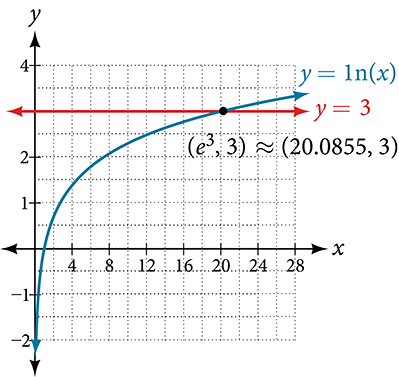
Figure 3 represents the graph of the equation. On the graph, the x-coordinate of the point at which the two graphs intersect is close to 20. In other words A calculator gives a better approximation:
図3はこの方程式のグラフを表している。グラフ上で、二つのグラフが交わる点の x座標は20に近い。言い換えれば である。電卓を使えばもっと良い近似が得られる: 。
Try It #11やってみよう11
Use a graphing calculator to estimate the approximate solution to the logarithmic equation to 2 decimal places.
グラフ電卓を使って、対数の方程式 の近似の解を小数第二位まで見積もれ。
Using the One-to-One Property of Logarithms to Solve Logarithmic Equations対数の一対一の性質を使って対数の方程式を解く
As with exponential equations, we can use the one-to-one property to solve logarithmic equations. The one-to-one property of logarithmic functions tells us that, for any real numbers and any positive real number where
指数の方程式と同じく、一対一の性質を使って対数の方程式を解ける。対数関数の一対一の性質は、任意の実数 、、 と、 を満たす任意の正の実数 について、次を教えている。
For example,
たとえば、
So, if then we can solve for and we get To check, we can substitute into the original equation: In other words, when a logarithmic equation has the same base on each side, the arguments must be equal. This also applies when the arguments are algebraic expressions. Therefore, when given an equation with logs of the same base on each side, we can use rules of logarithms to rewrite each side as a single logarithm. Then we use the fact that logarithmic functions are one-to-one to set the arguments equal to one another and solve for the unknown.
よって なら について解けて が得られる。検算するには を元の方程式に代入すればよい: 。言い換えれば、対数の方程式の両辺の底が同じなら、真数どうしが等しくなければならない。これは真数が代数の式のときにも当てはまる。したがって、両辺に同じ底の対数がある方程式が与えられたら、対数の法則を使って各辺を一つの対数に書き直せる。そして、対数関数が一対一であることを使って真数どうしを等しいとおき、未知の値について解く。
For example, consider the equation To solve this equation, we can use the rules of logarithms to rewrite the left side as a single logarithm, and then apply the one-to-one property to solve for
たとえば方程式 を考えよう。この方程式を解くには、対数の法則を使って左辺を一つの対数に書き直し、それから一対一の性質を当てはめて について解けばよい。
To check the result, substitute into
結果を検算するには、 を に代入する。
Using the One-to-One Property of Logarithms to Solve Logarithmic Equations 対数関数が一対一であることを使う解法
For any algebraic expressions and and any positive real number where
任意の代数の式 、 と、 を満たす任意の正の実数 について、
Note, when solving an equation involving logarithms, always check to see if the answer is correct or if it is an extraneous solution.
対数を含む方程式を解くときは、答えが正しいか、それとも無縁解かを必ず確かめること。
How To 手順
Given an equation containing logarithms, solve it using the one-to-one property.
対数を含む方程式が与えられたとき、一対一の性質を使って解く。
1. Use the rules of logarithms to combine like terms, if necessary, so that the resulting equation has the form 2. Use the one-to-one property to set the arguments equal.3. Solve the resulting equation, for the unknown.
1. 必要なら対数の法則を使って同類項をまとめ、できあがった方程式が の形になるようにする。2. 一対一の性質を使って、真数どうしを等しいとおく。3. できあがった方程式 を未知数について解く。
Example 12例12
Solving an Equation Using the One-to-One Property of Logarithms対数の一対一の性質を使って方程式を解く
Solve
を解け。
Solution 解答
Analysis 考察
There are two solutions: or The solution is negative, but it checks when substituted into the original equation because the argument of the logarithm functions is still positive.
解は二つある。 または である。解 は負だが、元の方程式に代入しても対数関数の真数は正のままなので、検算に通る。
Try It #12やってみよう12
Solve
を解け。
Solving Applied Problems Using Exponential and Logarithmic Equations指数方程式と対数方程式を使って応用問題を解く
In previous sections, we learned the properties and rules for both exponential and logarithmic functions. We have seen that any exponential function can be written as a logarithmic function and vice versa. We have used exponents to solve logarithmic equations and logarithms to solve exponential equations. We are now ready to combine our skills to solve equations that model real-world situations, whether the unknown is in an exponent or in the argument of a logarithm.
前の節では、指数関数と対数関数の両方の性質と法則を学んだ。どの指数関数も対数関数として書けること、その逆も成り立つことを見た。指数を使って対数の方程式を解き、対数を使って指数の方程式を解いた。これで身につけた技を合わせ、未知数が指数にあっても対数の真数にあっても、現実の状況のモデルとなる方程式を解く用意ができた。
One such application is in science, in calculating the time it takes for half of the unstable material in a sample of a radioactive substance to decay, called its half-life. Table 1 lists the half-life for several of the more common radioactive substances.
そうした応用の一つが科学にある。放射性物質の試料のうち、不安定な物質の半分が崩壊するのにかかる時間を計算するもので、これを半減期という。表1に、より身近な放射性物質のいくつかの半減期を挙げる。
| Substance物質 | Use用途 | Half-life半減期 |
|---|---|---|
| gallium-67ガリウム67 | nuclear medicine核医学 | 80 hours80時間 |
| cobalt-60コバルト60 | manufacturing製造 | 5.3 years5.3年 |
| technetium-99mテクネチウム99m | nuclear medicine核医学 | 6 hours6時間 |
| americium-241アメリシウム241 | construction建設 | 432 years432年 |
| carbon-14炭素14 | archeological dating考古学の年代測定 | 5,730 years5,730年 |
| uranium-235ウラン235 | atomic power原子力 | 703,800,000 years703,800,000年 |
We can see how widely the half-lives for these substances vary. Knowing the half-life of a substance allows us to calculate the amount remaining after a specified time. We can use the formula for radioactive decay:
これらの物質の半減期がどれほど大きく違うかが見てとれる。物質の半減期が分かっていれば、決めた時間の後に残る量を計算できる。放射性崩壊の公式が使える。
where
ここで
• is the amount initially present• is the half-life of the substance• is the time period over which the substance is studied• is the amount of the substance present after time
・ は初めにある量、・ はその物質の半減期、・ はその物質を調べる期間、・ は時間 の後にあるその物質の量である。
Example 13例13
Using the Formula for Radioactive Decay to Find the Quantity of a Substance放射性崩壊の公式を使って物質の量を求める
How long will it take for ten percent of a 1000-gram sample of uranium-235 to decay?
1000グラムのウラン235の試料の1割が崩壊するのに、どれだけかかるか。
Solution 解答
Analysis 考察
Ten percent of 1000 grams is 100 grams. If 100 grams decay, the amount of uranium-235 remaining is 900 grams.
1000グラムの1割は100グラムである。100グラムが崩壊すると、残るウラン235の量は900グラムである。
Try It #13やってみよう13
How long will it take before twenty percent of our 1000-gram sample of uranium-235 has decayed?
1000グラムのウラン235の試料の2割が崩壊するまでに、どれだけかかるか。
Media 教材
Access these online resources for additional instruction and practice with exponential and logarithmic equations.
指数方程式と対数方程式についての説明と練習をさらに求めるなら、次のオンライン教材にあたるとよい。
• Solving Logarithmic Equations• Solving Exponential Equations with Logarithms
・対数の方程式を解く・対数を使って指数の方程式を解く
Verbal言葉で答える問題
2. When does an extraneous solution occur? How can an extraneous solution be recognized?
2. 無縁解はどんなときに生じるか。無縁解はどう見分けられるか。
Algebraic代数の問題
For the following exercises, use like bases to solve the exponential equation.
次の各問について、同じ底を使って指数の方程式を解け。
For the following exercises, use logarithms to solve.
次の各問について、対数を使って解け。
For the following exercises, use the definition of a logarithm to rewrite the equation as an exponential equation.
次の各問について、対数の定義を使って、その方程式を指数の方程式に書き直せ。
For the following exercises, use the definition of a logarithm to solve the equation.
次の各問について、対数の定義を使って方程式を解け。
For the following exercises, use the one-to-one property of logarithms to solve.
次の各問について、対数の一対一の性質を使って解け。
For the following exercises, solve each equation for
次の各問について、各方程式を について解け。
Graphicalグラフの問題
For the following exercises, solve the equation for if there is a solution. Then graph both sides of the equation, and observe the point of intersection (if it exists) to verify the solution.
次の各問について、解があればその方程式を について解け。そして方程式の両辺のグラフを描き、交点があればそれを見て解を確かめよ。
For the following exercises, solve for the indicated value, and graph the situation showing the solution point.
次の各問について、指定された値を求め、その状況のグラフを描いて解の点を示せ。
66. The formula for measuring sound intensity in decibels is defined by the equation where is the intensity of the sound in watts per square meter and is the lowest level of sound that the average person can hear. How many decibels are emitted from a jet plane with a sound intensity of watts per square meter?
66. 音の強さをデシベル で測る公式は、式 で定められる。ここで は1平方メートルあたりのワットで表した音の強さ、 はふつうの人が聞きとれる最も低い音の水準である。音の強さが1平方メートルあたり ワットのジェット機は、何デシベルを出しているか。
Technology機器を使う問題
For the following exercises, solve each equation by rewriting the exponential expression using the indicated logarithm. Then use a calculator to approximate the variable to 3 decimal places.
次の各問について、指定された対数を使って指数の式を書き直し、各方程式を解け。そして電卓を使って、その変数を小数第三位まで近似せよ。
68. using the common log.
68. 常用対数を使って
70. using the common log
70. 常用対数を使って
72. using the natural log
72. 自然対数を使って
For the following exercises, use a calculator to solve the equation. Unless indicated otherwise, round all answers to the nearest ten-thousandth.
次の各問について、電卓を使って方程式を解け。とくに断らない限り、答えはすべて小数第四位まで丸めよ。
76. Atmospheric pressure in pounds per square inch is represented by the formula where is the number of miles above sea level. To the nearest foot, how high is the peak of a mountain with an atmospheric pressure of pounds per square inch? (Hint: there are 5280 feet in a mile)
76. 1平方インチあたりのポンドで表した大気圧 は、公式 で表される。ここで は海面からのマイル数である。大気圧が1平方インチあたり ポンドの山の頂は、フィート単位でどれだけの高さか。(ヒント: 1マイルは5280フィートである。)
77. The magnitude M of an earthquake is represented by the equation where is the amount of energy released by the earthquake in joules and is the assigned minimal measure released by an earthquake. To the nearest hundredth, what would the magnitude be of an earthquake releasing joules of energy?
77. 地震の規模 M は式 で表される。ここで は地震が放ったエネルギーの量(ジュール)、 は地震が放つと定められた最小の量である。 ジュールのエネルギーを放つ地震の規模は、小数第二位までいくらになるか。
Extensions発展問題
78. Use the definition of a logarithm along with the one-to-one property of logarithms to prove that
78. 対数の定義と対数の一対一の性質を使って、 を証明せよ。
80. Recall the compound interest formula Use the definition of a logarithm along with properties of logarithms to solve the formula for time
80. 複利の公式 を思い出そう。対数の定義と対数の性質を使って、この公式を時間 について解け。
81. Newton’s Law of Cooling states that the temperature of an object at any time t can be described by the equation where is the temperature of the surrounding environment, is the initial temperature of the object, and is the cooling rate. Use the definition of a logarithm along with properties of logarithms to solve the formula for time such that is equal to a single logarithm.
81. ニュートンの冷却の法則は、任意の時刻 t における物体の温度 が式 で述べられると言う。ここで は周りの環境の温度、 は物体の初めの温度、 は冷却の割合である。対数の定義と対数の性質を使って、この公式を時間 について、 が一つの対数に等しくなるように解け。