第6章指数関数と対数関数Exponential and Logarithmic Functions
6.5 Logarithmic Properties6.5 対数の性質
Learning Objectives 学習目標
In this section, you will:
この節を終えると、次のことができるようになる。
• Use the product rule for logarithms.• Use the quotient rule for logarithms.• Use the power rule for logarithms.• Expand logarithmic expressions.• Condense logarithmic expressions.• Use the change-of-base formula for logarithms.
・対数の積の法則を使う。・対数の商の法則を使う。・対数の累乗の法則を使う。・対数の式を展開する。・対数の式をまとめる。・対数の底の変換公式を使う。
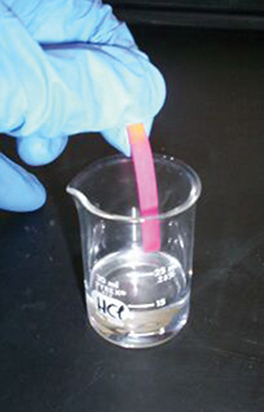
In chemistry, pH is used as a measure of the acidity or alkalinity of a substance. The pH scale runs from 0 to 14. Substances with a pH less than 7 are considered acidic, and substances with a pH greater than 7 are said to be basic. Our bodies, for instance, must maintain a pH close to 7.35 in order for enzymes to work properly. To get a feel for what is acidic and what is basic, consider the following pH levels of some common substances:
化学では、物質の酸性度やアルカリ度を測るものとして pH を使う。pH の尺度は0から14まで走る。pH が7より小さい物質は酸性、7より大きい物質は塩基性とされる。たとえば私たちの体は、酵素がきちんとはたらくために pH を7.35近くに保たなければならない。何が酸性で何が塩基性かをつかむために、身近な物質の次の pH の値を見よう。
• Battery acid: 0.8• Stomach acid: 2.7• Orange juice: 3.3• Pure water: 7 (at 25° C)• Human blood: 7.35• Fresh coconut: 7.8• Sodium hydroxide (lye): 14
・電池の酸: 0.8・胃酸: 2.7・オレンジジュース: 3.3・純水: 7(25°Cで)・人の血液: 7.35・新鮮なココナッツ: 7.8・水酸化ナトリウム(苛性ソーダ): 14
To determine whether a solution is acidic or basic, we find its pH, which is a measure of the number of active positive hydrogen ions in the solution. The pH is defined by the following formula, where is the concentration of hydrogen ion in the solution
ある溶液が酸性か塩基性かを決めるには、その pH を求める。pH は溶液中の活性な水素の陽イオンの数を測ったものである。pH は次の公式で定められる。ここで は溶液中の水素イオンの濃度である。
The equivalence of and is one of the logarithm properties we will examine in this section.
と が等しいことは、この節で調べる対数の性質の一つである。
Using the Product Rule for Logarithms対数の積の法則を使う
Recall that the logarithmic and exponential functions “undo” each other. This means that logarithms have similar properties to exponents. Some important properties of logarithms are given here. First, the following properties are easy to prove.
対数関数と指数関数が互いに相手を「元に戻す」ことを思い出そう。つまり対数は指数と似た性質を持つ。対数の大切な性質のいくつかをここに挙げる。まず、次の性質は簡単に証明できる。
For example, since And since
たとえば なので である。また なので である。
Next, we have the inverse property.
次に、逆の性質がある。
For example, to evaluate we can rewrite the logarithm as and then apply the inverse property to get
たとえば の値を求めるには、この対数を と書き直し、逆の性質 を当てはめて を得ればよい。
To evaluate we can rewrite the logarithm as and then apply the inverse property to get
の値を求めるには、この対数を と書き直し、逆の性質 を当てはめて を得ればよい。
Finally, we have the one-to-one property.
最後に、一対一の性質がある。
We can use the one-to-one property to solve the equation for Since the bases are the same, we can apply the one-to-one property by setting the arguments equal and solving for
一対一の性質を使えば、方程式 を について解ける。底が同じなので、一対一の性質を当てはめて真数どうしを等しいとおき、 について解けばよい。
But what about the equation The one-to-one property does not help us in this instance. Before we can solve an equation like this, we need a method for combining terms on the left side of the equation.
だが方程式 はどうか。この場合、一対一の性質は役に立たない。このような方程式を解く前に、左辺の項をまとめる方法が要る。
Recall that we use the product rule of exponents to combine the product of powers by adding exponents: We have a similar property for logarithms, called the product rule for logarithms, which says that the logarithm of a product is equal to a sum of logarithms. Because logs are exponents, and we multiply like bases, we can add the exponents. We will use the inverse property to derive the product rule below.
指数の積の法則を使い、指数を足して累乗の積をまとめたことを思い出そう: 。対数にも似た性質があり、対数の積の法則と呼ばれる。それは、積の対数は対数の和に等しいと述べる。対数は指数であり、同じ底どうしを掛けるので、指数を足せる。下では、逆の性質を使ってこの積の法則を導く。
Given any real number and positive real numbers and where we will show
任意の実数 と、 を満たす正の実数 、 について、次を示す。
Let and In exponential form, these equations are and It follows that
、 とする。指数の形では、これらの式は と である。したがって次が成り立つ。
Note that repeated applications of the product rule for logarithms allow us to simplify the logarithm of the product of any number of factors. For example, consider Using the product rule for logarithms, we can rewrite this logarithm of a product as the sum of logarithms of its factors:
対数の積の法則を繰り返し当てはめれば、いくつの因数の積の対数でも簡単にできることに注意しよう。たとえば を考えよう。対数の積の法則を使えば、この積の対数を、その各因数の対数の和として書き直せる。
The Product Rule for Logarithms 対数法則:積
The product rule for logarithms can be used to simplify a logarithm of a product by rewriting it as a sum of individual logarithms.
対数の積の法則を使えば、積の対数を個々の対数の和に書き直して簡単にできる。
How To 手順
Given the logarithm of a product, use the product rule of logarithms to write an equivalent sum of logarithms.
積の対数が与えられたとき、対数の積の法則を使って同値な対数の和を書く。
1. Factor the argument completely, expressing each whole number factor as a product of primes.2. Write the equivalent expression by summing the logarithms of each factor.
1. 真数を完全に因数分解し、整数の因数はそれぞれ素数の積として表す。2. 各因数の対数を足して、同値な式を書く。
Example 1例1
Using the Product Rule for Logarithms対数の積の法則を使う
Expand
を展開せよ。
Solution 解答
We begin by factoring the argument completely, expressing as a product of primes.
まず真数を完全に因数分解し、 を素数の積として表す。
Next we write the equivalent equation by summing the logarithms of each factor.
次に、各因数の対数を足して同値な式を書く。
Try It #1やってみよう1
Expand
を展開せよ。
Using the Quotient Rule for Logarithms対数の商の法則を使う
For quotients, we have a similar rule for logarithms. Recall that we use the quotient rule of exponents to combine the quotient of exponents by subtracting: The quotient rule for logarithms says that the logarithm of a quotient is equal to a difference of logarithms. Just as with the product rule, we can use the inverse property to derive the quotient rule.
商についても、対数に似た法則がある。指数の商の法則を使い、指数を引いて累乗の商をまとめたことを思い出そう:
Given any real number and positive real numbers and where we will show
任意の実数 と、 を満たす正の実数 、、 について、次を示す。
Let and In exponential form, these equations are and It follows that
、 とする。指数の形では、これらの式は と である。したがって次が成り立つ。
For example, to expand we must first express the quotient in lowest terms. Factoring and canceling we get,
たとえば を展開するには、まずこの商を約分しなければならない。因数分解して約分すると、次が得られる。
Next we apply the quotient rule by subtracting the logarithm of the denominator from the logarithm of the numerator. Then we apply the product rule.
次に、分子の対数から分母の対数を引いて商の法則を当てはめる。それから積の法則を当てはめる。
The Quotient Rule for Logarithms 対数法則:商
The quotient rule for logarithms can be used to simplify a logarithm or a quotient by rewriting it as the difference of individual logarithms.
対数の商の法則を使えば、商の対数を個々の対数の差に書き直して簡単にできる。
How To 手順
Given the logarithm of a quotient, use the quotient rule of logarithms to write an equivalent difference of logarithms.
商の対数が与えられたとき、対数の商の法則を使って同値な対数の差を書く。
1. Express the argument in lowest terms by factoring the numerator and denominator and canceling common terms.2. Write the equivalent expression by subtracting the logarithm of the denominator from the logarithm of the numerator.3. Check to see that each term is fully expanded. If not, apply the product rule for logarithms to expand completely.
1. 分子と分母を因数分解して共通の項を約分し、真数を約した形で表す。2. 分子の対数から分母の対数を引いて、同値な式を書く。3. 各項が完全に展開されているかを確かめる。そうでなければ、対数の積の法則を当てはめて完全に展開する。
Example 2例2
Using the Quotient Rule for Logarithms対数の商の法則を使う
Expand
を展開せよ。
Solution 解答
First we note that the quotient is factored and in lowest terms, so we apply the quotient rule.
まず、この商が因数分解されていて約した形になっていることに注意し、商の法則を当てはめる。
Notice that the resulting terms are logarithms of products. To expand completely, we apply the product rule, noting that the prime factors of the factor 15 are 3 and 5.
できあがった項が積の対数であることに注目しよう。完全に展開するために、因数15の素因数が3と5であることに注意して積の法則を当てはめる。
Analysis 考察
There are exceptions to consider in this and later examples. First, because denominators must never be zero, this expression is not defined for and Also, since the argument of a logarithm must be positive, we note as we observe the expanded logarithm, that and Combining these conditions is beyond the scope of this section, and we will not consider them here or in subsequent exercises.
この例と後の例には、考えるべき例外がある。まず、分母は決して0であってはならないので、この式は と では定義されない。また、対数の真数は正でなければならないので、展開した対数を見ると 、、、 であることに気づく。これらの条件をまとめることはこの節の範囲を超えるので、ここでも以後の問題でも考えない。
Try It #2やってみよう2
Expand
を展開せよ。
Using the Power Rule for Logarithms対数の累乗の法則を使う
We’ve explored the product rule and the quotient rule, but how can we take the logarithm of a power, such as One method is as follows:
積の法則と商の法則を調べたが、 のような累乗の対数はどうとればよいか。一つの方法は次のとおりである。
Notice that we used the product rule for logarithms to find a solution for the example above. By doing so, we have derived the power rule for logarithms, which says that the log of a power is equal to the exponent times the log of the base. Keep in mind that, although the input to a logarithm may not be written as a power, we may be able to change it to a power. For example,
上の例の答えを求めるのに対数の積の法則を使ったことに注目しよう。そうすることで、対数の累乗の法則を導いた。それは、累乗の対数は指数と底の対数の積に等しいと述べる。対数の入力が累乗の形で書かれていなくても、累乗に直せることがあるのを覚えておこう。たとえば次のとおりである。
The Power Rule for Logarithms 対数法則:累乗
The power rule for logarithms can be used to simplify the logarithm of a power by rewriting it as the product of the exponent times the logarithm of the base.
対数の累乗の法則を使えば、累乗の対数を、指数と底の対数の積に書き直して簡単にできる。
How To 手順
Given the logarithm of a power, use the power rule of logarithms to write an equivalent product of a factor and a logarithm.
累乗の対数が与えられたとき、対数の累乗の法則を使って、同値な因数と対数の積を書く。
1. Express the argument as a power, if needed.2. Write the equivalent expression by multiplying the exponent times the logarithm of the base.
1. 必要なら、真数を累乗の形で表す。2. 指数と底の対数を掛けて、同値な式を書く。
Example 3例3
Expanding a Logarithm with Powers累乗を含む対数を展開する
Expand
を展開せよ。
Solution 解答
The argument is already written as a power, so we identify the exponent, 5, and the base, and rewrite the equivalent expression by multiplying the exponent times the logarithm of the base.
真数はすでに累乗の形で書かれているので、指数5と底 を見分け、指数と底の対数を掛けて同値な式に書き直す。
Try It #3やってみよう3
Expand
を展開せよ。
Example 4例4
Rewriting an Expression as a Power before Using the Power Rule累乗の法則を使う前に式を累乗の形に書き直す
Expand using the power rule for logs.
対数の累乗の法則を使って を展開せよ。
Solution 解答
Expressing the argument as a power, we get
真数を累乗の形で表すと が得られる。
Next we identify the exponent, 2, and the base, 5, and rewrite the equivalent expression by multiplying the exponent times the logarithm of the base.
次に指数2と底5を見分け、指数と底の対数を掛けて同値な式に書き直す。
Try It #4やってみよう4
Expand
を展開せよ。
Example 5例5
Using the Power Rule in Reverse累乗の法則を逆に使う
Rewrite using the power rule for logs to a single logarithm with a leading coefficient of 1.
対数の累乗の法則を使って、 を先頭の係数が1の一つの対数に書き直せ。
Solution 解答
Because the logarithm of a power is the product of the exponent times the logarithm of the base, it follows that the product of a number and a logarithm can be written as a power. For the expression we identify the factor, 4, as the exponent and the argument, as the base, and rewrite the product as a logarithm of a power:
累乗の対数は指数と底の対数の積なので、数と対数の積は累乗の形で書ける。式 では、因数4を指数、真数 を底と見分け、この積を累乗の対数 に書き直す。
Try It #5やってみよう5
Rewrite using the power rule for logs to a single logarithm with a leading coefficient of 1.
対数の累乗の法則を使って、 を先頭の係数が1の一つの対数に書き直せ。
Expanding Logarithmic Expressions対数の式を展開する
Taken together, the product rule, quotient rule, and power rule are often called “laws of logs.” Sometimes we apply more than one rule in order to simplify an expression. For example:
積の法則、商の法則、累乗の法則を合わせて、しばしば「対数の法則」と呼ぶ。式を簡単にするために、二つ以上の法則を当てはめることもある。たとえば次のとおりである。
We can use the power rule to expand logarithmic expressions involving negative and fractional exponents. Here is an alternate proof of the quotient rule for logarithms using the fact that a reciprocal is a negative power:
累乗の法則を使えば、負の指数や分数の指数を含む対数の式を展開できる。逆数が負の累乗であることを使った、対数の商の法則の別の証明を次に示す。
We can also apply the product rule to express a sum or difference of logarithms as the logarithm of a product.
積の法則を当てはめて、対数の和や差を積の対数として表すこともできる。
With practice, we can look at a logarithmic expression and expand it mentally, writing the final answer. Remember, however, that we can only do this with products, quotients, powers, and roots—never with addition or subtraction inside the argument of the logarithm.
慣れれば、対数の式を見て暗算で展開し、最後の答えを書けるようになる。だが、これができるのは積・商・累乗・根に対してだけで、対数の真数の中の足し算や引き算には決してできないことを忘れないでほしい。
Example 6例6
Expanding Logarithms Using Product, Quotient, and Power Rules積・商・累乗の法則を使って対数を展開する
Rewrite as a sum or difference of logs.
を対数の和または差に書き直せ。
Solution 解答
First, because we have a quotient of two expressions, we can use the quotient rule:
まず、二つの式の商になっているので商の法則が使える。
Then seeing the product in the first term, we use the product rule:
次に、最初の項が積になっているので積の法則を使う。
Finally, we use the power rule on the first term:
最後に、最初の項に累乗の法則を使う。
Try It #6やってみよう6
Expand
を展開せよ。
Example 7例7
Using the Power Rule for Logarithms to Simplify the Logarithm of a Radical Expression対数の累乗の法則を使って根号の式の対数を簡単にする
Expand
を展開せよ。
Solution 解答
Try It #7やってみよう7
Expand
を展開せよ。
Q&A 疑問と答え
Can we expand
は展開できるか。
No. There is no way to expand the logarithm of a sum or difference inside the argument of the logarithm.
いいえ。対数の真数の中の和や差の対数を展開する方法は無い。
Example 8例8
Expanding Complex Logarithmic Expressions込み入った対数の式を展開する
Expand
を展開せよ。
Solution 解答
We can expand by applying the Product and Quotient Rules.
積の法則と商の法則を当てはめて展開できる。
Try It #8やってみよう8
Expand
を展開せよ。
Condensing Logarithmic Expressions対数の式をまとめる
We can use the rules of logarithms we just learned to condense sums, differences, and products with the same base as a single logarithm. It is important to remember that the logarithms must have the same base to be combined. We will learn later how to change the base of any logarithm before condensing.
今学んだ対数の法則を使えば、底が同じ対数の和・差・積を一つの対数にまとめられる。まとめるには対数の底が同じでなければならないことを忘れないのが大切である。まとめる前に対数の底を変える方法は、後で学ぶ。
How To 手順
Given a sum, difference, or product of logarithms with the same base, write an equivalent expression as a single logarithm.
底が同じ対数の和・差・積が与えられたとき、同値な式を一つの対数として書く。
1. Apply the power property first. Identify terms that are products of factors and a logarithm, and rewrite each as the logarithm of a power.2. Next apply the product property. Rewrite sums of logarithms as the logarithm of a product.3. Apply the quotient property last. Rewrite differences of logarithms as the logarithm of a quotient.
1. まず累乗の性質を当てはめる。因数と対数の積になっている項を見分け、それぞれを累乗の対数に書き直す。2. 次に積の性質を当てはめる。対数の和を積の対数に書き直す。3. 最後に商の性質を当てはめる。対数の差を商の対数に書き直す。
Example 9例9
Using the Product and Quotient Rules to Combine Logarithms積と商の法則を使って対数をまとめる
Write as a single logarithm.
を一つの対数として書け。
Solution 解答
Using the product and quotient rules
積と商の法則を使って、
This reduces our original expression to
これで元の式は次のようになる。
Then, using the quotient rule
そして商の法則を使って、
Try It #9やってみよう9
Condense
をまとめよ。
Example 10例10
Condensing Complex Logarithmic Expressions込み入った対数の式をまとめる
Condense
をまとめよ。
Solution 解答
We apply the power rule first:
まず累乗の法則を当てはめる。
Next we apply the product rule to the sum:
次に、その和に積の法則を当てはめる。
Finally, we apply the quotient rule to the difference:
最後に、その差に商の法則を当てはめる。
Try It #10やってみよう10
Rewrite as a single logarithm.
を一つの対数として書き直せ。
Example 11例11
Rewriting as a Single Logarithm一つの対数として書き直す
Rewrite as a single logarithm.
を一つの対数として書き直せ。
Solution 解答
We apply the power rule first:
まず累乗の法則を当てはめる。
Next we rearrange and apply the product rule to the sum:
次に並べ替えて、その和に積の法則を当てはめる。
Finally, we apply the quotient rule to the difference:
最後に、その差に商の法則を当てはめる。
Try It #11やってみよう11
Condense
をまとめよ。
Example 12例12
Applying of the Laws of Logs対数の法則を当てはめる
Recall that, in chemistry, If the concentration of hydrogen ions in a liquid is doubled, what is the effect on pH?
化学では であることを思い出そう。ある液体の水素イオンの濃度が2倍になると、pH はどうなるか。
Solution 解答
Suppose is the original concentration of hydrogen ions, and is the original pH of the liquid. Then If the concentration is doubled, the new concentration is Then the pH of the new liquid is
元の水素イオンの濃度を 、元の液体の pH を とする。すると である。濃度が2倍になると、新しい濃度は である。すると新しい液体の pH は次のようになる。
Using the product rule of logs
対数の積の法則を使って、
Since the new pH is
なので、新しい pH は次のとおりである。
When the concentration of hydrogen ions is doubled, the pH decreases by about 0.301.
水素イオンの濃度が2倍になると、pH はおよそ0.301下がる。
Try It #12やってみよう12
How does the pH change when the concentration of positive hydrogen ions is decreased by half?
水素の陽イオンの濃度が半分になると、pH はどう変わるか。
Using the Change-of-Base Formula for Logarithms対数の底の変換公式を使う
Most calculators can evaluate only common and natural logs. In order to evaluate logarithms with a base other than 10 or we use the change-of-base formula to rewrite the logarithm as the quotient of logarithms of any other base; when using a calculator, we would change them to common or natural logs.
ほとんどの電卓は常用対数と自然対数の値しか求められない。底が10でも でもない対数の値を求めるには、底の変換公式を使って、その対数をほかの任意の底の対数の商に書き直す。電卓を使うときは、常用対数か自然対数に変えることになる。
To derive the change-of-base formula, we use the one-to-one property and power rule for logarithms.
底の変換公式を導くには、対数の一対一の性質と累乗の法則を使う。
Given any positive real numbers and where and we show
かつ を満たす任意の正の実数 、 について、次を示す。
Let By exponentiating both sides with base, we arrive at an exponential form, namely It follows that
とする。両辺を底 で累乗すれば指数の形、すなわち が得られる。したがって次が成り立つ。
For example, to evaluate using a calculator, we must first rewrite the expression as a quotient of common or natural logs. We will use the common log.
たとえば電卓を使って の値を求めるには、まずこの式を常用対数か自然対数の商に書き直さなければならない。ここでは常用対数を使う。
The Change-of-Base Formula 底の変換公式
The change-of-base formula can be used to evaluate a logarithm with any base.
底の変換公式を使えば、どんな底の対数の値も求められる。
For any positive real numbers and where and
かつ を満たす任意の正の実数 、 について、
It follows that the change-of-base formula can be used to rewrite a logarithm with any base as the quotient of common or natural logs.
したがって、底の変換公式を使えば、どんな底の対数も常用対数か自然対数の商に書き直せる。
and
そして
How To 手順
Given a logarithm with the form use the change-of-base formula to rewrite it as a quotient of logs with any positive base where
の形の対数が与えられたとき、底の変換公式を使って、 を満たす任意の正の底 の対数の商に書き直す。
1. Determine the new base remembering that the common log, has base 10, and the natural log, has base 2. Rewrite the log as a quotient using the change-of-base formula The numerator of the quotient will be a logarithm with base and argument The denominator of the quotient will be a logarithm with base and argument
1. 新しい底 を決める。常用対数 の底は10、自然対数 の底は であることを思い出そう。2. 底の変換公式を使って、その対数を商に書き直す。商の分子は底 、真数 の対数になる。商の分母は底 、真数 の対数になる。
Example 13例13
Changing Logarithmic Expressions to Expressions Involving Only Natural Logs対数の式を自然対数だけを含む式に変える
Change to a quotient of natural logarithms.
を自然対数の商に変えよ。
Solution 解答
Because we will be expressing as a quotient of natural logarithms, the new base,
を自然対数の商として表すので、新しい底は である。
We rewrite the log as a quotient using the change-of-base formula. The numerator of the quotient will be the natural log with argument 3. The denominator of the quotient will be the natural log with argument 5.
底の変換公式を使って、その対数を商に書き直す。商の分子は真数3の自然対数になる。商の分母は真数5の自然対数になる。
Try It #13やってみよう13
Change to a quotient of natural logarithms.
を自然対数の商に変えよ。
Q&A 疑問と答え
Can we change common logarithms to natural logarithms?
常用対数を自然対数に変えられるか。
Yes. Remember that means So,
できる。 は を意味するのを思い出そう。よって である。
Example 14例14
Using the Change-of-Base Formula with a Calculator電卓で底の変換公式を使う
Evaluate using the change-of-base formula with a calculator.
電卓で底の変換公式を使って の値を求めよ。
Solution 解答
According to the change-of-base formula, we can rewrite the log base 2 as a logarithm of any other base. Since our calculators can evaluate the natural log, we might choose to use the natural logarithm, which is the log base
底の変換公式によれば、底2の対数をほかの任意の底の対数に書き直せる。電卓は自然対数の値を求められるので、底が の対数である自然対数を使うことにする。
Try It #14やってみよう14
Evaluate using the change-of-base formula.
底の変換公式を使って の値を求めよ。
Media 教材
Access these online resources for additional instruction and practice with laws of logarithms.
対数の法則についての説明と練習をさらに求めるなら、次のオンライン教材にあたるとよい。
• The Properties of Logarithms• Expand Logarithmic Expressions• Evaluate a Natural Logarithmic Expression
・対数の性質・対数の式を展開する・自然対数の式の値を求める
Verbal言葉で答える問題
Algebraic代数の問題
For the following exercises, expand each logarithm as much as possible. Rewrite each expression as a sum, difference, or product of logs.
次の各問について、各対数をできるかぎり展開せよ。各式を対数の和・差・積に書き直せ。
For the following exercises, condense to a single logarithm if possible.
次の各問について、できるなら一つの対数にまとめよ。
For the following exercises, use the properties of logarithms to expand each logarithm as much as possible. Rewrite each expression as a sum, difference, or product of logs.
次の各問について、対数の性質を使って各対数をできるかぎり展開せよ。各式を対数の和・差・積に書き直せ。
For the following exercises, condense each expression to a single logarithm using the properties of logarithms.
次の各問について、対数の性質を使って各式を一つの対数にまとめよ。
For the following exercises, rewrite each expression as an equivalent ratio of logs using the indicated base.
次の各問について、指定された底を使って、各式を同値な対数の比に書き直せ。
26. to base
26. を底 に
For the following exercises, suppose and Use the change-of-base formula along with properties of logarithms to rewrite each expression in terms of and Show the steps for solving.
次の各問では、 と とする。底の変換公式と対数の性質を使って、各式を と で書き直せ。解く手順を示せ。
Numeric数値の問題
For the following exercises, use properties of logarithms to evaluate without using a calculator.
次の各問について、対数の性質を使い、電卓を使わずに値を求めよ。
For the following exercises, use the change-of-base formula to evaluate each expression as a quotient of natural logs. Use a calculator to approximate each to five decimal places.
次の各問について、底の変換公式を使って各式を自然対数の商として求めよ。電卓を使って、それぞれを小数第五位まで近似せよ。
Extensions発展問題
38. Use the product rule for logarithms to find all values such that Show the steps for solving.
38. 対数の積の法則を使って、 を満たす の値をすべて求めよ。解く手順を示せ。
40. Can the power property of logarithms be derived from the power property of exponents using the equation If not, explain why. If so, show the derivation.
40. 式 を使って、対数の累乗の性質を指数の累乗の性質から導けるか。導けないなら、その理由を説明せよ。導けるなら、その導出を示せ。
42. Does Verify the claim algebraically.
42. は成り立つか。この主張を代数的に確かめよ。