第6章指数関数と対数関数Exponential and Logarithmic Functions
Graphing Transformations of Exponential Functions指数関数を変形したグラフを描く
Transformations of exponential graphs behave similarly to those of other functions. Just as with other parent functions, we can apply the four types of transformations—shifts, reflections, stretches, and compressions—to the parent function without loss of shape. For instance, just as the quadratic function maintains its parabolic shape when shifted, reflected, stretched, or compressed, the exponential function also maintains its general shape regardless of the transformations applied.
指数のグラフの変形は、ほかの関数のそれと同じようにふるまう。ほかの親関数と同じく、四つの種類の変形——移動、折り返し、伸長、圧縮——を、形を崩さずに親関数 に当てはめられる。たとえば、二次関数が移動・折り返し・伸長・圧縮されても放物線の形を保つのと同じく、指数関数もどんな変形を当てはめてもその全体の形を保つ。
Graphing a Vertical Shift縦の移動のグラフを描く
The first transformation occurs when we add a constant to the parent function giving us a vertical shift units in the same direction as the sign. For example, if we begin by graphing a parent function, we can then graph two vertical shifts alongside it, using the upward shift, and the downward shift, Both vertical shifts are shown in Figure 5.
一つ目の変形は、親関数 に定数 を足したときに起こり、符号と同じ向きに 単位の縦の移動になる。たとえば、まず親関数 のグラフを描き、その隣に二つの縦の移動のグラフを描ける。 を使って上への移動 を、そして下への移動 を描く。二つの縦の移動を図5に示す。
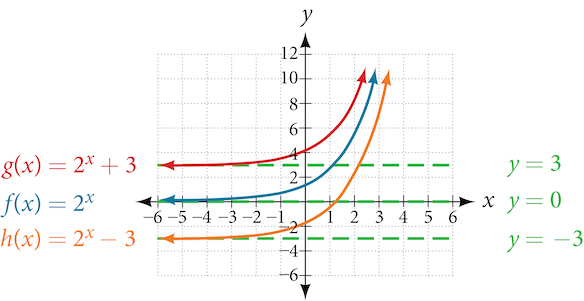
Observe the results of shifting vertically:
を縦に移した結果を見よう。
• The domain, remains unchanged.• When the function is shifted up units to The y-intercept shifts up units to The asymptote shifts up units to The range becomes • When the function is shifted down units to The y-intercept shifts down units to The asymptote also shifts down units to The range becomes
・定義域 は変わらない。・この関数を上に 単位移して にすると、y切片は上に 単位移って になる。漸近線は上に 単位移って になる。値域は になる。・この関数を下に 単位移して にすると、y切片は下に 単位移って になる。漸近線も下に 単位移って になる。値域は になる。
Graphing a Horizontal Shift横の移動のグラフを描く
The next transformation occurs when we add a constant to the input of the parent function giving us a horizontal shift units in the opposite direction of the sign. For example, if we begin by graphing the parent function we can then graph two horizontal shifts alongside it, using the shift left, and the shift right, Both horizontal shifts are shown in Figure 6.
次の変形は、親関数 の入力に定数 を足したときに起こり、符号と逆の向きに 単位の横の移動になる。たとえば、まず親関数 のグラフを描き、その隣に二つの横の移動のグラフを描ける。 を使って左への移動 を、そして右への移動 を描く。二つの横の移動を図6に示す。
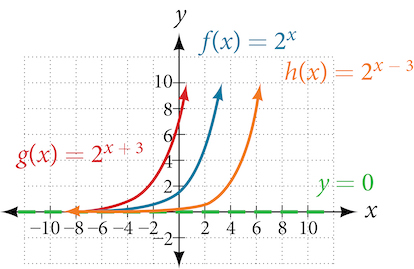
Observe the results of shifting horizontally:
を横に移した結果を見よう。
• The domain, remains unchanged.• The asymptote, remains unchanged.• The y-intercept shifts such that: When the function is shifted left units to the y-intercept becomes This is because so the initial value of the function is When the function is shifted right units to the y-intercept becomes Again, see that so the initial value of the function is
・定義域 は変わらない。・漸近線 は変わらない。・y切片は次のように移る。この関数を左に 単位移して にすると、y切片は になる。これは なので、この関数の初期値が になるからである。この関数を右に 単位移して にすると、y切片は になる。ここでも なので、この関数の初期値は である。
Shifts of the Parent Function 基本となるグラフの平行移動
Shifts of the Parent Function f(x) = b x 親関数 f(x) = b x の移動
For any constants and the function shifts the parent function
任意の定数 と について、関数 は親関数 を次のように移す。
• vertically units, in the same direction of the sign of • horizontally units, in the opposite direction of the sign of • The y-intercept becomes • The horizontal asymptote becomes • The range becomes • The domain, remains unchanged.
・ の符号と同じ向きに、縦に 単位。・ の符号と逆の向きに、横に 単位。・y切片は になる。・水平漸近線は になる。・値域は になる。・定義域 は変わらない。
How To 手順
Given an exponential function with the form graph the translation.
の形の指数関数が与えられたとき、その平行移動のグラフを描く。
1. Draw the horizontal asymptote 2. Identify the shift as Shift the graph of left units if is positive, and right units if is negative.3. Shift the graph of up units if is positive, and down units if is negative.4. State the domain, the range, and the horizontal asymptote
1. 水平漸近線 を描く。2. 移動を と見分ける。 が正なら のグラフを左に 単位、 が負なら右に 単位移す。3. が正なら のグラフを上に 単位、 が負なら下に 単位移す。4. 定義域 、値域 、水平漸近線 を答える。
Example 2例2
Graphing a Shift of an Exponential Function指数関数を移したグラフを描く
Graph State the domain, range, and asymptote.
のグラフを描け。定義域、値域、漸近線を答えよ。
Solution 解答
We have an exponential equation of the form with and
、、 である の形の指数の式がある。
Draw the horizontal asymptote , so draw
水平漸近線 を描く。すなわち を描く。
Identify the shift as so the shift is
移動を と見分ける。よって移動は である。
Shift the graph of left 1 units and down 3 units.
のグラフを左に1単位、下に3単位移す。
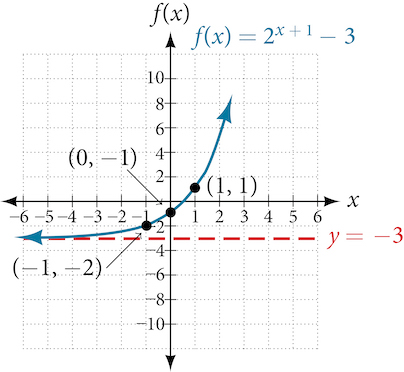
The domain is the range is the horizontal asymptote is
定義域は 、値域は 、水平漸近線は である。
Try It #2やってみよう2
Graph State domain, range, and asymptote.
のグラフを描け。定義域、値域、漸近線を答えよ。
How To 手順
Given an equation of the form for use a graphing calculator to approximate the solution.
について の形の式が与えられたとき、グラフ電卓を使ってその解を近似する。
• Press [Y=]. Enter the given exponential equation in the line headed “Y1=”.• Enter the given value for in the line headed “Y2=”.• Press [WINDOW]. Adjust the y-axis so that it includes the value entered for “Y2=”.• Press [GRAPH] to observe the graph of the exponential function along with the line for the specified value of • To find the value of we compute the point of intersection. Press [2ND] then [CALC]. Select “intersect” and press [ENTER] three times. The point of intersection gives the value of x for the indicated value of the function.
・[Y=] を押す。「Y1=」の行に、与えられた指数の式を入れる。・「Y2=」の行に、与えられた の値を入れる。・[WINDOW] を押す。「Y2=」に入れた値が入るように y軸を調える。・[GRAPH] を押して、指数関数のグラフと、指定した の値の直線を見る。・ の値を求めるために、交点を計算する。[2ND] を押してから [CALC] を押す。「intersect」を選び、[ENTER] を3回押す。交点が、指定した関数の値に対する x の値を与える。
Example 3例3
Approximating the Solution of an Exponential Equation指数の方程式の解を近似する
Solve graphically. Round to the nearest thousandth.
をグラフで解け。小数第三位まで丸めよ。
Solution 解答
Press [Y=] and enter next to Y1=. Then enter 42 next to Y2=. For a window, use the values –3 to 3 for and –5 to 55 for Press [GRAPH]. The graphs should intersect somewhere near
[Y=] を押し、Y1= の隣に を入れる。次に Y2= の隣に42を入れる。表示範囲は、 に–3から3、 に–5から55を使う。[GRAPH] を押す。二つのグラフは の近くで交わるはずである。
For a better approximation, press [2ND] then [CALC]. Select [5: intersect] and press [ENTER] three times. The x-coordinate of the point of intersection is displayed as 2.1661943. (Your answer may be different if you use a different window or use a different value for Guess?) To the nearest thousandth,
より良い近似を得るには、[2ND] を押してから [CALC] を押す。[5: intersect] を選び、[ENTER] を3回押す。交点の x座標が2.1661943と表示される。(違う表示範囲を使ったり、Guess? に違う値を使ったりすると、答えが違うことがある。)小数第三位まで求めると である。
Try It #3やってみよう3
Solve graphically. Round to the nearest thousandth.
をグラフで解け。小数第三位まで丸めよ。
Graphing a Stretch or Compression伸長や圧縮のグラフを描く
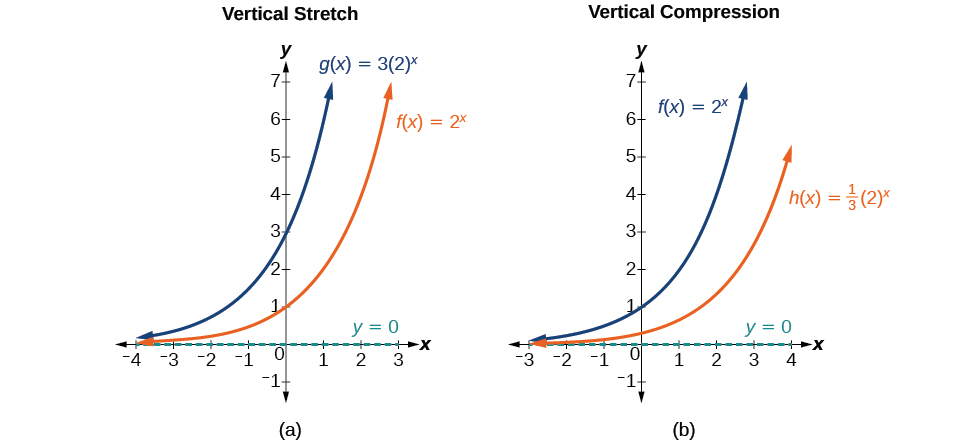
While horizontal and vertical shifts involve adding constants to the input or to the function itself, a stretch or compression occurs when we multiply the parent function by a constant For example, if we begin by graphing the parent function we can then graph the stretch, using to get as shown on the left in Figure 8, and the compression, using to get as shown on the right in Figure 8.
横と縦の移動が入力や関数そのものに定数を足すのに対し、伸長や圧縮は親関数 に定数 を掛けたときに起こる。たとえば、まず親関数 のグラフを描き、次に を使って伸長 のグラフを描ける。これは図8の左に示す。 を使った圧縮 は図8の右に示す。
Stretches and Compressions of the Parent Function 基本となるグラフの拡大・縮小
Stretches and Compressions of the Parent Function 親関数 の伸長と圧縮
For any factor the function
任意の倍率 について、関数 は次のとおりである。
• is stretched vertically by a factor of if • is compressed vertically by a factor of if • has a y-intercept of • has a horizontal asymptote at a range of and a domain of which are unchanged from the parent function.
・ なら、縦に 倍に伸ばされる。・ なら、縦に 倍に縮められる。・y切片は である。・ に水平漸近線、値域 、定義域 を持ち、これらは親関数から変わらない。
Example 4例4
Graphing the Stretch of an Exponential Function指数関数を伸ばしたグラフを描く
Sketch a graph of State the domain, range, and asymptote.
のグラフの概形を描け。定義域、値域、漸近線を答えよ。
Solution 解答
Before graphing, identify the behavior and key points on the graph.
グラフを描く前に、ふるまいとグラフの要点を見分ける。
• Since is between zero and one, the left tail of the graph will increase without bound as decreases, and the right tail will approach the x-axis as increases.• Since the graph of will be stretched by a factor of • Create a table of points as shown in Table 4. Table 4• Plot the y-intercept, along with two other points. We can use and
・ は0と1のあいだなので、 が減るとグラフの左の裾は限りなく増え、 が増えると右の裾は x軸に近づく。・ なので、 のグラフは 倍に伸ばされる。・表4のように点の表を作る。 表4・y切片 と、ほかに二点を打つ。 と が使える。
Draw a smooth curve connecting the points, as shown in Figure 9.
図9のように、その点をつなぐ滑らかな曲線を描く。
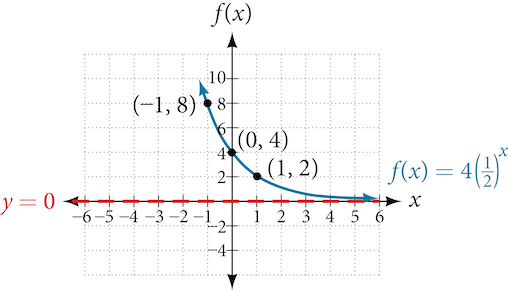
The domain is the range is the horizontal asymptote is
定義域は 、値域は 、水平漸近線は である。
Try It #4やってみよう4
Sketch the graph of State the domain, range, and asymptote.
のグラフの概形を描け。定義域、値域、漸近線を答えよ。
Graphing Reflections折り返しのグラフを描く
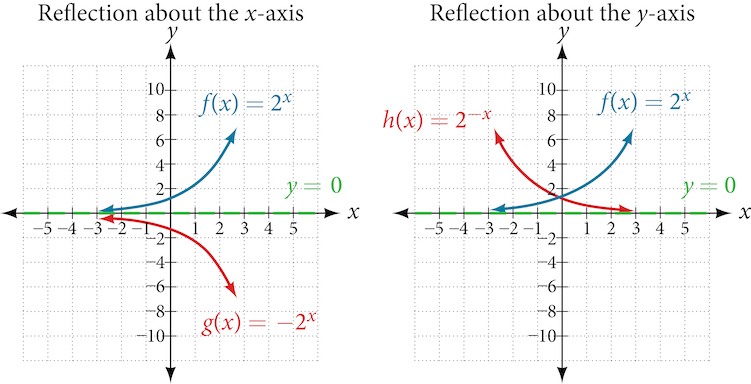
In addition to shifting, compressing, and stretching a graph, we can also reflect it about the x-axis or the y-axis. When we multiply the parent function by we get a reflection about the x-axis. When we multiply the input by we get a reflection about the y-axis. For example, if we begin by graphing the parent function we can then graph the two reflections alongside it. The reflection about the x-axis, is shown on the left side of Figure 10, and the reflection about the y-axis is shown on the right side of Figure 10.
グラフを移し、縮め、伸ばすほかに、x軸や y軸に関して折り返すこともできる。親関数 に を掛けると、x軸に関する折り返しになる。入力に を掛けると、y軸に関する折り返しになる。たとえば、まず親関数 のグラフを描き、その隣に二つの折り返しのグラフを描ける。x軸に関する折り返し を図10の左に、y軸に関する折り返し を図10の右に示す。
Reflections of the Parent Function 基本となるグラフの対称移動
Reflections of the Parent Function 親関数 の折り返し
The function
関数 は
• reflects the parent function about the x-axis.• has a y-intercept of • has a range of • has a horizontal asymptote at and domain of which are unchanged from the parent function.
・親関数 を x軸に関して折り返す。・y切片は である。・値域は である。・ に水平漸近線、定義域 を持ち、これらは親関数から変わらない。
The function
関数 は
• reflects the parent function about the y-axis.• has a y-intercept of a horizontal asymptote at a range of and a domain of which are unchanged from the parent function.
・親関数 を y軸に関して折り返す。・y切片 、 の水平漸近線、値域 、定義域 を持ち、これらは親関数から変わらない。
Example 5例5
Writing and Graphing the Reflection of an Exponential Function指数関数の折り返しを書き、そのグラフを描く
Find and graph the equation for a function, that reflects about the x-axis. State its domain, range, and asymptote.
を x軸に関して折り返した関数 の式を求め、そのグラフを描け。定義域、値域、漸近線を答えよ。
Solution 解答
Since we want to reflect the parent function about the x-axis, we multiply by to get, Next we create a table of points as in Table 5.
親関数 を x軸に関して折り返したいので、 に を掛けて を得る。次に表5のように点の表を作る。
Plot the y-intercept, along with two other points. We can use and
y切片 と、ほかに二点を打つ。 と が使える。
Draw a smooth curve connecting the points:
その点をつなぐ滑らかな曲線を描く。
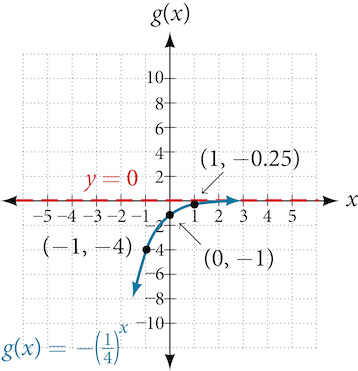
The domain is the range is the horizontal asymptote is
定義域は 、値域は 、水平漸近線は である。
Try It #5やってみよう5
Find and graph the equation for a function, that reflects about the y-axis. State its domain, range, and asymptote.
を y軸に関して折り返した関数 の式を求め、そのグラフを描け。定義域、値域、漸近線を答えよ。
Summarizing Translations of the Exponential Function指数関数の平行移動をまとめる
Now that we have worked with each type of translation for the exponential function, we can summarize them in Table 6 to arrive at the general equation for translating exponential functions.
指数関数の平行移動の種類をひととおり扱ったので、表6にまとめて、指数関数を平行移動する一般の式にたどりつこう。
| Transformations of the Parent Function 親関数 の変形 | |
|---|---|
| Transformation変形 | Form形 |
| Shift Horizontally units to the left Vertically units up移動 横に左へ 単位 縦に上へ 単位 | |
| Stretch and Compress Stretch if Compression if 伸長と圧縮 なら伸長 なら圧縮 | |
| Reflect about the x-axisx軸に関する折り返し | |
| Reflect about the y-axisy軸に関する折り返し | |
| General equation for all transformationsすべての変形をまとめた一般の式 | |
Translations of Exponential Functions 指数関数のグラフの平行移動
A translation of an exponential function has the form
指数関数の平行移動は次の形をとる。
Where the parent function, is
ここで親関数 、 は
• shifted horizontally units to the left.• stretched vertically by a factor of if • compressed vertically by a factor of if • shifted vertically units.• reflected about the x-axis when
・横に左へ 単位移される。・ なら縦に 倍に伸ばされる。・ なら縦に 倍に縮められる。・縦に 単位移される。・ のとき x軸に関して折り返される。
Note the order of the shifts, transformations, and reflections follow the order of operations.
移動・変形・折り返しの順序は、計算の順序に従うことに注意せよ。
Example 6例6
Writing a Function from a Description記述から関数を書く
Write the equation for the function described below. Give the horizontal asymptote, the domain, and the range.
下に述べる関数の式を書け。水平漸近線、定義域、値域を答えよ。
• is vertically stretched by a factor of , reflected across the y-axis, and then shifted up units.
・ を縦に 倍に伸ばし、y軸に関して折り返し、そして上に 単位移す。
Solution 解答
We want to find an equation of the general form We use the description provided to find and
一般の形 の式を求めたい。与えられた記述を使って 、、、 を求める。
• We are given the parent function so • The function is stretched by a factor of , so • The function is reflected about the y-axis. We replace with to get: • The graph is shifted vertically 4 units, so
・親関数 が与えられているので である。・この関数は 倍に伸ばされるので である。・この関数は y軸に関して折り返される。 を に置き換えて を得る。・グラフは縦に4単位移されるので である。
Substituting in the general form we get,
一般の形に代入すると、次が得られる。
The domain is the range is the horizontal asymptote is
定義域は 、値域は 、水平漸近線は である。
Try It #6やってみよう6
Write the equation for function described below. Give the horizontal asymptote, the domain, and the range.
下に述べる関数の式を書け。水平漸近線、定義域、値域を答えよ。
• is compressed vertically by a factor of reflected across the x-axis and then shifted down units.
・ を縦に 倍に縮め、x軸に関して折り返し、そして下に 単位移す。
Media 教材
Access this online resource for additional instruction and practice with graphing exponential functions.
指数関数のグラフを描くことについての説明と練習をさらに求めるなら、次のオンライン教材にあたるとよい。
・指数関数のグラフを描く
Verbal言葉で答える問題
2. What is the advantage of knowing how to recognize transformations of the graph of a parent function algebraically?
2. 親関数のグラフの変形を代数的に見分けられると、どんな利点があるか。
Algebraic代数の問題
4. The graph of is reflected about the y-axis and compressed vertically by a factor of What is the equation of the new function, State its y-intercept, domain, and range.
4. のグラフを y軸に関して折り返し、縦に 倍に縮める。新しい関数 の式は何か。その y切片、定義域、値域を答えよ。
6. The graph of is shifted right units, stretched vertically by a factor of reflected about the x-axis, and then shifted downward units. What is the equation of the new function, State its y-intercept (to the nearest thousandth), domain, and range.
6. のグラフを右に 単位移し、縦に 倍に伸ばし、x軸に関して折り返し、そして下に 単位移す。新しい関数 の式は何か。その y切片(小数第三位まで)、定義域、値域を答えよ。
Graphicalグラフの問題
For the following exercises, graph the function and its reflection about the y-axis on the same axes, and give the y-intercept.
次の各問について、その関数と、それを y軸に関して折り返したもののグラフを同じ座標軸に描き、y切片を答えよ。
For the following exercises, graph each set of functions on the same axes.
次の各問について、各組の関数のグラフを同じ座標軸に描け。
12. and
12. 、、
For the following exercises, match each function with one of the graphs in Figure 12.
次の各問について、各関数を図12のグラフのどれかに対応させよ。
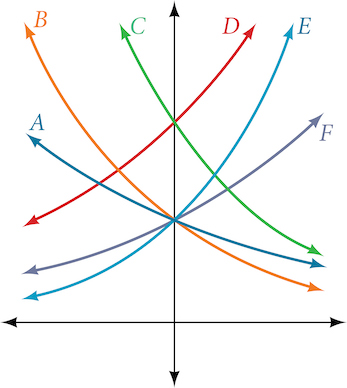
For the following exercises, use the graphs shown in Figure 13. All have the form
次の各問では、図13に示したグラフを使え。どれも の形である。
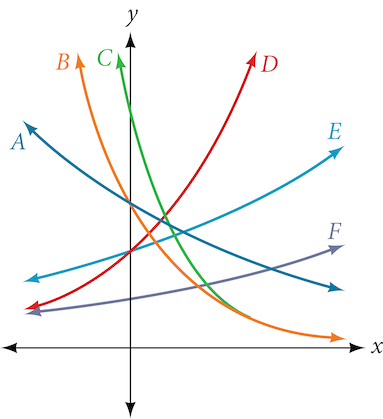
20. Which graph has the smallest value for
20. の値が最も小さいのはどのグラフか。
22. Which graph has the smallest value for
22. の値が最も小さいのはどのグラフか。
For the following exercises, graph the function and its reflection about the x-axis on the same axes.
次の各問について、その関数と、それを x軸に関して折り返したもののグラフを同じ座標軸に描け。
For the following exercises, graph the transformation of Give the horizontal asymptote, the domain, and the range.
次の各問について、 を変形したもののグラフを描け。水平漸近線、定義域、値域を答えよ。
For the following exercises, describe the end behavior of the graphs of the functions.
次の各問について、その関数のグラフの端のふるまいを述べよ。
For the following exercises, start with the graph of Then write a function that results from the given transformation.
次の各問では、 のグラフから始めよ。そして、与えられた変形の結果になる関数を書け。
32. Shift 4 units upward
32. を上に4単位移す
34. Shift 2 units left
34. を左に2単位移す
36. Reflect about the x-axis
36. を x軸に関して折り返す
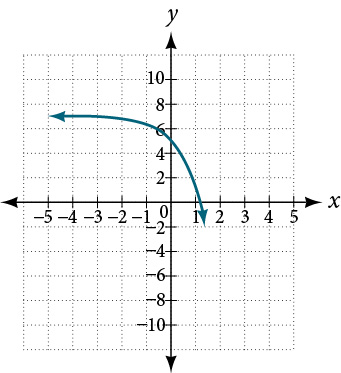
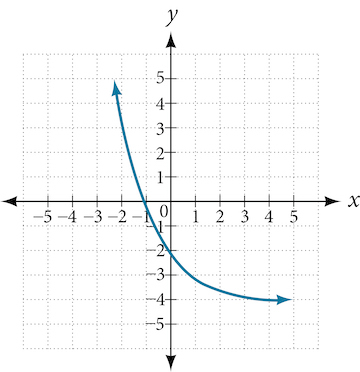
For the following exercises, each graph is a transformation of Write an equation describing the transformation.
次の各問について、各グラフは を変形したものである。その変形を述べる式を書け。
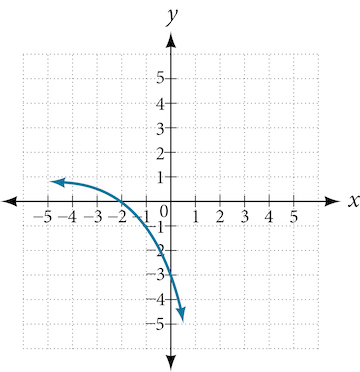
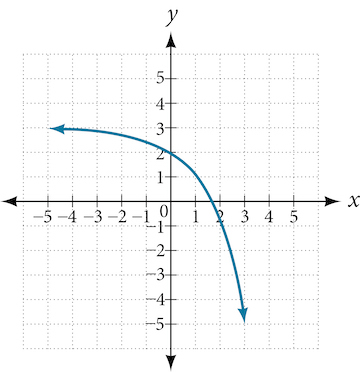
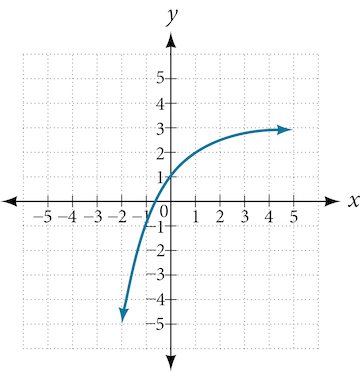
For the following exercises, find an exponential equation for the graph.
次の各問について、そのグラフの指数の式を求めよ。
Numeric数値の問題
Technology機器を使う問題
For the following exercises, use a graphing calculator to approximate the solutions of the equation. Round to the nearest thousandth.
次の各問について、グラフ電卓を使って方程式の解を近似せよ。小数第三位まで丸めよ。
Extensions発展問題
52. Prove the conjecture made in the previous exercise.
52. 前問で立てた予想を証明せよ。
54. Prove the conjecture made in the previous exercise.
54. 前問で立てた予想を証明せよ。