第7章思考と知能
7.6 The Source of Intelligence7.6 知能の源
Learning Objectives学習目標
By the end of this section, you will be able to:
この節を学び終えると、次のことができるようになる。
- Describe how genetics and environment affect intelligence遺伝と環境が知能にどのように影響するかを説明する
- Explain the relationship between IQ scores and socioeconomic statusIQ得点と社会経済的地位の関係を説明する
- Describe the difference between a learning disability and a developmental disorder学習障害と発達障害の違いを説明する
A young girl, born of teenage parents, lives with her grandmother in rural Mississippi. They have a very low income, but they do their best to get by with what they have. She learns to read when she is just 3 years old. As she grows older, she longs to live with her mother, who now resides in Wisconsin. She moves there at the age of 6 years. At 9 years of age, she is raped. During the next several years, several different male relatives repeatedly molest her. Her life unravels. She turns to drugs and sex to fill the deep, lonely void inside her. Her mother then sends her to Nashville to live with her father, who imposes strict behavioral expectations upon her, and over time, her wild life settles once again. She begins to experience success in school, and at 19 years old, becomes the youngest and first African-American female news anchor (“Dates and Events,” n.d.). The woman—Oprah Winfrey—goes on to become a media giant known for both her intelligence and her empathy.
英語のヒント
10代の両親のもとに生まれた幼い少女が、ミシシッピ州の田舎で祖母と暮らしている。二人の収入はごくわずかだが、手元にあるもので何とかやっていこうと精いっぱい努めている。少女はわずか3歳で字が読めるようになる。成長するにつれて、彼女は、今はウィスコンシン州に住む母親と暮らしたいと強く願うようになり、6歳のときにそこへ移る。9歳のとき、彼女はレイプされる。その後の数年間、何人もの男性の親族が、繰り返し彼女に性的虐待を加える。彼女の生活は崩れていく。心の奥にある深く孤独な空洞を埋めようと、彼女は薬物とセックスに走る。その後、母親は彼女を、父親と暮らさせるためにナッシュビルへ送る。父親は彼女に行動についての厳しい決まりを課し、時がたつにつれて、荒れていた生活は再び落ち着いていく。彼女は学校で成功を収めはじめ、19歳のとき、最年少で、しかもアフリカ系アメリカ人女性として初めてのニュースキャスターになる(“Dates and Events,” n.d.)。この女性、オプラ・ウィンフリーは、その後、知性と共感力の両方で知られるメディア界の巨人となる。
High Intelligence: Nature or Nurture?高い知能:生まれか育ちか
Where does high intelligence come from? Some researchers believe that intelligence is a trait inherited from a person’s parents. Scientists who research this topic typically use twin studies to determine the heritability of intelligence. The Minnesota Study of Twins Reared Apart is one of the most well-known twin studies. In this investigation, researchers found that identical twins raised together and identical twins raised apart exhibit a higher correlation between their IQ scores than siblings or fraternal twins raised together (Bouchard, Lykken, McGue, Segal, & Tellegen, 1990). The findings from this study reveal a genetic component to intelligence (Figure 7.16). At the same time, other psychologists believe that intelligence is shaped by a child’s developmental environment. If parents were to provide their children with intellectual stimuli from before they are born, it is likely that they would absorb the benefits of that stimulation, and it would be reflected in intelligence levels.
英語のヒント
高い知能はどこから来るのだろうか。一部の研究者は、知能は親から受け継がれる特性だと考えている。このテーマを研究する科学者は、知能の遺伝率を明らかにするために、たいてい双生児研究を用いる。「別々に育てられた双生児のミネソタ研究」は、最もよく知られた双生児研究の一つである。この調査で研究者たちは、一緒に育てられた一卵性双生児も、別々に育てられた一卵性双生児も、一緒に育てられたきょうだいや二卵性双生児に比べて、IQ得点のあいだに高い相関を示すことを見いだした(Bouchard, Lykken, McGue, Segal, & Tellegen, 1990)。この研究の知見は、知能に遺伝的な要素があることを明らかにしている(図7.16)。その一方で、知能は子どもの発達環境によって形づくられると考える心理学者もいる。もし親が、子どもが生まれる前から知的な刺激を与えるとしたら、子どもはその刺激の恩恵を吸収する可能性が高く、それは知能の水準に反映されるだろう。
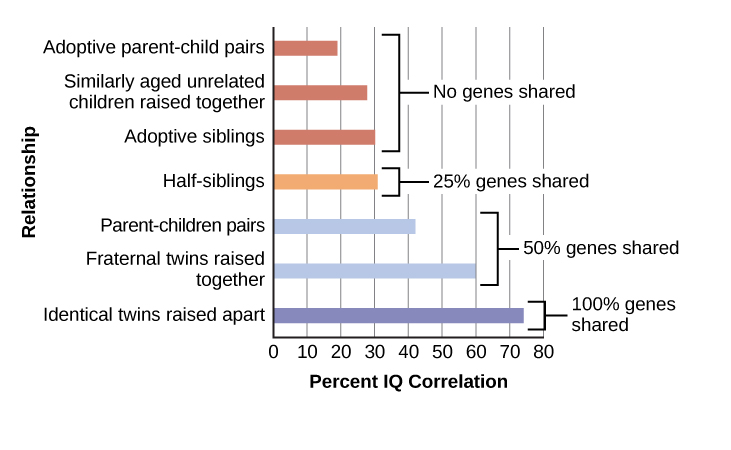

Figure 7.16図 7.16
The correlations of IQs of unrelated versus related persons reared apart or together suggest a genetic component to intelligence.
別々に、あるいは一緒に育てられた、血縁のない人どうしと血縁のある人どうしのIQの相関は、知能に遺伝的な要素があることを示唆している。
The reality is that aspects of each idea are probably correct. In fact, one study suggests that although genetics seem to be in control of the level of intelligence, the environmental influences provide both stability and change to trigger manifestation of cognitive abilities (Bartels, Rietveld, Van Baal, & Boomsma, 2002). Certainly, there are behaviors that support the development of intelligence, but the genetic component of high intelligence should not be ignored. As with all heritable traits, however, it is not always possible to isolate how and when high intelligence is passed on to the next generation.
英語のヒント
実際のところ、どちらの考えにも、おそらく正しい面がある。事実、ある研究は、知能の水準を左右しているのは遺伝であるように見えるものの、環境の影響が安定と変化の両方をもたらし、それが認知能力の発現の引き金になることを示唆している(Bartels, Rietveld, Van Baal, & Boomsma, 2002)。知能の発達を支える行動があるのは確かだが、高い知能の遺伝的な要素を無視すべきではない。ただし、遺伝しうるあらゆる特性と同じく、高い知能がどのように、いつ次の世代へ受け渡されるのかを切り分けて特定できるとは限らない。
Range of Reaction is the theory that each person responds to the environment in a unique way based on their genetic makeup. According to this idea, your genetic potential is a fixed quantity, but whether you reach your full intellectual potential is dependent upon the environmental stimulation you experience, especially in childhood. Think about this scenario: A couple adopts a child who has average genetic intellectual potential. They raise her in an extremely stimulating environment. What will happen to the couple’s new daughter? It is likely that the stimulating environment will improve her intellectual outcomes over the course of her life. But what happens if this experiment is reversed? If a child with an extremely strong genetic background is placed in an environment that does not stimulate him: What happens? Interestingly, according to a longitudinal study of highly gifted individuals, it was found that “the two extremes of optimal and pathological experience are both represented disproportionately in the backgrounds of creative individuals”; however, those who experienced supportive family environments were more likely to report being happy (Csikszentmihalyi & Csikszentmihalyi, 1993, p. 187).
英語のヒント
反応範囲とは、人はそれぞれ、自分の遺伝的な構成に基づいて、独自のしかたで環境に反応する、という理論である。この考え方によれば、遺伝的な潜在能力は一定の量に決まっているが、知的な潜在能力を十分に発揮できるかどうかは、とりわけ子ども時代に経験する環境からの刺激しだいである。次のような筋書きを考えてみよう。ある夫婦が、遺伝的には平均的な知的潜在能力を持つ子どもを養子に迎える。夫婦はその子を、きわめて刺激に富む環境で育てる。夫婦の新しい娘はどうなるだろうか。刺激に富む環境は、生涯を通じて彼女の知的な成果を高める可能性が高い。では、この実験を逆にしたらどうなるだろうか。きわめて優れた遺伝的背景を持つ子どもが、刺激を与えてくれない環境に置かれたら、どうなるのか。興味深いことに、非常に才能に恵まれた人々を対象とした縦断的研究によれば、「最適な経験と病的な経験という両極端は、どちらも創造的な人々の生い立ちに不釣り合いなほど多く現れている」ことが分かった。ただし、支えとなる家庭環境を経験した人の方が、幸せだと報告する可能性が高かった(Csikszentmihalyi & Csikszentmihalyi, 1993, p. 187)。
Another challenge to determining origins of high intelligence is the confounding nature of our human social structures. It is troubling to note that some ethnic groups perform better on IQ tests than others—and it is likely that the results do not have much to do with the quality of each ethnic group’s intellect. The same is true for socioeconomic status. Children who live in poverty experience more pervasive, daily stress than children who do not worry about the basic needs of safety, shelter, and food. These worries can negatively affect how the brain functions and develops, causing a dip in IQ scores. Mark Kishiyama and his colleagues determined that children living in poverty demonstrated reduced prefrontal brain functioning comparable to children with damage to the lateral prefrontal cortex (Kishiyama, Boyce, Jimenez, Perry, & Knight, 2009).
英語のヒント
高い知能の起源を突き止めるうえでのもう一つの難題は、私たち人間の社会構造が持つ交絡的な性質である。気がかりなことに、IQテストでほかの民族集団より成績のよい民族集団がある。そして、その結果は、それぞれの民族集団の知性の質とはあまり関係がない可能性が高い。社会経済的地位についても同じことが言える。貧困の中で暮らす子どもは、安全、住まい、食べ物という基本的な欲求について心配することのない子どもに比べて、より広範で日常的なストレスを経験する。こうした心配は、脳の働き方や発達のしかたに悪い影響を及ぼし、IQ得点の低下を引き起こしうる。マーク・キシヤマらは、貧困の中で暮らす子どもに、外側前頭前野に損傷のある子どもに匹敵するほどの前頭前野の機能低下が見られることを明らかにした(Kishiyama, Boyce, Jimenez, Perry, & Knight, 2009)。
The debate around the foundations and influences on intelligence exploded in 1969, when an educational psychologist named Arthur Jensen published the article “How Much Can We Boost I.Q. and Achievement” in the Harvard Educational Review. Jensen had administered IQ tests to diverse groups of students, and his results led him to the conclusion that IQ is determined by genetics. He also posited that intelligence was made up of two types of abilities: Level I and Level II. In his theory, Level I is responsible for rote memorization, whereas Level II is responsible for conceptual and analytical abilities. According to his findings, Level I remained consistent among the human race. Level II, however, exhibited differences among ethnic groups (Modgil & Routledge, 1987). Jensen’s most controversial conclusion was that Level II intelligence is prevalent among Asian people, then White people, then Black people. Robert Williams was among those who called out racial bias in Jensen’s results (Williams, 1970).
英語のヒント
知能の基盤と、知能に影響を与えるものをめぐる論争は、1969年に一気に燃え上がった。この年、教育心理学者のアーサー・ジェンセンが、『ハーバード・エデュケーショナル・レビュー』誌に「IQと学力はどれだけ伸ばせるか」という論文を発表したのである。ジェンセンはさまざまな集団の生徒にIQテストを実施しており、その結果から、IQは遺伝によって決まるという結論に至った。ジェンセンはまた、知能はレベルIとレベルIIという2種類の能力から成ると主張した。彼の理論では、レベルIは機械的な暗記を担い、レベルIIは概念的・分析的な能力を担う。彼の知見によれば、レベルIは人類全体で一定していた。しかし、レベルIIには民族集団のあいだで違いが見られた(Modgil & Routledge, 1987)。ジェンセンの結論の中で最も物議を醸したのは、レベルIIの知能が最も多く見られるのはアジア人で、次が白人、その次が黒人だというものだった。ロバート・ウィリアムズは、ジェンセンの結果に人種的バイアスがあると指摘して批判した人々の一人だった(Williams, 1970)。
Obviously, Jensen’s interpretation of his own data caused an intense response in a nation that continued to grapple with the effects of racism (Fox, 2012). While even some who took issue with Jensen's findings indicated that they did not detect overt racism in his work, Jensen himself made a number of racist statements during an interview with a White nationalist publication, American Renaissance. He indicated his belief that many Black people were not "educable up to a level for which there’s any economic demand," while also having a higher birth rate than other groups, which would lead to a shift in population and a deterioration of the nation (Taylor, 1992). However, Jensen’s ideas were not solitary or unique; rather, they represented one of many examples of psychologists asserting racial differences in IQ and cognitive ability. In fact, Rushton and Jensen (2005) reviewed three decades worth of research on the relationship between race and cognitive ability. Jensen’s belief in the inherited nature of intelligence and the validity of the IQ test to be the truest measure of intelligence are at the core of his conclusions.
英語のヒント
当然ながら、ジェンセンによる自分のデータの解釈は、人種差別がもたらした影響と格闘し続けていた国で、激しい反応を引き起こした(Fox, 2012)。ジェンセンの知見に異議を唱えた人の中にさえ、彼の研究にあからさまな人種差別は見いだせなかったと述べる人もいたが、ジェンセン自身は、白人民族主義の刊行物『アメリカン・ルネサンス』のインタビューで、人種差別的な発言を数多く行った。彼は、多くの黒人は「経済的な需要が少しでもある水準まで教育することはできない」うえに、ほかの集団より出生率も高く、それが人口構成の変化と国家の衰退につながるだろう、という考えを示した(Taylor, 1992)。しかし、ジェンセンの考えは孤立したものでも、彼だけのものでもなかった。むしろそれは、IQや認知能力に人種差があると主張する心理学者たちの、多くの例の一つだった。実際、ラシュトンとジェンセン(2005)は、人種と認知能力の関係についての30年分の研究を検討した。知能は遺伝によって受け継がれるということ、そしてIQテストが知能の最も正確な尺度として妥当であるということへのジェンセンの信念が、彼の結論の中核にある。
In a related story, parents of African American students filed a case against the State of California in 1979, because they believed that the testing method used to identify students with learning disabilities was culturally unfair as the tests were normed and standardized using White children (Larry P. v. Riles). The testing method used by the state disproportionately identified African American children as “mentally retarded," which resulted in many students being incorrectly classified. According to a summary of the case, Larry P. v. Riles:
英語のヒント
関連する話として、1979年、アフリカ系アメリカ人の生徒の親たちが、カリフォルニア州を相手に訴訟を起こした。学習障害のある生徒を判定するために使われていた検査方法は、白人の子どもをもとに規準化・標準化されていたため、文化的に不公平だと考えたからである(Larry P. v. Riles)。州が用いていた検査方法は、アフリカ系アメリカ人の子どもを不釣り合いに多く「精神遅滞」と判定し、その結果、多くの生徒が誤って分類されることになった。この「ラリー・P対ライルズ」裁判の要約には、次のように書かれている。
In violation of Title VI of the Civil Rights Act of 1964, the Rehabilitation Act of 1973, and the Education for All Handicapped Children Act of 1975, defendants have utilized standardized intelligence tests that are racially and culturally biased, have a discriminatory impact against Black children, and have not been validated for the purpose of essentially permanent placements of Black children into educationally dead-end, isolated, and stigmatizing classes for the so-called educable mentally retarded. Further, these federal laws have been violated by defendants' general use of placement mechanisms that, taken together, have not been validated and result in a large over-representation of Black children in the special E.M.R. classes. (Larry P. v. Riles, par. 6)英語のヒント
1964年公民権法第6編、1973年リハビリテーション法、1975年全障害児教育法に違反して、被告らは標準化された知能検査を用いてきた。その検査は、人種的・文化的に偏っており、黒人の子どもに対して差別的な影響を及ぼし、しかも、いわゆる教育可能な精神遅滞児のための、教育上の行き止まりで、隔離され、烙印を押すような学級へ黒人の子どもを事実上恒久的に配置するという目的について、妥当性が確認されていない。さらに、被告らは、配置の仕組みを全般的に用いることによっても、これらの連邦法に違反してきた。その仕組みは、全体として見れば妥当性が確認されておらず、特別なE.M.R.学級で黒人の子どもの占める割合が大幅に過剰になる結果を生んでいる。(Larry P. v. Riles, par. 6)
Once again, the limitations of intelligence testing were revealed.
英語のヒント
ここでも、知能検査の限界が明らかになった。