第7章思考と知能
7.5 Measures of Intelligence7.5 知能の測定
Learning Objectives学習目標
By the end of this section, you will be able to:
この節を学び終えると、次のことができるようになる。
- Explain how intelligence tests are developed知能検査がどのように開発されるかを説明する
- Describe the history of the use of IQ testsIQテストの使用の歴史を述べる
- Describe the purposes and benefits of intelligence testing知能検査の目的と利点を述べる
While you’re likely familiar with the term “IQ” and associate it with the idea of intelligence, what does IQ really mean? IQ stands for intelligence quotient and describes a score earned on a test designed to measure intelligence. You’ve already learned that there are many ways psychologists describe intelligence (or more aptly, intelligences). Similarly, IQ tests—the tools designed to measure intelligence—have been the subject of debate throughout their development and use.
英語のヒント
「IQ」という言葉にはおそらくなじみがあり、知能という考えと結びつけているだろう。では、IQとは本当は何を意味するのだろうか。IQは知能指数の略で、知能を測るために作られた検査で得た得点を表す。心理学者が知能(より適切に言えば、複数の知能)を記述するやり方がたくさんあることは、すでに学んだ。同じように、IQテスト、すなわち知能を測るために作られた道具も、開発され使われてきた歴史を通じて、ずっと議論の的になってきた。
When might an IQ test be used? What do we learn from the results, and how might people use this information? While there are certainly many benefits to intelligence testing, it is important to also note the limitations and controversies surrounding these tests. For example, IQ tests have sometimes been used as arguments in support of insidious purposes, such as the eugenics movement (Severson, 2011). The infamous Supreme Court Case, Buck v. Bell, legalized the forced sterilization of some people deemed “feeble-minded” through this type of testing, resulting in about 65,000 sterilizations (Buck v. Bell, 274 U.S. 200; Ko, 2016). Today, only professionals trained in psychology can administer IQ tests, and the purchase of most tests requires an advanced degree in psychology. Other professionals in the field, such as social workers and psychiatrists, cannot administer IQ tests. In this section, we will explore what intelligence tests measure, how they are scored, and how they were developed.
英語のヒント
IQテストは、どのようなときに使われうるのだろうか。その結果から何が分かり、人々はその情報をどのように使いうるのだろうか。知能検査に多くの利点があることは確かだが、こうした検査をめぐる限界や論争にも目を向けておくことが重要である。たとえばIQテストは、優生学運動のような悪質な目的を支持する論拠として使われることもあった(Severson, 2011)。悪名高い最高裁判所の「バック対ベル」裁判は、この種の検査によって「精神薄弱」とみなされた一部の人々への強制的な不妊手術を合法化し、その結果、約6万5000件の不妊手術が行われた(Buck v. Bell, 274 U.S. 200; Ko, 2016)。今日では、IQテストを実施できるのは心理学の訓練を受けた専門家だけであり、ほとんどの検査は、購入するのに心理学の上級学位が必要である。同じ分野のほかの専門職、たとえばソーシャルワーカーや精神科医は、IQテストを実施できない。この節では、知能検査が何を測るのか、どのように採点されるのか、そしてどのように開発されてきたのかを探っていく。
Measuring Intelligence知能を測定する
It seems that the human understanding of intelligence is somewhat limited when we focus on traditional or academic-type intelligence. How then, can intelligence be measured? And when we measure intelligence, how do we ensure that we capture what we’re really trying to measure (in other words, that IQ tests function as valid measures of intelligence)? In the following paragraphs, we will explore how intelligence tests were developed and the history of their use.
英語のヒント
伝統的な、あるいは学業的なタイプの知能に焦点を当てると、人間による知能の理解はいくぶん限られたものになるようである。では、知能はどのようにして測定できるのだろうか。そして知能を測定するとき、本当に測ろうとしているものをとらえていることを、どのように確かめればよいのだろうか(言い換えれば、IQテストが知能の妥当な測定手段として機能していることを、どう確かめるのか)。以下の段落では、知能検査の開発の経緯と、その使用の歴史を探っていく。
The IQ test has been synonymous with intelligence for over a century. In the late 1800s, Sir Francis Galton developed the first broad test of intelligence (Flanagan & Kaufman, 2004). Although he was not a psychologist, his contributions to the concepts of intelligence testing are still felt today (Gordon, 1995). Reliable intelligence testing (you may recall from earlier chapters that reliability refers to a test’s ability to produce consistent results) began in earnest during the early 1900s with a researcher named Alfred Binet (Figure 7.13). Binet was asked by the French government to develop an intelligence test to use on children to determine which ones might have difficulty in school; it included many verbally based tasks. American researchers soon realized the value of such testing. Louis Terman, a Stanford professor, modified Binet’s work by standardizing the administration of the test and tested thousands of different-aged children to establish an average score for each age. As a result, the test was normed and standardized, which means that the test was administered consistently to a large enough representative sample of the population that the range of scores resulted in a bell curve (bell curves will be discussed later). Standardization means that the manner of administration, scoring, and interpretation of results is consistent. Norming involves giving a test to a large population so data can be collected comparing groups, such as age groups. The resulting data provide norms, or referential scores, by which to interpret future scores. Norms are not expectations of what a given group should know but a demonstration of what that group does know. Norming and standardizing the test ensures that new scores are reliable. This new version of the test was called the Stanford-Binet Intelligence Scale (Terman, 1916). Remarkably, an updated version of this test is still widely used today.
英語のヒント
IQテストは、1世紀以上にわたって知能と同義とされてきた。1800年代後半、フランシス・ゴルトン卿が、最初の幅広い知能検査を開発した(Flanagan & Kaufman, 2004)。ゴルトンは心理学者ではなかったが、知能検査の概念に対する彼の貢献は、今日でもその影響が感じられる(Gordon, 1995)。信頼できる知能検査(前の章で学んだことを覚えているかもしれないが、信頼性とは、検査が一貫した結果を生み出す能力を指す)は、1900年代初頭に、アルフレッド・ビネーという研究者によって本格的に始まった(図7.13)。ビネーはフランス政府から、学校で困難を抱えるかもしれない子どもを見分けるために、子どもに使う知能検査を開発するよう依頼された。この検査には、言語に基づく課題が数多く含まれていた。アメリカの研究者たちは、こうした検査の価値にすぐに気づいた。スタンフォード大学の教授ルイス・ターマンは、検査の実施方法を標準化することでビネーの研究に手を加え、年齢ごとの平均得点を定めるために、さまざまな年齢の子ども何千人にも検査を行った。その結果、検査は規準化され標準化された。これは、得点の範囲がベル曲線(ベル曲線については後で論じる)を描くほど十分に大きな、母集団の代表標本に対して、検査が一貫したやり方で実施されたことを意味する。標準化とは、実施、採点、結果の解釈の仕方が一貫していることを意味する。規準化とは、年齢集団などの集団どうしを比較するデータを集められるように、大きな母集団に検査を実施することである。その結果得られたデータが規準、すなわち参照用の得点となり、今後の得点はそれに照らして解釈される。規準は、ある集団が何を知っているべきかについての期待ではなく、その集団が実際に何を知っているかを示すものである。検査を規準化し標準化することで、新しい得点の信頼性が確保される。この新しい版の検査は、スタンフォード・ビネー知能尺度と呼ばれた(Terman, 1916)。注目すべきことに、この検査の改訂版は今日でも広く使われている。
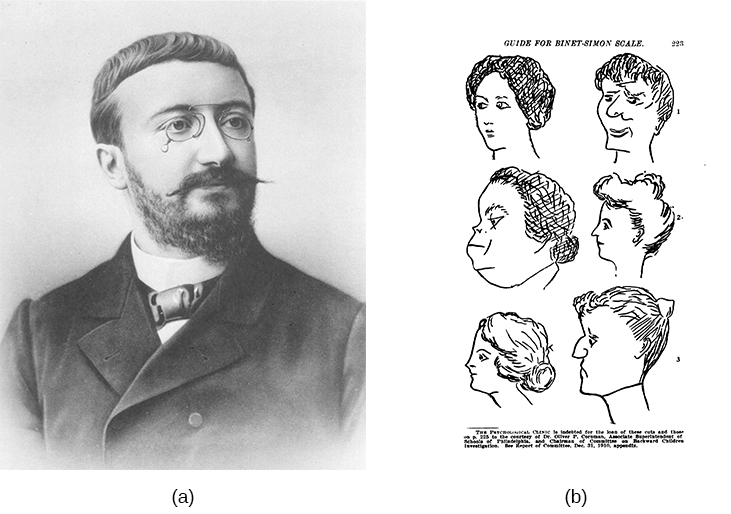

Figure 7.13図 7.13
French psychologist Alfred Binet helped to develop intelligence testing. (b) This page is from a 1908 version of the Binet-Simon Intelligence Scale. Children being tested were asked which face, of each pair, was prettier.
(a)フランスの心理学者アルフレッド・ビネーは、知能検査の開発に貢献した。(b)このページは、1908年版のビネー・シモン知能尺度のものである。検査を受ける子どもたちは、それぞれの対のうち、どちらの顔がよりきれいかを尋ねられた。
In 1939, David Wechsler, a psychologist who spent part of his career working with World War I veterans, developed a new IQ test in the United States. Wechsler combined several subtests from other intelligence tests used between 1880 and World War I. These subtests tapped into a variety of verbal and nonverbal skills, because Wechsler believed that intelligence encompassed “the global capacity of a person to act purposefully, to think rationally, and to deal effectively with his environment” (Wechsler, 1958, p. 7). He named the test the Wechsler-Bellevue Intelligence Scale (Wechsler, 1981). This combination of subtests became one of the most extensively used intelligence tests in the history of psychology. Although its name was later changed to the Wechsler Adult Intelligence Scale (WAIS) and has been revised several times, the aims of the test remain virtually unchanged since its inception (Boake, 2002). Today, there are three intelligence tests credited to Wechsler, the Wechsler Adult Intelligence Scale-fourth edition (WAIS-IV), the Wechsler Intelligence Scale for Children (WISC-V), and the Wechsler Preschool and Primary Scale of Intelligence—IV (WPPSI-IV) (Wechsler, 2012). These tests are used widely in schools and communities throughout the United States, and they are periodically normed and standardized as a means of recalibration. As a part of the recalibration process, the WISC-V was given to thousands of children across the country, and children taking the test today are compared with their same-age peers (Figure 7.13).
英語のヒント
1939年、キャリアの一部を第一次世界大戦の退役軍人とかかわる仕事に費やした心理学者デイヴィッド・ウェクスラーが、アメリカで新しいIQテストを開発した。ウェクスラーは、1880年から第一次世界大戦までのあいだに使われていたほかの知能検査から、いくつかの下位検査を組み合わせた。これらの下位検査は、さまざまな言語的・非言語的技能をとらえるものだった。ウェクスラーが、知能には「目的をもって行動し、合理的に考え、自分の環境に効果的に対処する、人の総合的な能力」が含まれると考えていたからである(Wechsler, 1958, p. 7)。彼はこの検査をウェクスラー・ベルビュー知能尺度と名づけた(Wechsler, 1981)。この下位検査の組み合わせは、心理学の歴史の中で最も広く使われた知能検査の一つとなった。その名前は後にウェクスラー成人知能尺度(WAIS)に変わり、何度か改訂もされてきたが、検査のねらいは誕生以来ほとんど変わっていない(Boake, 2002)。今日、ウェクスラーの作とされる知能検査は三つある。ウェクスラー成人知能尺度第4版(WAIS-IV)、ウェクスラー児童用知能尺度(WISC-V)、ウェクスラー幼児用知能尺度第4版(WPPSI-IV)である(Wechsler, 2012)。これらの検査はアメリカ全土の学校や地域社会で広く使われており、再較正の手段として、定期的に規準化と標準化が行われている。再較正の過程の一環として、WISC-Vは全国の何千人もの子どもに実施され、今日この検査を受ける子どもは、同じ年齢の仲間と比べられる(図7.13)。
The WISC-V is composed of 14 subtests, which comprise five indices, which then render an IQ score. The five indices are Verbal Comprehension, Visual Spatial, Fluid Reasoning, Working Memory, and Processing Speed. When the test is complete, individuals receive a score for each of the five indices and a Full Scale IQ score. The method of scoring reflects the understanding that intelligence is comprised of multiple abilities in several cognitive realms and focuses on the mental processes that the child used to arrive at their answers to each test item.
英語のヒント
WISC-Vは14の下位検査から成り、それらが五つの指標を構成し、さらにその指標からIQ得点が算出される。五つの指標とは、言語理解、視空間、流動性推理、ワーキングメモリー、処理速度である。検査を終えると、受検者は五つの指標それぞれの得点と、全検査IQの得点を受け取る。この採点方法は、知能はいくつかの認知領域にまたがる複数の能力から成るという理解を反映しており、また、子どもが各検査項目の答えにたどり着くために用いた心的過程に焦点を当てている。
Interestingly, the periodic recalibrations have led to an observation known as the Flynn effect. Named after James Flynn, who was among the first to describe this trend, the Flynn effect refers to the observation that each generation has a significantly higher IQ than the last. Flynn himself argues, however, that increased IQ scores do not necessarily mean that younger generations are more intelligent per se (Flynn, Shaughnessy, & Fulgham, 2012).
英語のヒント
興味深いことに、定期的な再較正は、フリン効果として知られる観察をもたらした。フリン効果は、この傾向を最初に記述した人々の一人であるジェームズ・フリンにちなんで名づけられたもので、各世代のIQが前の世代よりも著しく高いという観察を指す。しかしフリン自身は、IQ得点が上がったからといって、若い世代がそれ自体としてより知能が高いということには必ずしもならない、と論じている(Flynn, Shaughnessy, & Fulgham, 2012)。
Ultimately, we are still left with the question of how valid intelligence tests are. Certainly, the most modern versions of these tests tap into more than verbal competencies, yet the specific skills that should be assessed in IQ testing, the degree to which any test can truly measure an individual’s intelligence, and the use of the results of IQ tests are still issues of debate (Gresham & Witt, 1997; Flynn, Shaughnessy, & Fulgham, 2012; Richardson, 2002; Schlinger, 2003).
英語のヒント
結局のところ、知能検査がどれほど妥当なのかという問いは、依然として残されたままである。確かに、こうした検査の最新の版は、言語的な能力以外のものもとらえている。しかし、IQテストでどのような技能を評価すべきか、どんな検査であれ個人の知能をどの程度本当に測定できるのか、そしてIQテストの結果をどう使うのか、といった点は、今も議論の的である(Gresham & Witt, 1997; Flynn, Shaughnessy, & Fulgham, 2012; Richardson, 2002; Schlinger, 2003)。