第7章思考と知能
7.1 What Is Cognition?7.1 認知とは何か
Learning Objectives学習目標
By the end of this section, you will be able to:
この節を学び終えると、次のことができるようになる。
- Describe cognition認知について説明する
- Distinguish concepts and prototypes概念とプロトタイプを区別する
- Explain the difference between natural and artificial concepts自然概念と人工概念の違いを説明する
- Describe how schemata are organized and constructedスキーマがどのように整理され、組み立てられるかを説明する
Imagine all of your thoughts as if they were physical entities, swirling rapidly inside your mind. How is it possible that the brain is able to move from one thought to the next in an organized, orderly fashion? The brain is endlessly perceiving, processing, planning, organizing, and remembering—it is always active. Yet, you don’t notice most of your brain’s activity as you move throughout your daily routine. This is only one facet of the complex processes involved in cognition. Simply put, cognition is thinking, and it encompasses the processes associated with perception, knowledge, problem solving, judgment, language, and memory. Scientists who study cognition are searching for ways to understand how we integrate, organize, and utilize our conscious cognitive experiences without being aware of all of the unconscious work that our brains are doing (for example, Kahneman, 2011).
英語のヒント
自分の考えのすべてが、まるで物理的な実体であるかのように、心の中で目まぐるしく渦を巻いているところを想像してみよう。脳が、整然と秩序立ったやり方で一つの考えから次の考えへと移っていけるのは、どうしてなのだろうか。脳は絶えず知覚し、処理し、計画し、整理し、記憶している。脳はいつも活動しているのである。それでも、日々の決まった生活を送るあいだ、あなたは脳の活動の大部分に気づいていない。これは、認知にかかわる複雑な過程の一側面にすぎない。簡単に言えば、認知とは考えることであり、知覚、知識、問題解決、判断、言語、記憶に関連する過程を含んでいる。認知を研究する科学者たちは、私たちが、脳が行っている無意識の働きのすべてに気づくことなく、意識的な認知経験をどのように統合し、整理し、利用しているのかを理解する方法を探っている(たとえばKahneman, 2011)。
Cognition認知
Upon waking each morning, you begin thinking—contemplating the tasks that you must complete that day. In what order should you run your errands? Should you go to the bank, the cleaners, or the grocery store first? Can you get these things done before you head to class or will they need to wait until school is done? These thoughts are one example of cognition at work. Exceptionally complex, cognition is an essential feature of human consciousness, yet not all aspects of cognition are consciously experienced.
英語のヒント
毎朝、目を覚ますとすぐに、あなたは考えはじめる。その日に済ませなければならないことを、あれこれ思いめぐらすのである。用事はどんな順番で片づけるべきだろうか。まず銀行に行くべきか、クリーニング店か、それとも食料品店か。授業に向かう前にこうした用事を済ませられるだろうか、それとも学校が終わるまで待たなければならないだろうか。こうした考えは、認知が働いている一つの例である。認知はきわめて複雑であり、人間の意識に欠かせない特徴であるが、認知のすべての側面が意識的に経験されるわけではない。
Cognitive psychology is the field of psychology dedicated to examining how people think. It attempts to explain how and why we think the way we do by studying the interactions among human thinking, emotion, creativity, language, and problem solving, in addition to other cognitive processes. Cognitive psychologists strive to determine and measure different types of intelligence, why some people are better at problem solving than others, and how emotional intelligence affects success in the workplace, among countless other topics. They also sometimes focus on how we organize thoughts and information gathered from our environments into meaningful categories of thought, which will be discussed later.
英語のヒント
認知心理学は、人がどのように考えるのかを調べることに力を注ぐ心理学の分野である。認知心理学は、ほかの認知過程に加えて、人間の思考、感情、創造性、言語、問題解決のあいだの相互作用を研究することによって、私たちがどのように、そしてなぜ今のような考え方をするのかを説明しようとする。認知心理学者は数えきれないほど多くのテーマに取り組んでいるが、そのなかで、さまざまな種類の知能を特定して測定することや、ある人がほかの人よりも問題解決を得意とするのはなぜか、感情知能が職場での成功にどのように影響するのかを明らかにすることに努めている。認知心理学者はまた、私たちが環境から集めた考えや情報を、意味のある思考のカテゴリーへとどのように整理するのかに焦点を当てることもある。これについてはあとで論じる。
Concepts and Prototypes概念とプロトタイプ
The human nervous system is capable of handling endless streams of information. The senses serve as the interface between the mind and the external environment, receiving stimuli and translating it into nervous impulses that are transmitted to the brain. The brain then processes this information and uses the relevant pieces to create thoughts, which can then be expressed through language or stored in memory for future use. To make this process more complex, the brain does not gather information from external environments only. When thoughts are formed, the mind synthesizes information from emotions and memories (Figure 7.2). Emotion and memory are powerful influences on both our thoughts and behaviors.
英語のヒント
人間の神経系は、果てしなく続く情報の流れを扱うことができる。感覚は、心と外部環境とのあいだの接点として働き、刺激を受け取って、それを脳へ伝えられる神経インパルスに変換する。次に脳はこの情報を処理し、その中の関連する部分を使って考えをつくり出す。そうしてできた考えは、言語によって表現されたり、将来使うために記憶に蓄えられたりしうる。この過程をいっそう複雑にしているのは、脳が外部環境からだけ情報を集めているわけではないという点である。考えが形成されるとき、心は感情や記憶から来る情報を統合する(図7.2)。感情と記憶は、私たちの考えと行動の両方に強い影響を及ぼす。
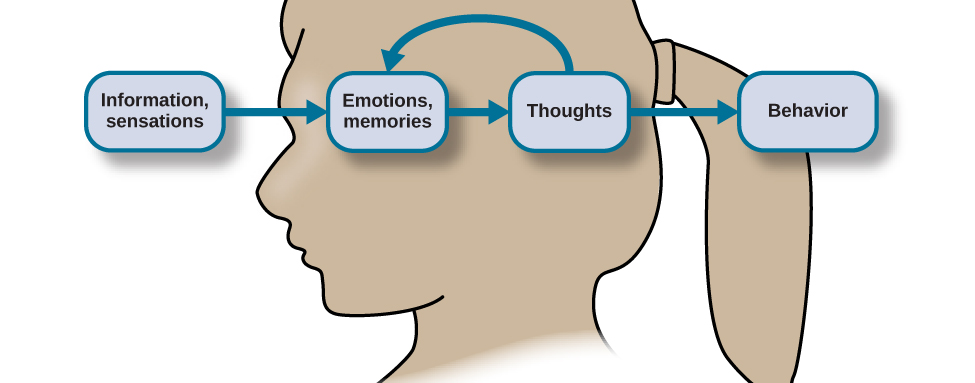

Figure 7.2図 7.2
Sensations and information are received by our brains, filtered through emotions and memories, and processed to become thoughts.
感覚と情報は脳に受け取られ、感情と記憶を通してふるいにかけられ、処理されて考えになる。
In order to organize this staggering amount of information, the mind has developed a "file cabinet" of sorts. The different files stored in the file cabinet are called concepts. Concepts are categories or groupings of linguistic information, images, ideas, or memories, such as life experiences. Concepts are, in many ways, big ideas that are generated by observing details, and categorizing and combining these details into cognitive structures. You use concepts to see the relationships among the different elements of your experiences and to keep the information in your mind organized and accessible.
英語のヒント
この驚くほど膨大な量の情報を整理するために、心は一種の「ファイル・キャビネット」を発達させてきた。そのファイル・キャビネットにしまわれているさまざまなファイルが、概念と呼ばれるものである。概念とは、言語的な情報、イメージ、考え、あるいは人生経験などの記憶の、カテゴリーまたはまとまりである。概念は多くの点で、細部を観察し、その細部を分類して組み合わせ、認知的な構造にまとめることによって生み出される大きな考えである。あなたは概念を使って、自分の経験を構成するさまざまな要素のあいだの関係を見てとり、また心の中の情報を、整理されていて取り出しやすい状態に保っている。
Concepts are informed by our semantic memory (you will learn more about semantic memory in a later chapter) and are present in every aspect of our lives; however, one of the easiest places to notice concepts is inside a classroom, where they are discussed explicitly. When you study United States history, for example, you learn about more than just individual events that have happened in America’s past. You absorb a large quantity of information by listening to and participating in discussions, examining maps, and reading first-hand accounts of people’s lives. Your brain analyzes these details and develops an overall understanding of American history. In the process, your brain gathers details that inform and refine your understanding of related concepts such as war, the judicial system, and voting rights and laws.
英語のヒント
概念は意味記憶(意味記憶については後の章でさらに詳しく学ぶ)に基づいて形づくられ、私たちの生活のあらゆる面に存在している。しかし、概念に最も気づきやすい場所の一つは教室の中であり、そこでは概念がはっきりと論じられる。たとえばアメリカ合衆国の歴史を学ぶとき、あなたが学んでいるのは、アメリカの過去に起こった個々の出来事だけではない。議論を聞いたり議論に参加したり、地図を調べたり、人々の暮らしについて当事者が記した記録を読んだりすることで、大量の情報を吸収しているのである。脳はこうした細部を分析し、アメリカの歴史についての全体的な理解を築き上げていく。その過程で脳は、戦争、司法制度、投票権と投票に関する法律など、関連する概念についての理解を形づくり、磨きをかける細部を集めている。
Concepts can be complex and abstract, like justice, or more concrete, like types of birds. In psychology, for example, Piaget’s stages of development are abstract concepts. Some concepts, like tolerance, are agreed upon by many people, because they have been used in various ways over many years. Other concepts, like the characteristics of your ideal friend or your family’s birthday traditions, are personal and individualized. In this way, concepts touch every aspect of our lives, from our many daily routines to the guiding principles behind the way governments function.
英語のヒント
概念には、正義のように複雑で抽象的なものもあれば、鳥の種類のように、より具体的なものもある。たとえば心理学では、ピアジェの発達段階は抽象的な概念である。寛容のように、長年にわたってさまざまな形で使われてきたために、多くの人のあいだで合意が得られている概念もある。ほかの概念、たとえば理想の友人の特徴や家族の誕生日の習わしなどは、個人的なもので、人それぞれに異なる。このように概念は、数多くの日々の決まりごとから、政府が機能するしくみの背後にある指導原理に至るまで、私たちの生活のあらゆる面にかかわっている。
Another technique used by your brain to organize information is the identification of prototypes for the concepts you have developed. A prototype is the best example or representation of a concept. For example, what comes to your mind when you think of a dog? Most likely your early experiences with dogs will shape what you imagine. If your first pet was a Golden Retriever, there is a good chance that this would be your prototype for the category of dogs.
英語のヒント
脳が情報を整理するために使うもう一つの方法は、自分が形成してきた概念について、そのプロトタイプを特定することである。プロトタイプとは、ある概念の最もよい例、またはその概念を最もよく表すものである。たとえば、犬のことを考えるとき、あなたの頭には何が浮かぶだろうか。おそらく、犬と接した早い時期の経験が、あなたの思い浮かべるものを形づくるだろう。最初のペットがゴールデン・レトリバーだったなら、それが犬というカテゴリーについてのあなたのプロトタイプになっている可能性が高いだろう。