第7章思考と知能
7.4 What Are Intelligence and Creativity?7.4 知能と創造性とは何か
Learning Objectives学習目標
By the end of this section, you will be able to:
この節を学び終えると、次のことができるようになる。
- Define intelligence知能を定義する
- Explain the triarchic theory of intelligence知能の鼎立理論を説明する
- Identify the difference between intelligence theories知能理論どうしの違いを見分ける
- Explain emotional intelligence感情知能を説明する
- Define creativity創造性を定義する
A four-and-a-half-year-old boy sits at the kitchen table with his father, who is reading a new story aloud to him. He turns the page to continue reading, but before he can begin, the boy says, “Wait, Daddy!” He points to the words on the new page and reads aloud, “Go, Pig! Go!” The father stops and looks at his son. “Can you read that?” he asks. “Yes, Daddy!” And he points to the words and reads again, “Go, Pig! Go!”
英語のヒント
4歳半の男の子が、キッチンのテーブルで父親と一緒に座っている。父親は新しい物語を声に出して読み聞かせている。父親がページをめくって続きを読もうとするが、読みはじめる前に男の子が「待って、パパ!」と言う。男の子は新しいページの言葉を指さし、「行け、ブタ! 行け!」と声に出して読む。父親は読むのをやめて息子を見る。「それ、読めるの?」と父親が聞く。「うん、パパ!」そして男の子はまた言葉を指さし、「行け、ブタ! 行け!」と読む。
This father was not actively teaching his son to read, even though the child constantly asked questions about letters, words, and symbols that they saw everywhere: in the car, in the store, on the television. The dad wondered about what else his son might understand and decided to try an experiment. Grabbing a sheet of blank paper, he wrote several simple words in a list: mom, dad, dog, bird, bed, truck, car, tree. He put the list down in front of the boy and asked him to read the words. “Dad, dog, bird, bed, truck, car, tree,” he read, slowing down to carefully pronounce bird and truck. Then, “Did I do it, Daddy?” “You sure did! That is very good.” The father gave his little boy a warm hug and continued reading the story about the pig, all the while wondering if his son’s abilities were an indication of exceptional intelligence or simply a normal pattern of linguistic development. Like the father in this example, psychologists have wondered what constitutes intelligence and how it can be measured.
英語のヒント
息子は、車の中でも、店の中でも、テレビでも、至るところで目にする文字や言葉、記号についていつも質問していたが、それでもこの父親は、息子に字の読み方を積極的に教えていたわけではなかった。父親は、息子がほかに何を理解しているのだろうかと考え、ある実験をしてみることにした。白紙を1枚さっと手に取り、簡単な単語をいくつか書き並べた。mom、dad、dog、bird、bed、truck、car、tree。父親はそのリストを男の子の前に置き、単語を読むように言った。「dad、dog、bird、bed、truck、car、tree」と男の子は読んだ。birdとtruckのところでは速度を落とし、注意深く発音した。それから男の子は「できた、パパ?」と聞いた。「もちろんできたよ! とても上手だ」。父親は小さな息子を温かく抱きしめ、ブタの物語の続きを読んだ。その間ずっと、息子のこの能力は並外れた知能の表れなのか、それとも単に言語発達の普通のパターンなのかと考えていた。この例の父親と同じように、心理学者たちも、知能とは何によって成り立っているのか、そして知能はどのように測定できるのかを考えてきた。
Classifying Intelligence知能の分類
What exactly is intelligence? The way that researchers have defined the concept of intelligence has been modified many times since the birth of psychology. British psychologist Charles Spearman believed intelligence consisted of one general factor, called g, which could be measured and compared among individuals. Spearman focused on the commonalities among various intellectual abilities and de-emphasized what made each unique. Long before modern psychology developed, however, ancient philosophers, such as Aristotle, held a similar view (Cianciolo & Sternberg, 2004).
英語のヒント
知能とは、正確にはいったい何だろうか。研究者たちが知能という概念を定義するやり方は、心理学の誕生以来、何度も修正されてきた。イギリスの心理学者チャールズ・スピアマンは、知能はgと呼ばれる一つの一般因子から成り、この因子は測定して個人のあいだで比較できると考えた。スピアマンは、さまざまな知的能力のあいだの共通点に焦点を当て、それぞれの能力を独自のものにしている点は重視しなかった。しかし、近代の心理学が発展するはるか前に、アリストテレスのような古代の哲学者たちも、同じような見方をしていた(Cianciolo & Sternberg, 2004)。
Other psychologists believe that instead of a single factor, intelligence is a collection of distinct abilities. In the 1940s, Raymond Cattell proposed a theory of intelligence that divided general intelligence into two components: crystallized intelligence and fluid intelligence (Cattell, 1963). Crystallized intelligence is characterized as acquired knowledge and the ability to retrieve it. When you learn, remember, and recall information, you are using crystallized intelligence. You use crystallized intelligence all the time in your coursework by demonstrating that you have mastered the information covered in the course. Fluid intelligence encompasses the ability to see complex relationships and solve problems. Navigating your way home after being detoured onto an unfamiliar route because of road construction would draw upon your fluid intelligence. Fluid intelligence helps you tackle complex, abstract challenges in your daily life, whereas crystallized intelligence helps you overcome concrete, straightforward problems (Cattell, 1963).
英語のヒント
一方、知能は単一の因子ではなく、互いに異なる能力の集まりだと考える心理学者もいる。1940年代、レイモンド・キャッテルは、一般知能を結晶性知能と流動性知能という二つの構成要素に分ける知能理論を提唱した(Cattell, 1963)。結晶性知能は、獲得された知識と、それを検索する能力として特徴づけられる。情報を学習し、覚え、思い出すとき、あなたは結晶性知能を使っている。授業の課題でも、授業で扱った情報を習得していることを示すという形で、あなたは絶えず結晶性知能を使っている。流動性知能は、複雑な関係を見抜き、問題を解決する能力を含む。道路工事のために見知らぬ道へ迂回させられた後で家までの道をたどるときには、流動性知能を頼りにすることになるだろう。流動性知能は日常生活の中で複雑で抽象的な課題に取り組むのを助け、それに対して結晶性知能は、具体的で単純な問題を乗り越えるのを助ける(Cattell, 1963)。
Other theorists and psychologists believe that intelligence should be defined in more practical terms. For example, what types of behaviors help you get ahead in life? Which skills promote success? Think about this for a moment. Being able to recite all of the presidents of the United States in order is an excellent party trick, but will knowing this make you a better person?
英語のヒント
ほかの理論家や心理学者は、知能はもっと実際的な観点から定義されるべきだと考えている。たとえば、どのような種類の行動が人生で成功するのに役立つだろうか。どのスキルが成功を後押しするだろうか。少しのあいだ、このことを考えてみよう。アメリカの歴代大統領を全員順番に暗唱できるのは、パーティーの余興としては見事な芸だが、それを知っていることで、あなたはよりよい人間になれるだろうか。
Robert Sternberg developed another theory of intelligence, which he titled the triarchic theory of intelligence because it sees intelligence as comprised of three parts (Sternberg, 1988): practical, creative, and analytical intelligence (Figure 7.12).
英語のヒント
ロバート・スタンバーグは別の知能理論を展開した。この理論は知能を三つの部分から成るものとみなすため、スタンバーグはこれを知能の鼎立理論と名づけた(Sternberg, 1988)。三つの部分とは、実践的知能、創造的知能、分析的知能である(図7.12)。
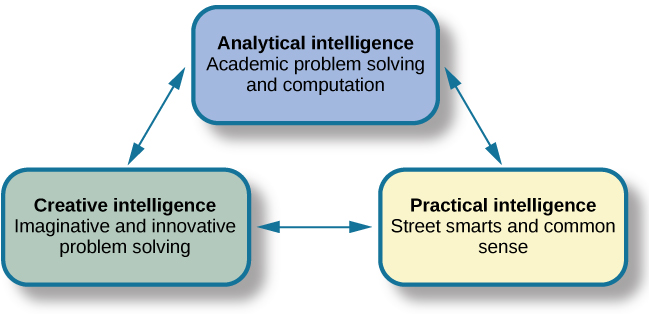

Figure 7.12図 7.12
Sternberg’s theory identifies three types of intelligence: practical, creative, and analytical.
スタンバーグの理論は、実践的知能、創造的知能、分析的知能という三種類の知能を挙げている。
Practical intelligence, as proposed by Sternberg, is sometimes compared to “street smarts.” Being practical means you find solutions that work in your everyday life by applying knowledge based on your experiences. This type of intelligence appears to be separate from traditional understanding of IQ; individuals who score high in practical intelligence may or may not have comparable scores in creative and analytical intelligence (Sternberg, 1988).
英語のヒント
スタンバーグが提唱した実践的知能は、「世渡りの知恵」にたとえられることがある。実践的であるとは、自分の経験に基づく知識を当てはめて、日常生活でうまくいく解決策を見つけることを意味する。この種類の知能は、IQについての従来の理解とは別のもののようである。実践的知能で高い得点をとる人が、創造的知能や分析的知能でも同程度の得点をとることもあれば、そうでないこともある(Sternberg, 1988)。
Analytical intelligence is closely aligned with academic problem solving and computations. Sternberg says that analytical intelligence is demonstrated by an ability to analyze, evaluate, judge, compare, and contrast. When reading a classic novel for literature class, for example, it is usually necessary to compare the motives of the main characters of the book or analyze the historical context of the story. In a science course such as anatomy, you must study the processes by which the body uses various minerals in different human systems. In developing an understanding of this topic, you are using analytical intelligence. When solving a challenging math problem, you would apply analytical intelligence to analyze different aspects of the problem and then solve it section by section.
英語のヒント
分析的知能は、学業上の問題解決や計算と密接に結びついている。スタンバーグによれば、分析的知能は、分析し、評価し、判断し、比較し、対比する能力によって示される。たとえば文学の授業で古典小説を読むときには、たいてい、その本の主要な登場人物たちの動機を比較したり、物語の歴史的背景を分析したりする必要がある。解剖学のような理科系の授業では、体がさまざまな器官系でいろいろなミネラルを使う過程を学ばなければならない。このテーマについての理解を深めていくとき、あなたは分析的知能を使っている。難しい数学の問題を解くときには、分析的知能を働かせて問題のさまざまな側面を分析し、それから部分ごとに解いていくことになるだろう。
Creative intelligence is marked by inventing or imagining a solution to a problem or situation. Creativity in this realm can include finding a novel solution to an unexpected problem or producing a beautiful work of art or a well-developed short story. Imagine for a moment that you are camping in the woods with some friends and realize that you’ve forgotten your camp coffee pot. The person in your group who figures out a way to successfully brew coffee for everyone would be credited as having higher creative intelligence.
英語のヒント
創造的知能の特徴は、問題や状況に対する解決策を考案したり想像したりすることにある。この領域での創造性には、予期しない問題に対して斬新な解決策を見つけることや、美しい芸術作品やよく練られた短編小説を生み出すことが含まれうる。少し想像してみよう。あなたは友人たちと森でキャンプをしていて、キャンプ用のコーヒーポットを忘れてきたことに気づく。グループの中で、全員分のコーヒーをうまくいれる方法を考え出した人は、創造的知能がより高いと評価されるだろう。
Multiple Intelligences Theory was developed by Howard Gardner, a Harvard psychologist and former student of Erik Erikson. In Gardner’s theory, each person possesses at least eight intelligences. The eight intelligences are linguistic intelligence, logical-mathematical intelligence, musical intelligence, bodily kinesthetic intelligence, spatial intelligence, interpersonal intelligence, intrapersonal intelligence, and naturalistic intelligence. Among cognitive psychologists, Gardner’s theory has been heavily criticized for lacking empirical evidence. However, educators continue to study and use Gardner’s theory, with some colleges even discussing how they integrate Gardner’s theory into their classrooms. Gottfredson describes one possible reason for the continued use of Gardner’s theory: “ . . . that there are multiple independent intelligences, suggesting that everyone can be smart in some way. This is, understandably, a very attractive idea in democratic societies” (2004).
英語のヒント
多重知能理論は、ハーバード大学の心理学者で、エリク・エリクソンの教え子でもあったハワード・ガードナーによって展開された。ガードナーの理論では、人はみな少なくとも八つの知能を持っている。八つの知能とは、言語的知能、論理数学的知能、音楽的知能、身体運動的知能、空間的知能、対人的知能、内省的知能、博物学的知能である。認知心理学者のあいだでは、ガードナーの理論は実証的な証拠を欠いているとして厳しく批判されてきた。しかし、教育者たちはガードナーの理論を研究し、使い続けており、ガードナーの理論を授業にどう取り入れているかを論じている大学さえある。ゴットフレッドソンは、ガードナーの理論が使われ続けている理由として考えられるものの一つを、次のように述べている。「……複数の独立した知能が存在するということであり、それは誰もが何らかの形で賢くありうることを示唆している。これは、無理もないことだが、民主的な社会ではきわめて魅力的な考えである」(2004)。
Gardner’s inter- and intrapersonal intelligences are often combined into a single type: emotional intelligence. Emotional intelligence encompasses the ability to understand the emotions of yourself and others, show empathy, understand social relationships and cues, and regulate your own emotions and respond in culturally appropriate ways (Parker, Saklofske, & Stough, 2009). People with high emotional intelligence typically have well-developed social skills. Some researchers, including Daniel Goleman, the author of Emotional Intelligence: Why It Can Matter More than IQ, argue that emotional intelligence is a better predictor of success than traditional intelligence (Goleman, 1995). However, emotional intelligence has been widely debated, with researchers pointing out inconsistencies in how it is defined and described, as well as questioning results of studies on a subject that is difficult to measure and study empirically (Locke, 2005; Mayer, Salovey, & Caruso, 2004).
英語のヒント
ガードナーの対人的知能と内省的知能は、しばしば感情知能という一つのタイプにまとめられる。感情知能には、自分や他者の感情を理解する能力、共感を示す能力、社会的な関係や手がかりを理解する能力、そして自分の感情を調整し、文化的に適切なやり方で反応する能力が含まれる(Parker, Saklofske, & Stough, 2009)。感情知能の高い人は、たいてい社会的スキルがよく発達している。『感情知能:なぜIQより重要になりうるのか』の著者ダニエル・ゴールマンをはじめとする一部の研究者は、感情知能は従来の知能よりもすぐれた成功の予測因子であると主張している(Goleman, 1995)。しかし、感情知能については広く議論されてきた。研究者たちは、その定義や記述のしかたに一貫性がないことを指摘するとともに、実証的に測定したり研究したりするのが難しいテーマについての研究結果に疑問を投げかけている(Locke, 2005; Mayer, Salovey, & Caruso, 2004)。
The most comprehensive theory of intelligence to date is the Cattell-Horn-Carroll (CHC) theory of cognitive abilities (Schneider & McGrew, 2018). In this theory, abilities are related and arranged in a hierarchy with general abilities at the top, broad abilities in the middle, and narrow (specific) abilities at the bottom. The narrow abilities are the only ones that can be directly measured; however, they are integrated within the other abilities. At the general level is general intelligence. Next, the broad level consists of general abilities such as fluid reasoning, short-term memory, and processing speed. Finally, as the hierarchy continues, the narrow level includes specific forms of cognitive abilities. For example, short-term memory would further break down into memory span and working memory capacity.
英語のヒント
現在までで最も包括的な知能理論は、認知能力についてのキャッテル=ホーン=キャロル(CHC)理論である(Schneider & McGrew, 2018)。この理論では、能力は互いに関連しあい、階層をなして配置されている。最上位に一般能力、中間に広範能力、最下位に限定(特定)能力が位置する。直接測定できるのは限定能力だけであるが、限定能力はほかの能力の中に組み込まれている。一般水準に位置するのは一般知能である。次に、広範水準は、流動性推論、短期記憶、処理速度といった全般的な能力から成る。最後に、階層をさらに下ると、限定水準には認知能力の特定の形が含まれる。たとえば短期記憶は、さらに記憶範囲とワーキングメモリ容量に分かれることになる。
Intelligence can also have different meanings and values in different cultures. If you live on a small island, where most people get their food by fishing from boats, it would be important to know how to fish and how to repair a boat. If you were an exceptional angler, your peers would probably consider you intelligent. If you were also skilled at repairing boats, your intelligence might be known across the whole island. Think about your own family’s culture. What values are important for Latinx families? Italian families? In Irish families, hospitality and telling an entertaining story are marks of the culture. If you are a skilled storyteller, other members of Irish culture are likely to consider you intelligent.
英語のヒント
知能は、文化によって異なる意味や価値を持つこともある。小さな島に住んでいて、そこではほとんどの人が船から魚をとって食料を得ているなら、魚のとり方や船の修理のしかたを知っていることが重要になるだろう。あなたが並外れた釣りの名人なら、仲間たちはおそらくあなたを知能が高いとみなすだろう。船の修理にも長けていれば、あなたの知能は島じゅうに知られるかもしれない。自分の家族の文化について考えてみよう。ラテン系の家族にとって大切な価値観は何だろうか。イタリア系の家族ではどうだろうか。アイルランド系の家族では、もてなしと面白い話をすることが、その文化のしるしである。あなたが話上手なら、アイルランド文化に属するほかの人々は、あなたを知能が高いとみなす可能性が高い。
Some cultures place a high value on working together as a collective. In these cultures, the importance of the group supersedes the importance of individual achievement. When you visit such a culture, how well you relate to the values of that culture exemplifies your cultural intelligence, sometimes referred to as cultural competence.
英語のヒント
集団として協力しあうことに高い価値を置く文化もある。そうした文化では、集団の重要性が個人の達成の重要性よりも優先される。そのような文化を訪れたとき、その文化の価値観にどれほどうまくなじめるかが、あなたの文化的知能を示す。文化的知能は、文化的コンピテンスと呼ばれることもある。