第7章思考と知能
What are Learning Disabilities?学習障害とは何か
Learning disabilities are cognitive disorders that affect different areas of cognition, particularly language or reading. It should be pointed out that learning disabilities are not the same thing as intellectual disabilities. Learning disabilities are considered specific neurological impairments rather than global intellectual or developmental disabilities. A person with a language disability has difficulty understanding or using spoken language, whereas someone with a reading disability, such as dyslexia, has difficulty processing what they are reading.
英語のヒント
学習障害とは、認知のさまざまな領域、とくに言語や読みに影響を及ぼす認知の障害である。指摘しておくべきなのは、学習障害は知的障害と同じものではないということである。学習障害は、全般的な知的障害や発達障害ではなく、特定の神経学的な機能障害とみなされている。言語の障害がある人は話し言葉を理解したり使ったりすることが難しく、一方、読字障害のような読みの障害がある人は、読んでいる内容を処理することが難しい。
Often, learning disabilities are not recognized until a child reaches school age. One confounding aspect of learning disabilities is that they most often affect children with average to above-average intelligence. In other words, the disability is specific to a particular area and not a measure of overall intellectual ability. At the same time, learning disabilities tend to exhibit comorbidity with other disorders, like attention-deficit hyperactivity disorder (ADHD). Anywhere between 30–70% of individuals with diagnosed cases of ADHD also have some sort of learning disability (Riccio, Gonzales, & Hynd, 1994). Let’s take a look at three examples of common learning disabilities: dysgraphia, dyslexia, and dyscalculia.
英語のヒント
学習障害は、子どもが学齢期に達するまで気づかれないことが多い。学習障害の不可解な点の一つは、平均から平均以上の知能を持つ子どもに現れることが最も多いという点である。言い換えれば、この障害は特定の領域に限られたものであり、全体的な知的能力を示すものではない。その一方で、学習障害は、注意欠如・多動性障害(ADHD)のようなほかの障害と併存する傾向がある。ADHDと診断された人の30〜70%が、何らかの学習障害も抱えている(Riccio, Gonzales, & Hynd, 1994)。よく見られる学習障害の例として、書字障害、読字障害、算数障害の三つを見てみよう。
Dysgraphia書字障害
Children with dysgraphia have a learning disability that results in a struggle to write legibly. The physical task of writing with a pen and paper is extremely challenging for the person. These children often have extreme difficulty putting their thoughts down on paper (Smits-Engelsman & Van Galen, 1997). This difficulty is inconsistent with a person’s IQ. That is, based on the child’s IQ and/or abilities in other areas, a child with dysgraphia should be able to write, but can’t. Children with dysgraphia may also have problems with spatial abilities.
英語のヒント
書字障害のある子どもは、読みやすく字を書くことに苦労する学習障害を抱えている。ペンと紙を使って書くという身体的な作業が、本人にとってきわめて難しいのである。こうした子どもは、自分の考えを紙に書き表すことに、しばしば非常に苦労する(Smits-Engelsman & Van Galen, 1997)。この困難は、その人のIQと釣り合わない。つまり、その子のIQ、ほかの領域の能力、あるいはその両方から考えれば、書字障害のある子どもは書けるはずなのに、書けないのである。書字障害のある子どもは、空間的な能力にも問題を抱えていることがある。
Students with dysgraphia need academic accommodations to help them succeed in school. These accommodations can provide students with alternative assessment opportunities to demonstrate what they know (Barton, 2003). For example, a student with dysgraphia might be permitted to take an oral exam rather than a traditional paper-and-pencil test. Treatment is usually provided by an occupational therapist, although there is some question as to how effective such treatment is (Zwicker, 2005).
英語のヒント
書字障害のある生徒が学校でうまくやっていけるようにするには、学業上の配慮が必要である。こうした配慮によって、生徒は、自分の知っていることを示すための別の形の評価の機会を得られる(Barton, 2003)。たとえば、書字障害のある生徒には、従来の紙と鉛筆による試験の代わりに、口頭試験を受けることが認められるかもしれない。治療は通常、作業療法士によって行われるが、そうした治療がどれほど効果的かについては、いくらか疑問もある(Zwicker, 2005)。
Dyslexia読字障害
Dyslexia is the most common learning disability in children. An individual with dyslexia exhibits an inability to correctly process letters. The neurological mechanism for sound processing does not work properly in someone with dyslexia. As a result, dyslexic children may not understand sound-letter correspondence. A child with dyslexia may mix up letters within words and sentences—letter reversals, such as those shown in Figure 7.17, are a hallmark of this learning disability—or skip whole words while reading. A dyslexic child may have difficulty spelling words correctly while writing. Because of the disordered way that the brain processes letters and sound, learning to read is a frustrating experience. Some dyslexic individuals cope by memorizing the shapes of most words, but they never actually learn to read (Berninger, 2008).
英語のヒント
読字障害は、子どもに最も多く見られる学習障害である。読字障害のある人は、文字を正しく処理できない。読字障害のある人では、音を処理する神経の仕組みが正常に働かないのである。その結果、読字障害のある子どもは、音と文字の対応を理解できないことがある。読字障害のある子どもは、単語や文の中の文字を取り違えたり(図7.17に示すような文字の反転は、この学習障害の特徴である)、読んでいる途中で単語をまるごと飛ばしたりすることがある。書くときに単語を正しくつづるのに苦労することもある。脳が文字と音を処理するしかたが乱れているために、読むことを学ぶのはもどかしい経験になる。読字障害のある人の中には、ほとんどの単語の形を覚えることで対処する人もいるが、そうした人も実際に読めるようになることはない(Berninger, 2008)。
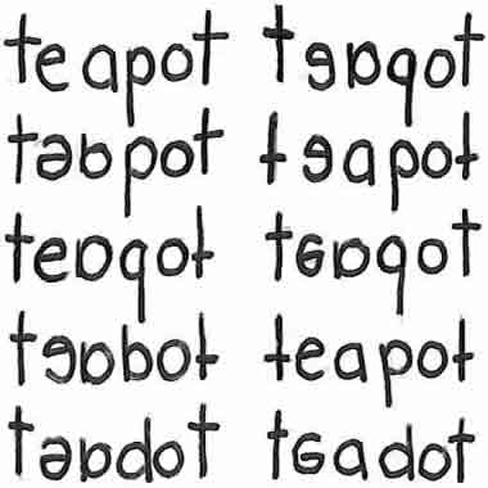

Figure 7.17図 7.17
These written words show variations of the word “teapot” as written by individuals with dyslexia.
これらは、読字障害のある人が書いた、「teapot」という単語のさまざまな形である。
Dyscalculia算数障害
Dyscalculia is difficulty in learning or comprehending arithmetic. This learning disability is often first evident when children exhibit difficulty discerning how many objects are in a small group without counting them. Other symptoms may include struggling to memorize math facts, organize numbers, or fully differentiate between numerals, math symbols, and written numbers (such as “3” and “three”).
英語のヒント
算数障害とは、算数を学んだり理解したりすることの困難である。この学習障害は、小さな集まりにいくつの物があるかを数えずに見分けることに、子どもが苦労する様子を見せたときに、初めてはっきり表れることが多い。ほかの症状としては、基本的な計算の答えを覚えること、数を整理すること、あるいは数字、数学の記号、文字で書かれた数(「3」と「three」など)を完全に区別することに苦労する、といったものがありうる。
Summaryまとめ
Genetics and environment affect intelligence and the challenges of certain learning disabilities. The intelligence levels of all individuals seem to benefit from rich stimulation in their early environments. Highly intelligent individuals, however, may have a built-in resiliency that allows them to overcome difficult obstacles in their upbringing. Learning disabilities can cause major challenges for children who are learning to read and write. Unlike developmental disabilities, learning disabilities are strictly neurological in nature and are not related to intelligence levels. Students with dyslexia, for example, may have extreme difficulty learning to read, but their intelligence levels are typically average or above average.
遺伝と環境は、知能と、ある種の学習障害がもたらす困難に影響する。すべての人の知能の水準は、幼いころの環境で豊かな刺激を受けることで恩恵を受けるようである。ただし、知能の高い人は、生まれながらに備わったレジリエンスを持っていて、それによって生い立ちの中の困難な障壁を乗り越えられるのかもしれない。学習障害は、読み書きを学んでいる子どもに大きな困難をもたらしうる。発達障害とは違って、学習障害は厳密に神経学的な性質のものであり、知能の水準とは関係がない。たとえば、読字障害のある生徒は、読むことを学ぶのにきわめて苦労することがあるが、知能の水準は通常、平均か平均以上である。
Review Questions確認問題
Exercise 37問題 37
Where does high intelligence come from?
高い知能はどこから来るのか。
- genetics遺伝
- environment環境
- both A and BAとBの両方
- neither A nor BAとBのどちらでもない
Solution解き方
C
C
Exercise 38問題 38
Arthur Jensen believed that ________.
アーサー・ジェンセンは、________と考えていた。
- genetics was solely responsible for intelligence知能を決めるのは遺伝だけである
- environment was solely responsible for intelligence知能を決めるのは環境だけである
- intelligence level was determined by race知能の水準は人種によって決まる
- IQ tests do not take socioeconomic status into accountIQテストは社会経済的地位を考慮していない
Solution解き方
A
A
Exercise 39問題 39
What is a learning disability?
学習障害とは何か。
- a developmental disorder発達障害
- a neurological disorder神経学的な障害
- an emotional disorder感情の障害
- an intellectual disorder知的な障害
Solution解き方
B
B
Exercise 40問題 40
Which of the following statements is true?
次の記述のうち、正しいのはどれか。
- Poverty always affects whether individuals are able to reach their full intellectual potential.貧困は、人が知的な潜在能力を十分に発揮できるかどうかに必ず影響する。
- An individual’s intelligence is determined solely by the intelligence levels of his siblings.人の知能は、その人のきょうだいの知能の水準だけによって決まる。
- The environment in which an individual is raised is the strongest predictor of her future intelligence人が育てられる環境は、その人の将来の知能を最も強く予測する要因である。
- There are many factors working together to influence an individual’s intelligence level.多くの要因が互いに作用し合って、人の知能の水準に影響を与えている。
Solution解き方
D
D