第7章思考と知能
Pitfalls to Problem Solving問題解決の落とし穴
Not all problems are successfully solved, however. What challenges stop us from successfully solving a problem? Imagine a person in a room that has four doorways. One doorway that has always been open in the past is now locked. The person, accustomed to exiting the room by that particular doorway, keeps trying to get out through the same doorway even though the other three doorways are open. The person is stuck—but they just need to go to another doorway, instead of trying to get out through the locked doorway. A mental set is where you persist in approaching a problem in a way that has worked in the past but is clearly not working now.
英語のヒント
しかし、すべての問題がうまく解決されるわけではない。問題をうまく解決するのを妨げるのは、どのような困難だろうか。出入り口が四つある部屋に、ある人がいるところを想像してほしい。これまでいつも開いていた出入り口の一つが、いまは鍵がかかっている。その人は、その出入り口から部屋を出ることに慣れているので、ほかの三つの出入り口が開いているにもかかわらず、同じ出入り口から出ようとし続ける。その人は行き詰まっている。だが、鍵のかかった出入り口から出ようとするのをやめて、別の出入り口へ行きさえすればよいのである。心的構えとは、過去にはうまくいったが、いまは明らかにうまくいっていないやり方で、問題に取り組み続けることである。
Functional fixedness is a type of mental set where you cannot perceive an object being used for something other than what it was designed for. Duncker (1945) conducted foundational research on functional fixedness. He created an experiment in which participants were given a candle, a book of matches, and a box of thumbtacks. They were instructed to use those items to attach the candle to the wall so that it did not drip wax onto the table below. Participants had to use functional fixedness to overcome the problem (Figure 7.10). During the Apollo 13 mission to the moon, NASA engineers at Mission Control had to overcome functional fixedness to save the lives of the astronauts aboard the spacecraft. An explosion in a module of the spacecraft damaged multiple systems. The astronauts were in danger of being poisoned by rising levels of carbon dioxide because of problems with the carbon dioxide filters. The engineers found a way for the astronauts to use spare plastic bags, tape, and air hoses to create a makeshift air filter, which saved the lives of the astronauts.
英語のヒント
機能的固着とは心的構えの一種で、ある物が、本来作られた用途とは別のことに使われるところを思い描けない状態をいう。ドゥンカー(1945)は、機能的固着についての基礎となる研究を行った。ドゥンカーが考案した実験では、参加者にろうそく、ブックマッチ、画鋲一箱が渡された。参加者は、それらの物を使って、下の机にろうが垂れないようにろうそくを壁に取り付けるよう指示された。参加者は、この問題を解決するために機能的固着を乗り越えなければならなかった(図7.10)。月へ向かうアポロ13号のミッションの最中に、管制センターのNASAの技術者たちが、宇宙船に乗っていた宇宙飛行士の命を救うために、機能的固着を乗り越えなければならなかった。宇宙船のモジュールの一つで爆発が起こり、複数のシステムが損傷した。二酸化炭素フィルターに問題が生じたため、宇宙飛行士たちは、上昇していく二酸化炭素濃度によって中毒を起こす危険にさらされていた。技術者たちは、宇宙飛行士が予備のビニール袋、テープ、空気ホースを使って間に合わせの空気フィルターをつくる方法を見つけ出し、それが宇宙飛行士たちの命を救った。
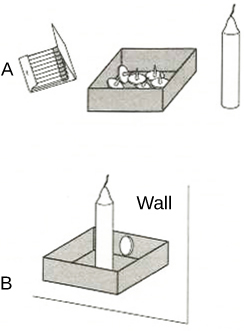
Figure 7.10図 7.10
In Duncker's classic study, participants were provided the three objects in the top panel and asked to solve the problem. The solution is shown in the bottom portion.
ドゥンカーの古典的な研究では、参加者は上の図にある三つの物を渡され、問題を解くよう求められた。解答は下の部分に示されている。
Researchers have investigated whether functional fixedness is affected by culture. In one experiment, individuals from the Shuar group in Ecuador were asked to use an object for a purpose other than that for which the object was originally intended. For example, the participants were told a story about a bear and a rabbit that were separated by a river and asked to select among various objects, including a spoon, a cup, erasers, and so on, to help the animals. The spoon was the only object long enough to span the imaginary river, but if the spoon was presented in a way that reflected its normal usage, it took participants longer to choose the spoon to solve the problem. (German & Barrett, 2005). The researchers wanted to know if exposure to highly specialized tools, as occurs with individuals in industrialized nations, affects their ability to transcend functional fixedness. It was determined that functional fixedness is experienced in both industrialized and nonindustrialized cultures (German & Barrett, 2005).
英語のヒント
研究者たちは、機能的固着が文化の影響を受けるかどうかを調べてきた。ある実験では、エクアドルのシュアール族の人々に、ある物を、その物が本来意図されていた目的とは別の目的に使うよう求めた。たとえば参加者は、川で隔てられたクマとウサギの話を聞かされ、スプーン、コップ、消しゴムなど、さまざまな物の中から、動物たちを助けるための物を選ぶよう求められた。想像上の川に架け渡せるほど長い物はスプーンだけだったが、スプーンがふだんの使い方を反映するようなかたちで示されると、参加者が問題を解くためにスプーンを選ぶまでに、より長い時間がかかった(German & Barrett, 2005)。研究者たちが知りたかったのは、工業化した国々の人々に見られるように、高度に専門化した道具に触れていることが、機能的固着を乗り越える能力に影響するかどうかだった。その結果、機能的固着は、工業化した文化でも工業化していない文化でも経験されることが明らかになった(German & Barrett, 2005)。
In order to make good decisions, we use our knowledge and our reasoning. Often, this knowledge and reasoning is sound and solid. Sometimes, however, we are swayed by biases or by others manipulating a situation. For example, let’s say you and three friends wanted to rent a house and had a combined target budget of $1,600. The realtor shows you only very run-down houses for $1,600 and then shows you a very nice house for $2,000. Might you ask each person to pay more in rent to get the $2,000 home? Why would the realtor show you the run-down houses and the nice house? The realtor may be challenging your anchoring bias. An anchoring bias occurs when you focus on one piece of information when making a decision or solving a problem. In this case, you’re so focused on the amount of money you are willing to spend that you may not recognize what kinds of houses are available at that price point.
英語のヒント
よい決定を下すために、私たちは自分の知識と推論を用いる。多くの場合、そうした知識や推論は確かで堅実なものである。しかし、ときにはバイアスに流されたり、状況を操作するほかの人に左右されたりすることもある。たとえば、あなたと3人の友人が家を借りたいと考えていて、4人合わせた予算の目標が1,600ドルだったとしよう。不動産業者は、1,600ドルではひどく荒れた家ばかりを見せ、そのあとで2,000ドルのとても素敵な家を見せる。あなたは2,000ドルの家を借りるために、一人ひとりに家賃を多めに払うよう頼むだろうか。不動産業者は、なぜ荒れた家と素敵な家を見せるのだろうか。不動産業者は、あなたのアンカリング・バイアスに働きかけているのかもしれない。アンカリング・バイアスが生じるのは、決定を下したり問題を解いたりする際に、一つの情報に注目するときである。この場合、あなたは自分が払ってもよいと思う金額にあまりに注目しているので、その価格帯でどのような家が借りられるのかに気づかないかもしれない。
The confirmation bias is the tendency to focus on information that confirms your existing beliefs. For example, if you think that your professor is not very nice, you notice all of the instances of rude behavior exhibited by the professor while ignoring the countless pleasant interactions he is involved in on a daily basis. Hindsight bias leads you to believe that the event you just experienced was predictable, even though it really wasn’t. In other words, you knew all along that things would turn out the way they did. Representative bias describes a faulty way of thinking, in which you make a decision or judgment based on your perception of the similarity of the person or thing to your existing stereotypes and prior beliefs; for example, you may assume that your professors spend their free time reading books and engaging in intellectual conversation, because the idea of them spending their time playing volleyball or visiting an amusement park does not fit in with your stereotypes of professors. In another example, an urgent care nurse may be more likely to efficiently detect a heart attack in a male patient rather than a female patient, due to the nurse's unintentional stereotype that heart attacks happen more often to males.
英語のヒント
確証バイアスとは、自分がすでに持っている信念を裏づける情報に注目する傾向である。たとえば、自分の教授はあまり感じのよい人ではないと思っていると、教授が見せる無礼なふるまいの例にはことごとく気づく一方で、教授が日々かかわっている数えきれないほどの感じのよいやりとりは無視してしまう。後知恵バイアスは、たったいま経験した出来事が、実際には予測できなかったにもかかわらず、予測可能だったと思い込ませる。言い換えれば、物事がそうなったとおりになることを、自分ははじめからずっと分かっていた、というわけである。代表性バイアスとは、ある誤った考え方を指す。その考え方では、ある人や物が、自分の既存のステレオタイプや以前からの信念にどれだけ似ているかという知覚に基づいて、決定や判断を下す。たとえば、あなたは、教授たちは暇な時間を読書や知的な会話をして過ごしていると思い込んでいるかもしれない。教授たちがバレーボールをしたり遊園地に行ったりして時間を過ごすという考えは、あなたが持っている教授についてのステレオタイプに合わないからである。もう一つ例を挙げると、救急診療の看護師は、心臓発作は男性により多く起こるという、意図せず抱いているステレオタイプのために、女性の患者よりも男性の患者で心臓発作を効率よく見つけ出す可能性が高いかもしれない。
Finally, the availability heuristic is a heuristic in which you make a decision based on an example, information, or recent experience that is that readily available to you, even though it may not be the best example to inform your decision. Biases tend to “preserve that which is already established—to maintain our preexisting knowledge, beliefs, attitudes, and hypotheses” (Aronson, 1995; Kahneman, 2011). These biases are summarized in Table 7.3.
英語のヒント
最後に、利用可能性ヒューリスティックとは、決定の判断材料として最善の例ではないかもしれないにもかかわらず、自分がすぐに利用できる例や情報、最近の経験に基づいて決定を下すヒューリスティックである。バイアスには、「すでに確立されているものを保存する、つまり、私たちがすでに持っている知識、信念、態度、仮説を維持する」傾向がある(Aronson, 1995; Kahneman, 2011)。これらのバイアスを表7.3にまとめる。
Summary of Decision Biases 意思決定のバイアスのまとめ |
|
|---|---|
Bias バイアス |
Description 説明 |
Anchoring アンカリング |
Tendency to focus on one particular piece of information when making decisions or problem-solving 決定を下したり問題を解いたりするときに、特定の一つの情報に注目する傾向 |
Confirmation 確証 |
Focuses on information that confirms existing beliefs 既存の信念を裏づける情報に注目する |
Hindsight 後知恵 |
Belief that the event just experienced was predictable たったいま経験した出来事が予測可能だったという信念 |
Representative 代表性 |
Making a decision or judgment based on perceived similarity to existing stereotypes or prior beliefs 既存のステレオタイプや以前からの信念に似ていると知覚されることに基づいて、決定や判断を下すこと |
Availability 利用可能性 |
Decision is based upon either an available precedent or an example that may be faulty 利用できる前例か、誤っているかもしれない例のどちらかに基づいて決定が下される |
Were you able to determine how many marbles are needed to balance the scales in Figure 7.9? You need nine. Were you able to solve the problems in Figure 7.7 and Figure 7.8? Here are the answers (Figure 7.11).
英語のヒント
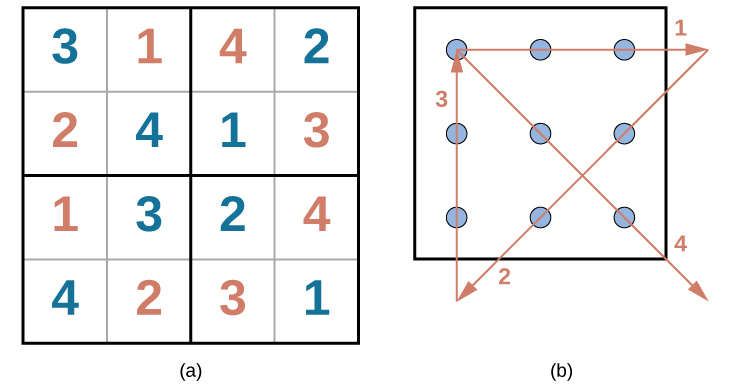


Figure 7.11図 7.11