第1章心理学入門
Personality Psychologyパーソナリティ心理学
Personality psychology focuses on patterns of thoughts and behaviors that make each individual unique. Several individuals (e.g., Freud and Maslow) that we have already discussed in our historical overview of psychology, and the American psychologist Gordon Allport, contributed to early theories of personality. These early theorists attempted to explain how an individual’s personality develops from their given perspective. For example, Freud proposed that personality arose as conflicts between the conscious and unconscious parts of the mind were carried out over the lifespan. Specifically, Freud theorized that an individual went through various psychosexual stages of development. According to Freud, adult personality would result from the resolution of various conflicts that centered on the migration of erogenous (or sexual pleasure-producing) zones from the oral (mouth) to the anus to the phallus to the genitals. Like many of Freud’s theories, this particular idea was controversial and did not lend itself to experimental tests (Person, 1980).
英語のヒント
パーソナリティ心理学は、一人ひとりを独自の存在にしている思考と行動のパターンに焦点を当てる。心理学の歴史の概観ですでに取り上げた何人か(たとえばフロイトやマズロー)と、アメリカの心理学者ゴードン・オールポートが、初期のパーソナリティ理論に貢献した。これらの初期の理論家たちは、それぞれの立場から、個人のパーソナリティがどのように発達するのかを説明しようとした。たとえばフロイトは、パーソナリティは、心の意識的な部分と無意識的な部分のあいだの葛藤が生涯を通じて展開されるなかで生じると唱えた。具体的には、フロイトは、人はいくつかの心理性的発達段階を通過すると理論化した。フロイトによれば、大人のパーソナリティは、性感帯(すなわち性的な快感を生む部位)が口唇(口)から肛門、男根、性器へと移っていくことを中心とする、さまざまな葛藤の解決から生じる。フロイトの理論の多くと同じく、この考えにも異論があり、実験による検証にはなじまなかった(Person, 1980)。
More recently, the study of personality has taken on a more quantitative approach. Rather than explaining how personality arises, research is focused on identifying personality traits, measuring these traits, and determining how these traits interact in a particular context to determine how a person will behave in any given situation. Personality traits are relatively consistent patterns of thought and behavior, and many have proposed that five trait dimensions are sufficient to capture the variations in personality seen across individuals. These five dimensions are known as the “Big Five” or the Five Factor model, and include dimensions of conscientiousness, agreeableness, neuroticism, openness, and extraversion (Figure 1.13). Each of these traits has been demonstrated to be relatively stable over the lifespan (e.g., Rantanen, Metsäpelto, Feldt, Pulkinnen, and Kokko, 2007; Soldz & Vaillant, 1999; McCrae & Costa, 2008) and is influenced by genetics (e.g., Jang, Livesly, and Vernon, 1996).
英語のヒント
最近では、パーソナリティの研究はより量的なアプローチをとるようになっている。パーソナリティがどのように生じるかを説明するのではなく、パーソナリティ特性を特定して測定し、それらの特性が特定の文脈でどのように相互作用して、人がある状況でどう振る舞うかを決めるのかを明らかにすることに研究の焦点がある。パーソナリティ特性とは、比較的一貫した思考と行動のパターンである。個人間に見られるパーソナリティの違いをとらえるには、5つの特性次元で十分だと多くの人が提唱してきた。この5つの次元は「ビッグファイブ」または5因子モデルとして知られ、誠実性、協調性、神経症傾向、開放性、外向性の次元からなる(図1.13)。これらの特性はいずれも、生涯を通じて比較的安定しており(たとえばRantanen, Metsäpelto, Feldt, Pulkinnen, and Kokko, 2007; Soldz & Vaillant, 1999; McCrae & Costa, 2008)、遺伝の影響を受けることが示されている(たとえばJang, Livesly, and Vernon, 1996)。
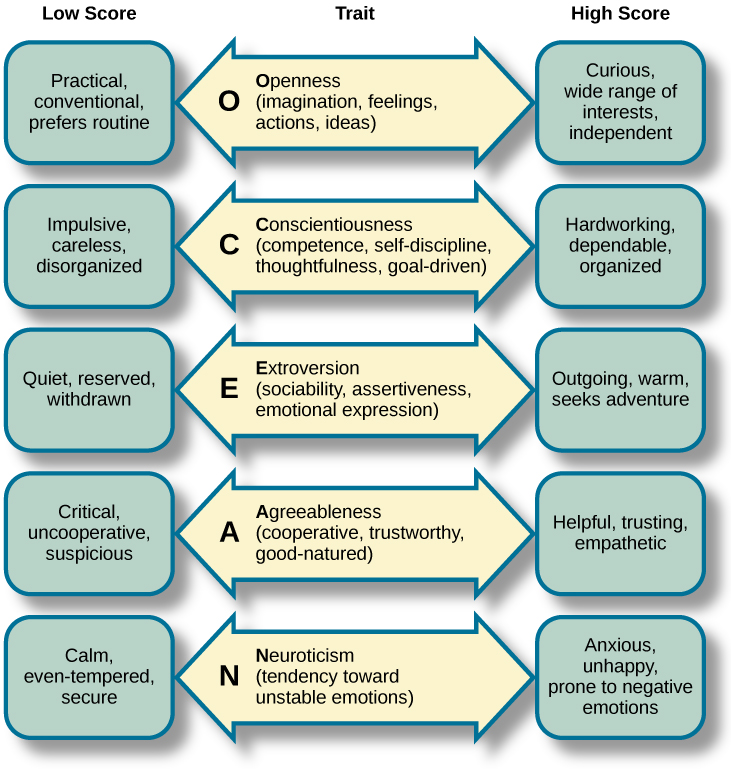
Figure 1.13図 1.13
Each of the dimensions of the Five Factor model is shown in this figure. The provided description would describe someone who scored highly on that given dimension. Someone with a lower score on a given dimension could be described in opposite terms.
この図は5因子モデルの各次元を示している。示された説明は、その次元で得点の高い人を表すものである。ある次元の得点が低い人は、反対の言葉で表されるだろう。
Social Psychology社会心理学
Social psychology focuses on how we interact with and relate to others. Social psychologists conduct research on a wide variety of topics that include differences in how we explain our own behavior versus how we explain the behaviors of others, prejudice, and attraction, and how we resolve interpersonal conflicts. Social psychologists have also sought to determine how being among other people changes our own behavior and patterns of thinking.
英語のヒント
社会心理学は、私たちが他者とどのようにかかわり、どのような関係を結ぶかに焦点を当てる。社会心理学者は、自分の行動の説明の仕方と他者の行動の説明の仕方の違い、偏見、魅力、そして対人間の葛藤をどう解決するかなど、幅広いテーマについて研究を行う。社会心理学者はまた、ほかの人々の中にいることが、私たち自身の行動や考え方のパターンをどう変えるのかを明らかにしようとしてきた。
There are many interesting examples of social psychological research, and you will read about many of these in a later chapter of this textbook. Until then, you will be introduced to one of the most controversial psychological studies ever conducted. Stanley Milgram was an American social psychologist who is most famous for research that he conducted on obedience. After the holocaust, in 1961, a Nazi war criminal, Adolf Eichmann, who was accused of committing mass atrocities, was put on trial. Many people wondered how German soldiers were capable of torturing prisoners in concentration camps, and they were unsatisfied with the excuses given by soldiers that they were simply following orders. At the time, most psychologists agreed that few people would be willing to inflict such extraordinary pain and suffering, simply because they were obeying orders. Milgram decided to conduct research to determine whether or not this was true (Figure 1.14). As you will read later in the text, Milgram found that nearly two-thirds of his participants were willing to deliver what they believed to be lethal shocks to another person, simply because they were instructed to do so by an authority figure (in this case, a man dressed in a lab coat). This was in spite of the fact that participants received payment for simply showing up for the research study and could have chosen not to inflict pain or more serious consequences on another person by withdrawing from the study. No one was actually hurt or harmed in any way, Milgram’s experiment was a clever ruse that took advantage of research confederates, those who pretend to be participants in a research study who are actually working for the researcher and have clear, specific directions on how to behave during the research study (Hock, 2009). Milgram’s and others’ studies that involved deception and potential emotional harm to study participants catalyzed the development of ethical guidelines for conducting psychological research that discourage the use of deception of research subjects, unless it can be argued not to cause harm and, in general, requiring informed consent of participants.
英語のヒント
社会心理学の研究には興味深い例が数多くあり、その多くは本書の後の章で読むことになる。それまでのあいだに、これまでに行われたなかで最も議論を呼んだ心理学研究の一つを紹介しておこう。スタンレー・ミルグラムはアメリカの社会心理学者で、服従についての研究で最もよく知られている。ホロコーストの後、1961年に、大量の残虐行為を犯したとして告発されたナチスの戦争犯罪人アドルフ・アイヒマンが裁判にかけられた。多くの人は、ドイツの兵士たちがなぜ強制収容所で囚人を拷問することができたのかと疑問に思い、ただ命令に従っていただけだという兵士たちの言い訳に納得しなかった。当時、ほとんどの心理学者は、ただ命令に従っているというだけで、これほどの苦痛と苦しみを進んで他者に与える人はほとんどいないだろうという点で一致していた。ミルグラムは、これが本当かどうかを確かめるための研究を行うことにした(図1.14)。本書で後に読むように、ミルグラムは、参加者のほぼ3分の2が、権威のある人物(この場合は白衣を着た男性)に指示されたというだけで、致死的だと信じた電気ショックを別の人に与えようとすることを見いだした。参加者は研究に来ただけで報酬を受け取っており、研究から離脱すれば、別の人に苦痛やそれ以上の深刻な結果を与えないことを選べたにもかかわらず、である。実際には誰もけがをしたり害を受けたりはしなかった。ミルグラムの実験は、サクラ、すなわち研究の参加者のふりをしているが実際には研究者のために働いており、研究中にどう振る舞うかについて明確で具体的な指示を受けている人々を利用した、巧妙な策略だったのである(Hock, 2009)。ミルグラムやほかの研究者による、欺きや参加者への潜在的な心理的危害を伴う研究は、心理学研究を行うための倫理指針の整備を促した。この指針は、害を与えないと論証できる場合を除いて研究参加者を欺くことを思いとどまらせ、原則として参加者のインフォームド・コンセントを求めるものである。



Figure 1.14図 1.14
Stanley Milgram’s research demonstrated just how far people will go in obeying orders from an authority figure. This advertisement was used to recruit subjects for his research.
スタンレー・ミルグラムの研究は、人が権威のある人物からの命令にどこまで従うのかを示した。この広告は、研究の参加者を募集するために使われた。