第1章心理学入門
1.2 History of Psychology1.2 心理学の歴史
Learning Objectives学習目標
By the end of this section, you will be able to:
この節を学び終えると、次のことができるようになる。
- Understand the importance of Wundt and James in the development of psychology心理学の発展においてヴントとジェームズが果たした重要性を理解する
- Appreciate Freud’s influence on psychology心理学へのフロイトの影響を正しく理解する
- Understand the basic tenets of Gestalt psychologyゲシュタルト心理学の基本的な考え方を理解する
- Appreciate the important role that behaviorism played in psychology’s history心理学の歴史において行動主義が果たした重要な役割を正しく理解する
- Understand basic tenets of humanism人間主義の基本的な考え方を理解する
- Understand how the cognitive revolution shifted psychology’s focus back to the mind認知革命によって心理学の焦点がどのように心へと戻ったかを理解する
Psychology is a relatively young science with its experimental roots in the 19th century, compared, for example, to human physiology, which dates much earlier. As mentioned, anyone interested in exploring issues related to the mind generally did so in a philosophical context prior to the 19th century. Two 19th century scholars, Wilhelm Wundt and William James, are generally credited as being the founders of psychology as a science and academic discipline that was distinct from philosophy. This section will provide an overview of the shifts in paradigms that have influenced psychology from Wundt and James through today.
英語のヒント
心理学は比較的新しい科学で、その実験的な起源は19世紀にある。はるか以前にさかのぼる人体生理学などと比べると、その若さがよく分かる。すでに述べたように、19世紀より前には、心にかかわる問題を探究しようとする人は、たいてい哲学の文脈でそれを行っていた。19世紀の二人の学者、ヴィルヘルム・ヴントとウィリアム・ジェームズが、哲学とは別の科学・学問分野としての心理学を創始したとされるのが一般的である。この節では、ヴントとジェームズから今日に至るまで、心理学に影響を与えてきたパラダイムの移り変わりを概観する。
Wundt and Structuralismヴントと構成主義
Wilhelm Wundt (1832–1920) was a German scientist who was the first person to be referred to as a psychologist. His famous book entitled Principles of Physiological Psychology was published in 1873. Wundt viewed psychology as a scientific study of conscious experience, and he believed that the goal of psychology was to identify components of consciousness and how those components combined to result in our conscious experience. Wundt used introspection (he called it “internal perception”), a process by which someone examines their own conscious experience as objectively as possible, making the human mind like any other aspect of nature that a scientist observed. He believed in the notion of voluntarism—that people have free will and should know the intentions of a psychological experiment if they were participating (Danziger, 1980). Wundt considered his version experimental introspection; he used instruments such as those that measured reaction time. He also wrote Volkerpsychologie in 1904 in which he suggested that psychology should include the study of culture, as it involves the study of people. Edward Titchener, one of his students, went on to develop structuralism. Its focus was on the contents of mental processes rather than their function (Pickren & Rutherford, 2010). Wundt established his psychology laboratory at the University at Leipzig in 1879 (Figure 1.2). In this laboratory, Wundt and his students conducted experiments on, for example, reaction times. A subject, sometimes in a room isolated from the scientist, would receive a stimulus such as a light, image, or sound. The subject’s reaction to the stimulus would be to push a button, and an apparatus would record the time to reaction. Wundt could measure reaction time to one-thousandth of a second (Nicolas & Ferrand, 1999).
英語のヒント
ヴィルヘルム・ヴント(1832〜1920)はドイツの科学者で、心理学者と呼ばれた最初の人物である。有名な著書『生理学的心理学綱要』は1873年に出版された。ヴントは心理学を意識経験についての科学的研究とみなし、心理学の目標は、意識の構成要素を明らかにし、それらの要素がどのように組み合わさって私たちの意識経験が生じるのかを明らかにすることだと考えた。ヴントは内観(彼自身は「内的知覚」と呼んだ)を用いた。内観とは、自分自身の意識経験をできるだけ客観的に調べる過程であり、これによって人間の心を、科学者が観察する自然のほかの側面と同じように扱えるようにした。ヴントは主意主義という考え方、すなわち人は自由意志を持っており、心理学実験に参加するならその実験の意図を知っているべきだ、という考えを信じていた(Danziger, 1980)。ヴントは自分のやり方を実験的内観と考え、反応時間を測る装置などの器具を用いた。1904年には『民族心理学』を著し、心理学は人々を研究するものである以上、文化の研究も含むべきだと述べた。ヴントの弟子の一人エドワード・ティチェナーは、のちに構成主義を発展させた。構成主義が焦点を当てたのは、心的過程の働きではなく、その内容だった(Pickren & Rutherford, 2010)。ヴントは1879年、ライプツィヒ大学に心理学実験室を開設した(図1.2)。この実験室でヴントと弟子たちは、たとえば反応時間についての実験を行った。参加者は、ときには研究者から離れた部屋で、光や画像、音などの刺激を受ける。参加者はその刺激に反応してボタンを押し、装置が反応までの時間を記録した。ヴントは反応時間を1000分の1秒単位で測ることができた(Nicolas & Ferrand, 1999)。
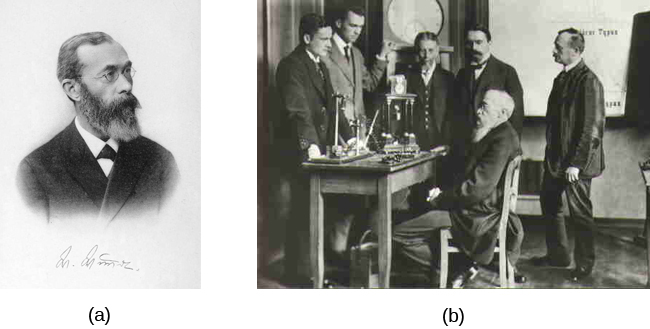
Figure 1.2図 1.2
(a) Wilhelm Wundt is credited as one of the founders of psychology. He created the first laboratory for psychological research. (b) This photo shows him seated and surrounded by fellow researchers and equipment in his laboratory in Germany.
(a)ヴィルヘルム・ヴントは、心理学の創始者の一人とされている。心理学研究のための最初の実験室をつくった。(b)ドイツの実験室で、研究仲間と装置に囲まれて座るヴント。
However, despite his efforts to train individuals in the process of introspection, this process remained highly subjective, and there was very little agreement between individuals.
英語のヒント
しかし、ヴントは人々に内観の手順を訓練しようと努めたが、この手順は非常に主観的なままで、人によって結果がほとんど一致しなかった。
Functionalism機能主義
William James, John Dewey, and Charles Sanders Peirce helped establish functional psychology (Figure 1.3). They accepted Darwin’s theory of evolution by natural selection and viewed this theory as an explanation of an organism’s characteristics. Key to that theory is the idea that natural selection leads to organisms that are adapted to their environment, including their behavior. Adaptation means that a trait of an organism has a function for the survival and reproduction of the individual, because it has been naturally selected. As James saw it, psychology’s purpose was to study the function of behavior in the world, and as such, his perspective was known as functionalism. Functionalism focused on how mental activities helped an organism fit into its environment. Functionalism has a second, more subtle meaning in that functionalists were more interested in the operation of the whole mind rather than of its individual parts, which were the focus of structuralism. Like Wundt, James believed that introspection could serve as one means by which someone might study mental activities, but James also relied on more objective measures, including the use of various recording devices, and examinations of concrete products of mental activities and of anatomy and physiology (Gordon, 1995).
英語のヒント
ウィリアム・ジェームズ、ジョン・デューイ、チャールズ・サンダース・パースは、機能心理学の確立に貢献した(図1.3)。彼らはダーウィンの自然選択による進化論を受け入れ、この理論を生物の特徴を説明するものとみなした。この理論の鍵となるのは、自然選択によって、生物がその行動も含めて環境に適応したものになるという考えである。適応とは、生物のある特性が、自然選択されてきたために、その個体の生存と繁殖にとって機能を持っていることを意味する。ジェームズの考えでは、心理学の目的は世界の中での行動の機能を研究することであり、そのため彼の立場は機能主義として知られるようになった。機能主義は、心的活動が、生物が環境になじむのにどのように役立つのかに焦点を当てた。機能主義にはもう一つ、より微妙な意味がある。機能主義者は、構成主義が焦点を当てた心の個々の部分よりも、心全体の働きに関心を持っていたという点である。ヴントと同じくジェームズも、内観は心的活動を研究する手段の一つになりうると考えたが、より客観的な測定にも頼った。そこには、さまざまな記録装置の使用や、心的活動の具体的な産物の検討、解剖学と生理学の検討が含まれていた(Gordon, 1995)。
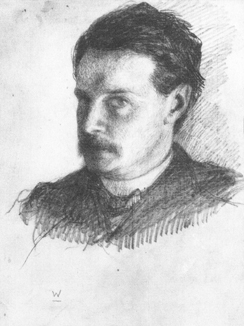


Figure 1.3図 1.3
William James, shown here in a self-portrait, was the first American psychologist.
自画像に描かれたウィリアム・ジェームズ。アメリカで最初の心理学者である。