第1章心理学入門
Pavlov, Watson, Skinner, and Behaviorismパヴロフ、ワトソン、スキナーと行動主義
Early work in the field of behavior was conducted by the Russian physiologist Ivan Pavlov (1849–1936). Pavlov studied a form of learning behavior called a conditioned reflex, in which an animal or human produced a reflex (unconscious) response to a stimulus and, over time, was conditioned to produce the response to a different stimulus that the experimenter associated with the original stimulus. The reflex Pavlov worked with was salivation in response to the presence of food. The salivation reflex could be elicited using a second stimulus, such as a specific sound, that was presented in association with the initial food stimulus several times. Once the response to the second stimulus was “learned,” the food stimulus could be omitted. Pavlov’s “classical conditioning” is only one form of learning behavior studied by behaviorists.
英語のヒント
行動の分野の初期の研究は、ロシアの生理学者イワン・パヴロフ(1849〜1936)によって行われた。パヴロフは、条件反射と呼ばれる学習行動の一形態を研究した。条件反射とは、動物や人間がある刺激に対して反射的な(無意識の)反応をし、時間がたつうちに、実験者がもとの刺激と結びつけた別の刺激に対してもその反応をするように条件づけられることである。パヴロフが扱った反射は、食物があるときの唾液分泌だった。唾液分泌の反射は、最初の食物刺激と結びつけて何度か提示した第二の刺激、たとえば特定の音によっても引き起こされるようになった。第二の刺激への反応がいったん「学習」されると、食物刺激はなくてもよくなった。パヴロフの「古典的条件づけ」は、行動主義者が研究した学習行動の一形態にすぎない。
John B. Watson (1878–1958) was an influential American psychologist whose most famous work occurred during the early 20th century at Johns Hopkins University (Figure 1.5). While Wundt and James were concerned with understanding conscious experience, Watson thought that the study of consciousness was flawed. Because he believed that objective analysis of the mind was impossible, Watson preferred to focus directly on observable behavior and try to bring that behavior under control. Watson was a major proponent of shifting the focus of psychology from the mind to behavior, and this approach of observing and controlling behavior came to be known as behaviorism. A major object of study by behaviorists was learned behavior and its interaction with inborn qualities of the organism. Behaviorism commonly used animals in experiments under the assumption that what was learned using animal models could, to some degree, be applied to human behavior. Indeed, Tolman (1938) stated, “I believe that everything important in psychology (except … such matters as involve society and words) can be investigated in essence through the continued experimental and theoretical analysis of the determiners of rat behavior at a choice-point in a maze.”
英語のヒント
ジョン・B・ワトソン(1878〜1958)は影響力のあるアメリカの心理学者で、最も有名な研究は20世紀前半にジョンズ・ホプキンズ大学で行われた(図1.5)。ヴントとジェームズが意識経験の理解にかかわっていたのに対し、ワトソンは意識の研究には欠陥があると考えた。心を客観的に分析することは不可能だと考えたので、ワトソンは観察可能な行動に直接焦点を当て、その行動を制御しようとすることを好んだ。ワトソンは、心理学の焦点を心から行動へ移すことを強く唱えた主要な人物であり、行動を観察し制御するこのアプローチは行動主義として知られるようになった。行動主義者の主な研究対象は、学習された行動と、それが生物の生得的な性質とどう相互作用するかだった。行動主義では、動物モデルを使って分かったことはある程度人間の行動にも当てはまる、という前提のもとで、実験に動物を用いることが一般的だった。実際、トールマン(1938)は次のように述べた。「心理学において重要なことはすべて(…社会や言葉にかかわるような事柄を除けば)、迷路の選択点におけるネズミの行動の決定因を、実験的・理論的に分析し続けることによって、本質的に研究できると私は信じる。」
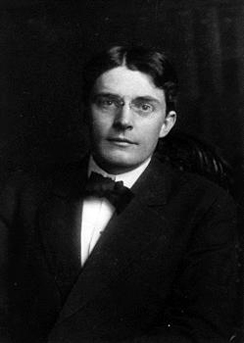
Figure 1.5図 1.5
John B. Watson is known as the father of behaviorism within psychology.
ジョン・B・ワトソンは、心理学における行動主義の父として知られる。
Behaviorism dominated experimental psychology for several decades, and its influence can still be felt today (Thorne & Henley, 2005). Behaviorism is largely responsible for establishing psychology as a scientific discipline through its objective methods and especially experimentation. In addition, it is used in behavioral and cognitive-behavioral therapy. Behavior modification is commonly used in classroom settings. Behaviorism has also led to research on environmental influences on human behavior.
英語のヒント
行動主義は数十年にわたって実験心理学を支配し、その影響は今日でも感じられる(Thorne & Henley, 2005)。行動主義は、客観的な方法、とりわけ実験を通して、心理学を科学的な学問分野として確立するうえで大きな役割を果たした。さらに、行動主義は行動療法や認知行動療法にも使われている。行動変容は教室の場面でもよく用いられる。行動主義は、人間の行動に対する環境の影響についての研究にもつながった。
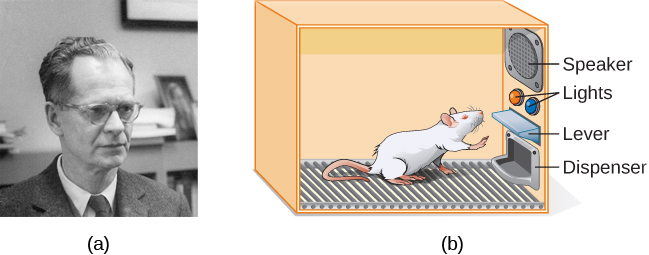
B. F. Skinner (1904–1990) was an American psychologist (Figure 1.6). Like Watson, Skinner was a behaviorist, and he concentrated on how behavior was affected by its consequences. Therefore, Skinner spoke of reinforcement and punishment as major factors in driving behavior. As a part of his research, Skinner developed a chamber that allowed the careful study of the principles of modifying behavior through reinforcement and punishment. This device, known as an operant conditioning chamber (or more familiarly, a Skinner box), has remained a crucial resource for researchers studying behavior (Thorne & Henley, 2005).
英語のヒント
B・F・スキナー(1904〜1990)はアメリカの心理学者である(図1.6)。スキナーはワトソンと同じく行動主義者であり、行動がその結果によってどのように影響を受けるかに集中した。そのためスキナーは、行動を動かす主な要因として強化と罰を論じた。研究の一環として、スキナーは、強化と罰によって行動を変える原理を詳しく研究できる箱型の装置を開発した。この装置はオペラント条件づけ箱(より身近な呼び方ではスキナー箱)として知られ、行動を研究する研究者にとって欠かせない道具であり続けている(Thorne & Henley, 2005)。
OpenStax, Rice University; Psychology 2e. (credit a: modification of work by "Silly rabbit"/Wikimedia Commons) · CC BY 4.0 · Source出典
Figure 1.6図 1.6
(a) B. F. Skinner is famous for his research on operant conditioning. (b) Modified versions of the operant conditioning chamber, or Skinner box, are still widely used in research settings today. (credit a: modification of work by "Silly rabbit"/Wikimedia Commons)
(a)B・F・スキナーはオペラント条件づけの研究で有名である。(b)オペラント条件づけ箱、すなわちスキナー箱を改良したものは、今日でも研究の場で広く使われている。(出典a:“Silly rabbit”/Wikimedia Commonsの作品を改変)
The Skinner box is a chamber that isolates the subject from the external environment and has a behavior indicator such as a lever or a button. When the animal pushes the button or lever, the box is able to deliver a positive reinforcement of the behavior (such as food) or a punishment (such as a noise).
英語のヒント
スキナー箱は、対象の動物を外部環境から隔離し、レバーやボタンのような行動の指標を備えた箱である。動物がボタンやレバーを押すと、箱はその行動に対して正の強化(食物など)や罰(騒音など)を与えることができる。
Skinner’s focus on positive and negative reinforcement of learned behaviors had a lasting influence in psychology that has waned somewhat since the growth of research in cognitive psychology. Despite this, conditioned learning is still used in human behavioral modification (Greengrass, 2004).
英語のヒント
学習された行動の正の強化と負の強化にスキナーが注目したことは、心理学に長く影響を残したが、その影響は認知心理学の研究が広がってからいくぶん弱まった。それでも、条件づけによる学習は、人間の行動変容に今でも用いられている(Greengrass, 2004)。
Maslow, Rogers, and Humanismマズロー、ロジャーズと人間主義
During the early 20th century, American psychology was dominated by behaviorism and psychoanalysis. However, some psychologists were uncomfortable with what they viewed as limited perspectives being so influential to the field. They objected to the pessimism and determinism (all actions driven by the unconscious) of Freud. They also disliked the reductionism, or simplifying nature, of behaviorism. Behaviorism is also deterministic at its core, because it sees human behavior as entirely determined by a combination of genetics and environment. Some psychologists began to form their own ideas that emphasized personal control, intentionality, and a true predisposition for “good” as important for our self-concept and our behavior. Thus, humanism emerged. Humanism is a perspective within psychology that emphasizes the potential for good that is innate to all humans. Two of the most well-known proponents of humanistic psychology are Abraham Maslow and Carl Rogers (O’Hara, n.d.).
英語のヒント
20世紀前半、アメリカの心理学は行動主義と精神分析に支配されていた。しかし、一部の心理学者は、自分たちから見て視野の狭い立場がこの分野にそれほど大きな影響力を持っていることに違和感を抱いていた。彼らは、フロイトの悲観主義と決定論(すべての行動は無意識によって動かされるという考え)に反対した。また、行動主義の還元主義、すなわち物事を単純化してとらえる性質も好まなかった。行動主義もその核心においては決定論的である。人間の行動は、遺伝と環境の組み合わせによって完全に決まると見るからである。一部の心理学者は、自己概念と行動にとって重要なものとして、自分で自分を制御すること、意図性、そして「善」に向かう真の傾向を強調する独自の考えを形づくりはじめた。こうして人間主義が生まれた。人間主義とは、すべての人間に生まれつき備わっている善への可能性を強調する、心理学の中の一つの立場である。人間性心理学の提唱者として最もよく知られているのは、アブラハム・マズローとカール・ロジャーズの二人である(O’Hara, n.d.)。
Abraham Maslow (1908–1970) was an American psychologist who is best known for proposing a hierarchy of human needs in motivating behavior (Figure 1.7). Although this concept will be discussed in more detail in a later chapter, a brief overview will be provided here. Maslow asserted that so long as basic needs necessary for survival were met (e.g., food, water, shelter), higher-level needs (e.g., social needs) would begin to motivate behavior. According to Maslow, the highest-level needs relate to self-actualization, a process by which we achieve our full potential. Obviously, the focus on the positive aspects of human nature that are characteristic of the humanistic perspective is evident (Thorne & Henley, 2005). Humanistic psychologists rejected, on principle, the research approach based on reductionist experimentation in the tradition of the physical and biological sciences, because it missed the “whole” human being. Beginning with Maslow and Rogers, there was an insistence on a humanistic research program. This program has been largely qualitative (not measurement-based), but there exist a number of quantitative research strains within humanistic psychology, including research on happiness, self-concept, meditation, and the outcomes of humanistic psychotherapy (Friedman, 2008).
英語のヒント
アブラハム・マズロー(1908〜1970)はアメリカの心理学者で、行動を動機づける人間の欲求階層を提唱したことで最もよく知られている(図1.7)。この概念は後の章でさらに詳しく論じるが、ここで簡単に概観しておく。マズローは、生存に必要な基本的欲求(たとえば食物、水、住まい)が満たされているかぎり、より高次の欲求(たとえば社会的欲求)が行動を動機づけるようになると主張した。マズローによれば、最も高次の欲求は自己実現、すなわち自分の潜在能力を十分に発揮する過程にかかわる。人間主義の立場の特徴である、人間性の肯定的な側面への注目が、ここにはっきり表れている(Thorne & Henley, 2005)。人間性心理学者は、物理科学や生物科学の伝統に基づく還元主義的な実験による研究アプローチを、原則として退けた。それでは「全体としての」人間をとらえ損ねるからである。マズローとロジャーズ以来、人間性心理学に固有の研究計画が強く求められてきた。この研究計画は主に質的なもの(測定に基づかないもの)だったが、人間性心理学の中にも、幸福、自己概念、瞑想、人間性心理療法の成果などについての量的研究の系統がいくつも存在する(Friedman, 2008)。
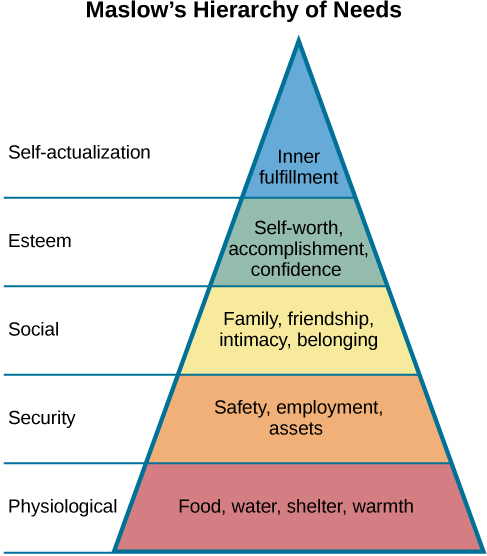


Figure 1.7図 1.7
Maslow’s hierarchy of needs is shown.
マズローの欲求階層を示す。
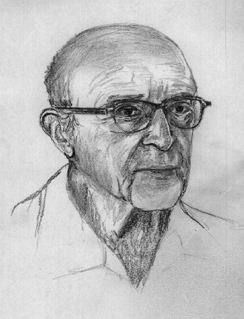
Carl Rogers (1902–1987) was also an American psychologist who, like Maslow, emphasized the potential for good that exists within all people (Figure 1.8). Rogers used a therapeutic technique known as client-centered therapy in helping his clients deal with problematic issues that resulted in their seeking psychotherapy. Unlike a psychoanalytic approach in which the therapist plays an important role in interpreting what conscious behavior reveals about the unconscious mind, client-centered therapy involves the patient taking a lead role in the therapy session. Rogers believed that a therapist needed to display three features to maximize the effectiveness of this particular approach: unconditional positive regard, genuineness, and empathy. Unconditional positive regard refers to the fact that the therapist accepts their client for who they are, no matter what they might say. Provided these factors, Rogers believed that people were more than capable of dealing with and working through their own issues (Thorne & Henley, 2005).
英語のヒント
カール・ロジャーズ(1902〜1987)もアメリカの心理学者で、マズローと同じく、すべての人の内にある善への可能性を強調した(図1.8)。ロジャーズは、クライエントが心理療法を受けに来るもとになった問題に対処するのを助けるために、来談者中心療法として知られる治療技法を用いた。精神分析的アプローチでは、意識的な行動が無意識の心について何を明らかにしているかを解釈するうえで、セラピストが重要な役割を果たす。これに対して来談者中心療法では、治療の場で主導的な役割を果たすのは患者の方である。ロジャーズは、このアプローチの効果を最大にするためには、セラピストが三つの特徴、すなわち無条件の肯定的配慮、純粋性、共感を示す必要があると考えた。無条件の肯定的配慮とは、クライエントが何を言おうとも、セラピストがクライエントをありのままに受け入れることを指す。こうした条件がそろえば、人は自分の問題に対処し、それを乗り越えていく十分な力を持っている、とロジャーズは考えた(Thorne & Henley, 2005)。
OpenStax, Rice University; Psychology 2e. (credit: "Didius"/Wikimedia Commons) · CC BY 4.0 · Source出典

Figure 1.8図 1.8
Carl Rogers, shown in this portrait, developed a client-centered therapy method that has been influential in clinical settings. (credit: "Didius"/Wikimedia Commons)
この肖像画のカール・ロジャーズは、臨床の場で影響力を持ってきた来談者中心療法を開発した。(出典:“Didius”/Wikimedia Commons)
Humanism has been influential to psychology as a whole. Both Maslow and Rogers are well-known names among students of psychology (you will read more about both later in this text), and their ideas have influenced many scholars. Furthermore, Rogers’ client-centered approach to therapy is still commonly used in psychotherapeutic settings today (O’hara, n.d.)
英語のヒント
人間主義は心理学全体に影響を与えてきた。マズローとロジャーズはどちらも心理学を学ぶ学生によく知られた名前であり(本書でも、のちに二人について詳しく読む)、その考えは多くの研究者に影響を与えてきた。さらに、ロジャーズの来談者中心のアプローチは、今日でも心理療法の場で広く用いられている(O’hara, n.d.)