第23章素粒子物理Particle Physics原書 p.795–832
23.2 Quarks23.2 クォーク
SECTION LEARNING OBJECTIVES By the end of the section, you will be able to do the following:
この節の学習目標 この節を終えると、次のことができるようになる。
• Describe quarks and their relationship to other particles• Distinguish hadrons from leptons• Distinguish matter from antimatter• Describe the standard model of the atom• Define a Higgs boson and its importance to particle physics
・クォークと、それが他の粒子とどう関わるかを述べる・ハドロンとレプトンを見分ける・物質と反物質を見分ける・原子の標準模型を述べる・ヒッグス粒子とは何か、それが素粒子物理でなぜ重要かを述べる
Section Key Termsこの節の重要語
annihilationantimatterbaryonbottom quarkcharmed quarkcolordown quarkflavorgluonhadronHiggs bosonHiggs fieldleptonmesonpair productionpositronquantum chromodynamicsquarkStandard Modelstrange quarktop quarkup quark
対消滅 反物質 バリオン ボトムクォーク チャームクォーク色 ダウンクォーク フレーバー グルーオン ハドロンヒッグス粒子 ヒッグス場 レプトン 中間子 対生成陽電子 量子色力学 クォーク 標準模型 ストレンジクォークトップクォーク アップクォーク
Quarksクォーク
“The first principles of the universe are atoms and empty space. Everything else is merely thought to exist…”
「宇宙の第一の原理は原子と空虚である。それ以外はすべて、あると思われているにすぎない……」
“… Further, the atoms are unlimited in size and number, and they are borne along with the whole universe in a vortex, and thereby generate all composite things—fire, water, air, earth. For even these are conglomerations of given atoms. And it because of their solidity that these atoms are impassive and unalterable.”
「……さらに原子は大きさも数も限りがなく、宇宙全体とともに渦の中を運ばれ、そうしてあらゆる合わさったもの——火、水、空気、土——を生む。これらもまた、決まった原子の寄り集まりだからである。そして原子が何にも動かされず変わらないのは、その堅さゆえである。」
—Diogenes Laertius (summarizing the views of Democritus, circa 460–370 B.C.)
——ディオゲネス・ラエルティオス(デモクリトス〈紀元前460年ごろ–370年ごろ〉の考えをまとめたもの)
The search for fundamental particles is nothing new. Atomists of the Greek and Indian empires, like Democritus of fifth century B.C., openly wondered about the most finite components of our universe. Though dormant for centuries, curiosity about the atomic nature of matter was reinvigorated by Rutherford’s gold foil experiment and the discovery of the nucleus. By the early 1930s, scientists believed they had fully determined the tiniest constituents of matter—in the form of the proton, neutron, and electron.
根本の粒子を探すことは、何も新しいことではない。紀元前5世紀のデモクリトスをはじめとするギリシアやインドの帝国の原子論者は、私たちの宇宙の最も細かい部品について公然と考えをめぐらせた。何世紀も眠っていたが、物質の原子としての性質への関心は、ラザフォードの金箔の実験と原子核の発見によって呼び覚まされた。1930年代の初めまでに、科学者は物質の最も小さな構成要素——陽子・中性子・電子——を完全に突き止めたと信じていた。
This would be only partially true. At present, scientists know that there are hundreds of particles not unlike our electron and nucleons, all making up what some have termed the particle zoo. While we are confident that the electron remains fundamental, it is surrounded by a plethora of similar sounding terms, like leptons, hadrons, baryons, and mesons. Even though not every particle is considered fundamental, they all play a vital role in understanding the intricate structure of our universe.
それは半分しか当たっていなかった。今日、科学者は、私たちの電子や核子とさして違わない粒子が何百もあることを知っている。それらすべてが、いわゆる「粒子の動物園」を作っている。電子が根本のものであることは確かだが、そのまわりにはレプトン、ハドロン、バリオン、中間子といった似た響きの語があふれている。すべての粒子が根本のものとみなされるわけではないが、どれも私たちの宇宙の入り組んだ構造を理解するうえで欠かせない役割を果たす。
A fundamental particle is defined as a particle with no substructure and no finite size. According to the Standard Model, there are three types of fundamental particles: leptons, quarks, and carrier particles. As you may recall, carrier particles are responsible for transmitting fundamental forces between their interacting masses. Leptons are a group of six particles not bound by the strong nuclear force, of which the electron is one. As for quarks, they are the fundamental building blocks of a group of particles called hadrons, a group that includes both the proton and the neutron.
根本の粒子とは、細かい構造を持たず、有限の大きさも持たない粒子と定められる。標準模型によれば、根本の粒子には三つの型がある。レプトン、クォーク、運び手の粒子である。思い出してほしいが、運び手の粒子は、作用し合う質量のあいだに基本の力を伝える役目を持つ。レプトンは強い核力に縛られない六つの粒子の一群で、電子はその一つである。クォークはハドロンと呼ばれる一群の粒子の根本の組み立ての部品であり、その一群には陽子も中性子も含まれる。
Now for a brief history of quarks. Quarks were first proposed independently by American physicists Murray Gell- Mann and George Zweig in 1963. Originally, three quark types—or flavors—were proposed with the names up (u), down (d), and strange (s).
ここでクォークの歴史を手短に。クォークは1963年、アメリカの物理学者マレー・ゲルマンとジョージ・ツワイクによってそれぞれ独立に提案された。もともとは三つの型——フレーバー——のクォークが提案され、アップ(u)、ダウン(d)、ストレンジ(s)と名づけられた。
At first, physicists expected that, with sufficient energy, we should be able to free quarks and observe them directly. However, this has not proved possible, as the current understanding is that the force holding quarks together is incredibly great and, much like a spring, increases in magnitude as the quarks are separated. As a result, when large energies are put into collisions, other particles are created—but no quarks emerge. With that in mind, there is compelling evidence for the existence of quarks. By 1967, experiments at the SLAC National Accelerator Laboratory scattering 20-GeV electrons from protons produced results like Rutherford had obtained for the nucleus nearly 60 years earlier. The SLAC scattering experiments showed unambiguously that there were three point-like (meaning they had sizes considerably smaller than the probe’s wavelength) charges inside the proton as seen in Figure 23.12. This evidence made all but the most skeptical admit that there was validity to the quark substructure of hadrons.
初め、物理学者は十分なエネルギーがあればクォークを解き放って直接観測できるだろうと考えていた。しかしそれはできなかった。今日の理解では、クォークをつなぐ力は信じがたいほど大きく、ばねのようにクォークを引き離すほど強くなるからである。その結果、衝突に大きなエネルギーを入れると別の粒子が作られるが、クォークは出てこない。それでもクォークの存在の説得力ある証拠はある。1967年までに、SLAC国立加速器研究所で20 GeVの電子を陽子で散乱させる実験が行われ、およそ60年前にラザフォードが原子核について得たのと同じような結果が出た。SLACの散乱の実験は、図23.12に見るように、陽子の中に三つの点のような電荷(つまり探りの波長よりかなり小さな大きさの電荷)があることを疑いなく示した。この証拠によって、ごく疑い深い人を除けば誰もが、ハドロンのクォークという細かい構造には筋があると認めた。
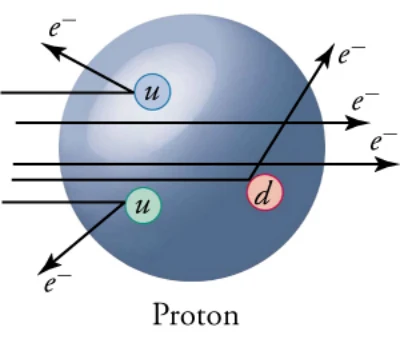
The inclusion of the strange quark with Zweig and Gell-Mann’s model concerned physicists. While the up and down quarks demonstrated fairly clear symmetry and were present in common fundamental particles like protons and neutrons, the strange quark did not have a counterpart of its own. This thought, coupled with the four known leptons at the time, caused scientists to predict that a fourth quark, yet to be found, also existed.
ツワイクとゲルマンのモデルにストレンジクォークが入っていることは、物理学者を悩ませた。アップとダウンのクォークはかなりはっきりした対称性を示し、陽子や中性子といったありふれた基本の粒子の中にあったが、ストレンジクォークには相手がいなかった。この考えと、当時知られていた四つのレプトンとが相まって、科学者はまだ見つかっていない四つ目のクォークも存在すると予測した。
In 1974, two groups of physicists independently discovered a particle with this new quark, labeled charmed. This completed the second exotic quark pair, strange (s) and charmed (c). A final pair of quarks was proposed when a third pair of leptons was discovered in 1975. The existence of the bottom (b) quark and the top (t) quark was verified through experimentation in 1976 and 1995, respectively. While it may seem odd that so much time would elapse between the original quark discovery in 1967 and the verification of the top quark in 1995, keep in mind that each quark discovered had a progressively larger mass. As a result, each new quark has required more energy to discover.
1974年、二つの物理学者の集団がそれぞれ独立に、この新しいクォークを持つ粒子を発見し、チャームと名づけた。これで二つ目の風変わりなクォークの対、ストレンジ(s)とチャーム(c)がそろった。1975年に三つ目のレプトンの対が見つかると、最後のクォークの対が提案された。ボトム(b)クォークとトップ(t)クォークの存在は、それぞれ1976年と1995年に実験で確かめられた。1967年の最初のクォークの発見から1995年のトップクォークの確認までこれほど時間が空いたのは奇妙に思えるかもしれないが、見つかったクォークは次々に質量が大きくなっていったことを心に留めよう。その結果、新しいクォークほど発見により大きなエネルギーが要ったのである。
TIPS FOR SUCCESS Note that a very important tenet of science occurred throughout the period of quark discovery. The charmed, bottom, and top quarks were all speculated on, and then were discovered some time later. Each of their discoveries helped to verify and strengthen the quark model. This process of speculation and verification continues to take place today and is part of what drives physicists to search for evidence of the graviton and Grand Unified Theory.
学習のポイント クォークの発見の時代を通して、科学の非常に重要な原則がはたらいていたことに注意せよ。チャーム、ボトム、トップの各クォークは、まず考えとして唱えられ、しばらくのちに発見された。その発見のそれぞれがクォークのモデルを確かめ、強めた。この推測と検証の過程は今日も続いており、物理学者に重力子と大統一理論の証拠を探させている力の一部である。
One of the most confounding traits of quarks is their electric charge. Long assumed to be discrete, and specifically a multiple of the elementary charge of the electron, the electric charge of an individual quark is fractional and thus seems to violate a presumed tenet of particle physics. The fractional charge of quarks, which are and
クォークの最も当惑させる性質の一つがその電荷である。長いあいだ離散的、とくに電子の素電荷の整数倍だと考えられてきたのに、一つ一つのクォークの電荷は分数であり、素粒子物理の前提とされてきた原則を破っているように見える。クォークの分数の電荷、すなわちと
, are the only structures found in nature with a nonintegral number of charge . However, note that despite this odd construction, the fractional value of the quark does not violate the quantum nature of the charge. After all, free quarks cannot be found in nature, and all quarks are bound into arrangements in which an integer number of charge is constructed. Table 23.3 shows the six known quarks, in addition to their antiquark components, as will be discussed later in this section.
は、自然の中で電荷の整数でない値を持つ唯一の構造である。ただし、この奇妙な作りにもかかわらず、クォークの分数の値は電荷の量子としての性質を破ってはいないことに注意せよ。何しろ自由なクォークは自然の中に見つからず、すべてのクォークは電荷が整数になる組み合わせに縛られている。表23.3は、知られている六つのクォークと、この節でのちに論じる反クォークの成分を示す。
While the term flavor is used to differentiate between types of quarks, the concept of color is more analogous to the electric charge in that it is primarily responsible for the force interactions between quarks. Note—Take a moment to think about the electrostatic force. It is the electric charge that causes attraction and repulsion. It is the same case here but with a color charge. The three colors available to a quark are red, green, and blue, with antiquarks having colors of anti-red (or cyan), anti-green (or magenta), and anti-blue (or yellow).
フレーバーという語がクォークの型を見分けるのに使われるのに対し、色という考えはむしろ電荷に近い。主にクォークどうしの力の相互作用の原因になるからである。注——静電気の力を少し考えてみよう。引き合いと反発を起こすのは電荷である。ここでも同じで、ただし色の電荷である。クォークが取りうる三つの色は赤・緑・青であり、反クォークは反赤(すなわちシアン)、反緑(すなわちマゼンタ)、反青(すなわち黄)の色を持つ。
Why use colors when discussing quarks? After all, the quarks are not actually colored with visible light. The reason colors are used is because the properties of a quark are analogous to the three primary and secondary colors mentioned above. Just as different colors of light can be combined to create white, different colors of quark may be combined to construct a particle like a proton or neutron. In fact, for each hadron, the quarks must combine such that their color sums to white! Recall that two up quarks and one down quark construct a proton, as seen in Figure 23.12. The sum of the three quarks’ colors—red, green, and blue—yields the color white. This theory of color interaction within particles is called quantum chromodynamics, or QCD. As part of QCD, the strong nuclear force can be explained using color. In fact, some scientists refer to the color force, not the strong force, as one of the four fundamental forces. Figure 23.13 is a Feynman diagram showing the interaction between two quarks by using the transmission of a colored gluon. Note that the gluon is also considered the charge carrier for the strong nuclear force.
なぜクォークを論じるのに色を使うのか。クォークが実際に可視光の色に染まっているわけではない。色を使うのは、クォークの性質が、上に挙げた三つの原色と補色に似ているからである。異なる色の光を合わせて白を作れるのと同じように、異なる色のクォークを合わせて陽子や中性子のような粒子を組み立てられる。実際、どのハドロンでも、クォークは色の和が白になるように合わさらなければならない。図23.12に見たように、アップクォーク二つとダウンクォーク一つが陽子を作る。三つのクォークの色——赤・緑・青——の和は白になる。粒子の中の色の相互作用についてのこの理論を量子色力学(QCD)という。QCDの一部として、強い核力は色で説明できる。実際、四つの基本の力の一つとして強い力ではなく色の力を挙げる科学者もいる。図23.13は、色のついたグルーオンのやりとりによる二つのクォークの相互作用を示すファインマン図である。グルーオンは強い核力の電荷の運び手ともみなされることに注意せよ。
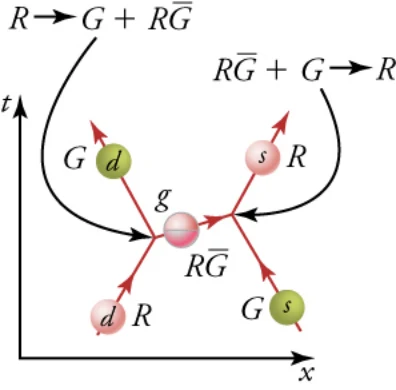
Note that quark flavor may have any color. For instance, in Figure 23.13, the down quark has a red color and a green color. In other words, colors are not specific to a particle quark flavor.
クォークのフレーバーはどの色も取りうることに注意せよ。たとえば図23.13では、ダウンクォークが赤の色と緑の色を持っている。言いかえれば、色は特定のクォークのフレーバーに固有ではない。
Hadrons and Leptonsハドロンとレプトン
Particles can be revealingly grouped according to what forces they feel between them. All particles (even those that are massless) are affected by gravity since gravity affects the space and time in which particles exist. All charged particles are affected by the electromagnetic force, as are neutral particles that have an internal distribution of charge (such as the neutron with its magnetic moment). Special names are given to particles that feel the strong and weak nuclear forces. Hadrons are particles that feel the strong nuclear force, whereas leptons are particles that do not. All particles feel the weak nuclear force. This means that hadrons are distinguished by being able to feel both the strong and weak nuclear forces. Leptons and hadrons are distinguished in other ways as well. Leptons are fundamental particles that have no measurable size, while hadrons are composed of quarks and have a diameter on the order of 10–15 m. Six particles, including the electron and neutrino, make up the list of known leptons. There are hundreds of complex particles in the hadron class, a few of which (including the proton and neutron) are listed in Table 23.4.
粒子は、そのあいだにどの力を感じるかで分けると多くのことがわかる。すべての粒子は(質量のないものでさえ)重力の影響を受ける。重力は粒子が存在する空間と時間そのものに作用するからである。電荷を持つすべての粒子は電磁気力の影響を受け、中性でも内部に電荷の分布を持つ粒子(磁気モーメントを持つ中性子など)も同じである。強い核力と弱い核力を感じる粒子には特別な名がある。ハドロンは強い核力を感じる粒子であり、レプトンは感じない粒子である。すべての粒子は弱い核力を感じる。つまりハドロンは、強い核力と弱い核力の両方を感じられる点で区別される。レプトンとハドロンは他の点でも区別される。レプトンは測れる大きさを持たない根本の粒子だが、ハドロンはクォークからできており、直径は10-15 mの桁である。電子とニュートリノを含む六つの粒子が、知られたレプトンの一覧を作る。ハドロンの類には何百もの込み入った粒子があり、そのいくつか(陽子と中性子を含む)を表23.4に挙げる。
[1]Neutrino masses may be zero. Experimental upper limits are given in parentheses. [2]Many other mesons known [3]Many other baryons known TABLE 23.4 List of Leptons and Hadrons.
[1]ニュートリノの質量は0かもしれない。実験による上限を括弧内に示す。 [2]他にも多くの中間子が知られている [3]他にも多くのバリオンが知られている 表23.4 レプトンとハドロンの一覧。
There are many more leptons, mesons, and baryons yet to be discovered and measured. The purpose of trying to uncover the smallest indivisible things in existence is to explain the world around us through forces and the interactions between particles, galaxies and objects. This is why a handful of scientists devote their life’s work to smashing together small particles.
まだ見つかっておらず測られてもいないレプトン・中間子・バリオンは他にも多くある。存在する最も小さな分けられないものを明らかにしようとするねらいは、力と、粒子・銀河・物どうしの相互作用によって身のまわりの世界を説明することにある。だからこそ、一握りの科学者が小さな粒子どうしをぶつけ合わせることに生涯の仕事を捧げるのである。
What internal structure makes a proton so different from an electron? The proton, like all hadrons, is made up of quarks. A few examples of hadron quark composition can be seen in Figure 23.14. As shown, each hadron is constructed of multiple quarks. As mentioned previously, the fractional quark charge in all four hadrons sums to the particle’s integral value. Also, notice that the color composition for each of the four particles adds to white. Each of the particles shown is constructed of up, down, and their antiquarks. This is not surprising, as the quarks strange, charmed, top, and bottom are found in only our most exotic particles.
どんな内部の構造が、陽子を電子とこれほど違うものにしているのか。すべてのハドロンと同じく、陽子はクォークからできている。ハドロンのクォークの組み合わせの例は図23.14に見られる。示されているように、どのハドロンも複数のクォークからできている。先に述べたとおり、四つのハドロンのいずれでも、クォークの分数の電荷の和は粒子の整数の値になる。また、四つの粒子それぞれの色の組み合わせの和が白になることにも注意せよ。示されているどの粒子も、アップ、ダウンと、その反クォークからできている。これは驚くにあたらない。ストレンジ、チャーム、トップ、ボトムのクォークは、最も風変わりな粒子にしか見つからないからである。
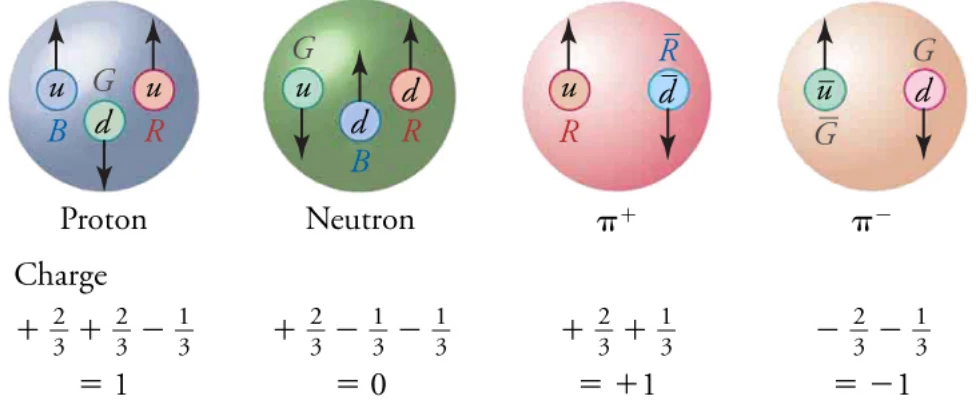
You may have noticed that while the proton and neutron in Figure 23.14 are composed of three quarks, both pions are comprised of only two quarks. This refers to a final delineation in particle structure. Particles with three quarks are called baryons. These are heavy particles that can decay into another baryon. Particles with only two quarks—a-quark–anti-quark pair—are called mesons. These are particles of moderate mass that cannot decay into the more massive baryons.
図23.14で陽子と中性子が三つのクォークからできているのに、二つのパイ中間子はクォークが二つしかないことに気づいたかもしれない。これは粒子の構造の最後の区分けにあたる。クォークが三つの粒子をバリオンという。他のバリオンへ崩壊しうる重い粒子である。クォークが二つだけの粒子——クォークと反クォークの対——を中間子という。中くらいの質量の粒子で、より重いバリオンへは崩壊できない。
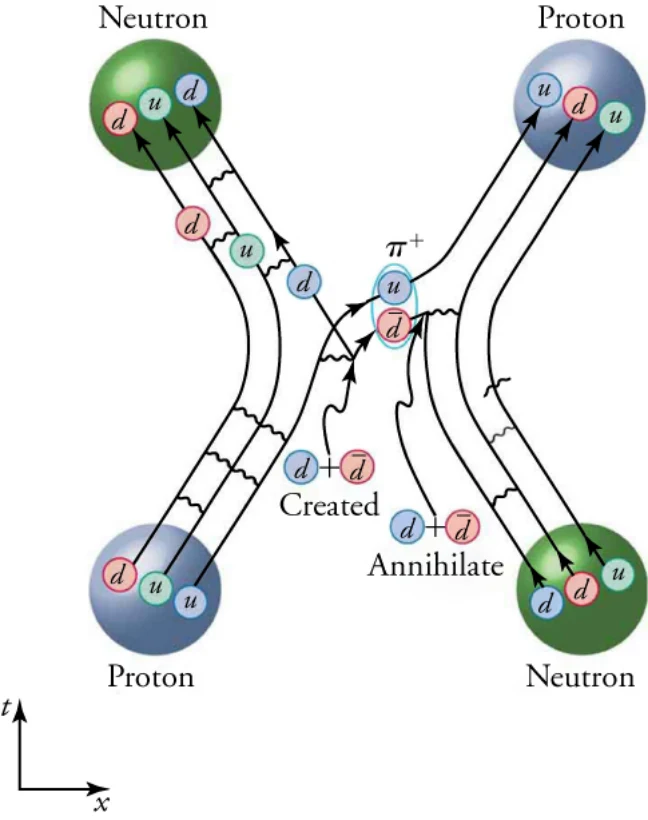
Before continuing, take a moment to view Figure 23.15. In this figure, you can see the strong force reimagined as a color force. The particles interacting in this figure are the proton and neutron, just as they were in Figure 23.6. This reenvisioning of the strong force as an interaction between colored quarks is the critical concept behind quantum chromodynamics.
先へ進む前に、図23.15を見てみよう。この図では、強い力が色の力として描き直されている。この図で相互作用しているのは陽子と中性子であり、図23.6と同じである。強い力を色のついたクォークどうしの相互作用として描き直すこの見方が、量子色力学の背後にある決定的な考えである。
Matter and Antimatter物質と反物質
809Antimatter was first discovered in the form of the positron, the positively charged electron. In 1932, American physicist Carl Anderson discovered the positron in cosmic ray studies. Through a cloud chamber modified to curve the trajectories of cosmic rays, Anderson noticed that the curves of some particles followed that of a negative charge, while others curved like a positive charge. However, the positive curve showed not the mass of a proton but the mass of an electron. This outcome is shown in Figure 23.16 and suggests the existence of a positively charged version of the electron, created by the destruction of solar photons.
反物質は最初、陽電子——正に帯電した電子——の形で見つかった。1932年、アメリカの物理学者カール・アンダーソンが宇宙線の研究で陽電子を発見した。宇宙線の道すじを曲げるように手を加えた霧箱で、アンダーソンは、ある粒子の曲がり方が負の電荷のものに従う一方、別のものは正の電荷のように曲がることに気づいた。しかし正に曲がるものが示したのは陽子の質量ではなく電子の質量だった。この結果は図23.16に示され、太陽の光子が壊れることで作られる、正に帯電した電子の相手の存在を示している。
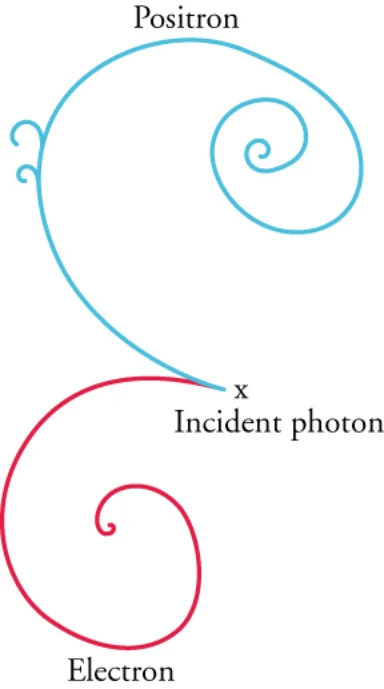
Antimatter is considered the opposite of matter. For most antiparticles, this means that they share the same properties as their original particles with the exception of their charge. This is why the positron can be considered a positive electron while the antiproton is considered a negative proton. The idea of an opposite charge for neutral particles (like the neutron) can be confusing, but it makes sense when considered from the quark perspective. Just as the neutron is composed of one up quark and two down quarks (of charge and , respectively), the antineutron is composed of one anti–up quark and two anti–down quarks (of charge and , respectively).
反物質は物質の反対のものとみなされる。ほとんどの反粒子では、電荷を除いてもとの粒子と同じ性質を持つということである。だから陽電子は正の電子、反陽子は負の陽子とみなせる。中性の粒子(中性子など)に反対の電荷があるという考えは分かりにくいかもしれないが、クォークの側から見れば筋が通る。中性子がアップクォーク一つとダウンクォーク二つ(電荷はそれぞれと)からできているのと同じように、反中性子は反アップクォーク一つと反ダウンクォーク二つ(電荷はそれぞれと)からできている。
While the overall charge of the neutron remains the same, its constituent particles do not!
中性子の全体の電荷は変わらないが、それを作る粒子は変わっているのである。
A word about antiparticles: Like regular particles, antiparticles could function just fine on their own. In fact, a universe made up of antimatter may operate just as our own matter-based universe does. However, we do not know fully whether this is the case. The reason for this is annihilation. Annihilation is the process of destruction that occurs when a particle and its antiparticle interact. As soon as two particles (like a positron and an electron) coincide, they convert their masses to energy through the equation . This mass-to-energy conversion, which typically results in photon release, happens instantaneously and makes it very difficult for scientists to study antimatter. That said, scientists have had success creating antimatter through high-energy particle collisions. Both antineutrons and antiprotons were created through accelerator experiments in 1956, and an anti–hydrogen atom was even created at CERN in 1995! As referenced in Figure 22.40, the annihilation of antiparticles is currently used in medical studies to determine the location of radioisotopes.
反粒子について一言。ふつうの粒子と同じく、反粒子もそれだけで何の問題もなくはたらきうる。実際、反物質でできた宇宙は、私たちの物質でできた宇宙と同じようにはたらくかもしれない。しかしそうなのかどうかは完全にはわかっていない。その理由は対消滅である。対消滅とは、粒子とその反粒子が出会うときに起こる破壊の過程である。二つの粒子(陽電子と電子など)が重なるやいなや、式によって質量をエネルギーに変える。ふつう光子が放たれるこの質量からエネルギーへの変換は瞬時に起こり、科学者が反物質を調べるのを非常に難しくしている。とはいえ、科学者は高エネルギーの粒子の衝突で反物質を作ることに成功してきた。反中性子も反陽子も1956年に加速器の実験で作られ、1995年にはCERNで反水素の原子まで作られた。図22.40で触れたように、反粒子の対消滅は今日、放射性同位体の位置を定める医療の研究に使われている。
Completing the Standard Model of the Atom原子の標準模型を仕上げる
The Standard Model of the atom refers to the current scientific view of the fundamental components and interacting forces of matter. The Standard Model (Figure 23.17) shows the six quarks that bind to form all hadrons, the six lepton particles already considered fundamental, the four carrier particles (or gauge bosons) that transmit forces between the leptons and quarks, and the recently added Higgs boson (which will be discussed shortly). This totals 17 fundamental particles, combinations of which are responsible for all known matter in our entire universe! When adding the antiquarks and antileptons, 31 components make up the Standard Model.
原子の標準模型とは、物質の根本の部品と、作用し合う力についての現在の科学の見方を指す。標準模型(図23.17)は、すべてのハドロンを作るように結びつく六つのクォーク、すでに根本のものとされる六つのレプトン、レプトンとクォークのあいだに力を伝える四つの運び手の粒子(すなわちゲージボソン)、そして最近加わったヒッグス粒子(まもなく論じる)を示す。合わせて17の根本の粒子であり、その組み合わせが私たちの宇宙全体の知られたすべての物質を作っている。反クォークと反レプトンを加えると、標準模型は31の部品からなる。
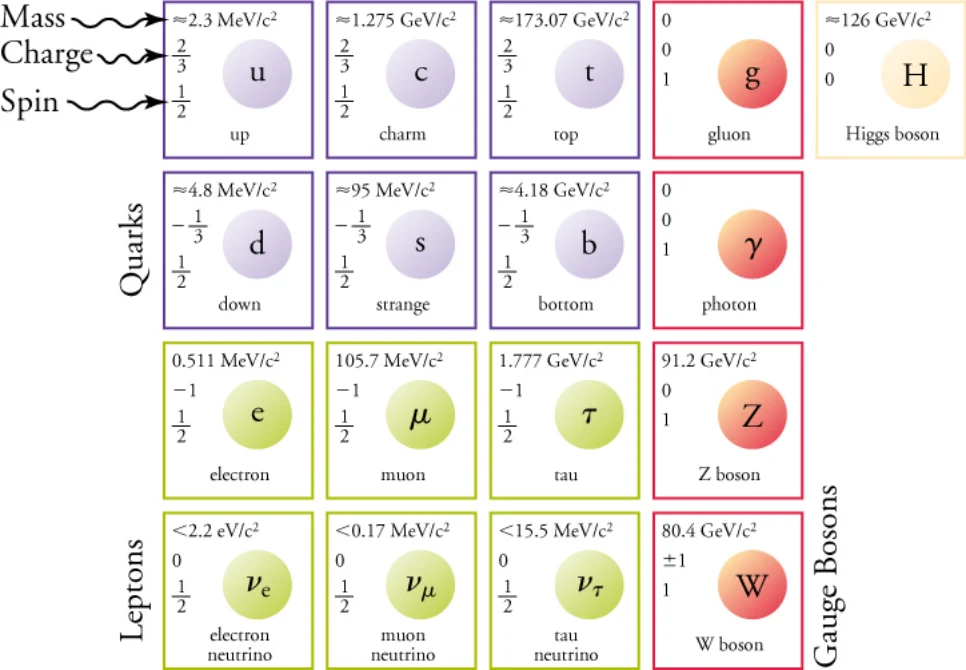
Figure 23.17 shows all particles within the Standard Model of the atom. Not only does this chart divide all known particles by color-coded group, but it also provides information on particle stability. Note that the color-coding system in this chart is separate from the red, green, and blue color labeling system of quarks. The first three columns represent the three families of matter. The first column, considered Family 1, represents particles that make up normal matter, constructing the protons, neutrons, and electrons that make up the common world. Family 2, represented from the charm quark to the muon neutrino, is comprised of particles that are more massive. The leptons in this group are less stable and more likely to decay. Family 3, represented by the third column, are more massive still and decay more quickly. The order of these families also conveniently represents the order in which these particles were discovered.
図23.17は原子の標準模型の中のすべての粒子を示す。この図表は知られたすべての粒子を色分けした群に分けるだけでなく、粒子の安定性についての情報も与える。この図表の色分けの仕組みは、クォークの赤・緑・青という色づけの仕組みとは別のものであることに注意せよ。最初の三つの列は物質の三つの家族を表す。第一の列、すなわち家族1は、ふつうの物質を作る粒子を表し、ありふれた世界を作る陽子・中性子・電子を組み立てる。チャームクォークからミューニュートリノまでで表される家族2は、より重い粒子からなる。この群のレプトンは安定でなく、崩壊しやすい。第三の列で表される家族3はさらに重く、より速く崩壊する。これらの家族の並びは、ちょうどこれらの粒子が発見された順にもなっている。
TIPS FOR SUCCESS Look for trends that exist within the Standard Model. Compare the charge of each particle. Compare the spin. How does mass relate to the model structure? Recognizing each of these trends and asking questions will yield more insight into the organization of particles and the forces that dictate particle relationships. Our understanding of the Standard Model is still young, and the questions you may have in analyzing the Standard Model may be some of the same questions that particle physicists are searching for answers to today!
学習のポイント 標準模型の中にある傾向を探そう。それぞれの粒子の電荷を比べよう。スピンを比べよう。質量はモデルの構造とどう関わるか。こうした傾向に気づき、問いを立てることで、粒子の並び方と、粒子どうしの関係を決める力について、より深い見通しが得られる。標準模型についての私たちの理解はまだ若く、標準模型を眺めて浮かぶ問いは、今日の素粒子物理の研究者が答えを探している問いと同じものかもしれない。
The Standard Model also summarizes the fundamental forces that exist as particles interact. A closer look at the Standard Model, as shown in Figure 23.18, reveals that the arrangement of carrier particles describes these interactions.
標準模型はまた、粒子が相互作用するときにはたらく基本の力もまとめている。図23.18のように標準模型をより近くで見ると、運び手の粒子の並び方がこれらの相互作用を述べていることがわかる。
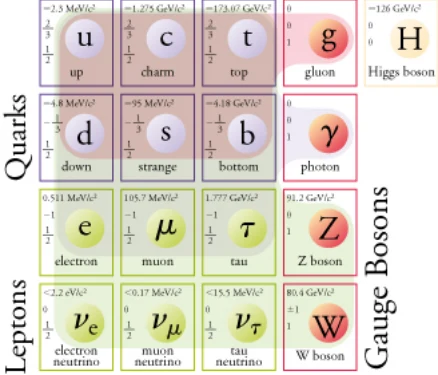
Each of the shaded areas represents a fundamental force and its constituent particles. The red shaded area shows all particles involved in the strong nuclear force, which we now know is due to quantum chromodynamics. The blue shaded area corresponds to the electromagnetic force, while the green shaded area corresponds to the weak nuclear force, which affects all quarks and leptons. The electromagnetic force and weak nuclear force are considered united by the electroweak force within the Standard Model. Also, because definitive evidence of the graviton is yet to be found, it is not included in the Standard Model.
網かけの領域はそれぞれ、一つの基本の力とそれに関わる粒子を表す。赤の網かけの領域は強い核力に関わるすべての粒子を示す。強い核力は今日、量子色力学によるものとわかっている。青の網かけの領域は電磁気力にあたり、緑の網かけの領域は弱い核力にあたる。弱い核力はすべてのクォークとレプトンに作用する。電磁気力と弱い核力は、標準模型の中では電弱力として統一されているとみなされる。また、重力子の決定的な証拠はまだ見つかっていないので、標準模型には含まれていない。
The Higgs Boson One interesting feature of the Standard Model shown in Figure 23.18 is that, while the gluon and photon have no mass, the Z and W bosons are very massive. What supplies these quickly moving particles with mass and not the gluons and photons? Furthermore, what causes some quarks to have more mass than others?
ヒッグス粒子 図23.18に示す標準模型の面白い特徴の一つは、グルーオンと光子には質量がないのに、ZボソンとWボソンは非常に重いことである。速く動くこれらの粒子に質量を与え、グルーオンと光子には与えないものは何か。さらに、あるクォークが他のクォークより重いのはなぜか。
In the 1960s, British physicist Peter Higgs and others speculated that the W and Z bosons were actually just as massless as the gluon and photon. However, as the W and Z bosons traveled from one particle to another, they were slowed down by the presence of a Higgs field, much like a fish swimming through water. The thinking was that the existence of the Higgs field would slow down the bosons, causing them to decrease in energy and thereby transfer this energy to mass. Under this theory, all particles pass through the Higgs field, which exists throughout the universe. The gluon and photon travel through this field as well but are able to do so unaffected.
1960年代、英国の物理学者ピーター・ヒッグスらは、WボソンとZボソンも実はグルーオンや光子と同じく質量がないのだと考えた。ただしWボソンとZボソンは、ある粒子から別の粒子へ進むあいだに、水の中を泳ぐ魚のように、ヒッグス場の存在によって遅くされる。ヒッグス場があればボソンは遅くなってエネルギーを減らし、そのエネルギーを質量に移す、という考えだった。この理論では、すべての粒子が、宇宙のいたるところにあるヒッグス場を通り抜ける。グルーオンと光子もこの場を通るが、影響を受けずに通れる。
The presence of a force from the Higgs field suggests the existence of its own carrier particle, the Higgs boson. This theorized boson interacts with all particles but gluons and photons, transferring force from the Higgs field. Particles with large mass (like the top quark) are more likely to receive force from the Higgs boson.
ヒッグス場からの力があるということは、それ自身の運び手の粒子、すなわちヒッグス粒子があることを示す。この理論の上のボソンは、グルーオンと光子を除くすべての粒子と相互作用し、ヒッグス場から力を移す。質量の大きな粒子(トップクォークなど)ほど、ヒッグス粒子から力を受けやすい。
While it is difficult to examine a field, it is somewhat simpler to find evidence of its carrier. On July 4, 2012, two groups of scientists at the LHC independently confirmed the existence of a Higgs-like particle. By examining trillions of proton–proton collisions at energies of 7 to 8 TeV, LHC scientists were able to determine the constituent particles that created the protons. In this data, scientists found a particle with similar mass, spin, parity, and interactions with other particles that matched the Higgs boson predicted decades prior. On March 13, 2013, the existence of the Higgs boson was tentatively confirmed by CERN. Peter Higgs and Francois Englert received the Nobel Prize in 2013 for the “theoretical discovery of a mechanism that contributes to our understanding of the origin and mass of subatomic particles.”
場を直接調べるのは難しいが、その運び手の証拠を見つけるのはいくぶんやさしい。2012年7月4日、LHCの二つの科学者の集団がそれぞれ独立に、ヒッグス粒子らしき粒子の存在を確かめた。7から8 TeVのエネルギーでの何兆回もの陽子どうしの衝突を調べることで、LHCの科学者は陽子を作っていた粒子を突き止められた。このデータの中に、何十年も前に予言されたヒッグス粒子と合う質量・スピン・パリティ・他の粒子との相互作用を持つ粒子を見つけたのである。2013年3月13日、CERNはヒッグス粒子の存在を暫定的に認めた。ピーター・ヒッグスとフランソワ・アングレールは、「亜原子粒子の起源と質量についての私たちの理解に寄与する機構の理論的な発見」により2013年のノーベル賞を受けた。
Particle Physicist If you have an innate desire to unravel life’s great mysteries and further understand the nature of the physical world, a career in particle physics may be for you!
素粒子物理の研究者 生命の大きな謎を解き明かし、物の世界の性質をさらに理解したいという生まれつきの欲があるなら、素粒子物理の道はあなたに向いているかもしれない。
Particle physicists have played a critical role in much of society’s technological progress. From lasers to computers, televisions to space missions, splitting the atom to understanding the DNA molecule to MRIs and PET scans, much of our modern society is based on the work done by particle physicists.
素粒子物理の研究者は、社会の技術の進歩の多くで決定的な役割を果たしてきた。レーザーからコンピュータ、テレビから宇宙の探査、原子を割ることからDNAの分子の理解、MRIやPETまで、現代社会の多くは素粒子物理の研究者の仕事の上に成り立っている。
While many particle physicists focus on specialized tasks in the fields of astronomy and medicine, the main goal of particle physics is to further scientists’ understanding of the Standard Model. This may mean work in government, industry, or academics. Within the government, jobs in particle physics can be found within the National Institute for Standards and Technology, Department of Energy, NASA, and Department of Defense. Both the electronics and computer industries rely on the expertise of particle physicists. College teaching and research positions can also be potential career opportunities for particle physicists, though they often require some postgraduate work as a prerequisite. In addition, many particle physicists are employed to work on high-energy colliders. Domestic collider labs include the Brookhaven National Laboratory in New York, the Fermi National Accelerator Laboratory near Chicago, and the SLAC National Accelerator Laboratory operated by Stanford University. For those who like to travel, work at international collider labs can be found at the CERN facility in Switzerland in addition to institutes like the Budker Institute of Nuclear Physics in Russia, DESY in Germany, and KEK in Japan.
天文や医療の分野で専門の仕事に取り組む素粒子物理の研究者も多いが、素粒子物理の主なねらいは標準模型についての科学者の理解を進めることである。それは政府・産業・学術のいずれの場での仕事にもなりうる。政府では、素粒子物理の仕事は国立標準技術研究所、エネルギー省、NASA、国防総省の中にある。電子産業もコンピュータ産業も、素粒子物理の研究者の専門の知識に頼っている。大学での教育と研究の職も素粒子物理の研究者の進路になりうるが、しばしば大学院の課程が前提になる。さらに、多くの素粒子物理の研究者が高エネルギーの衝突型加速器の仕事に就いている。国内の衝突型加速器の研究所には、ニューヨークのブルックヘブン国立研究所、シカゴ近くのフェルミ国立加速器研究所、スタンフォード大学が運営するSLAC国立加速器研究所がある。旅が好きなら、スイスのCERNの施設のほか、ロシアのブドカー核物理研究所、ドイツのDESY、日本のKEKといった機関で国際的な衝突型加速器の仕事も見つかる。
Shirley Jackson became the first African American woman to earn a Ph.D. from MIT back in 1973, and she went on to lead a highly successful career in the field of particle physics. Like Dr. Jackson, successful students of particle physics grow up with a strong curiosity in the world around them and a drive to continually learn more. If you are interested in exploring a career in particle physics, work to achieve good grades and SAT scores, and find time to read popular books on physics topics that interest you. While some math may be challenging, recognize that this is only a tool of physics and should not be considered prohibitive to the field. High-level work in particle physics often requires a Ph.D.; however, it is possible to find work with a master’s degree. Additionally, jobs in industry and teaching can be achieved with solely an undergraduate degree.
シャーリー・ジャクソンは1973年、アフリカ系アメリカ人の女性として初めてMITで博士号を取り、素粒子物理の分野で大きな成功を収めた道を歩んだ。ジャクソン博士と同じように、素粒子物理でうまくやる学生は、身のまわりの世界への強い好奇心と、学び続けたいという駆り立てを持って育つ。素粒子物理の道に興味があるなら、よい成績とSATの点を取れるよう努め、関心のある物理の話題についての一般向けの本を読む時間を作ろう。数学の一部は手強いかもしれないが、それは物理の道具にすぎず、この分野へ進む妨げとみなすべきではない。素粒子物理の高い水準の仕事にはしばしば博士号が要る。ただし修士号でも仕事は見つかる。さらに、産業や教育の仕事は学士号だけでも就ける。
What is the primary goal of all work in particle physics?
素粒子物理のすべての仕事の第一のねらいは何か。
a. The primary goal is to further our understanding of the Standard Model.b. The primary goal is to further our understanding of Rutherford’s model.c. The primary goal is to further our understanding of Bohr’s model.d. The primary goal is to further our understanding of Thomson’s model.
a. 第一のねらいは標準模型についての理解を進めることである。b. 第一のねらいはラザフォードのモデルについての理解を進めることである。c. 第一のねらいはボーアのモデルについての理解を進めることである。d. 第一のねらいはトムソンのモデルについての理解を進めることである。
Check Your Understanding理解の確認
8In what particle were quarks originally discovered?a. the electronb. the neutron
8クォークはもともとどの粒子の中で見つかったか。a. 電子b. 中性子
c. the protond. the photon
c. 陽子d. 光子
9Why was the existence of the charm quark speculated, even though no direct evidence of it existed?a. The existence of the charm quark was symmetrical with up and down quarks. Additionally, there were two known leptons at the time and only two quarks.b. The strange particle lacked the symmetry that existed with the up and down quarks. Additionally, there were four known leptons at the time and only three quarks.c. The bottom particle lacked the symmetry that existed with the up and down quarks. Additionally, there were two known leptons at the time and only two quarks.d. The existence of charm quarks was symmetrical with up and down quarks. Additionally, there were four known leptons at the time and only three quarks.
9直接の証拠がなかったのに、チャームクォークの存在が唱えられたのはなぜか。a. チャームクォークの存在はアップとダウンのクォークと対称だったから。さらに当時、知られたレプトンは二つで、クォークは二つしかなかったから。b. ストレンジの粒子には、アップとダウンのクォークにあった対称性が欠けていたから。さらに当時、知られたレプトンは四つで、クォークは三つしかなかったから。c. ボトムの粒子には、アップとダウンのクォークにあった対称性が欠けていたから。さらに当時、知られたレプトンは二つで、クォークは二つしかなかったから。d. チャームクォークの存在はアップとダウンのクォークと対称だったから。さらに当時、知られたレプトンは四つで、クォークは三つしかなかったから。
10What type of particle is the electron?a. The electron is a lepton.b. The electron is a hadron.
10電子はどの型の粒子か。a. 電子はレプトンである。b. 電子はハドロンである。
c. The electron is a baryon.d. The electron is an antibaryon.
c. 電子はバリオンである。d. 電子は反バリオンである。
11How do the number of fundamental particles differ between hadrons and leptons? a. Hadrons are constructed of at least three fundamental quark particles, while leptons are fundamental particles.
11根本の粒子の数は、ハドロンとレプトンとでどう違うか。 a. ハドロンは少なくとも三つの根本のクォークの粒子からできているが、レプトンは根本の粒子そのものである。
b. Hadrons are constructed of at least three fundamental quark particles, while leptons are constructed of two fundamental particles.c. Hadrons are constructed of at least two fundamental quark particles, while leptons are constructed of three fundamental particles.d. Hadrons are constructed of at least two fundamental quark particles, while leptons are fundamental particles.
b. ハドロンは少なくとも三つの根本のクォークの粒子からできているが、レプトンは二つの根本の粒子からできている。c. ハドロンは少なくとも二つの根本のクォークの粒子からできているが、レプトンは三つの根本の粒子からできている。d. ハドロンは少なくとも二つの根本のクォークの粒子からできているが、レプトンは根本の粒子そのものである。
12Does antimatter exist?a. nob. yes
12反物質は存在するか。a. しないb. する
13How does the deconstruction of a photon into an electron and a positron uphold the principles of mass and charge conservation?
13光子が電子と陽電子に分かれることは、質量と電荷の保存の原理をどう保っているか。
a. The sum of the masses of an electron and a positron is equal to the mass of the photon before pair production. The sum of the charges on an electron and a positron is equal to the zero charge of the photon.b. The sum of the masses of an electron and a positron is equal to the mass of the photon before pair production. The sum of the same charges on an electron and a positron is equal to the charge on a photon.c. During the particle production the total energy of the photon is converted to the mass of an electron and a positron. The sum of the opposite charges on the electron and positron is equal to the zero charge of the photon.d. During particle production, the total energy of the photon is converted to the mass of an electron and a positron. The sum of the same charges on an electron and a positron is equal to the charge on a photon.
a. 電子と陽電子の質量の和は、対生成の前の光子の質量に等しい。電子と陽電子の電荷の和は、光子の電荷0に等しい。b. 電子と陽電子の質量の和は、対生成の前の光子の質量に等しい。電子と陽電子の同じ電荷の和は、光子の電荷に等しい。c. 粒子が作られるあいだに、光子の全エネルギーが電子と陽電子の質量に変わる。電子と陽電子の反対の電荷の和は、光子の電荷0に等しい。d. 粒子が作られるあいだに、光子の全エネルギーが電子と陽電子の質量に変わる。電子と陽電子の同じ電荷の和は、光子の電荷に等しい。
14How many fundamental particles exist in the Standard Model, including the Higgs boson and the graviton (not yet observed)?
14ヒッグス粒子と(まだ観測されていない)重力子を含めて、標準模型には根本の粒子がいくつあるか。
a. 12b. 15c. 13d. 19
a. 12b. 15c. 13d. 19
15Why do gluons interact only with particles in the first two rows of the Standard Model?a. The leptons in the third and fourth rows do not have mass, but the gluons can interact between the quarks through gravity only.b. The leptons in the third and fourth rows do not have color, but the gluons can interact between quarks through color interactions only.c. The leptons in the third and fourth rows do not have spin, but the gluons can interact between quarks through spin interactions only.d. The leptons in the third and fourth rows do not have charge, but the gluons can interact between quarks through charge interactions only.
15グルーオンが標準模型の初めの二行の粒子としか相互作用しないのはなぜか。a. 三行目と四行目のレプトンは質量を持たないが、グルーオンは重力だけでクォークのあいだに相互作用できるから。b. 三行目と四行目のレプトンは色を持たないが、グルーオンは色の相互作用だけでクォークのあいだに相互作用できるから。c. 三行目と四行目のレプトンはスピンを持たないが、グルーオンはスピンの相互作用だけでクォークのあいだに相互作用できるから。d. 三行目と四行目のレプトンは電荷を持たないが、グルーオンは電荷の相互作用だけでクォークのあいだに相互作用できるから。
16What fundamental property is provided by particle interaction with the Higgs boson?a. chargeb. mass
16粒子がヒッグス粒子と相互作用することで与えられる根本の性質は何か。a. 電荷b. 質量
c. spind. color
c. スピンd. 色
17Considering the Higgs field, what differentiates more massive particles from less massive particles?a. More massive particles interact more with the Higgs field than the less massive particles.b. More massive particles interact less with the Higgs field than the less massive particles.
17ヒッグス場を考えるとき、質量の大きな粒子と小さな粒子を分けるものは何か。a. 質量の大きな粒子は、小さな粒子よりヒッグス場と多く相互作用する。b. 質量の大きな粒子は、小さな粒子よりヒッグス場と少なく相互作用する。
18What particles were launched into the proton during the original discovery of the quark?
18クォークが最初に発見されたとき、陽子へ撃ち込まれたのはどの粒子か。
a. bosonsb. electronsc. neutronsd. photons
a. ボソンb. 電子c. 中性子d. 光子