第23章素粒子物理Particle Physics原書 p.795–832
23.3 The Unification of Forces23.3 力の統一
SECTION LEARNING OBJECTIVES By the end of the section, you will be able to do the following:
この節の学習目標 この節を終えると、次のことができるようになる。
• Define a grand unified theory and its importance• Explain the evolution of the four fundamental forces from the Big Bang onward• Explain how grand unification theories can be tested
・大統一理論とは何か、それがなぜ重要かを述べる・ビッグバン以降の四つの基本の力の移り変わりを説明する・大統一理論をどう試せるかを説明する
Section Key Termsこの節の重要語
Big BangElectroweak Epochelectroweak theoryGrand Unification EpochGrand Unified TheoryInflationary EpochPlanck EpochQuark ErasuperforceTheory of Everything
電弱 ビッグバン 時期電弱理論大統一の時期大統一理論インフレーションの プランクの時期 クォークの時代 超力 時期 万物の理論
Understanding the Grand Unified Theory大統一理論を理解する
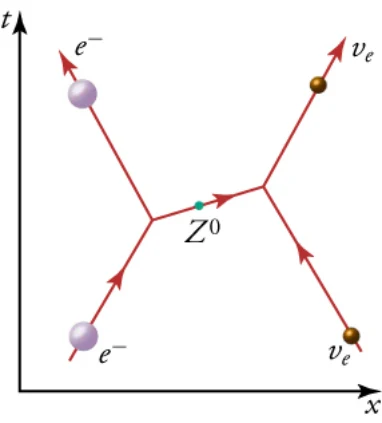
Present quests to show that the four basic forces are different manifestations of a single unified force that follow a long tradition. In the nineteenth century, the distinct electric and magnetic forces were shown to be intimately connected and are now collectively called the electromagnetic force. More recently, the weak nuclear force was united with the electromagnetic force. As shown in Figure 23.19, carrier particles transmit three of the four fundamental forces in very similar ways. With these considerations in mind, it is natural to suggest that a theory may be constructed in which the strong nuclear, weak nuclear, and electromagnetic forces are all unified. The search for a correct theory linking the forces, called the Grand Unified Theory (GUT), is explored in this section.
四つの基本の力が一つの統一された力の違う現れ方であることを示そうとする今日の探究は、長い伝統に連なる。19世紀には、別々だった電気の力と磁気の力が深く結びついていることが示され、今ではまとめて電磁気力と呼ばれる。より最近には、弱い核力が電磁気力と統一された。図23.19に示すように、四つの基本の力のうち三つは、運び手の粒子が非常によく似たやり方で伝える。こうしたことを考えると、強い核力・弱い核力・電磁気力がすべて統一される理論を組み立てられるのではないかと考えるのは自然である。力を結びつける正しい理論の探索——大統一理論(GUT)——をこの節で見ていく。
In the 1960s, the electroweak theory was developed by Steven Weinberg, Sheldon Glashow, and Abdus Salam. This theory proposed that the electromagnetic and weak nuclear forces are identical at sufficiently high energies. At lower energies, like those in our present-day universe, the two forces remain united but manifest themselves in different ways. One of the main consequences of the electroweak theory was the prediction of three short-range carrier particles, now known as the and bosons. Not only were three particles predicted, but the mass of each and boson was predicted to be 81 GeV/c2, and that of the boson was predicted to be 90 GeV/c2. In 1983, these carrier particles were observed at CERN with the predicted characteristics, including masses having those predicted values as given in Figure 23.17.
1960年代、電弱理論がスティーヴン・ワインバーグ、シェルドン・グラショー、アブドゥス・サラムによって作られた。この理論は、十分に高いエネルギーでは電磁気力と弱い核力が同じものであると唱えた。今日の宇宙のような低いエネルギーでは、二つの力は統一されたままだが、違う現れ方をする。電弱理論の主な帰結の一つは、届く範囲の短い三つの運び手の粒子——今日ボソンとボソンとして知られるもの——の予言だった。三つの粒子が予言されただけでなく、ボソンとボソンの質量はそれぞれ81 GeV/c2、ボソンの質量は90 GeV/c2と予言された。1983年、これらの運び手の粒子は、図23.17に示す予言どおりの質量を含め、予言された特徴とともにCERNで観測された。
How can forces be unified? They are definitely distinct under most circumstances. For example, they are carried by different particles and have greatly different strengths. But experiments show that at extremely short distances and at extremely high energies, the strengths of the forces begin to become more similar, as seen in Figure 23.20.
力はどうすれば統一されうるのか。たいていの状況では、力ははっきり別のものである。たとえば運び手の粒子が違い、強さも大きく違う。しかし実験が示すところでは、きわめて短い距離ときわめて高いエネルギーでは、力の強さは互いに近づき始める。図23.20に見るとおりである。
As discussed earlier, the short ranges and large masses of the weak carrier bosons require correspondingly high energies to create them. Thus, the energy scale on the horizontal axis of Figure 23.20 also corresponds to shorter and shorter distances (going from left to right), with 100 GeV corresponding to approximately 10−18 m, for example. At that distance, the strengths of the electromagnetic and weak nuclear forces are the same. To test this, energies of about 100 GeV are put into the system. When this occurs, the , , and carrier particles are created and released. At those and higher energies, the masses of the carrier particles become less and less relevant, and the boson in particular resembles the massless, chargeless photon. As further energy is added, the , , and particles are further transformed into massless carrier particles even more similar to photons and gluons.
先に論じたように、弱い力の運び手のボソンは届く範囲が短く質量が大きいので、それを作るにはそれに応じた高いエネルギーが要る。したがって図23.20の横軸のエネルギーの目盛りは、より短い距離にも対応する(左から右へ行くほど短くなる)。たとえば100 GeVはおよそ10-18 mにあたる。その距離では、電磁気力と弱い核力の強さは同じである。これを試すには、系にほぼ100 GeVのエネルギーを入れる。そうすると、、の運び手の粒子が作られて放たれる。そのエネルギーとそれ以上のエネルギーでは、運び手の粒子の質量はますます関係なくなり、とくにボソンは質量も電荷もない光子に似てくる。さらにエネルギーを加えると、、、そしてのこれらの粒子は、光子やグルーオンにいっそう似た質量のない運び手の粒子へと変わっていく。
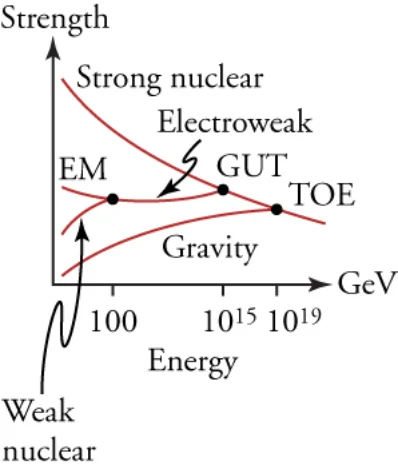
The extremely short distances and high energies at which the electroweak force becomes identical with the strong nuclear force are not reachable with any conceivable human-built accelerator. At energies of about 1014 GeV (16,000 J per particle), distances of about 10–30 m can be probed. Such energies are needed to test the theory directly, but these are about 1010 times higher than the maximum energy associated with the LHC, and the distances are about 1012 smaller than any structure we have direct knowledge of. This would be the realm of various GUTs, of which there are many, since there is no constraining evidence at these energies and distances. Past experience has shown that anytime you probe so many orders of magnitude further, you find the unexpected.
電弱力が強い核力と同じものになるきわめて短い距離と高いエネルギーは、人が作れるどんな加速器でも届かない。およそ1014 GeV(粒子あたり16,000 J)のエネルギーがあれば、およそ10-30 mの距離を探れる。理論を直接試すにはそうしたエネルギーが要るが、それはLHCに結びつく最大のエネルギーのおよそ1010倍であり、距離は私たちが直接知っているどんな構造よりもおよそ1012倍小さい。これがさまざまなGUTの領分であり、GUTは数多くある。このエネルギーと距離では、しぼり込む証拠がないからである。これまでの経験では、これほど何桁も先を探るときには、いつも予想外のものが見つかってきた。
While direct evidence of a GUT is not presently possible, that does not rule out the ability to assess a GUT through an indirect process. Current GUTs require various other events as a consequence of their theory. Some GUTs require the existence of magnetic monopoles, very massive individual north- and south-pole particles, which have not yet been proven to exist, while others require the use of extra dimensions. However, not all theories result in the same consequences. For example, disproving the existence of magnetic monopoles will not disprove all GUTs. Much of the science we accept in our everyday lives is based on different models, each with their own strengths and limitations. Although a particular model may have drawbacks, that does not necessarily mean that it should be discounted completely.
GUTの直接の証拠は今のところ得られないが、だからといって間接の道すじでGUTを評価できないわけではない。今日のGUTは、その理論の帰結としてさまざまな別の出来事を要求する。磁気単極子——非常に重い、N極だけ、S極だけの粒子——の存在を要求するGUTもあり、これはまだ存在が証明されていない。余分な次元を使うものもある。ただし、どの理論も同じ帰結を持つわけではない。たとえば磁気単極子の存在を否定しても、すべてのGUTを否定することにはならない。日々の暮らしで私たちが受け入れている科学の多くは、それぞれに強みと限界を持つ異なるモデルにもとづいている。あるモデルに難点があっても、それを完全に捨て去るべきだとは限らない。
One consequence of GUTs that can theoretically be assessed is proton decay. Multiple current GUTs hypothesize that the stable proton should actually decay at a lifetime of 1031 years. While this time is incredibly large (keep in mind that the age of the universe is less than 14 billion years), scientists at the Super-Kamiokande in Japan have used a 50,000-ton tank of water to search for its existence. The decay of a single proton in the Super-Kamiokande tank would be observed by a detector, thereby providing support for the predicting GUT model. However, as of 2014, 17 years into the experiment, decay is yet to be found. This time span equates to a minimum limit on proton life of years. While this result certainly does not support many grand unifying theories, an acceptable model may still exist.
GUTの帰結のうち、理論の上で評価できるものの一つが陽子の崩壊である。今日の複数のGUTは、安定なはずの陽子が実は1031年の寿命で崩壊すると仮定する。この時間は信じがたいほど長いが(宇宙の年齢が140億年に満たないことを心に留めよ)、日本のスーパーカミオカンデの科学者は5万トンの水槽を使ってその存在を探してきた。スーパーカミオカンデの水槽の中で陽子が一つ崩壊すれば検出器がそれをとらえ、予言するGUTのモデルを裏づけることになる。しかし2014年の時点、実験開始から17年たっても崩壊は見つかっていない。この年月は、陽子の寿命の下限が年であることに等しい。この結果は確かに多くの大統一理論を支持しないが、受け入れられるモデルがまだあるかもしれない。
TIPS FOR SUCCESS The Super-Kamiokande experiment is a clever use of proportional reasoning. Because it is not feasible to test for 1031 years in order for a single proton to decay, scientists chose instead to manipulate the proton–time ratio. If one proton decays in 1031 years, then in one year 10−31 protons will decay. With this in mind, if scientists wanted to test the proton decay theory in one year, they would need 1031 protons. While this is also unfeasible, the use of a 50,000-ton tank of water helps to bring both the wait time and proton number to within reason.
学習のポイント スーパーカミオカンデの実験は、比例の考えの巧みな使い方である。陽子が一つ崩壊するのを1031年待つのは無理なので、科学者は陽子と時間の比のほうを操ることにした。陽子が一つ1031年で崩壊するなら、一年では10-31個の陽子が崩壊する。これを踏まえると、陽子の崩壊の理論を一年で試したければ、1031個の陽子が要る。それも無理だが、5万トンの水槽を使えば、待ち時間も陽子の数も手の届く範囲に近づけられる。
The Standard Model and the Big Bang標準模型とビッグバン
Nature is full of examples where the macroscopic and microscopic worlds intertwine. Newton realized that the nature of gravity on Earth that pulls an apple to the ground could explain the motion of the moon and planets so much farther away. Decays of tiny nuclei explain the hot interior of the Earth. Fusion of nuclei likewise explains the energy of stars. Today, the patterns in particle physics seem to be explaining the evolution and character of the universe. And the nature of the universe has implications for unexplored regions of particle physics.
自然には、巨視的な世界と微視的な世界が絡み合う例が満ちている。ニュートンは、リンゴを地面へ引く地球の重力の性質が、はるかに遠い月や惑星の運動をも説明できると見抜いた。小さな原子核の崩壊が地球の熱い内部を説明する。同じように、原子核の融合が星のエネルギーを説明する。今日、素粒子物理の中の模様が、宇宙の移り変わりと姿を説明しつつあるように見える。そして宇宙の性質は、素粒子物理のまだ探られていない領域にも意味を持つ。
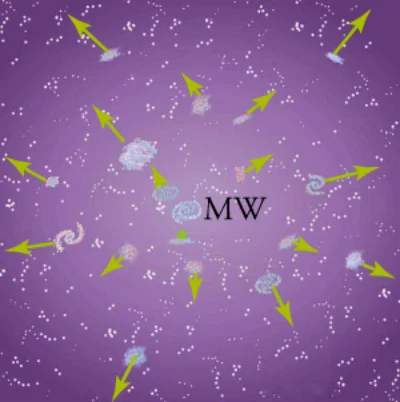
In 1929, Edwin Hubble observed that all but the closest galaxies surrounding our own had a red shift in their hydrogen spectra that was proportional to their distance from us. Applying the Doppler Effect, Hubble recognized that this meant that all galaxies were receding from our own, with those farther away receding even faster. Knowing that our place in the universe was no more unique than any other, the implication was clear: The space within the universe itself was expanding. Just like pen marks on an expanding balloon, everything in the universe was accelerating away from everything else.
1929年、エドウィン・ハッブルは、私たちの銀河のまわりの、最も近いものを除くすべての銀河で、水素のスペクトルの赤方偏移が私たちからの距離に比例していることを観測した。ドップラー効果を当てはめて、ハッブルはこれがすべての銀河が私たちから遠ざかっており、遠いものほど速く遠ざかることを意味すると見抜いた。宇宙での私たちの場所が他のどこより特別なわけではないと知っていれば、意味は明らかだった。宇宙そのものの中の空間が広がっているのである。膨らむ風船に打たれたペンの点と同じように、宇宙のあらゆるものが他のあらゆるものから加速しながら離れている。
Figure 23.21 shows how the recession of galaxies looks like the remnants of a gigantic explosion, the famous Big Bang. Extrapolating backward in time, the Big Bang would have occurred between 13 and 15 billion years ago, when all matter would have been at a single point. From this, questions instantly arise. What caused the explosion? What happened before the Big Bang? Was there a before, or did time start then? For our purposes, the biggest question relating to the Big Bang is this: How does the Big Bang relate to the unification of the fundamental forces?
図23.21は、銀河が遠ざかる様子が、巨大な爆発——有名なビッグバン——の名残のように見えることを示す。時間をさかのぼって外挿すると、ビッグバンは130億年から150億年前に起こり、そのときすべての物質は一点にあったことになる。ここからすぐに問いが生まれる。何がこの爆発を起こしたのか。ビッグバンの前に何があったのか。「前」はあったのか、それとも時間はそのとき始まったのか。私たちのねらいからすれば、ビッグバンに関わる最大の問いはこれである——ビッグバンは基本の力の統一とどう関わるのか。
To fully understand the conditions of the very early universe, recognize that as the universe contracts to the size of the Big Bang, changes will occur. The density and temperature of the universe will increase dramatically. As particles become closer together, they will become too close to exist as we know them. The high energies will create other, more unusual particles to exist in greater abundance. Knowing this, let’s move forward from the start of the universe, beginning with the Big Bang, as illustrated in Figure 23.22.
ごく初期の宇宙の条件を十分に理解するには、宇宙がビッグバンの大きさまで縮むにつれて何が変わるかを見てとる必要がある。宇宙の密度と温度は劇的に増す。粒子どうしが近づくと、私たちの知る形では存在できないほど近くなる。高いエネルギーは、他のもっと珍しい粒子をより多く存在させる。これを踏まえて、図23.22に描くように、ビッグバンに始まる宇宙のはじまりから時を追って進もう。
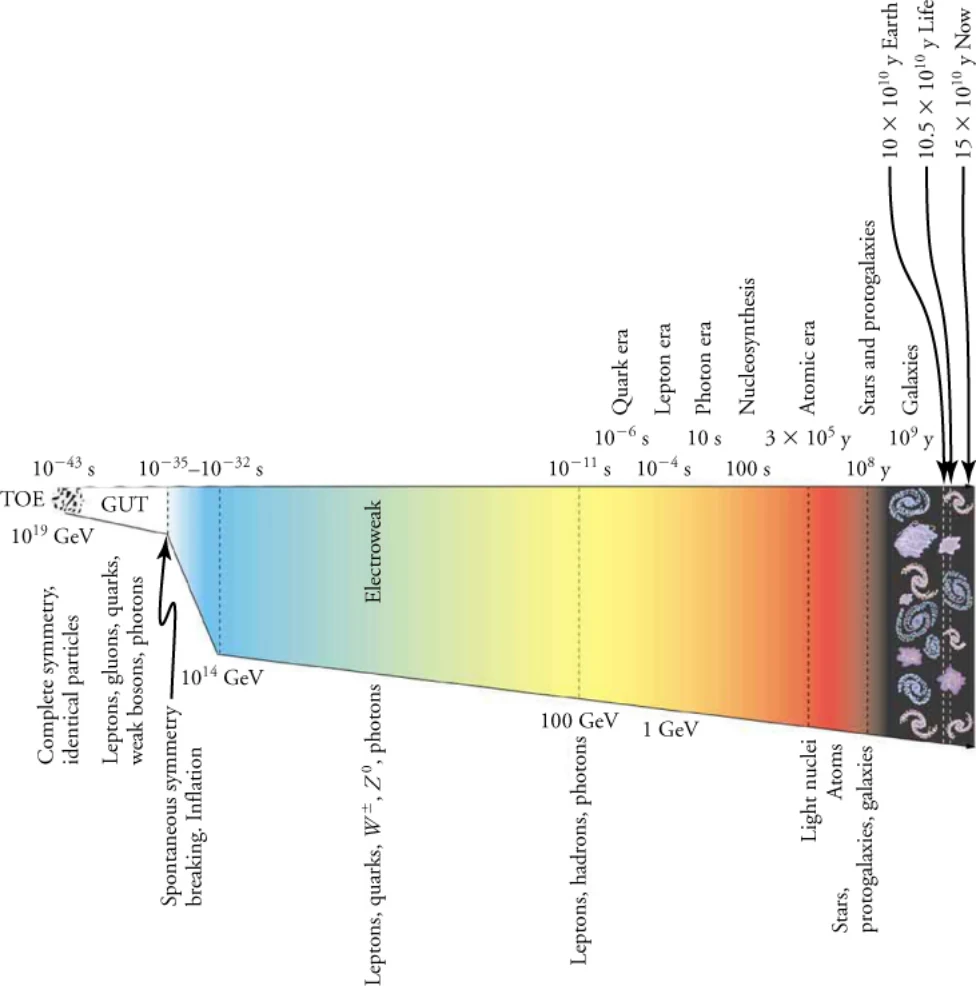
The Planck Epoch —Though scientists are unable to model the conditions of the Planck Epoch in the laboratory, speculation is that at this time compressed energy was great enough to reach the immense GeV necessary to unify gravity with all other forces. As a result, modern cosmology suggests that all four forces would have existed as one force, a hypothetical superforce as suggested by the Theory of Everything.
プランクの時期 ——科学者はプランクの時期の条件を実験室で再現できないが、この時期には、圧し縮められたエネルギーが、重力を他のすべての力と統一するのに要る途方もない GeVに達するほど大きかったと考えられている。その結果、現代の宇宙論は、四つの力すべてが一つの力——万物の理論が唱える仮の超力——として存在していたと考える。
The Grand Unification Epoch —As the universe expands, the temperatures necessary to maintain the superforce decrease. As a result, gravity separates, leaving the electroweak and strong nuclear forces together. At this time, the electromagnetic, weak, and strong forces are identical, matching the conditions requested in the Grand Unification Theory.
大統一の時期 ——宇宙が広がるにつれて、超力を保つのに要る温度は下がる。その結果、重力が分かれ、電弱力と強い核力がともに残る。このとき、電磁気力・弱い力・強い力は同じものであり、大統一理論が求める条件と合う。
The Inflationary Epoch —The separation of the strong nuclear force from the electroweak force during this time is thought to have been responsible for the massive inflation of the universe. Corresponding to the steep diagonal line on the left side of Figure 23.22, the universe may have expanded by a factor of or more in size. In fact, the expansion was so great during this time that it actually occurred faster than the speed of light! Unfortunately, there is little hope that we may be able to test the inflationary scenario directly since it occurs at energies near GeV, vastly greater than the limits of modern accelerators.
インフレーションの時期 ——この時期に強い核力が電弱力から分かれたことが、宇宙の巨大な膨張の原因だったと考えられている。図23.22の左側の急な斜めの線にあたり、宇宙は大きさで倍かそれ以上に広がったかもしれない。実際、この時期の膨張はあまりに大きく、光速より速く起こったのである。残念ながら、インフレーションの筋書きを直接試せる見込みはほとんどない。それは GeVに近いエネルギーで起こり、現代の加速器の限界をはるかに超えるからである。
The Electroweak Epoch —Now separated from both gravity and the strong nuclear force, the electroweak force exists as a singular force during this time period. As stated earlier, scientists are able to create the energies at this stage in the universe’s expansion, needing only 100 GeV, as shown in Figure 23.20. W and Z bosons, as well as the Higgs boson, are released during this time.
電弱の時期 ——重力からも強い核力からも分かれた電弱力は、この時期には一つの力として存在する。先に述べたとおり、図23.20に示すように100 GeVあればよいので、科学者は宇宙の膨張のこの段階のエネルギーを作れる。WボソンとZボソン、そしてヒッグス粒子がこの時期に放たれる。
The Quark Era —During the Quark Era, the universe has expanded and temperatures have decreased to the point at which all four fundamental forces have separated. Additionally, quarks began to take form as energies decreased.
クォークの時代 ——クォークの時代には、宇宙が広がって温度が下がり、四つの基本の力がすべて分かれた点に達している。さらに、エネルギーが下がるにつれてクォークが形をとり始めた。
As the universe expanded, further eras took place, allowing for the existence of hadrons, leptons, and photons, the fundamental particles of the standard model. Eventually, in nucleosynthesis, nuclei would be able to form, and the basic building blocks of atomic matter could take place. Using particle accelerators, we are very much working backwards in an attempt to understand the universe. It is encouraging to see that the macroscopic conditions of the Big Bang align nicely with our submicroscopic particle theory.
宇宙が広がるにつれ、さらに後の時代が訪れ、標準模型の根本の粒子であるハドロン・レプトン・光子が存在できるようになった。やがて元素合成で原子核ができるようになり、原子でできた物質の基本の組み立ての部品がそろいうるようになった。粒子加速器を使って、私たちはまさに時間をさかのぼりながら宇宙を理解しようとしている。ビッグバンという巨視的な条件が、微視より小さな粒子の理論とうまく合うのは心強い。
Check Your Understanding理解の確認
19Is there one grand unified theory or multiple grand unifying theories?a. one grand unifying theoryb. multiple grand unifying theories
19大統一理論は一つか、それとも複数あるか。a. 一つの大統一理論b. 複数の大統一理論
20In what manner is considered a precursor to the Grand Unified Theory?a. The grand unified theory seeks to relate the electroweak and strong nuclear forces to one another just as related energy and mass.b. The grand unified theory seeks to relate the electroweak force and mass to one another just as related energy and mass.c. The grand unified theory seeks to relate the mass and strong nuclear forces to one another just as related energy and mass.d. The grand unified theory seeks to relate gravity and strong nuclear force to one another, just as related energy and mass.
20は、どういう意味で大統一理論の先ぶれとみなされるか。a. がエネルギーと質量を結びつけたのと同じように、大統一理論は電弱力と強い核力を互いに結びつけようとするから。b. がエネルギーと質量を結びつけたのと同じように、大統一理論は電弱力と質量を互いに結びつけようとするから。c. がエネルギーと質量を結びつけたのと同じように、大統一理論は質量と強い核力を互いに結びつけようとするから。d. がエネルギーと質量を結びつけたのと同じように、大統一理論は重力と強い核力を互いに結びつけようとするから。
21List the following eras in order of occurrence from the Big Bang: Electroweak Epoch, Grand Unification Epoch, Inflationary Epoch, Planck Epoch, Quark Era.
21次の時代を、ビッグバンからの起こった順に並べよ——電弱の時期、大統一の時期、インフレーションの時期、プランクの時期、クォークの時代。
a. Quark Era, Grand Unification Epoch, Inflationary Epoch, Electroweak Epoch, Planck Epochb. Planck Epoch, Inflationary Epoch, Grand Unification Epoch, Electroweak Epoch, Quark Erac. Planck Epoch, Electroweak Epoch, Grand Unification Epoch, Inflationary Epoch, Quark Erad. Planck Epoch, Grand Unification Epoch, Inflationary Epoch, Electroweak Epoch, Quark Era
a. クォークの時代、大統一の時期、インフレーションの時期、電弱の時期、プランクの時期b. プランクの時期、インフレーションの時期、大統一の時期、電弱の時期、クォークの時代c. プランクの時期、電弱の時期、大統一の時期、インフレーションの時期、クォークの時代d. プランクの時期、大統一の時期、インフレーションの時期、電弱の時期、クォークの時代
22How did the temperature of the universe change as it expanded?a. The temperature of the universe increased.b. The temperature of the universe decreased.
22宇宙が広がるにつれて、その温度はどう変わったか。a. 宇宙の温度は上がった。b. 宇宙の温度は下がった。
c. The temperature of the universe first decreased and then increased.d. The temperature of the universe first increased and then decreased.
c. 宇宙の温度はまず下がり、それから上がった。d. 宇宙の温度はまず上がり、それから下がった。
23Under current conditions, is it possible for scientists to use particle accelerators to verify the Grand Unified Theory?
23今日の条件で、科学者が粒子加速器を使って大統一理論を確かめることはできるか。
a. No, there is not enough energy.b. Yes, there is enough energy.
a. いいえ、エネルギーが足りない。b. はい、エネルギーは足りている。
24Why are particles and antiparticles made to collide as shown in this image?
24この図のように粒子と反粒子を衝突させるのはなぜか。
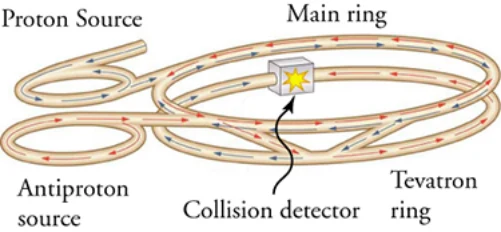
a. Particles and antiparticles have the same mass.b. Particles and antiparticles have different mass.
a. 粒子と反粒子は質量が同じだから。b. 粒子と反粒子は質量が違うから。
c. Particles and antiparticles have the same charge.
c. 粒子と反粒子は電荷が同じだから。
d. Particles and antiparticles have opposite charges.
d. 粒子と反粒子は電荷が反対だから。
25The existence of what particles were predicted as a consequence of the electroweak theory?a. fermionsb. Higgs bosons
25電弱理論の帰結として存在が予言されたのはどの粒子か。a. フェルミオンb. ヒッグス粒子
c. leptonsd. W+, W-, and Z0 bosons
c. レプトンd. W+、W-、Z0ボソン