第23章素粒子物理Particle Physics原書 p.795–832
23.1 The Four Fundamental Forces23.1 四つの基本の力
SECTION LEARNING OBJECTIVES By the end of the section, you will be able to do the following:
この節の学習目標 この節を終えると、次のことができるようになる。
• Define, describe, and differentiate the four fundamental forces• Describe the carrier particles and explain how their exchange transmits force• Explain how particle accelerators work to gather evidence about particle physics
・四つの基本の力を定め、述べ、見分ける・運び手の粒子を述べ、そのやりとりがどう力を伝えるかを説明する・粒子加速器が、素粒子物理の証拠を集めるためにどうはたらくかを説明する
Section Key Termsこの節の重要語
carrier particlecolliding beamcyclotronFeynman diagramgravitonparticle physicspionquantum electrodynamicssynchrotronboson
運び手の粒子 衝突ビーム サイクロトロン ファインマン図 重力子素粒子物理 パイ中間子 量子電磁力学 シンクロトロン ボソン
Despite the apparent complexity within the universe, there remain just four basic forces. These forces are responsible for all interactions known to science: from the very small to the very large to those that we experience in our day-to-day lives. These forces describe the movement of galaxies, the chemical reactions in our laboratories, the structure within atomic nuclei, and the cause of radioactive decay. They describe the true cause behind familiar terms like friction and the normal force. These four basic forces are known as fundamental because they alone are responsible for all observations of forces in nature. The four fundamental forces are gravity, electromagnetism, weak nuclear force, and strong nuclear force.
宇宙は一見込み入っているが、基本の力は四つしかない。この四つの力が、科学に知られるすべての相互作用の原因である——ごく小さなものから、ごく大きなもの、そして日々の暮らしで出会うものまで。これらの力は、銀河の動き、実験室での化学反応、原子核の中の構造、放射性崩壊の原因を述べる。摩擦や垂直抗力といったなじみの言葉の背後にある本当の原因も述べる。この四つの基本の力が「基本」と呼ばれるのは、自然の中の力についてのすべての観察の原因がこの四つだけだからである。四つの基本の力とは、重力・電磁気力・弱い核力・強い核力である。
bosonweak nuclear forceboson
ボソン 弱い核力 ボソン
Understanding the Four Forces四つの力を理解する
The gravitational force is most familiar to us because it describes so many of our common observations. It explains why a dropped ball falls to the ground and why our planet orbits the Sun. It gives us the property of weight and determines much about the motion of objects in our daily lives. Because gravitational force acts between all objects of mass and has the ability to act over large distances, the gravitational force can be used to explain much of what we observe and can even describe the motion of objects on astronomical scales! That said, gravity is incredibly weak compared to the other fundamental forces and is the weakest of all of the fundamental forces. Consider this: The entire mass of Earth is needed to hold an iron nail to the ground. Yet with a simple magnet, the force of gravity can be overcome, allowing the nail to accelerate upward through space.
重力は、ふだんの観察の多くを説明するので私たちに最もなじみが深い。落とした球が地面へ落ちる理由も、私たちの惑星が太陽のまわりを回る理由も、これで説明される。重力は重さという性質を与え、日々の暮らしでの物の運動の多くを決める。重力は質量を持つすべての物のあいだにはたらき、遠くまで届くので、観察されることの多くを説明するのに使え、天文の尺度での物の運動さえ述べられる。とはいえ、重力は他の基本の力に比べて信じがたいほど弱く、基本の力の中で最も弱い。考えてみよう——鉄の釘を地面に留めておくのに、地球の全質量が要る。それなのに、ただの磁石で重力に打ち勝ち、釘を上へ加速させられるのである。
The electromagnetic force is responsible for both electrostatic interactions and the magnetic force seen between bar magnets. When focusing on the electrostatic relationship between two charged particles, the electromagnetic force is known as the coulomb force. The electromagnetic force is an important force in the chemical and biological sciences, as it is responsible for molecular connections like ionic bonding and hydrogen bonding. Additionally, the electromagnetic force is behind the common physics forces of friction and the normal force. Like the gravitational force, the electromagnetic force is an inverse square law. However, the electromagnetic force does not exist between any two objects of mass, only those that are charged.
電磁気力は、静電気の相互作用と、棒磁石のあいだに見られる磁気の力の両方の原因である。二つの帯電した粒子のあいだの静電気の関係に注目するとき、電磁気力はクーロン力と呼ばれる。電磁気力は化学と生物の科学で重要な力である。イオン結合や水素結合のような分子どうしのつながりの原因だからである。さらに、電磁気力は摩擦や垂直抗力といった物理でおなじみの力の背後にもある。重力と同じく、電磁気力は逆二乗の法則に従う。ただし電磁気力は、質量を持つどの二つの物のあいだにもはたらくのではなく、電荷を持つ物のあいだにだけはたらく。
When considering the structure of an atom, the electromagnetic force is somewhat apparent. After all, the electrons are held in place by an attractive force from the nucleus. But what causes the nucleus to remain intact? After all, if all protons are positive, it makes sense that the coulomb force between the protons would repel the nucleus apart immediately. Scientists theorized that another force must exist within the nucleus to keep it together. They further theorized that this nuclear force must be significantly stronger than gravity, which has been observed and measured for centuries, and also stronger than the electromagnetic force, which would cause the protons to want to accelerate away from each other.
原子の構造を考えると、電磁気力はある程度はっきり見える。何しろ電子は原子核からの引き合う力でその場に留められている。しかし原子核がばらばらにならないのは何のおかげか。陽子がどれも正なら、陽子どうしのクーロン力が原子核をただちに反発してばらばらにするはずである。科学者たちは、原子核をまとめておく別の力が核の中にあるにちがいないと考えた。さらに、この核の力は、何世紀も観察され測られてきた重力よりはるかに強く、陽子どうしを離れる向きに加速させようとする電磁気力よりも強いはずだと考えた。
The strong nuclear force is an attractive force that exists between all nucleons. This force, which acts equally between proton-proton connections, proton-neutron connections, and neutron-neutron connections, is the strongest of all forces at short ranges. However, at a distance of 10–13 cm, or the diameter of a single proton, the force dissipates to zero. If the nucleus is large (it has many nucleons), then the distance between each nucleon could be much larger than the diameter of a single proton.
強い核力は、すべての核子のあいだにはたらく引き合う力である。この力は陽子と陽子、陽子と中性子、中性子と中性子のつながりに等しくはたらき、短い距離ではすべての力の中で最も強い。しかし10-13 cm、すなわち陽子一つの直径ほどの距離になると、この力は0まで消える。原子核が大きければ(核子が多ければ)、核子どうしの距離は陽子一つの直径よりはるかに大きくなりうる。
The weak nuclear force is responsible for beta decay, as seen in the equation
弱い核力はベータ崩壊の原因であり、次の式に見られる。
Recall that beta decay is when a beta particle is ejected from an atom. In order to accelerate away from the nucleus, the particle must be acted on by a force. Enrico Fermi was the first to envision this type of force. While this force is appropriately labeled, it remains stronger than the gravitational force. However, its range is even smaller than that of the strong force, as can be seen in Table 23.1. The weak nuclear force is more important than it may appear at this time, as will be addressed when we discuss quarks.
ベータ崩壊とは、原子からベータ粒子が放り出されることだったことを思い出そう。原子核から離れる向きに加速するには、その粒子に力がはたらかなければならない。この型の力を最初に思い描いたのはエンリコ・フェルミである。この力の名は「弱い」で妥当だが、それでも重力よりは強い。ただし届く範囲は強い力よりさらに短い。表23.1に見るとおりである。弱い核力は今の時点で見えるより重要であり、クォークを論じるときにそれを扱う。
Transmitting the Four Fundamental Forces四つの基本の力を伝える
Just as it troubled Einstein prior to formulating the gravitational field theory, the concept of forces acting over a distance had greatly troubled particle physicists. That is, how does one proton know that another exists?Furthermore, what causes one proton to make a second proton repel? Or, for that matter, what is it about a proton that causes a neutron to attract? These mysterious interactions were first considered by Hideki Yukawa in 1935 and laid the foundation for much of what we now understand about particle physics.
重力場の理論を立てる前のアインシュタインを悩ませたのと同じように、離れて作用する力という考えは素粒子物理の研究者を大いに悩ませてきた。つまり、ある陽子はもう一つの陽子の存在をどうやって知るのか。さらに、ある陽子が二つ目の陽子を反発させる原因は何か。あるいは、陽子の何が中性子を引きつけるのか。これらの謎めいた相互作用を最初に考えたのは1935年の湯川秀樹であり、それが今日の素粒子物理の理解の多くの土台となった。
Hideki Yukawa’s focus was on the strong nuclear force and, in particular, its incredibly short range. His idea was a blend of particles, relativity, and quantum mechanics that was applicable to all four forces. Yukawa proposed that the nuclear force is actually transmitted by the exchange of particles, called carrier particles, and that what we commonly refer to as the force’s field consists of these carrier particles. Specifically for the strong nuclear force, Yukawa proposed that a previously unknown particle, called a pion, is exchanged between nucleons, transmitting the force between them. Figure 23.3 illustrates how a pion would carry a force between a proton and a neutron.
湯川秀樹が注目したのは強い核力、とくにその信じがたいほど短い届く範囲だった。彼の考えは粒子と相対論と量子力学を混ぜたもので、四つの力すべてに当てはまるものだった。湯川は、核力は実は粒子のやりとりで伝えられると提案した。その粒子を運び手の粒子といい、私たちがふつう力の場と呼ぶものはこの運び手の粒子からなるとした。とくに強い核力について、湯川はそれまで知られていなかった粒子——パイ中間子——が核子どうしでやりとりされ、そのあいだに力を伝えると提案した。図23.3は、パイ中間子が陽子と中性子のあいだで力をどう運ぶかを示す。
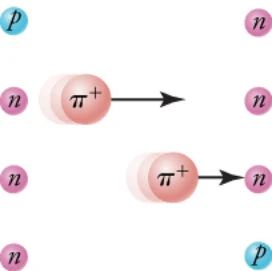
directly observable and is called a virtual particle. Note that the proton and neutron change identity in the process. The range of the force is limited by the fact that the pion can exist for only the short time allowed by the Heisenberg uncertainty principle. Yukawa used the finite range of the strong nuclear force to estimate the mass of the pion; the shorter the range, the larger the mass of the carrier particle.
直接には観測できず、仮想粒子と呼ばれる。この過程で陽子と中性子は正体を入れ替えることに注意せよ。この力の届く範囲は、パイ中間子がハイゼンベルクの不確定性原理の許す短い時間しか存在できないことで限られる。湯川は強い核力の届く範囲が有限であることを使ってパイ中間子の質量を見積もった。届く範囲が短いほど、運び手の粒子の質量は大きい。
In Yukawa’s strong force, the carrier particle is assumed to be transmitted at the speed of light and is continually transferred between the two nucleons shown. The particle that Yukawa predicted was finally discovered within cosmic rays in 1947. Its name, the pion, stands for pi meson, where meson means medium mass; it’s a medium mass because it is smaller than a nucleon but larger than an electron. Yukawa launched the field that is now called quantum chromodynamics, and the carrier particles are now called gluons due to their strong binding power. The reason for the change in the particle name will be explained when quarks are discussed later in this section.
湯川の強い力では、運び手の粒子は光速で伝えられ、示された二つの核子のあいだでたえずやりとりされると仮定される。湯川が予言した粒子は、1947年にようやく宇宙線の中で見つかった。その名パイ中間子(pion)はpi meson、すなわちπ中間子の意で、mesonは中くらいの質量を意味する。中くらいの質量というのは、核子より小さく電子より大きいからである。湯川は今日量子色力学と呼ばれる分野を切り開き、運び手の粒子は強く結びつける力にちなんで今ではグルーオンと呼ばれる。粒子の名が変わった理由は、この節でのちにクォークを論じるときに説明する。
As you may assume, the strong force is not the only force with a carrier particle. Nuclear decay from the weak force also requires a particle transfer. In the weak force are the following three: the weak negative carrier, W–; the weak positive carrier, W+; and the zero charge carrier, Z0. As we will see, Fermi inferred that these particles must carry mass, as the total mass of the products of nuclear decay is slightly larger than the total mass of all reactants after nuclear decay.
察しがつくとおり、運び手の粒子を持つのは強い力だけではない。弱い力による核の崩壊にも粒子のやりとりが要る。弱い力には次の三つがある。負の弱い運び手W-、正の弱い運び手W+、そして電荷0の運び手Z0である。のちに見るように、フェルミはこれらの粒子が質量を持つはずだと推し量った。核の崩壊の生成物の質量の合計が、崩壊後のすべての反応物の質量の合計よりわずかに大きいからである。
The carrier particle for the electromagnetic force is, not surprisingly, the photon. After all, just as a lightbulb can emit photons from a charged tungsten filament, the photon can be used to transfer information from one electrically charged particle to another. Finally, the graviton is the proposed carrier particle for gravity. While it has not yet been found, scientists are currently looking for evidence of its existence (see Boundless Physics: Searching for the Graviton).
電磁気力の運び手の粒子は、驚くまでもなく光子である。何しろ、電球が帯電したタングステンのフィラメントから光子を放てるのと同じように、光子は電気を帯びたある粒子から別の粒子へ情報を運べる。最後に、重力子は重力の運び手の粒子として提案されているものである。まだ見つかっていないが、科学者はその存在の証拠を探し続けている(「限りなき物理——重力子を探す」を見よ)。
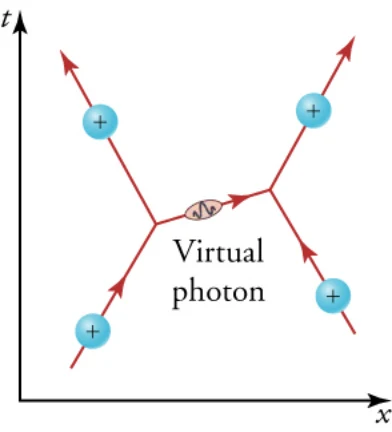
So how does a carrier particle transmit a fundamental force? Figure 23.4 shows a virtual photon transmitted from one positively charged particle to another. The transmitted photon is referred to as a virtual particle because it cannot be directly observed while transmitting the force. Figure 23.5 shows a way of graphing the exchange of a virtual photon between the two positively charged particles. This graph of time versus position is called a Feynman diagram, after the brilliant American physicist Richard Feynman (1918–1988), who developed it.
では、運び手の粒子はどうやって基本の力を伝えるのか。図23.4は、正に帯電した粒子から別の粒子へ伝えられる仮想光子を示す。伝えられる光子が仮想粒子と呼ばれるのは、力を伝えているあいだ直接には観測できないからである。図23.5は、二つの正に帯電した粒子のあいだの仮想光子のやりとりをグラフにする一つのやり方を示す。この時間対位置のグラフはファインマン図と呼ばれ、それを作り出した優れたアメリカの物理学者リチャード・ファインマン(1918–1988)にちなむ。
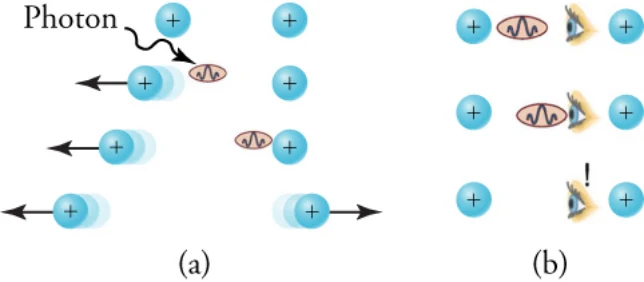
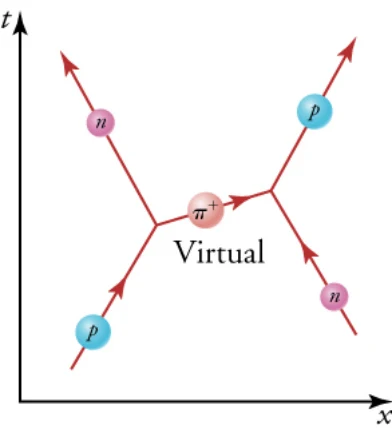
The Feynman diagram should be read from the bottom up to show the movement of particles over time. In it, you can see that the left proton is propelled leftward from the photon emission, while the right proton feels an impulse to the right when the photon is received. In addition to the Feynman diagram, Richard Feynman was one of the theorists who developed the field of quantum electrodynamics (QED), which further describes electromagnetic interactions on the submicroscopic scale. For this work, he shared the 1965 Nobel Prize with Julian Schwinger and S.I. Tomonaga. A Feynman diagram explaining the strong force interaction hypothesized by Yukawa can be seen in Figure 23.6. Here, you can see the change in particle type due to the exchange of the pi meson.
ファインマン図は、粒子の時間にわたる動きを見るために下から上へ読むべきである。図では、左の陽子が光子を放って左へ押しやられ、右の陽子が光子を受け取って右へ力積を受けるのが見てとれる。ファインマン図のほかにも、リチャード・ファインマンは量子電磁力学(QED)という分野を築いた理論家の一人である。それは微視より小さな尺度での電磁気の相互作用をさらに詳しく述べる。この仕事で彼は1965年のノーベル賞をジュリアン・シュウィンガー、朝永振一郎と分かち合った。湯川が唱えた強い力の相互作用を説明するファインマン図は図23.6に見られる。ここでは、π中間子のやりとりによる粒子の種類の変化が見てとれる。
The relative masses of the listed carrier particles describe something valuable about the four fundamental forces, as can be seen in Table 23.2. W bosons (consisting of and bosons) and Z bosons ( bosons), carriers of the weak nuclear force, are nearly 1,000 times more massive than pions, carriers of the strong nuclear force.Simultaneously, the distance that the weak nuclear force can be transmitted is approximately times the strong force transmission distance. Unlike carrier particles, which have a limited range, the photon is a massless particle that has no limit to the transmission distance of the electromagnetic force. This relationship leads scientists to understand that the yet-unfound graviton is likely massless as well.
挙げられた運び手の粒子の相対的な質量は、四つの基本の力について価値あることを述べている。表23.2に見るとおりである。弱い核力の運び手であるWボソン(ボソンとボソンからなる)とZボソン(ボソン)は、強い核力の運び手であるパイ中間子のほぼ1000倍重い。同時に、弱い核力が伝えられる距離は強い力の伝わる距離のおよそ倍である。届く範囲の限られた運び手の粒子と違い、光子は質量のない粒子で、電磁気力の伝わる距離に限りがない。この関係から、まだ見つかっていない重力子もおそらく質量を持たないと科学者は理解している。
Searching for the Graviton From Newton’s Universal Law of Gravitation to Einstein’s field equations, gravitation has held the focus of scientists for centuries. Given the discovery of carrier particles during the twentieth century, the importance of understanding gravitation has yet again gained the interest of prominent physicists everywhere.
重力子を探す ニュートンの万有引力の法則からアインシュタインの場の方程式まで、重力は何世紀も科学者の関心を集めてきた。20世紀に運び手の粒子が見つかったことで、重力を理解することの重要さは、各地の名だたる物理学者の関心を再び集めている。
With carrier particles discovered for three of the four fundamental forces, it is sensible to scientists that a similar particle, titled the graviton, must exist for the gravitational force. While evidence of this particle is yet to be uncovered, scientists are working diligently to discover its existence.
四つの基本の力のうち三つで運び手の粒子が見つかったのだから、重力にも重力子と名づけられた似た粒子があるはずだと考えるのは科学者にとって理にかなっている。この粒子の証拠はまだ見つかっていないが、科学者はその存在を突き止めようと精力的に取り組んでいる。
So what do scientists think about the unfound particle? For starters, the graviton (like the photon) should be a massless particle traveling at the speed of light. This is assumed because, like the electromagnetic force, gravity is an inverse square law, . Scientists also theorize that the graviton is an electrically neutral particle, as an empty space within the influence of gravity is chargeless.
では、この見つかっていない粒子について科学者はどう考えているのか。まず、重力子は(光子と同じく)質量がなく光速で進む粒子のはずである。電磁気力と同じく、重力も逆二乗の法則に従うからそう考えられる。また科学者は、重力子は電気的に中性の粒子だと理論的に考えている。重力のはたらく空っぽの空間に電荷はないからである。
However, because gravity is such a weak force, searching for the graviton has resulted in some unique methods. LIGO, the Laser Interferometer Gravitational-Wave Observatory, is one tool currently being utilized (see Figure 23.7). While searching for a gravitational wave to find a carrier particle may seem counterintuitive, it is similar to the approach taken by Planck and Einstein to learn more about the photon. According to wave-particle duality, if a gravitational wave can be found, the graviton should be present along with it. Predicted by Einstein’s theory of general relativity, scientists have been monitoring binary star systems for evidence of these gravitational waves.
しかし重力はこれほど弱い力なので、重力子の探索には独特のやり方が採られてきた。レーザー干渉計重力波観測所LIGOは、今使われている道具の一つである(図23.7を見よ)。運び手の粒子を見つけるのに重力波を探すのは直感に反するように思えるかもしれないが、それは光子についてもっと知るためにプランクとアインシュタインが採った道すじと似ている。波と粒子の二重性によれば、重力波が見つかれば、それとともに重力子もあるはずである。アインシュタインの一般相対論が予言したこの重力波の証拠を求めて、科学者は連星系を監視してきた。
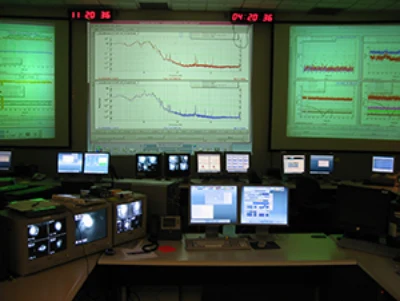
Particle accelerators like the Large Hadron Collider (LHC) are being used to search for the graviton through high-energy collisions. While scientists at the LHC speculate that the particle may not exist long enough to be seen, evidence of its prior existence, like footprints in the sand, can be found through gaps in projected energy and momentum.
大型ハドロン衝突型加速器(LHC)のような粒子加速器は、高いエネルギーの衝突によって重力子を探すのに使われている。LHCの科学者は、この粒子は見えるほど長くは存在しないかもしれないと見ているが、砂の上の足跡のように、かつてそこにあった証拠は、予測されるエネルギーと運動量の欠けとして見つかりうる。
Some scientists are even searching the remnants of the Big Bang in an attempt to find the graviton. By observing the cosmic background radiation, they are looking for anomalies in gravitational waves that would provide information about the gravity particles that existed at the start of our universe.
ビッグバンの名残を調べて重力子を見つけようとする科学者さえいる。宇宙背景放射を観測して、宇宙の始まりに存在した重力の粒子についての情報を与えてくれるような重力波の異常を探しているのである。
Regardless of the method used, scientists should know the graviton once they find it. A massless, chargeless particle with a spin of 2 and traveling at the speed of light—there is no other particle like it. Should it be found, its discovery would surely be considered by future generations to be on par with those of Newton and Einstein.
どのやり方を使うにせよ、重力子が見つかれば科学者にはそれとわかるはずである。質量がなく、電荷を持たず、スピンが2で、光速で進む粒子——そんな粒子は他にない。もし見つかれば、その発見は後の世代からニュートンやアインシュタインの発見と並ぶものとみなされるにちがいない。
Why are binary star systems used by LIGO to find gravitational waves?a. Binary star systems have high temperature.b. Binary star systems have low density.
LIGOが重力波を見つけるのに連星系を使うのはなぜか。a. 連星系は温度が高いから。b. 連星系は密度が低いから。
c. Binary star systems contain a large amount of mass, but because they are orbiting each other, the gravitational field between the two is much less.d. Binary star systems contain a large amount of mass. As a result, the gravitational field between the two is great.
c. 連星系は大きな質量を含むが、互いに回り合っているので、二つのあいだの重力場ははるかに小さいから。d. 連星系は大きな質量を含む。その結果、二つのあいだの重力場は大きいから。
Accelerators Create Matter From Energy加速器はエネルギーから物質を作る
Before looking at all the particles that make up our universe, let us first examine some of the machines that create them. The fundamental process in creating unknown particles is to accelerate known particles, such as protons or electrons, and direct a beam of them toward a target. Collisions with target nuclei provide a wealth of information, such as information obtained by Rutherford in the gold foil experiment. If the energy of the incoming particles is large enough, new matter can even be created in the collision. The more energy input or ΔE, the more matter m can be created, according to mass energy equivalence . Limitations are placed on what can occur by known conservation laws, such as conservation of mass-energy, momentum, and charge. Even more interesting are the unknown limitations provided by nature. While some expected reactions do occur, others do not, and still other unexpected reactions may appear. New laws are revealed, and the vast majority of what we know about particle physics has come from accelerator laboratories. It is the particle physicist’s favorite indoor sport.
私たちの宇宙を作るすべての粒子を見る前に、まずそれらを作る機械のいくつかを見よう。知られていない粒子を作る基本の過程は、陽子や電子など知られた粒子を加速し、その束を的へ向けることである。的の原子核との衝突は、ラザフォードが金箔の実験で得たような豊かな情報を与える。入ってくる粒子のエネルギーが十分大きければ、衝突で新しい物質さえ作られうる。入れるエネルギーΔEが大きいほど、質量とエネルギーの同等性によって、作られる物質mも多くなる。何が起こりうるかは、質量とエネルギーの保存、運動量の保存、電荷の保存といった知られた保存則で制限される。さらに面白いのは、自然が与える知られていない制限である。予想された反応のいくつかは起こるが、他のものは起こらず、さらに予想外の反応が現れることもある。新しい法則が明らかになり、素粒子物理について私たちが知ることの大部分は加速器の研究所から来ている。それは素粒子物理の研究者の大好きな屋内競技である。
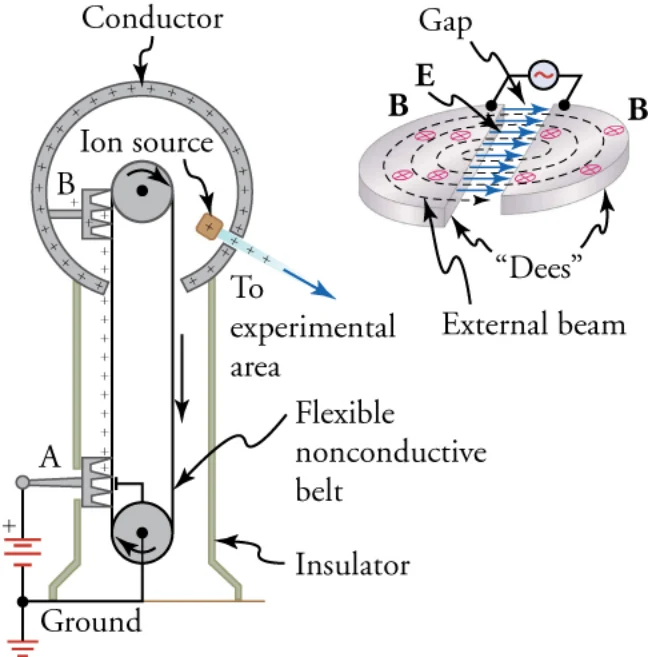
Our earliest model of a particle accelerator comes from the Van de Graaff generator. The relatively simple device, which you have likely seen in physics demonstrations, can be manipulated to produce potentials as great as 50 million volts. While these machines do not have energies large enough to produce new particles, analysis of their accelerated ions was instrumental in exploring several aspects of the nucleus.
粒子加速器の最も初期の型はヴァン・デ・グラーフ起電機である。物理の実演で見たことがあるだろうこの比較的簡単な装置は、5000万ボルトもの電位を作れるように仕立てられる。この機械は新しい粒子を作れるほどのエネルギーは持たないが、加速したイオンの分析は、原子核のいくつもの面を探るのに役立った。
Another equally famous early accelerator is the cyclotron, invented in 1930 by the American physicist, E.O. Lawrence (1901–1958). Figure 23.8 is a visual representation with more detail. Cyclotrons use fixed-frequency alternating electric fields to accelerate particles. The particles spiral outward in a magnetic field, making increasingly larger radius orbits during acceleration. This clever arrangement allows the successive addition of electric potential energy with each loop. As a result, greater particle energies are possible than in a Van de Graaff generator.
同じく有名なもう一つの初期の加速器がサイクロトロンで、1930年にアメリカの物理学者E・O・ローレンス(1901–1958)が発明した。図23.8はより詳しく描いたものである。サイクロトロンは振動数の決まった交流の電場で粒子を加速する。粒子は磁場の中で外へ渦を巻き、加速されながら半径のより大きな軌道を描く。この巧みな仕組みによって、一周ごとに電位のエネルギーを次々に加えられる。その結果、ヴァン・デ・グラーフ起電機より大きな粒子のエネルギーが得られる。
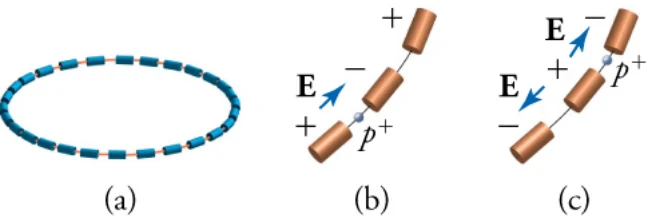
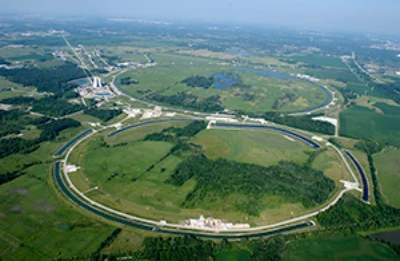
A synchrotron is a modification of the cyclotron in which particles continually travel in a fixed-radius orbit, increasing speed each time. Accelerating voltages are synchronized with the particles to accelerate them, hence the name. Additionally, magnetic field strength is increased to keep the orbital radius constant as energy increases. A ring of magnets and accelerating tubes, as shown in Figure 23.9, are the major components of synchrotrons. High-energy particles require strong magnetic fields to steer them, so superconducting magnets are commonly employed. Still limited by achievable magnetic field strengths, synchrotrons need to be very large at very high energies since the radius of a high-energy particle’s orbit is very large.
シンクロトロンはサイクロトロンを改めたもので、粒子は半径の決まった軌道をたえず回り、そのたびに速さを増す。加速の電圧は粒子と同期させて加速するので、この名がある。さらに、エネルギーが増しても軌道の半径を一定に保つために磁場の強さも増される。図23.9に示す磁石と加速の管の輪が、シンクロトロンの主な部品である。エネルギーの高い粒子を曲げるには強い磁場が要るので、超伝導の磁石がよく使われる。それでも実現できる磁場の強さに限りがあるため、非常に高いエネルギーではシンクロトロンは非常に大きくなければならない。エネルギーの高い粒子の軌道の半径が非常に大きいからである。
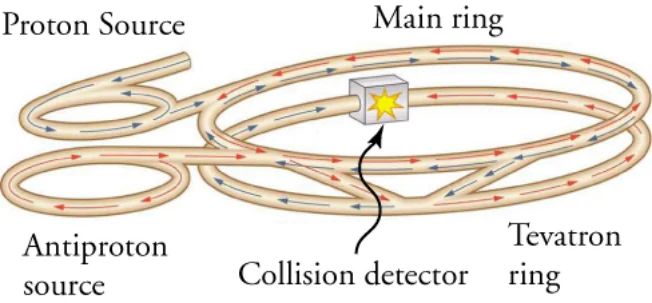
To further probe the nucleus, physicists need accelerators of greater energy and detectors of shorter wavelength. To do so requires not only greater funding but greater ingenuity as well. Colliding beams used at both the Fermi National Accelerator Laboratory (Fermilab; see Figure 23.11) near Chicago and the LHC in Switzerland are designed to reduce energy loss in particle collisions. Typical stationary particle detectors lose a large amount of energy to the recoiling target struck by the accelerating particle. By providing head-on collisions between particles moving in opposite directions, colliding beams make it possible to create particles with momenta and kinetic energies near zero. This allows for particles of greater energy and mass to be created. Figure 23.10 is a schematic representation of this effect. In addition to circular accelerators, linear accelerators can be used to reduce energy radiation losses. The Stanford Linear Accelerator Center (now called the SLAC National Accelerator Laboratory) in California is home to the largest such accelerator in the world.
原子核をさらに探るには、物理学者はより大きなエネルギーの加速器と、より短い波長の検出器を必要とする。そのためには、より多くの資金だけでなく、より大きな工夫も要る。シカゴ近くのフェルミ国立加速器研究所(フェルミ研究所。図23.11を見よ)とスイスのLHCの両方で使われている衝突ビームは、粒子の衝突でのエネルギーの損失を減らすように作られている。ふつうの止まった的の検出器では、加速された粒子にたたかれて跳ね返る的に多くのエネルギーが逃げる。逆向きに動く粒子どうしを正面衝突させることで、衝突ビームは運動量と運動エネルギーがほぼ0の粒子を作れるようにする。これによって、よりエネルギーと質量の大きな粒子を作れる。図23.10はこの効果の略図である。円形の加速器のほかに、エネルギーが放射で逃げるのを減らすために線形加速器も使える。カリフォルニアのスタンフォード線形加速器センター(今はSLAC国立加速器研究所)には、この型で世界最大の加速器がある。
Check Your Understanding理解の確認
1Which of the four forces is responsible for radioactive decay?a. the electromagnetic forceb. the gravitational force
1放射性崩壊の原因になるのは四つの力のうちどれか。a. 電磁気力b. 重力
c. the strong nuclear forced. the weak nuclear force
c. 強い核力d. 弱い核力
2What force or forces exist between an electron and a proton?
2電子と陽子のあいだにはどの力、あるいはどの力の組み合わせがはたらくか。
a. the strong nuclear force, the electromagnetic force, and gravityb. the weak nuclear force, the strong nuclear force, and gravity
a. 強い核力、電磁気力、重力b. 弱い核力、強い核力、重力
c. the weak nuclear force, the strong nuclear force, and the electromagnetic forced. the weak nuclear force, the electromagnetic force, and gravity
c. 弱い核力、強い核力、電磁気力d. 弱い核力、電磁気力、重力
3What is the proposed carrier particle for the gravitational force?a. bosonb. graviton
3重力の運び手の粒子として提案されているのは何か。a. ボソンb. 重力子
c. gluond. photon
c. グルーオンd. 光子
4What is the relationship between the mass and range of a carrier particle?a. Range of a carrier particle is inversely proportional to its mass.b. Range of a carrier particle is inversely proportional to square of its mass.c. Range of a carrier particle is directly proportional to its mass.d. Range of a carrier particle is directly proportional to square of its mass.
4運び手の粒子の質量と届く範囲の関係はどうなっているか。a. 運び手の粒子の届く範囲はその質量に反比例する。b. 運び手の粒子の届く範囲はその質量の2乗に反比例する。c. 運び手の粒子の届く範囲はその質量に比例する。d. 運び手の粒子の届く範囲はその質量の2乗に比例する。
5What type of particle accelerator uses fixed-frequency oscillating electric fields to accelerate particles?a. cyclotronb. synchrotron
5振動数の決まった振動する電場で粒子を加速するのはどの型の粒子加速器か。a. サイクロトロンb. シンクロトロン
c. betatrond. Van de Graaff accelerator
c. ベータトロンd. ヴァン・デ・グラーフ加速器
6How does the expanding radius of the cyclotron provide evidence of particle acceleration?a. A constant magnetic force is exerted on particles at all radii. As the radius increases, the velocity of the particle must increase to maintain this constant force.b. A constant centripetal force is exerted on particles at all radii. As the radius increases, the velocity of the particle must decrease to maintain this constant force.c. A constant magnetic force is exerted on particles at all radii. As the radius increases, the velocity of the particle must decrease to maintain this constant force.d. A constant centripetal force is exerted on particles at all radii. As the radius increases, the velocity of the particle must increase to maintain this constant force.
6サイクロトロンで半径が広がることは、粒子が加速されている証拠になぜなるのか。a. どの半径でも粒子には一定の磁気の力がはたらく。半径が増えると、この一定の力を保つために粒子の速度は増えなければならないから。b. どの半径でも粒子には一定の向心力がはたらく。半径が増えると、この一定の力を保つために粒子の速度は減らなければならないから。c. どの半径でも粒子には一定の磁気の力がはたらく。半径が増えると、この一定の力を保つために粒子の速度は減らなければならないから。d. どの半径でも粒子には一定の向心力がはたらく。半径が増えると、この一定の力を保つために粒子の速度は増えなければならないから。
7Which of the four forces is responsible for the structure of galaxies?a. electromagnetic forceb. gravity
7銀河の構造の原因になるのは四つの力のうちどれか。a. 電磁気力b. 重力
c. strong nuclear forced. weak nuclear force
c. 強い核力d. 弱い核力