第21章光の量子的な性質The Quantum Nature of Light原書 p.711–742
21.2 Einstein and the Photoelectric Effect21.2 アインシュタインと光電効果
SECTION LEARNING OBJECTIVES By the end of this section, you will be able to do the following:
この節の学習目標 この節を終えると、次のことができるようになる。
• Describe Einstein’s explanation of the photoelectric effect• Describe how the photoelectric effect could not be explained by classical physics• Calculate the energy of a photoelectron under given conditions• Describe use of the photoelectric effect in biological applications, photoelectric devices and movie soundtracks
・アインシュタインによる光電効果の説明を述べる・光電効果が古典物理では説明できなかったことを述べる・与えられた条件のもとで光電子のエネルギーを計算する・生物学の応用、光電の装置、映画のサウンドトラックでの光電効果の使い方を述べる
Section Key Termsこの節の重要語
electric eyephotoelectric effectphotoelectronphoton
電気の目光電効果光電子光子
The Photoelectric Effect光電効果
Teacher Support教員向けの補助
[EL]Ask the students what they think the term photoelectric means. How does the term relate to its definition?
[EL]photoelectric(光電の)という語が何を意味すると思うかを生徒に尋ねる。この語はその定義とどう関係するか。
When light strikes certain materials, it can eject electrons from them. This is called the photoelectric effect, meaning that light (photo) produces electricity. One common use of the photoelectric effect is in light meters, such as those that adjust the automatic iris in various types of cameras. Another use is in solar cells, as you probably have in your calculator or have seen on a rooftop or a roadside sign. These make use of the photoelectric effect to convert light into electricity for running different devices.
光がある種の材料にあたると、そこから電子をたたき出すことがある。これを光電効果という。光(photo)が電気を生むという意味である。光電効果のよくある使い道の一つが、いろいろな型のカメラの自動絞りを調節するような露出計である。もう一つが太陽電池で、たぶん電卓にあるか、屋根や道路脇の標識で見たことがあるだろう。これらは光電効果を使って光を、いろいろな装置を動かす電気へ変える。
Revolutionary Properties of the Photoelectric Effect光電効果の革命的な性質
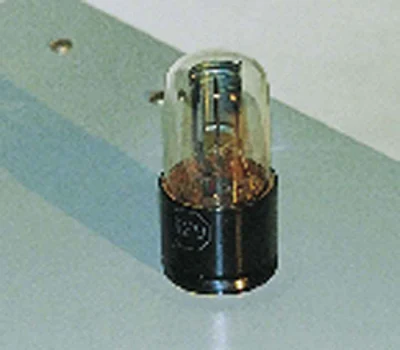
When Max Planck theorized that energy was quantized in a blackbody radiator, it is unlikely that he would have recognized just how revolutionary his idea was. Using tools similar to the light meter in Figure 21.5, it would take a scientist of Albert Einstein’s stature to fully discover the implications of Max Planck’s radical concept.
マックス・プランクが黒体の放射体でエネルギーが量子化されていると理論化したとき、自分の考えがどれほど革命的かを彼が見抜いていたとは思えない。図21.5の露出計に似た道具を使って、マックス・プランクの過激な考えの含みを完全に見いだすには、アルベルト・アインシュタインほどの人物を要した。
Through careful observations of the photoelectric effect, Albert Einstein realized that there were several characteristics that could be explained only if EM radiation is itself quantized. While these characteristics will be explained a bit later in this section, you can already begin to appreciate why Einstein’s idea is very important. It means that the apparently continuous stream of energy in an EM wave is actually not a continuous stream at all. In fact, the EM wave itself is actually composed of tiny quantum packets of energy called photons.
光電効果の注意深い観察を通して、アルベルト・アインシュタインは、電磁放射そのものが量子化されている場合にのみ説明できる特徴がいくつもあることに気づいた。この特徴はこの節で少しあとに説明するが、アインシュタインの考えがなぜとても重要かは、もう分かり始めているだろう。それは、電磁波の一見連続なエネルギーの流れが、実はまったく連続な流れではないという意味である。実のところ、電磁波そのものが、光子と呼ばれる小さな量子のエネルギーの包みでできている。
In equation form, Einstein found the energy of a photon or photoelectron to be
式で書けば、アインシュタインは光子、すなわち光電子のエネルギーを
where E is the energy of a photon of frequency f and h is Planck’s constant. A beam from a flashlight, which to this point had been considered a wave, instead could now be viewed as a series of photons, each providing a specific amount of energy see Figure 21.6. Furthermore, the amount of energy within each individual photon is based upon its individual frequency, as dictated by As a result, the total amount of energy provided by the beam could now be viewed as the sum of all frequency-dependent photon energies added together.
と見いだした。ここでEは振動数fの光子のエネルギー、hはプランク定数である。ここまで波とみなされてきた懐中電灯の光束は、いまや一連の光子として見られ、そのそれぞれが決まった量のエネルギーを与える。図21.6を見よ。さらに、個々の光子の中のエネルギーの量は、が決めるとおり、その個々の振動数にもとづく。その結果、光束が与えるエネルギーの総量は、振動数に依存するすべての光子のエネルギーを足し合わせたものとして見られるようになった。
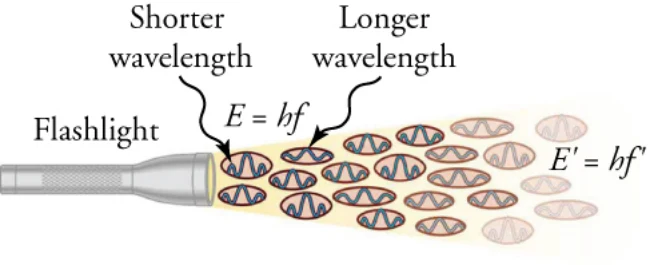
, where h is Planck’s constant and f is the frequency of the EM radiation. Higher intensity means more photons per unit area per second. The flashlight emits large numbers of photons of many different frequencies, hence others have energy , and so on.
である。ここでhはプランク定数、fは電磁放射の振動数である。強さが大きいとは、単位面積あたり毎秒の光子が多いということである。懐中電灯は多くの違う振動数の光子を大量に放つので、他のものはエネルギーを持つ、という具合である。
Just as with Planck’s blackbody radiation, Einstein’s concept of the photon could take hold in the scientific community only if it could succeed where classical physics failed. The photoelectric effect would be a key to demonstrating Einstein’s brilliance.
プランクの黒体放射と同じく、アインシュタインの光子の概念も、古典物理が失敗したところで成功できてはじめて科学の世界に根づきえた。光電効果はアインシュタインの卓越を示す鍵となった。
Consider the following five properties of the photoelectric effect. All of these properties are consistent with the idea that individual photons of EM radiation are absorbed by individual electrons in a material, with the electron gaining the photon’s energy. Some of these properties are inconsistent with the idea that EM radiation is a simple wave. For simplicity, let us consider what happens with monochromatic EM radiation in which all photons have the same energy hf.
光電効果の次の五つの性質を考えよう。これらの性質はすべて、電磁放射の個々の光子が材料の個々の電子に吸収され、電子が光子のエネルギーを得るという考えと辻褄が合う。これらの性質のいくつかは、電磁放射が単なる波だという考えとは辻褄が合わない。単純にするために、すべての光子が同じエネルギーhfを持つ単色の電磁放射で何が起こるかを考えよう。
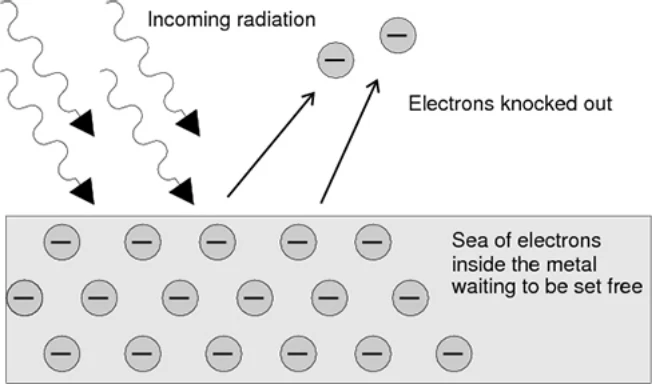
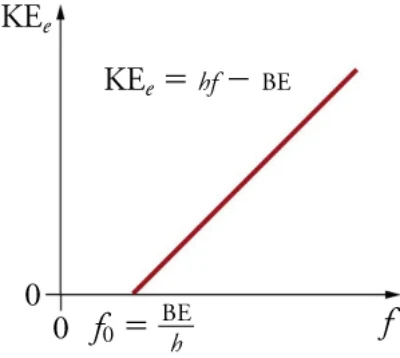
1. If we vary the frequency of the EM radiation falling on a clean metal surface, we find the following: For a given material, there is a threshold frequency f0 for the EM radiation below which no electrons are ejected, regardless of intensity. Using the photon model, the explanation for this is clear. Individual photons interact with individual electrons. Thus if the energy of an individual photon is too low to break an electron away, no electrons will be ejected. However, if EM radiation were a simple wave, sufficient energy could be obtained simply by increasing the intensity.2. Once EM radiation falls on a material, electrons are ejected without delay. As soon as an individual photon of sufficiently high frequency is absorbed by an individual electron, the electron is ejected. If the EM radiation were a simple wave, several minutes would be required for sufficient energy to be deposited at the metal surface in order to eject an electron.3. The number of electrons ejected per unit time is proportional to the intensity of the EM radiation and to no other characteristic. High-intensity EM radiation consists of large numbers of photons per unit area, with all photons having the same characteristic energy, hf. The increased number of photons per unit area results in an increased number of electrons per unit area ejected.4. If we vary the intensity of the EM radiation and measure the energy of ejected electrons, we find the following: The maximum kinetic energy of ejected electrons is independent of the intensity of the EM radiation. Instead, as noted in point 3 above, increased intensity results in more electrons of the same energy being ejected. If EM radiation were a simple wave, a higher intensity could transfer more energy, and higher-energy electrons would be ejected.5. The kinetic energy KE of an ejected electron equals the photon energy minus the binding energy BE of the electron in the specific material. An individual photon can give all of its energy to an electron. The photon’s energy is partly used to break the electron away from the material. The remainder goes into the ejected electron’s kinetic energy. In equation form, this is given by
1. きれいな金属の面にあたる電磁放射の振動数を変えると、次のことが分かる。決まった材料には、それより下では強さによらず電子がたたき出されない、電磁放射のしきい振動数f0がある。光子のモデルを使えば、この説明ははっきりしている。個々の光子が個々の電子と作用し合う。したがって、個々の光子のエネルギーが電子を引き離すには低すぎれば、電子はたたき出されない。しかし電磁放射が単なる波なら、単に強さを上げるだけで十分なエネルギーを得られるはずである。2. いったん電磁放射が材料にあたれば、電子は遅れなくたたき出される。十分に高い振動数の個々の光子が個々の電子に吸収されるやいなや、電子はたたき出される。電磁放射が単なる波なら、電子をたたき出すのに十分なエネルギーが金属の面に溜まるには数分が要るはずである。3. 単位時間にたたき出される電子の数は、電磁放射の強さに比例し、他のどんな特徴にもよらない。強い電磁放射は、単位面積あたり多数の光子からなり、どの光子も同じ特有のエネルギーhfを持つ。単位面積あたりの光子の数が増えれば、単位面積あたりたたき出される電子の数も増える。4. 電磁放射の強さを変えてたたき出された電子のエネルギーを測ると、次のことが分かる。たたき出された電子の最大の運動エネルギーは、電磁放射の強さによらない。かわりに、上の3で述べたとおり、強さが増せば同じエネルギーの電子がより多くたたき出される。電磁放射が単なる波なら、強さが増せばより多くのエネルギーを移せ、より高いエネルギーの電子がたたき出されるはずである。5. たたき出された電子の運動エネルギーKEは、光子のエネルギーから、その特定の材料での電子の結合エネルギーBEを引いたものに等しい。個々の光子はそのエネルギーをすべて電子に与えうる。光子のエネルギーの一部は電子を材料から引き離すのに使われる。残りはたたき出された電子の運動エネルギーになる。式で書けば
where is the maximum kinetic energy of the ejected electron, is the photon’s energy, and BE is the binding energy of the electron to the particular material. The binding energy is also often called the work function of the material. This equation explains the properties of the photoelectric effect quantitatively and demonstrates that BE is the minimum amount of energy necessary to eject an electron. If the energy supplied is less than BE, the electron cannot be ejected. The binding energy can also be written as where is the threshold frequency for the particular material. Figure 21.8 shows a graph of maximum versus the frequency of incident EM radiation falling on a particular material.
となる。ここではたたき出された電子の最大の運動エネルギー、は光子のエネルギー、BEはその特定の材料への電子の結合エネルギーである。結合エネルギーはしばしばその材料の仕事関数とも呼ばれる。この式は光電効果の性質を量的に説明し、BEが電子をたたき出すのに必要な最小のエネルギーであることを示す。与えられるエネルギーがBEより小さければ、電子はたたき出されない。結合エネルギーはとも書ける。ここではその特定の材料のしきい振動数である。図21.8は、ある材料にあたる入射電磁放射の振動数に対する最大ののグラフを示す。
TIPS FOR SUCCESS The following five pieces of information can be difficult to follow without some organization. It may be useful to create a table of expected results of each of the five properties, with one column showing the classical wave model result and one column showing the modern photon model result.The table may look something like Table 21.1
学習のポイント 次の五つの情報は、整理しないと追いにくい。五つの性質それぞれについて、古典の波のモデルの結果を示す列と、現代の光子のモデルの結果を示す列を持つ、期待される結果の表を作ると役に立つだろう。表は表21.1のようになるだろう。
VIRTUAL PHYSICSシミュレーションPhotoelectric Effect光電効果
In this demonstration (https://openstax.org/l/28photoelectric), see how light knocks electrons off a metal target, and recreate the experiment that spawned the field of quantum mechanics.
この実演(https://openstax.org/l/28photoelectric)で、光が金属の的から電子をたたき出す様子を見て、量子力学という分野を生んだ実験を再現しよう。
GRASP CHECK In the circuit provided, what are the three ways to increase the current?a. increase the intensity, increase the wavelength, alter the targetb. decrease the intensity, increase the wavelength, alter the target
理解の確認 用意された回路で、電流を増やす三つのやり方はどれか。a. 強さを上げる、波長を長くする、的を変えるb. 強さを下げる、波長を長くする、的を変える
c. decrease the intensity, decrease the wavelength, alter the targetd. increase the intensity, decrease the wavelength, alter the target
c. 強さを下げる、波長を短くする、的を変えるd. 強さを上げる、波長を短くする、的を変える
Photon Energy and the Photoelectric Effect: A Violet Light (a) What is the energy in joules and electron volts of a photon of 420-nm violet light? (b) What is the maximum kinetic energy of electrons ejected from calcium by 420 nm violet light, given that the binding energy of electrons for calcium metal is 2.71 eV?Strategy
光子のエネルギーと光電効果:紫の光 (a)420 nmの紫の光の光子のエネルギーは、ジュールと電子ボルトでいくらか。(b)カルシウム金属の電子の結合エネルギーが2.71 eVだとして、420 nmの紫の光がカルシウムからたたき出す電子の最大の運動エネルギーはいくらか。方針
To solve part (a), note that the energy of a photon is given by . For part (b), once the energy of the photon is calculated, it is a straightforward application of to find the ejected electron’s maximum kinetic energy, since BE is given.
(a)を解くには、光子のエネルギーがで与えられることに注意する。(b)では、光子のエネルギーが計算できれば、BEが与えられているので、をそのまま当てはめてたたき出された電子の最大の運動エネルギーを求められる。
Solution for (a)(a)の解答
Photon energy is given by
光子のエネルギーは次で与えられる。
Since we are given the wavelength rather than the frequency, we solve the familiar relationship for the frequency, yielding
振動数でなく波長が与えられているので、なじみの関係を振動数について解くと
Combining these two equations gives the useful relationship
となる。この二つの式を組み合わせると、次の役に立つ関係が得られる。
Now substituting known values yields
分かっている値を代入すると
Converting to eV, the energy of the photon is
eVに直すと、光子のエネルギーは
Solution for (b)(b)の解答
Finding the kinetic energy of the ejected electron is now a simple application of the equation . Substituting the photon energy and binding energy yields
たたき出された電子の運動エネルギーを求めるのは、いまや式を当てはめるだけである。光子のエネルギーと結合エネルギーを代入すると
Discussion考察
The energy of this 420 nm photon of violet light is a tiny fraction of a joule, and so it is no wonder that a single photon would be difficult for us to sense directly—humans are more attuned to energies on the order of joules. But looking at the energy in electron volts, we can see that this photon has enough energy to affect atoms and molecules. A DNA molecule can be broken with about 1 eV of energy, for example, and typical atomic and molecular energies are on the order of eV, so that the photon in this example could have biological effects, such as sunburn. The ejected electron has rather low energy, and it would not travel far, except in a vacuum. The electron would be stopped by a retarding potential of only 0.26 eV, a slightly larger KE than calculated above. In fact, if the photon wavelength were longer and its energy less than 2.71 eV, then the formula would give a negative kinetic energy, an impossibility. This simply means that the 420 nm photons with their 2.96 eV energy are not much above the frequency threshold. You can see for yourself that the threshold wavelength is 458 nm (blue light). This means that if calcium metal were used in a light meter, the meter would be insensitive to wavelengths longer than those of blue light. Such a light meter would be completely insensitive to red light, for example.
この420 nmの紫の光の光子のエネルギーは1ジュールのごくわずかな一部であり、一つの光子を私たちが直接感じ取るのが難しいのも無理はない。人はジュールの程度のエネルギーによりなじんでいる。しかし電子ボルトで見れば、この光子が原子や分子に影響するのに十分なエネルギーを持つことが分かる。たとえばDNAの分子はおよそ1 eVのエネルギーで切れるし、典型的な原子と分子のエネルギーはeVの程度なので、この例の光子は日焼けのような生物学的な効果を持ちうる。たたき出された電子はかなり低いエネルギーしか持たず、真空中でなければ遠くまでは進まない。この電子は、上で計算したKEよりわずかに大きいだけの0.26 eVの減速する電位で止められる。実のところ、光子の波長がもっと長くてそのエネルギーが2.71 eVより小さければ、この式は負の運動エネルギーを与えることになり、それはありえない。これは単に、2.96 eVのエネルギーを持つ420 nmの光子が、振動数のしきいをさほど上回っていないという意味である。しきいの波長が458 nm(青い光)であることは自分で確かめられる。これは、光電池にカルシウム金属を使うと、その計器は青い光より長い波長には感じないという意味である。そうした露出計は、たとえば赤い光にはまったく感じないだろう。
Practice Problems練習問題
10What is the longest-wavelength EM radiation that can eject a photoelectron from silver, given that the bonding energy is 4.73 eV ? Is this radiation in the visible range?a. 2.63 × 10⁻⁷ m; No, the radiation is in microwave region.b. 2.63 × 10⁻⁷ m; No, the radiation is in visible region.c. 2.63 × 10⁻⁷ m; No, the radiation is in infrared region.d. 2.63 × 10⁻⁷ m; No, the radiation is in ultraviolet region.
10銀の結合エネルギーが4.73 eVだとして、銀から光電子をたたき出せる最も長い波長の電磁放射はいくらか。この放射は可視の範囲にあるか。a. 2.63 × 10⁻⁷ m。いいえ、この放射はマイクロ波の領域にある。b. 2.63 × 10⁻⁷ m。いいえ、この放射は可視の領域にある。c. 2.63 × 10⁻⁷ m。いいえ、この放射は赤外の領域にある。d. 2.63 × 10⁻⁷ m。いいえ、この放射は紫外の領域にある。
11What is the maximum kinetic energy in eV of electrons ejected from sodium metal by 450-nm EM radiation, given that the binding energy is 2.28 eV?
11ナトリウム金属の結合エネルギーが2.28 eVだとして、450 nmの電磁放射がナトリウム金属からたたき出す電子の最大の運動エネルギーはeVでいくらか。
a. 0.48 Vb. 0.82 eVc. 1.21 eVd. 0.48 eV
a. 0.48 Vb. 0.82 eVc. 1.21 eVd. 0.48 eV
Technological Applications of the Photoelectric Effect光電効果の技術への応用
While Einstein’s understanding of the photoelectric effect was a transformative discovery in the early 1900s, its presence is ubiquitous today. If you have watched streetlights turn on automatically in response to the setting sun, stopped elevator doors from closing simply by putting your hands between them, or turned on a water faucet by sliding your hands near it, you are familiar with the electric eye, a name given to a group of devices that use the photoelectric effect for detection.
アインシュタインによる光電効果の理解は1900年代初めの変革をもたらす発見だったが、今日その存在はいたるところにある。日が沈むのに応じて街灯が自動で点くのを見たことがあるなら、エレベーターの扉に手を挟んで閉まるのを止めたことがあるなら、あるいは手を近づけて水道の蛇口を出したことがあるなら、電気の目——検出に光電効果を使う一群の装置に与えられた名——になじみがあることになる。
All these devices rely on photoconductive cells. These cells are activated when light is absorbed by a semi-conductive material, knocking off a free electron. When this happens, an electron void is left behind, which attracts a nearby electron. The movement of this electron, and the resultant chain of electron movements, produces a current. If electron ejection continues, further holes are created, thereby increasing the electrical conductivity of the cell. This current can turn switches on and off and activate various familiar mechanisms.
これらの装置はすべて光導電のセルに頼っている。このセルは、半導体の材料が光を吸収し、自由電子をたたき出したときに働き始める。これが起こると電子の空席があとに残り、それが近くの電子を引きつける。この電子の移動と、それに続く電子の移動の連鎖が電流を生む。電子がたたき出され続ければ、さらに空席ができ、それによってセルの電気伝導が増す。この電流がスイッチを入れたり切ったりし、いろいろなおなじみの仕組みを働かせる。
One such mechanism takes place where you may not expect it. Next time you are at the movie theater, pay close attention to the sound coming out of the speakers. This sound is actually created using the photoelectric effect! The audiotape in the projector booth is a transparent piece of film of varying width. This film is fed between a photocell and a bright light produced by an exciter lamp. As the transparent portion of the film varies in width, the amount of light that strikes the photocell varies as well. As a result, the current in the photoconductive circuit changes with the width of the filmstrip. This changing current is converted to a changing frequency, which creates the soundtrack commonly heard in the theater.
そうした仕組みの一つは、思いがけないところで働いている。こんど映画館へ行ったら、スピーカーから出る音に注意してみよう。この音は実は光電効果を使って作られている。映写室の音声のテープは、幅の変わる透明なフィルムである。このフィルムが、光電池と、励起ランプが作る明るい光の間を送られる。フィルムの透明な部分の幅が変わるにつれ、光電池にあたる光の量も変わる。その結果、光導電の回路の電流がフィルムの幅とともに変わる。この変わる電流が変わる振動数へ変えられ、それが映画館でよく聞く音声になる。
Solar Energy Physicist According to the U.S. Department of Energy, Earth receives enough sunlight each hour to power the entire globe for a year. While converting all of this energy is impossible, the job of the solar energy physicist is to explore and improve upon solar energy conversion technologies so that we may harness more of this abundant resource.
太陽エネルギーの物理学者 アメリカエネルギー省によれば、地球は毎時間、地球全体を一年間まかなえるだけの日光を受けている。このエネルギーをすべて変換するのは不可能だが、太陽エネルギーの物理学者の仕事は、この豊富な資源をもっと利用できるように、太陽エネルギーの変換技術を探り、改良することである。
The field of solar energy is not a new one. For over half a century, satellites and spacecraft have utilized photovoltaic cells to create current and power their operations. As time has gone on, scientists have worked to adapt this process so that it may be used in homes, businesses, and full-scale power stations using solar cells like the one shown in Figure 21.9.
太陽エネルギーの分野は新しいものではない。半世紀以上にわたって、人工衛星や宇宙船は光起電のセルを使って電流を作り、運用に電力を供給してきた。時とともに科学者は、図21.9のような太陽電池を使って、家庭・事業所・本格的な発電所でこの過程が使えるように改良してきた。
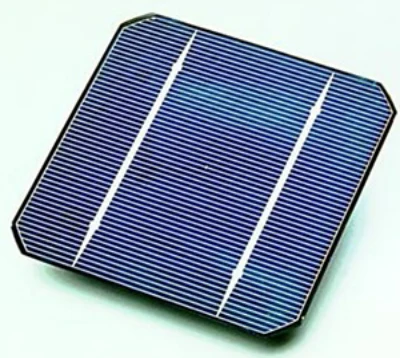
Solar energy is converted to electrical energy in one of two manners: direct transfer through photovoltaic cells or thermal conversion through the use of a CSP, concentrating solar power, system. Unlike electric eyes, which trip a mechanism when current is lost, photovoltaic cells utilize semiconductors to directly transfer the electrons released through the photoelectric effect into a directed current. The energy from this current can then be converted for storage, or immediately used in an electric process. A CSP system is an indirect method of energy conversion. In this process, light from the Sun is channeled using parabolic mirrors. The light from these mirrors strikes a thermally conductive material, which then heats a pool of water. This water, in turn, is converted to steam, which turns a turbine and creates electricity. While indirect, this method has long been the traditional means of large-scale power generation.
太陽エネルギーは二つのしかたのどちらかで電気エネルギーへ変えられる。光起電のセルによる直接の移し替えか、CSP(集光型太陽熱発電)の仕組みを使う熱への変換である。電流が失われると仕組みを働かせる電気の目と違い、光起電のセルは半導体を使って、光電効果で解き放たれた電子を直接、決まった向きの電流へ移す。この電流のエネルギーは蓄えるために変換することも、すぐに電気の過程に使うこともできる。CSPの仕組みはエネルギーを間接に変換する方法である。この過程では、太陽からの光が放物面鏡で導かれる。この鏡からの光が熱を伝えやすい材料にあたり、それが水の溜まりを熱する。この水がさらに蒸気になり、タービンを回して電気を作る。間接ではあるが、この方法は大規模な発電の伝統的な手段として長く使われてきた。
There are, of course, limitations to the efficacy of solar power. Cloud cover, nightfall, and incident angle strike at high altitudes are all factors that directly influence the amount of light energy available. Additionally, the creation of photovoltaic cells requires rare-earth minerals that can be difficult to obtain. However, the major role of a solar energy physicist is to find ways to improve the efficiency of the solar energy conversion process. Currently, this is done by experimenting with new semi conductive materials, by refining current energy transfer methods, and by determining new ways of incorporating solar structures into the current power grid.
もちろん太陽の力の効き目には限界がある。雲、日没、高い緯度で入射角が浅くなること——これらはすべて使える光のエネルギーの量に直接影響する要因である。さらに、光起電のセルを作るには手に入れにくい希土類の鉱物が要る。しかし太陽エネルギーの物理学者のおもな役割は、太陽エネルギーの変換の効率を上げる方法を見つけることである。いまのところ、それは新しい半導体の材料を試し、いまのエネルギーの移し方を洗練し、太陽の構造をいまの送電網に組み込む新しい方法を見つけることで行われている。
Additionally, many solar physicists are looking into ways to allow for increased solar use in impoverished, more remote locations. Because solar energy conversion does not require a connection to a large-scale power grid, research into thinner, more mobile materials will permit remote cultures to use solar cells to convert sunlight collected during the day into stored energy that can then be used at night.
さらに、多くの太陽の物理学者は、貧しく、より辺鄙な場所で太陽の利用を増やす方法を探している。太陽エネルギーの変換は大規模な送電網につながる必要がないので、より薄く持ち運びやすい材料の研究によって、遠隔の共同体が太陽電池を使い、昼間に集めた日光を蓄えたエネルギーへ変えて夜に使えるようになる。
Regardless of the application, solar energy physicists are an important part of the future in responsible energy growth. While a doctoral degree is often necessary for advanced research applications, a bachelor's or master's degree in a related science or engineering field is typically enough to gain access into the industry. Computer skills are very important for energy modeling, including knowledge of CAD software for design purposes. In addition, the ability to collaborate and communicate with others is critical to becoming a solar energy physicist.
どんな用途であれ、太陽エネルギーの物理学者は責任あるエネルギーの成長の未来にとって重要な一部である。進んだ研究の応用にはしばしば博士号が必要だが、関連する理学か工学の分野の学士か修士があれば、ふつうこの産業に入れる。設計のためのCADソフトの知識を含め、エネルギーのモデル化にはコンピューターの技能がとても重要である。加えて、他の人と協力し意思を通わせる能力は、太陽エネルギーの物理学者になるのに決定的である。
GRASP CHECK What role does the photoelectric effect play in the research of a solar energy physicist?
理解の確認 光電効果は太陽エネルギーの物理学者の研究でどんな役割を果たすか。
a. The understanding of photoelectric effect allows the physicist to understand the generation of light energy when using photovoltaic cells.b. The understanding of photoelectric effect allows the physicist to understand the generation of electrical energy when using photovoltaic cells.c. The understanding of photoelectric effect allows the physicist to understand the generation of electromagnetic energy when using photovoltaic cells.d. The understanding of photoelectric effect allows the physicist to understand the generation of magnetic energy when using photovoltaic cells.
a. 光電効果を理解することで、物理学者は光起電のセルを使うときの光のエネルギーの発生を理解できる。b. 光電効果を理解することで、物理学者は光起電のセルを使うときの電気エネルギーの発生を理解できる。c. 光電効果を理解することで、物理学者は光起電のセルを使うときの電磁のエネルギーの発生を理解できる。d. 光電効果を理解することで、物理学者は光起電のセルを使うときの磁気のエネルギーの発生を理解できる。
Check Your Understanding理解の確認
12How did Einstein’s model of photons change the view of a beam of energy leaving a flashlight?a. A beam of light energy is now considered a continual stream of wave energy, not photons.b. A beam of light energy is now considered a collection of photons, each carrying its own individual energy.
12アインシュタインの光子のモデルは、懐中電灯から出るエネルギーの束の見方をどう変えたか。a. 光のエネルギーの束は、いまや光子ではなく波のエネルギーの連続な流れとみなされる。b. 光のエネルギーの束は、いまや光子の集まりとみなされ、そのそれぞれが自分のエネルギーを運ぶ。
13True or false—Visible light is the only type of electromagnetic radiation that can cause the photoelectric effect.
13正誤問題——可視光は光電効果を起こせる唯一の型の電磁放射である。
a. falseb. true
a. 誤b. 正
14Is the photoelectric effect a direct consequence of the wave character of EM radiation, or the particle character of EM radiation?
14光電効果は電磁放射の波としての性格の直接の帰結か、それとも粒子としての性格の直接の帰結か。
a. The photoelectric effect is a direct consequence of the particle nature of EM radiation.b. The photoelectric effect is a direct consequence of the wave nature of EM radiation.
a. 光電効果は電磁放射の粒子としての性質の直接の帰結である。b. 光電効果は電磁放射の波としての性質の直接の帰結である。
c. The photoelectric effect is a direct consequence of both the wave and particle nature of EM radiation.d. The photoelectric effect is a direct consequence of neither the wave nor the particle nature of EM radiation.
c. 光電効果は電磁放射の波と粒子の両方の性質の直接の帰結である。d. 光電効果は電磁放射の波の性質の帰結でも粒子の性質の帰結でもない。
15Which aspects of the photoelectric effect can only be explained using photons?a. aspects 1, 2, and 3b. aspects 1, 2, and 4
15光電効果のどの面が光子でしか説明できないか。a. 面1、2、3b. 面1、2、4
c. aspects 1, 2, 4 and 5d. aspects 1, 2, 3, 4 and 5
c. 面1、2、4、5d. 面1、2、3、4、5
16In a photovoltaic cell, what energy transformation takes place?a. Solar energy transforms into electric energy.b. Solar energy transforms into mechanical energy.
16光起電のセルでは、どんなエネルギーの変換が起こるか。a. 太陽のエネルギーが電気エネルギーへ変わる。b. 太陽のエネルギーが力学的エネルギーへ変わる。
c. Solar energy transforms into thermal energy.d. In a photovoltaic cell, thermal energy transforms into electric energy.
c. 太陽のエネルギーが熱エネルギーへ変わる。d. 光起電のセルでは熱エネルギーが電気エネルギーへ変わる。
17True or false—A current is created in a photoconductive cell, even if only one electron is expelled from a photon strike.
17正誤問題——光導電のセルでは、光子のあたりによって電子が一つ追い出されただけでも電流が生じる。
a. falseb. true
a. 誤b. 正
18What is a photon and how is it different from other fundamental particles?a. A photon is a quantum packet of energy; it has infinite mass.b. A photon is a quantum packet of energy; it is massless.
18光子とは何で、他の素粒子とどう違うか。a. 光子は量子のエネルギーの包みであり、無限の質量を持つ。b. 光子は量子のエネルギーの包みであり、質量を持たない。
c. A photon is a fundamental particle of an atom; it has infinite mass.d. A photon is a fundamental particle of an atom; it is massless.
c. 光子は原子の素粒子であり、無限の質量を持つ。d. 光子は原子の素粒子であり、質量を持たない。