第21章光の量子的な性質The Quantum Nature of Light原書 p.711–742
21.1 Planck and Quantum Nature of Light21.1 プランクと光の量子的な性質
SECTION LEARNING OBJECTIVES By the end of this section, you will be able to do the following:
この節の学習目標 この節を終えると、次のことができるようになる。
• Describe blackbody radiation• Define quantum states and their relationship to modern physics• Calculate the quantum energy of lights• Explain how photon energies vary across divisions of the electromagnetic spectrum
・黒体放射を述べる・量子状態を定義し、現代物理との関係を述べる・光の量子のエネルギーを計算する・光子のエネルギーが電磁スペクトルの区分ごとにどう変わるかを説明する
Section Key Termsこの節の重要語
blackbodyquantizedquantumultraviolet catastrophe
黒体量子化された量子紫外破綻
Blackbodies黒体
Our first story of curious significance begins with a T-shirt. You are likely aware that wearing a tight black T-shirt outside on a hot day provides a significantly less comfortable experience than wearing a white shirt. Black shirts, as well as all other black objects, will absorb and re-emit a significantly greater amount of radiation from the sun. This shirt is a good approximation of what is called a blackbody.
好奇にみちた最初の物語はTシャツから始まる。暑い日に外で体にぴったりした黒いTシャツを着ると、白いシャツよりずっと不快なことは知っているだろう。黒いシャツも、他のあらゆる黒い物も、太陽からの放射をずっと多く吸収し、また放出する。このシャツは黒体と呼ばれるもののよい近似である。
A perfect blackbody is one that absorbs and re-emits all radiated energy that is incident upon it. Imagine wearing a tight shirt that did this! This phenomenon is often modeled with quite a different scenario. Imagine carving a small hole in an oven that can be heated to very high temperatures. As the temperature of this container gets hotter and hotter, the radiation out of this dark hole would increase as well, re-emitting all energy provided it by the increased temperature. The hole may even begin to glow in different colors as the temperature is increased. Like a burner on your stove, the hole would glow red, then orange, then blue, as the temperature is increased. In time, the hole would continue to glow but the light would be invisible to our eyes. This container is a good model of a perfect blackbody.
完全な黒体とは、そこにあたる放射のエネルギーをすべて吸収し、また放出するものである。これをするぴったりしたシャツを着るところを想像してみよう。この現象はしばしば、まるで違う場面でモデル化される。とても高い温度まで熱せられるオーブンに小さな穴を開けるところを想像しよう。この容器の温度がどんどん熱くなるにつれ、この暗い穴から出る放射も増え、上がった温度が与えたエネルギーをすべて放出する。温度が上がるにつれ、穴はいろいろな色に輝き始めさえする。コンロのバーナーのように、温度が上がるにつれて穴は赤く、それからオレンジ、それから青く輝くだろう。やがて穴は輝き続けるが、その光は私たちの目には見えなくなる。この容器は完全な黒体のよいモデルである。
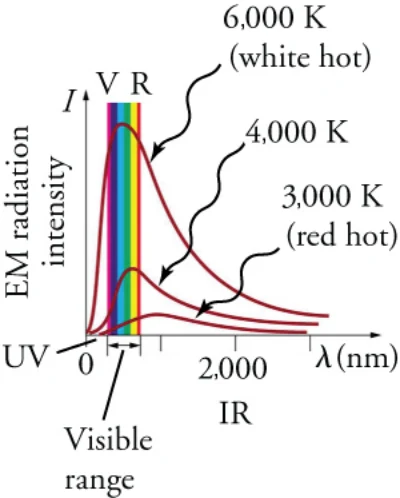
It is the analysis of blackbodies that led to one of the most consequential discoveries of the twentieth century. Take a moment to carefully examine Figure 21.2. What relationships exist? What trends can you see? The more time you spend interpreting this figure, the closer you will be to understanding quantum physics!
20世紀で最も重大な発見の一つへ導いたのは、黒体の分析である。少し時間をとって図21.2を注意深く調べてみよう。どんな関係があるか。どんな傾向が見えるか。この図の解釈に時間をかけるほど、量子物理の理解に近づく。
TIPS FOR SUCCESS When encountering a new graph, it is best to try to interpret the graph before you read about it. Doing this will make the following text more meaningful and will help to remind yourself of some of the key concepts within the section.
学習のポイント 新しいグラフに出会ったら、それについて読む前にまずグラフを解釈してみるのがよい。そうすれば続く文章がより意味を持ち、その節の要となる考えのいくつかを思い出す助けにもなる。
Understanding Blackbody Graphs黒体のグラフを理解する
Figure 21.2 is a plot of radiation intensity against radiated wavelength. In other words, it shows how the intensity of radiated light changes when a blackbody is heated to a particular temperature.
図21.2は放射の強さを放射された波長に対して描いたものである。言い換えれば、黒体をある温度まで熱したときに、放射される光の強さがどう変わるかを示している。
It may help to just follow the bottom-most red line labeled 3,000 K, red hot. The graph shows that when a blackbody acquires a temperature of 3,000 K, it radiates energy across the electromagnetic spectrum. However, the energy is most intensely emitted at a wavelength of approximately 1000 nm. This is in the infrared portion of the electromagnetic spectrum. While a body at this temperature would appear red-hot to our eyes, it would truly appear ‘infrared-hot’ if we were able to see the entire spectrum.
「3,000 K, 赤熱」と書かれた一番下の赤い線をたどるとよいだろう。このグラフは、黒体が3,000 Kの温度になると、電磁スペクトルの全体にわたってエネルギーを放射することを示す。しかしエネルギーはおよそ1000 nmの波長で最も強く放たれる。これは電磁スペクトルの赤外の部分である。この温度の物体は私たちの目には赤熱して見えるが、スペクトル全体を見られるなら、本当は「赤外に熱い」ように見えるだろう。
A few other important notes regarding Figure 21.2:
図21.2についてのその他の重要な注意:
• As temperature increases, the total amount of energy radiated increases. This is shown by examining the area underneath each line.• Regardless of temperature, all red lines on the graph undergo a consistent pattern. While electromagnetic radiation is emitted throughout the spectrum, the intensity of this radiation peaks at one particular wavelength.• As the temperature changes, the wavelength of greatest radiation intensity changes. At 4,000 K, the radiation is most intense in the yellow-green portion of the spectrum. At 6,000 K, the blackbody would radiate white hot, due to intense radiation throughout the visible portion of the electromagnetic spectrum. Remember that white light is the emission of all visible colors simultaneously.• As the temperature increases, the frequency of light providing the greatest intensity increases as well. Recall the equation Because the speed of light is constant, frequency and wavelength are inversely related. This is verified by the leftward movement of the three red lines as temperature is increased.
・温度が上がると、放射されるエネルギーの総量は増える。これはそれぞれの線の下の面積を調べれば分かる。・温度によらず、グラフのどの赤い線も同じ型をたどる。電磁放射はスペクトル全体にわたって放たれるが、この放射の強さは一つの決まった波長で尖る。・温度が変わると、放射の強さが最大になる波長も変わる。4,000 Kでは、放射はスペクトルの黄緑の部分で最も強い。6,000 Kでは、電磁スペクトルの可視の部分全体にわたる強い放射のために、黒体は白熱して放射するだろう。白い光はすべての可視の色が同時に放たれたものであることを思い出そう。・温度が上がると、最も強い光の振動数も上がる。式を思い出そう。光の速さは一定なので、振動数と波長は反比例する。温度が上がるにつれて三本の赤い線が左へ動くことがこれを裏づける。
While in science it is important to categorize observations, theorizing as to why the observations exist is crucial to scientific advancement. Why doesn’t a blackbody emit radiation evenly across all wavelengths? Why does the temperature of the body change the peak wavelength that is radiated? Why does an increase in temperature cause the peak wavelength emitted to decrease? It is questions like these that drove significant research at the turn of the twentieth century. And within the context of these questions, Max Planck discovered something of tremendous importance.
科学では観察を分類することが大事だが、なぜその観察が生じるのかを理論化することは、科学の進歩に決定的である。なぜ黒体はすべての波長にわたって一様に放射しないのか。なぜ物体の温度が、放射される尖りの波長を変えるのか。なぜ温度が上がると尖りの波長は短くなるのか。20世紀の変わり目に重要な研究を駆り立てたのは、こうした問いである。そしてこれらの問いの文脈の中で、マックス・プランクはとてつもなく重要なものを見いだした。
Planck’s Revolutionプランクの革命
The prevailing theory at the time of Max Planck’s discovery was that intensity and frequency were related by the equation This equation, derived from classical physics and using wave phenomena, infers that as wavelength increases, the intensity of energy provided will decrease with an inverse-squared relationship. This relationship is graphed in Figure 21.3 and shows a troubling trend. For starters, it should be apparent that the graph from this equation does not match the blackbody graphs found experimentally. Additionally, it shows that for an object of any temperature, there should be an infinite amount of energy quickly emitted in the shortest wavelengths. When theory and experimental results clash, it is important to re-evaluate both models. The disconnect between theory and reality was termed the ultraviolet catastrophe.
マックス・プランクの発見の時点で有力だった理論では、強さと振動数は式で結びついていた。古典物理から導かれ波の現象を使ったこの式は、波長が長くなるにつれて与えられるエネルギーの強さが逆二乗の関係で減ることを意味する。この関係を図21.3に描く。それは困った傾向を示している。まず、この式のグラフが実験で得られた黒体のグラフに合わないのは明らかだろう。さらにそれは、どんな温度の物体でも、最も短い波長で無限の量のエネルギーが素早く放たれるはずだと示している。理論と実験の結果が食い違うときは、両方のモデルを見直すことが大切である。理論と現実の断絶は紫外破綻と呼ばれた。
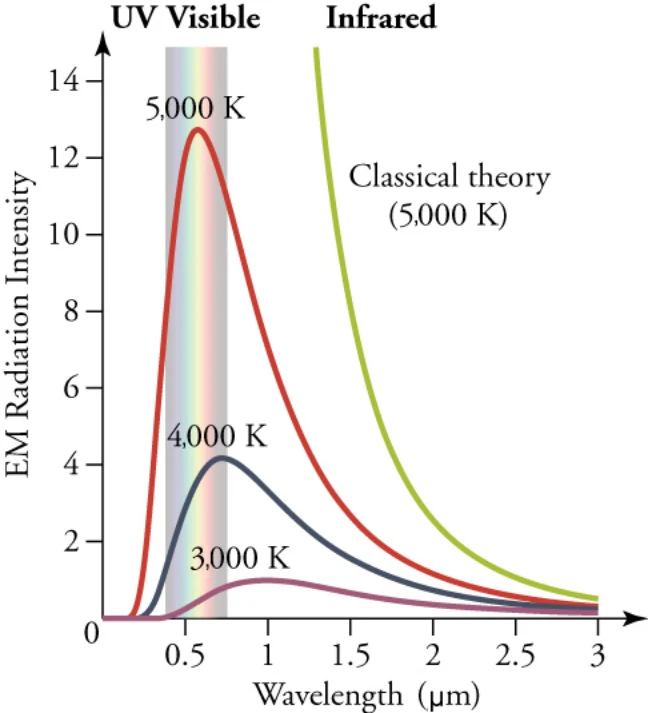
Due to concerns over the ultraviolet catastrophe, Max Planck began to question whether another factor impacted the relationship between intensity and wavelength. This factor, he posited, should affect the probability that short wavelength light would be emitted. Should this factor reduce the probability of short wavelength light, it would cause the radiance curve to not progress infinitely as in the classical theory, but would instead cause the curve to precipitate back downward as is shown in the 5,000 K, 4,000 K, and 3,000 K temperature lines of the graph in Figure 21.3. Planck noted that this factor, whatever it may be, must also be dependent on temperature, as the intensity decreases at lower and lower wavelengths as the temperature increases.
紫外破綻の懸念から、マックス・プランクは強さと波長の関係に別の要因が影響していないかを問い始めた。この要因は、短い波長の光が放たれる確率に影響するはずだと彼は考えた。この要因が短い波長の光の確率を下げるなら、古典理論のように輝きの曲線が無限に伸びていくのではなく、図21.3のグラフの5,000 K、4,000 K、3,000 Kの温度の線のように、曲線が下へ落ちていくことになる。プランクは、この要因が何であれ温度にもよるはずだと注意した。温度が上がるにつれて、より短い波長で強さが減っていくからである。
The determination of this probability factor was a groundbreaking discovery in physics, yielding insight not just into light but also into energy and matter itself. It would be the basis for Planck’s 1918 Nobel Prize in Physics and would result in the transition of physics from classical to modern understanding. In an attempt to determine the cause of the probability factor, Max Planck constructed a new theory. This theory, which created the branch of physics called quantum mechanics, speculated that the energy radiated by the blackbody could exist only in specific numerical, or quantum, states. This theory is described by the equation where n is any nonnegative integer (0, 1, 2, 3, …) and h is Planck’s constant, given by and f is frequency.
この確率の因子を突き止めたことは物理における画期的な発見であり、光だけでなくエネルギーと物質そのものへの洞察を与えた。それは1918年のプランクのノーベル物理学賞の土台となり、物理を古典的な理解から現代的な理解へ移らせることになった。確率の因子の原因を突き止めようとして、マックス・プランクは新しい理論を組み立てた。量子力学と呼ばれる物理の分野を生んだこの理論は、黒体が放射するエネルギーが特定の数値の状態、すなわち量子状態でしか存在しえないと考えた。この理論は式で述べられる。ここでnは0以上の任意の整数(0, 1, 2, 3, …)、hはプランク定数で、fは振動数である。
Through this equation, Planck’s probability factor can be more clearly understood. Each frequency of light provides a specific quantized amount of energy. Low frequency light, associated with longer wavelengths would provide a smaller amount of energy, while high frequency light, associated with shorter wavelengths, would provide a larger amount of energy. For specified temperatures with specific total energies, it makes sense that more low frequency light would be radiated than high frequency light. To a degree, the relationship is like pouring coins through a funnel. More of the smaller pennies would be able to pass through the funnel than the larger quarters. In other words, because the value of the coin is somewhat related to the size of the coin, the probability of a quarter passing through the funnel is reduced!
この式を通して、プランクの確率の因子はよりはっきり理解できる。それぞれの振動数の光が、特定の量子化されたエネルギーを与える。長い波長に結びつく低い振動数の光はより小さな量のエネルギーを与え、短い波長に結びつく高い振動数の光はより大きな量のエネルギーを与える。決まった全エネルギーを持つ決まった温度では、高い振動数の光より低い振動数の光のほうが多く放射されるのは筋が通る。ある程度、この関係は硬貨を漏斗に注ぐのに似ている。大きい25セント硬貨より、小さい1セント硬貨のほうが多く漏斗を通れる。言い換えれば、硬貨の価値が硬貨の大きさにいくらか関係するので、25セント硬貨が漏斗を通る確率は下がるのである。
Furthermore, an increase in temperature would signify the presence of higher energy. As a result, the greater amount of total blackbody energy would allow for more of the high frequency, short wavelength, energies to be radiated. This permits the peak of the blackbody curve to drift leftward as the temperature increases, as it does from the 3,000 K to 4,000 K to 5,000 K values. Furthering our coin analogy, consider a wider funnel. This funnel would permit more quarters to pass through and allow for a reduction in concern about the probability factor.
さらに、温度が上がることはより高いエネルギーがあることを意味する。その結果、黒体の全エネルギーが多くなれば、高い振動数、短い波長のエネルギーがより多く放射されうる。これによって、3,000 Kから4,000 K、5,000 Kへと温度が上がるにつれて、黒体の曲線の尖りが左へ移れる。硬貨の類比を進めれば、より広い漏斗を考えよう。この漏斗はより多くの25セント硬貨を通し、確率の因子の心配を減らせる。
In summary, it is the interplay between the predicted classical model and the quantum probability that creates the curve depicted in Figure 21.3. Just as quarters have a higher currency denomination than pennies, higher frequencies come with larger amounts of energy. However, just as the probability of a quarter passing through a fixed diameter funnel is reduced, so is the probability of a high frequency light existing in a fixed temperature object. As is often the case in physics, it is the balancing of multiple incredible ideas that finally allows for better understanding.
まとめると、図21.3に描かれた曲線を作るのは、予言された古典的なモデルと量子の確率のせめぎ合いである。25セント硬貨が1セント硬貨より高い額面を持つのとちょうど同じように、高い振動数はより大きなエネルギーをともなう。しかし、決まった直径の漏斗を25セント硬貨が通る確率が下がるのとちょうど同じように、決まった温度の物体に高い振動数の光が存在する確率も下がる。物理でよくあるとおり、よりよい理解をついに与えるのは、いくつもの驚くべき考えの釣り合いなのである。
Quantization量子化
It may be helpful at this point to further consider the idea of quantum states. Atoms, molecules, and fundamental electron and proton charges are all examples of physical entities that are quantized—that is, they appear only in certain discrete values and do not have every conceivable value. On the macroscopic scale, this is not a revolutionary concept. A standing wave on a string allows only particular harmonics described by integers. Going up and down a hill using discrete stair steps causes your potential energy to take on discrete values as you move from step to step. Furthermore, we cannot have a fraction of an atom, or part of an electron’s charge, or 14.33 cents. Rather, everything is built of integral multiples of these substructures.
ここで量子状態の考えをさらに考えておくと役に立つだろう。原子・分子・電子と陽子の基本の電荷は、いずれも量子化された物理的な存在の例である。すなわち、ある決まった離散的な値でしか現れず、考えうるすべての値をとるわけではない。巨視的な尺度では、これは革命的な考えではない。弦の上の定常波は、整数で表される決まった倍音しか許さない。離散的な階段の段を上り下りすれば、段から段へ移るにつれて位置エネルギーは離散的な値をとる。さらに、原子の一部分も、電子の電荷の一部も、14.33セントも持てない。むしろ、あらゆるものがこれらの下部構造の整数倍でできている。
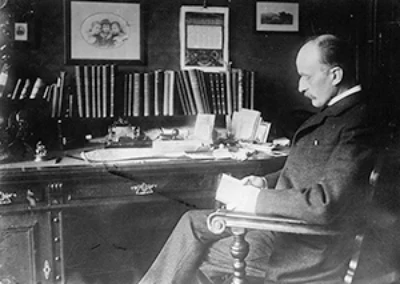
That said, to discover quantum states within a phenomenon that science had always considered continuous would certainly be surprising. When Max Planck was able to use quantization to correctly describe the experimentally known shape of the blackbody spectrum, it was the first indication that energy was quantized on a small scale as well. This discovery earned Planck the Nobel Prize in Physics in 1918 and was such a revolutionary departure from classical physics that Planck himself was reluctant to accept his own idea. The general acceptance of Planck’s energy quantization was greatly enhanced by Einstein’s explanation of the photoelectric effect (discussed in the next section), which took energy quantization a step further.
とはいえ、科学がつねに連続だとみなしてきた現象の中に量子状態を見つけるのは、確かに驚きだっただろう。マックス・プランクが量子化を使って、実験で知られていた黒体のスペクトルの形を正しく述べられたとき、それはエネルギーが小さな尺度でも量子化されているという最初の示唆だった。この発見は1918年のノーベル物理学賞をプランクにもたらしたが、古典物理からのあまりに革命的な逸脱だったので、プランク自身が自分の考えを受け入れるのをためらった。プランクのエネルギーの量子化が広く受け入れられるようになったのは、アインシュタインによる光電効果の説明(次の節で論じる)が大いに後押しした。それはエネルギーの量子化をさらに一歩進めた。
How Many Photons per Second Does a Typical Light Bulb Produce?Assuming that 10 percent of a 100-W light bulb’s energy output is in the visible range (typical for incandescent bulbs) with an average wavelength of 580 nm, calculate the number of visible photons emitted per second. Strategy
典型的な電球は毎秒何個の光子を出すか 100 Wの電球のエネルギーの出力の10パーセントが(白熱電球で典型的な)可視の範囲にあり、平均の波長が580 nmだとして、毎秒放たれる可視の光子の数を計算せよ。方針
The number of visible photons per second is directly related to the amount of energy emitted each second, also known as the bulb’s power. By determining the bulb’s power, the energy emitted each second can be found. Since the power is given in watts, which is joules per second, the energy will be in joules. By comparing this to the amount of energy associated with each photon, the number of photons emitted each second can be determined.
毎秒の可視の光子の数は、毎秒放たれるエネルギーの量——すなわち電球の仕事率——に直接関係する。電球の仕事率を決めれば、毎秒放たれるエネルギーが求まる。仕事率はワット、すなわち毎秒ジュールで与えられるので、エネルギーはジュールになる。これをそれぞれの光子に結びつくエネルギーの量とくらべれば、毎秒放たれる光子の数が求められる。
Solution解答
The power in visible light production is 10.0 percent of 100 W, or 10.0 J/s. The energy of the average visible photon is found by substituting the given average wavelength into the formula
可視光を作る仕事率は100 Wの10.0パーセント、すなわち10.0 J/sである。平均の可視の光子のエネルギーは、与えられた平均の波長を次の式に入れて求まる。
By rearranging the above formula to determine energy per photon, this produces
上の式を光子あたりのエネルギーを求めるように変形すると
The number of visible photons per second is thus
したがって毎秒の可視の光子の数は
Discussion考察
This incredible number of photons per second is verification that individual photons are insignificant in ordinary human experience. However, it is also a verification of our everyday experience—on the macroscopic scale, photons are so small that quantization becomes essentially continuous.
この毎秒の光子の途方もない数は、個々の光子がふつうの人の経験では取るに足りないことを確かめてくれる。しかしそれはまた、私たちの日常の経験の裏づけでもある。巨視的な尺度では、光子はあまりに小さいので、量子化は事実上連続になる。
How does Photon Energy Change with Various Portions of the EM Spectrum?Refer to the Graphs of Blackbody Radiation shown in the first figure in this section. Compare the energy necessary to radiate one photon of infrared light and one photon of visible light.Strategy
電磁スペクトルの部分ごとに光子のエネルギーはどう変わるかこの節の最初の図の黒体放射のグラフを見よ。赤外の光の光子一つと、可視の光の光子一つを放つのに必要なエネルギーを比べよ。方針
To determine the energy radiated, it is necessary to use the equation It is also necessary to find a representative frequency for infrared light and visible light.
放たれるエネルギーを決めるには式を使う必要がある。また赤外の光と可視の光の代表的な振動数を求める必要もある。
Solution解答
According to the first figure in this section, one representative wavelength for infrared light is 2000 nm (2.000 × 10⁻⁶ m). The associated frequency of an infrared light is
この節の最初の図によれば、赤外の光の代表的な波長の一つは2000 nm(2.000 × 10⁻⁶ m)である。赤外の光の対応する振動数は
Using the equation , the energy associated with one photon of representative infrared light is
である。式を使うと、代表的な赤外の光の光子一つに結びつくエネルギーは
The same process above can be used to determine the energy associated with one photon of representative visible light. According to the first figure in this section, one representative wavelength for visible light is 500 nm.
となる。上と同じ手順で、代表的な可視の光の光子一つに結びつくエネルギーも求められる。この節の最初の図によれば、可視光の代表的な波長の一つは500 nmである。
Discussion考察
This example verifies that as the wavelength of light decreases, the quantum energy increases. This explains why a fire burning with a blue flame is considered more dangerous than a fire with a red flame. Each photon of short-wavelength blue light emitted carries a greater amount of energy than a long-wavelength red light. This example also helps explain the differences in the 3,000 K, 4,000 K, and 6,000 K lines shown in the first figure in this section. As the temperature is increased, more energy is available for a greater number of short-wavelength photons to be emitted.
この例は、光の波長が短くなるにつれて量子のエネルギーが増えることを確かめてくれる。これは、青い炎で燃える火が赤い炎の火より危険だとみなされる理由を説明する。放たれる波長の短い青い光の光子は、波長の長い赤い光よりも大きなエネルギーを運ぶ。この例はまた、この節の最初の図に示した3,000 K、4,000 K、6,000 Kの線の違いを説明する助けにもなる。温度が上がるにつれ、より多くの短い波長の光子が放たれるためのエネルギーがより多く使えるようになる。
Practice Problems練習問題
1An AM radio station broadcasts at a frequency of 1,530 kHz . What is the energy in Joules of a photon emitted from this station?a. 10.1 × 10⁻²⁶ Jb. 1.01 × 10⁻²⁸ Jc. 1.01 × 10⁻²⁹ Jd. 1.01 × 10⁻²⁷ J
1あるAMラジオ局は1,530 kHzの振動数で放送している。この局から放たれる光子のエネルギーはジュールでいくらか。a. 10.1 × 10⁻²⁶ Jb. 1.01 × 10⁻²⁸ Jc. 1.01 × 10⁻²⁹ Jd. 1.01 × 10⁻²⁷ J
2A photon travels with energy of 1.0 eV. What type of EM radiation is this photon?a. visible radiationb. microwave radiation
2ある光子が1.0 eVのエネルギーで進む。この光子はどの型の電磁放射か。a. 可視の放射b. マイクロ波
c. infrared radiationd. ultraviolet radiation
c. 赤外線d. 紫外線
Check Your Understanding理解の確認
3Do reflective or absorptive surfaces more closely model a perfect blackbody?a. reflective surfacesb. absorptive surfaces
3完全な黒体により近いモデルになるのは、よく反射する面か、よく吸収する面か。a. よく反射する面b. よく吸収する面
4A black T-shirt is a good model of a blackbody. However, it is not perfect. What prevents a black T-shirt from being considered a perfect blackbody?
4黒いTシャツは黒体のよいモデルである。しかし完全ではない。黒いTシャツが完全な黒体とみなせないのはなぜか。
a. The T-shirt reflects some light.b. The T-shirt absorbs all incident light.
a. Tシャツは光をいくらか反射するから。b. Tシャツはあたった光をすべて吸収するから。
c. The T-shirt re-emits all the incident light.d. The T-shirt does not reflect light.
c. Tシャツはあたった光をすべて放出するから。d. Tシャツは光を反射しないから。
5What is the mathematical relationship linking the energy of a photon to its frequency?a. E = h(ω)b. E = h/ω
5光子のエネルギーをその振動数に結びつける数式はどれか。a. E = h(ω)b. E = h/ω
c. E = h/fd. E = hf
c. E = h/fd. E = hf
6Why do we not notice quantization of photons in everyday experience?a. because the size of each photon is very largeb. because the mass of each photon is so small
6日常の経験で光子の量子化に気づかないのはなぜか。a. それぞれの光子の大きさがとても大きいからb. それぞれの光子の質量がとても小さいから
c. because the energy provided by photons is very larged. because the energy provided by photons is very small
c. 光子が与えるエネルギーがとても大きいからd. 光子が与えるエネルギーがとても小さいから
7Two flames are observed on a stove. One is red while the other is blue. Which flame is hotter?a. The red flame is hotter because red light has lower frequency.b. The red flame is hotter because red light has higher frequency.
7コンロで二つの炎が見える。一方は赤く、もう一方は青い。どちらの炎が熱いか。a. 赤い炎のほうが熱い。赤い光は振動数が低いから。b. 赤い炎のほうが熱い。赤い光は振動数が高いから。
c. The blue flame is hotter because blue light has lower frequency.d. The blue flame is hotter because blue light has higher frequency.
c. 青い炎のほうが熱い。青い光は振動数が低いから。d. 青い炎のほうが熱い。青い光は振動数が高いから。
8Your pupils dilate when visible light intensity is reduced. Does wearing sunglasses that lack UV blockers increase or decrease the UV hazard to your eyes? Explain.
8可視光の強さが減ると瞳孔は開く。紫外線を遮らないサングラスをかけることは、目への紫外線の危険を増やすか、減らすか。説明せよ。
a. Increase, because more high-energy UV photons can enter the eye.b. Increase, because less high-energy UV photons can enter the eye.
a. 増やす。高いエネルギーの紫外線の光子がより多く目に入りうるから。b. 増やす。高いエネルギーの紫外線の光子が目に入る数が減るから。
c. Decrease, because more high-energy UV photons can enter the eye.d. Decrease, because less high-energy UV photons can enter the eye.
c. 減らす。高いエネルギーの紫外線の光子がより多く目に入りうるから。d. 減らす。高いエネルギーの紫外線の光子が目に入る数が減るから。
9The temperature of a blackbody radiator is increased. What will happen to the most intense wavelength of light emitted as this increase occurs?
9黒体の放射体の温度を上げる。この上昇が起こると、放たれる光の最も強い波長はどうなるか。
a. The wavelength of the most intense radiation will vary randomly.b. The wavelength of the most intense radiation will increase.
a. 最も強い放射の波長はでたらめに変わる。b. 最も強い放射の波長は長くなる。
c. The wavelength of the most intense radiation will remain unchanged.d. The wavelength of the most intense radiation will decrease.
c. 最も強い放射の波長は変わらない。d. 最も強い放射の波長は短くなる。