第21章光の量子的な性質The Quantum Nature of Light原書 p.711–742
21.3 The Dual Nature of Light21.3 光の二重性
SECTION LEARNING OBJECTIVES By the end of this section, you will be able to do the following:• Describe the Compton effect• Calculate the momentum of a photon• Explain how photon momentum is used in solar sails• Explain the particle-wave duality of light
この節の学習目標 この節を終えると、次のことができるようになる。・コンプトン効果を述べる・光子の運動量を計算する・光子の運動量が太陽帆にどう使われるかを説明する・光の粒子と波の二重性を説明する
Section Key Termsこの節の重要語
Compton effectparticle-wave dualityphoton momentum
コンプトン効果粒子と波の二重性光子の運動量
Photon Momentum光子の運動量
Do photons abide by the fundamental properties of physics? Can packets of electromagnetic energy possibly follow the same rules as a ping-pong ball or an electron? Although strange to consider, the answer to both questions is yes.
光子は物理の基本の性質に従うのか。電磁のエネルギーの包みが、卓球の球や電子と同じ規則に従いうるのか。考えると奇妙だが、どちらの問いの答えもイエスである。
Despite the odd nature of photons, scientists prior to Einstein had long suspected that the fundamental particle of electromagnetic radiation shared properties with our more macroscopic particles. This is no clearer than when considering the photoelectric effect, where photons knock electrons out of a substance. While it is strange to think of a massless particle exhibiting momentum, it is now a well-established fact within the scientific community. Figure 21.10 shows macroscopic evidence of photon momentum.
光子の奇妙な性質にもかかわらず、アインシュタイン以前の科学者は、電磁放射の素粒子が、より巨視的な粒子と性質を共有するのではないかと長く疑っていた。これは、光子が物質から電子をたたき出す光電効果を考えるときに最もはっきりする。質量のない粒子が運動量を示すというのは奇妙に思えるが、いまや科学の世界でよく確かめられた事実である。図21.10は光子の運動量の巨視的な証拠を示す。
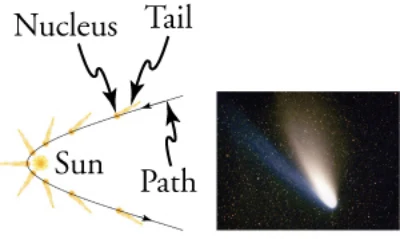
Figure 21.10 shows a comet with two prominent tails. Comet tails are composed of gases and dust evaporated from the body of the comet and ionized gas. What most people do not know about the tails is that they always point away from the Sun rather than trailing behind the comet. This can be seen in the diagram.
図21.10は目立つ二本の尾を持つ彗星を示す。彗星の尾は、彗星の本体から蒸発したガスと塵、そしてイオン化したガスからなる。尾についてたいていの人が知らないのは、尾が彗星の後ろへたなびくのではなく、つねに太陽と反対を向くことである。これは図で見られる。
Why would this be the case? The evidence indicates that the dust particles of the comet are forced away from the Sun when photons strike them. Evidently, photons carry momentum in the direction of their motion away from the Sun, and some of this momentum is transferred to dust particles in collisions. The blue tail is caused by the solar wind, a stream of plasma consisting primarily of protons and electrons evaporating from the corona of the Sun.
なぜそうなるのか。証拠は、彗星の塵の粒子が光子にあたられて太陽から押しやられることを示している。明らかに光子は太陽から離れる運動の向きに運動量を運び、その一部が衝突で塵の粒子へ移る。青い尾は太陽風によるもので、それは太陽のコロナから蒸発する、おもに陽子と電子からなるプラズマの流れである。
Momentum, The Compton Effect, and Solar Sails運動量、コンプトン効果、太陽帆
Momentum is conserved in quantum mechanics, just as it is in relativity and classical physics. Some of the earliest direct experimental evidence of this came from the scattering of X-ray photons by electrons in substances, a phenomenon discovered by American physicist Arthur H. Compton (1892–1962). Around 1923, Compton observed that X-rays reflecting from materials had decreased energy and correctly interpreted this as being due to the scattering of the X-ray photons by electrons. This phenomenon could be handled as a collision between two particles—a photon and an electron at rest in the material. After careful observation, it was found that both energy and momentum were conserved in the collision. See Figure 21.11. For the discovery of this conserved scattering, now known as the Compton effect, Arthur Compton was awarded the Nobel Prize in 1929.
運動量は、相対論や古典物理と同じく、量子力学でも保存される。これの最も早い直接の実験の証拠のいくつかが、物質の中の電子によるX線の光子の散乱から来た。この現象はアメリカの物理学者アーサー・H・コンプトン(1892–1962)が見つけた。1923年ごろ、コンプトンは材料から反射したX線のエネルギーが減っていることを観測し、これがX線の光子が電子に散乱されるためだと正しく解釈した。この現象は、二つの粒子——光子と、材料の中で静止した電子——の衝突として扱えた。注意深い観察のあと、この衝突ではエネルギーも運動量も保存されることが分かった。図21.11を見よ。いまコンプトン効果として知られるこの保存される散乱の発見によって、アーサー・コンプトンは1929年にノーベル賞を受けた。
Shortly after the discovery of Compton scattering, the value of the photon momentum,
コンプトン散乱の発見のすぐあと、光子の運動量の値
was determined by Louis de Broglie. In this equation, called the de Broglie relation, h represents Planck’s constant and λ is the photon wavelength.
がルイ・ド・ブロイによって決められた。ド・ブロイの関係と呼ばれるこの式で、hはプランク定数、λは光子の波長を表す。
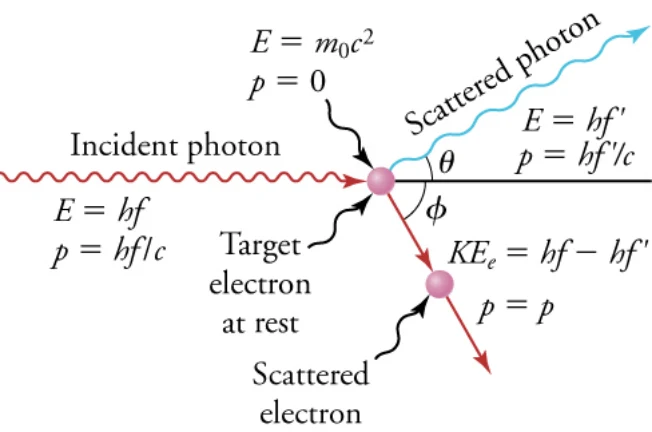
We can see that photon momentum is small, since and h is very small. It is for this reason that we do not ordinarily observe photon momentum. Our mirrors do not recoil when light reflects from them, except perhaps in cartoons. Compton saw the effects of photon momentum because he was observing X-rays, which have a small wavelength and a relatively large momentum, interacting with the lightest of particles, the electron.
でhがとても小さいので、光子の運動量が小さいことが分かる。私たちがふだん光子の運動量を観測しないのはこのためである。漫画でもない限り、鏡は光が反射するときに跳ね返らない。コンプトンが光子の運動量の効果を見たのは、波長が短くわりあい大きな運動量を持つX線が、最も軽い粒子である電子と作用し合うのを観測していたからである。
Electron and Photon Momentum Compared (a) Calculate the momentum of a visible photon that has a wavelength of 500 nm. (b) Find the velocity of an electron having the same momentum. (c) What is the energy of the electron, and how does it compare with the energy of the photon?Strategy
電子と光子の運動量を比べる (a)波長500 nmの可視の光子の運動量を計算せよ。(b)同じ運動量を持つ電子の速度を求めよ。(c)この電子のエネルギーはいくらで、光子のエネルギーとくらべてどうか。方針
Finding the photon momentum is a straightforward application of its definition: If we find the photon momentum is small, we can assume that an electron with the same momentum will be nonrelativistic, making it easy to find its velocity and kinetic energy from the classical formulas.
光子の運動量を求めるのは、その定義をそのまま当てはめるだけである。光子の運動量が小さいと分かれば、同じ運動量を持つ電子は非相対論的だとみなせ、古典の式から速度と運動エネルギーを簡単に求められる。
Solution for (a)(a)の解答
Photon momentum is given by the de Broglie relation.
光子の運動量はド・ブロイの関係で与えられる。
Entering the given photon wavelength yields
与えられた光子の波長を入れると
Solution for (b)(b)の解答
Since this momentum is indeed small, we will use the classical expression to find the velocity of an electron with this momentum. Solving for v and using the known value for the mass of an electron gives
この運動量は確かに小さいので、古典の式を使ってこの運動量を持つ電子の速度を求める。vについて解き、既知の電子の質量を使うと
Solution for (c)(c)の解答
The electron has kinetic energy, which is classically given by
電子は運動エネルギーを持ち、それは古典的には次で与えられる。
Thus,
したがって、
Converting this to eV by multiplying by yields
これにをかけてeVに直すと
The photon energy E is
光子のエネルギーEは
which is about five orders of magnitude greater.
であり、これはおよそ5桁大きい。
Discussion考察
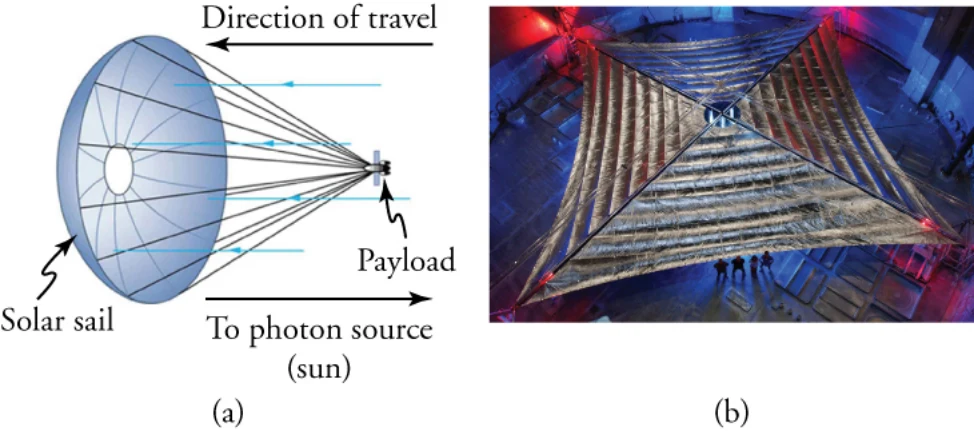
Even in huge numbers, the total momentum that photons carry is small. An electron that carries the same momentum as a 500-nm photon will have a 1,460 m/s velocity, which is clearly nonrelativistic. This is borne out by the experimental observation that it takes far less energy to give an electron the same momentum as a photon. That said, for high-energy photons interacting with small masses, photon momentum may be significant. Even on a large scale, photon momentum can have an effect if there are enough of them and if there is nothing to prevent the slow recoil of matter. Comet tails are one example, but there are also proposals to build space sails that use huge low-mass mirrors (made of aluminized Mylar) to reflect sunlight. In the vacuum of space, the mirrors would gradually recoil and could actually accelerate spacecraft within the solar system. See the following figure.
莫大な数があっても、光子が運ぶ運動量の合計は小さい。500 nmの光子と同じ運動量を持つ電子は1,460 m/sの速度を持ち、それは明らかに非相対論的である。これは、光子と同じ運動量を電子に与えるのにずっと少ないエネルギーで済むという実験の観察に裏づけられる。とはいえ、高いエネルギーの光子が小さな質量と作用し合う場合、光子の運動量は大きくなりうる。大きな尺度でも、光子が十分に多く、物質のゆっくりした跳ね返りを妨げるものがなければ、光子の運動量は効果を持ちうる。彗星の尾がその一例だが、日光を反射する巨大で軽い鏡(アルミを蒸着したマイラー製)を使う宇宙帆を作る提案もある。宇宙の真空では、鏡はしだいに跳ね返り、実際に太陽系の中で宇宙船を加速しうる。次の図を見よ。
TIPS FOR SUCCESS When determining energies in particle physics, it is more sensible to use the unit eV instead of Joules. Using eV will help you to recognize differences in magnitude more easily and will make calculations simpler. Also, eV is used by scientists to describe the binding energy of particles and their rest mass, so using eV will eliminate the need to convert energy quantities. Finally, eV is a convenient unit when linking electromagnetic forces to particle physics, as one eV is the amount energy given to an electron when placed in a field of 1-V potential difference.
学習のポイント 素粒子物理でエネルギーを決めるときは、ジュールでなくeVの単位を使うほうが筋が通る。eVを使えば桁の違いをより簡単に見て取れ、計算も単純になる。またeVは科学者が粒子の結合エネルギーと静止質量を述べるのに使うので、eVを使えばエネルギーの量を換算する必要がなくなる。最後に、eVは電磁気の力を素粒子物理に結びつけるときに便利な単位である。1 eVは、1 Vの電位差の場に置かれた電子に与えられるエネルギーの量だからである。
Practice Problems練習問題
19Find the momentum of a 4.00-cm wavelength microwave photon.a. 0.83 × 10⁻³² kg ⋅ m/sb. 1.66 × 10⁻³⁴ kg ⋅ m/sc. 0.83 × 10⁻³⁴ kg ⋅ m/sd. 1.66 × 10⁻³² kg ⋅ m/s
19波長4.00 cmのマイクロ波の光子の運動量を求めよ。a. 0.83 × 10⁻³² kg·m/sb. 1.66 × 10⁻³⁴ kg·m/sc. 0.83 × 10⁻³⁴ kg·m/sd. 1.66 × 10⁻³² kg·m/s
20Calculate the wavelength of a photon that has the same momentum of a proton moving at 1.00 percent of the speed of light.a. 2.43 × 10⁻¹⁰ mb. 2.43 × 10⁻¹² mc. 1.32 × 10⁻¹⁵ md. 1.32 × 10⁻¹³ m
20光の速さの1.00パーセントで動く陽子と同じ運動量を持つ光子の波長を計算せよ。a. 2.43 × 10⁻¹⁰ mb. 2.43 × 10⁻¹² mc. 1.32 × 10⁻¹⁵ md. 1.32 × 10⁻¹³ m
LightSail-1 Project “Provide ships or sails adapted to the heavenly breezes, and there will be some who will brave even that void.”
ライトセイル1号計画 「天のそよ風に合わせた船や帆を用意せよ。そうすればその虚空にさえ挑む者が現れるだろう。」
— Johannes Kepler (in a letter to Galileo Galilei in 1608)
——ヨハネス・ケプラー(1608年のガリレオ・ガリレイへの手紙より)
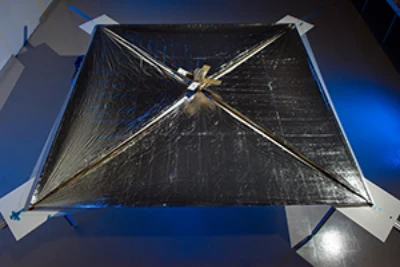
Traversing the Solar System using nothing but the Sun’s power has long been a fantasy of scientists and science fiction writers alike. Though physicists like Compton, Einstein, and Planck all provided evidence of light’s propulsive capacity, it is only recently that the technology has become available to truly put these visions into motion. In 2016, by sending a lightweight satellite into space, the LightSail-1 project is designed to do just that.
太陽の力だけで太陽系を渡ることは、科学者にもSF作家にも長く夢だった。コンプトン、アインシュタイン、プランクといった物理学者はみな光が推す能力を持つ証拠を与えたが、この構想を本当に動かす技術が使えるようになったのはごく最近である。2016年、軽い人工衛星を宇宙へ送ることで、ライトセイル1号計画はまさにそれを行うよう設計されている。
A citizen-funded project headed by the Planetary Society, the 5.45-million-dollar LightSail-1 project is set to launch two crafts into orbit around the Earth. Each craft is equipped with a 32-square-meter solar sail prepared to unfurl once a rocket has launched it to an appropriate altitude. The sails are made of large mirrors, each a quarter of the thickness of a trash bag, which will receive an impulse from the Sun’s reflecting photons. Each time the Sun’s photon strikes the craft’s reflective surface and bounces off, it will provide a momentum to the sail much greater than if the photon were simply absorbed.
惑星協会が率いる市民の資金による545万ドルのライトセイル1号計画は、二機を地球周回軌道へ打ち上げる。それぞれの機は32平方メートルの太陽帆を備え、ロケットが適切な高度まで運んだら広げるようになっている。帆は大きな鏡ででき、それぞれゴミ袋の4分の1の厚さで、太陽の反射する光子から力積を受ける。太陽の光子が機の反射する面にあたって跳ね返るたび、光子が単に吸収される場合よりずっと大きな運動量を帆に与える。
Attached to three tiny satellites called CubeSats, whose combined volume is no larger than a loaf of bread, the received momentum from the Sun’s photons should be enough to record a substantial increase in orbital speed. The intent of the LightSail-1 mission is to prove that the technology behind photon momentum travel is sound and can be done cheaply. A test flight in May 2015 showed that the craft’s Mylar sails could unfurl on command. With another successful result in 2016, the Planetary Society will be planning future versions of the craft with the hopes of eventually achieving interplanetary satellite travel. Though a few centuries premature, Kepler’s fantastic vision may not be that far away.
合わせた体積が食パン一斤より小さい、キューブサットと呼ばれる三つの小さな人工衛星に取り付けられ、太陽の光子から受ける運動量は軌道速度のかなりの増加を記録するのに十分なはずである。ライトセイル1号の目的は、光子の運動量による移動の技術が健全で、安く行えることを示すことである。2015年5月の試験飛行は、機のマイラーの帆が命令どおり広げられることを示した。2016年にもう一度成功すれば、惑星協会は、最終的に惑星間の人工衛星の移動を実現する望みをもって、将来の機を計画するだろう。数世紀早すぎたとはいえ、ケプラーの素晴らしい構想はそれほど遠くないのかもしれない。
Predict the motion of a solar sail released into interplanetary space, considering only the influence of the nearest star.
20惑星間の空間へ放たれた太陽帆の運動を、最も近い恒星の影響だけを考えて予測せよ。
a. The sail’s speed will increase continuously at constant acceleration proportional only to the rate of photon ejection from the sun and the sail area.b. The sail’s speed will increase continuously at an acceleration proportional to the distance from the sun and the area of the sail.c. The sail’s speed will increase continuously until it cannot overcome friction from the solar wind, which is proportional to the sail area, then move at constant speed from there.d. The sail’s speed will increase continuously until it cannot overcome friction from the solar wind, which is proportional to the sail area, then decrease in speed.
a. 帆の速さは、太陽からの光子の放出の速さと帆の面積だけに比例する一定の加速度で増え続ける。b. 帆の速さは、太陽からの距離と帆の面積に比例する加速度で増え続ける。c. 帆の速さは、帆の面積に比例する太陽風の摩擦に打ち勝てなくなるまで増え続け、それから一定の速さで進む。d. 帆の速さは、帆の面積に比例する太陽風の摩擦に打ち勝てなくなるまで増え続け、それから減る。
Particle-Wave Duality粒子と波の二重性
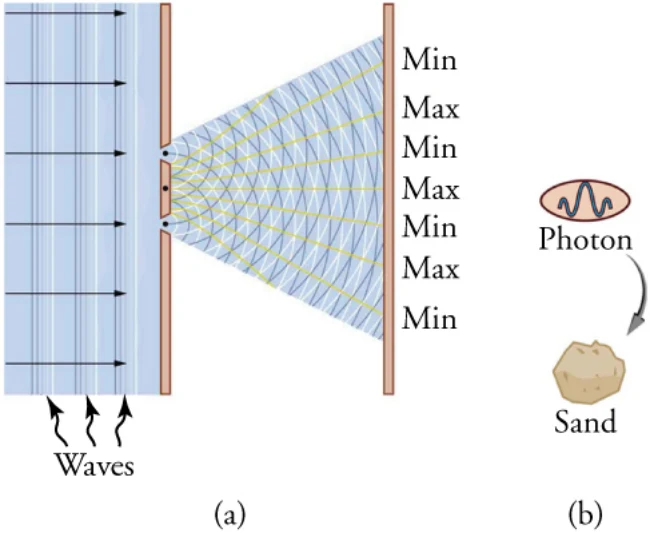
We have long known that EM radiation is like a wave, capable of interference and diffraction. We now see that light can also be modeled as particles—massless photons of discrete energy and momentum. We call this twofold nature the particle-wave duality, meaning that EM radiation has properties of both particles and waves. This may seem contradictory, since we ordinarily deal with large objects that never act like both waves and particles. An ocean wave, for example, looks nothing like a grain of sand. However, this so-called duality is simply a term for properties of the photon analogous to phenomena we can observe directly, on a macroscopic scale. See Figure 21.14. If this term seems strange, it is because we do not ordinarily observe details on the quantum level directly, and our observations yield either particle-like or wave-like properties, but never both simultaneously.
電磁放射が波のようであり、干渉と回折を起こせることは長く知られてきた。いまや、光が粒子——離散的なエネルギーと運動量を持つ、質量のない光子——としてもモデル化できることが分かった。この二重の性質を粒子と波の二重性という。電磁放射が粒子の性質も波の性質も持つという意味である。ふだん扱う大きな物は波としても粒子としてもふるまわないので、これは矛盾に思えるかもしれない。たとえば海の波は砂粒とはまるで似ていない。しかし、いわゆるこの二重性は、巨視的な尺度で直接観察できる現象になぞらえた光子の性質を表す語にすぎない。図21.14を見よ。この語が奇妙に思えるとすれば、それは私たちがふだん量子の水準の細部を直接観察せず、観察が粒子らしい性質か波らしい性質のどちらかを与えて、決して両方を同時には与えないからである。
Since we have a particle-wave duality for photons, and since we have seen connections between photons and matter in that both have momentum, it is reasonable to ask whether there is a particle-wave duality for matter as well. If the EM radiation we once thought to be a pure wave has particle properties, is it possible that matter has wave properties? The answer, strangely, is yes. The consequences of this are tremendous, as particle-wave duality has been a constant source of scientific wonder during the twentieth and twenty-first centuries.
光子に粒子と波の二重性があり、光子と物質のどちらも運動量を持つというつながりも見たので、物質にも粒子と波の二重性があるかを問うのは理にかなう。かつて純粋な波だと思われていた電磁放射が粒子の性質を持つなら、物質が波の性質を持つこともありうるのか。答えは、奇妙にも、イエスである。この帰結はとてつもない。粒子と波の二重性は、20世紀と21世紀を通じて科学の驚異の絶えざる源であり続けてきた。
Check Your Understanding理解の確認
21What fundamental physics properties were found to be conserved in Compton scattering?a. energy and wavelengthb. energy and momentum
21コンプトン散乱で保存されると分かった物理の基本の量はどれか。a. エネルギーと波長b. エネルギーと運動量
c. mass and energyd. energy and angle
c. 質量とエネルギーd. エネルギーと角度
22Why do classical or relativistic momentum equations not work in explaining the conservation of momentum that occurs in Compton scattering?
22コンプトン散乱で起こる運動量の保存を説明するのに、古典や相対論の運動量の式が使えないのはなぜか。
a. because neither classical nor relativistic momentum equations utilize mass as a variable in their equationsb. because relativistic momentum equations utilize mass as a variable in their formulas but classical momentum equations do notc. because classical momentum equations utilize mass as a variable in their formulas but relativistic momentum equations do notd. because both classical and relativistic momentum equations utilize mass as a variable in their formulas
a. 古典の運動量の式も相対論の運動量の式も、質量を変数として使っていないからb. 相対論の運動量の式は質量を変数として使うが、古典の運動量の式は使わないからc. 古典の運動量の式は質量を変数として使うが、相対論の運動量の式は使わないからd. 古典の運動量の式も相対論の運動量の式も質量を変数として使うから
23If solar sails were constructed with more massive materials, how would this influence their effectiveness?a. The effect of the momentum would increase due to the decreased inertia of the sails.b. The effect of the momentum would reduce due to the decreased inertia of the sails.
23太陽帆をより重い材料で作ったら、その効き目にどう影響するか。a. 帆の慣性が減るので運動量の効果は増える。b. 帆の慣性が減るので運動量の効果は減る。
c. The effect of the momentum would increase due to the increased inertia of the sails.d. The effect of the momentum would be reduced due to the increased inertia of the sails.
c. 帆の慣性が増えるので運動量の効果は増える。d. 帆の慣性が増えるので運動量の効果は減る。
24True or false—It is possible to propel a solar sail craft using just particles within the solar wind.a. trueb. false
24正誤問題——太陽風の中の粒子だけで太陽帆の機を進めることができる。a. 正b. 誤
25True or false—Photon momentum more directly supports the wave model of light.a. falseb. true
25正誤問題——光子の運動量は光の波のモデルをより直接に支持する。a. 誤b. 正
26True or false—wave-particle duality exists for objects on the macroscopic scale.a. falseb. true
26正誤問題——波と粒子の二重性は巨視的な尺度の物にも存在する。a. 誤b. 正
27What type of electromagnetic radiation was used in Compton scattering?a. visible lightb. ultraviolet radiation
27コンプトン散乱にはどの型の電磁放射が使われたか。a. 可視光b. 紫外線
c. radio wavesd. X-rays
c. 電波d. X線