第18章静電気Static Electricity原書 p.567–622
18.4 Electric Potential18.4 電位
SECTION LEARNING OBJECTIVES By the end of this section, you will be able to do the following:
この節の学習目標 この節を終えると、次のことができるようになる。
• Explain the similarities and differences between electric potential energy and gravitational potential energy• Calculate the electric potential difference between two point charges and in a uniform electric field
・電気的な位置エネルギーと重力による位置エネルギーの似ている点と違う点を説明する・二つの点電荷の間の、また一様な電場の中の電位差を計算する
Section Key Termsこの節の重要語
As you learned in studying gravity, a mass in a gravitational field has potential energy, which means it has the potential to accelerate and thereby increase its kinetic energy. This kinetic energy can be used to do work. For example, imagine you want to use a stone to pound a nail into a piece of wood. You first lift the stone high above the nail, which increases the potential energy of the stone-Earth system—because Earth is so large, it does not move, so we usually shorten this by saying simply that the potential energy of the stone increases. When you drop the stone, gravity converts the potential energy into kinetic energy. When the stone hits the nail, it does work by pounding the nail into the wood. The gravitational potential energy is the work that a mass can potentially do by virtue of its position in a gravitational field. Potential energy is a very useful concept, because it can be used with conservation of energy to calculate the motion of masses in a gravitational field.
重力を学んだときに知ったとおり、重力場の中の質量は位置エネルギーを持つ。これは、加速して運動エネルギーを増やす能力を持つという意味である。この運動エネルギーは仕事をするのに使える。たとえば、石を使って釘を木に打ち込みたいとしよう。まず石を釘の上の高いところへ持ち上げる。これは石と地球からなる系の位置エネルギーを増やす——地球はあまりに大きくて動かないので、ふつうは単に石の位置エネルギーが増えると短く言う。石を落とすと、重力が位置エネルギーを運動エネルギーへ変える。石が釘にあたると、釘を木に打ち込む仕事をする。重力による位置エネルギーとは、重力場の中の位置によって質量がなしうる仕事である。位置エネルギーはとても役に立つ概念である。エネルギー保存と組み合わせて、重力場の中の質量の運動を計算できるからである。
electric potentialelectric potential energy
電位電気的な位置エネルギー
Electric potential energy works much the same way, but it is based on the electric field instead of the gravitational field. By virtue of its position in an electric field, a charge has an electric potential energy. If the charge is free to move, the force due to the electric field causes it to accelerate, so its potential energy is converted to kinetic energy, just like a mass that falls in a gravitational field. This kinetic energy can be used to do work. The electric potential energy is the work that a charge can do by virtue of its position in an electric field.
電気的な位置エネルギーもほとんど同じように働くが、重力場でなく電場にもとづく。電場の中の位置によって、電荷は電気的な位置エネルギーを持つ。電荷が自由に動けるなら、電場による力がそれを加速させ、重力場の中で落ちる質量とちょうど同じように、位置エネルギーが運動エネルギーへ変わる。この運動エネルギーは仕事をするのに使える。電気的な位置エネルギーとは、電場の中の位置によって電荷がなしうる仕事である。
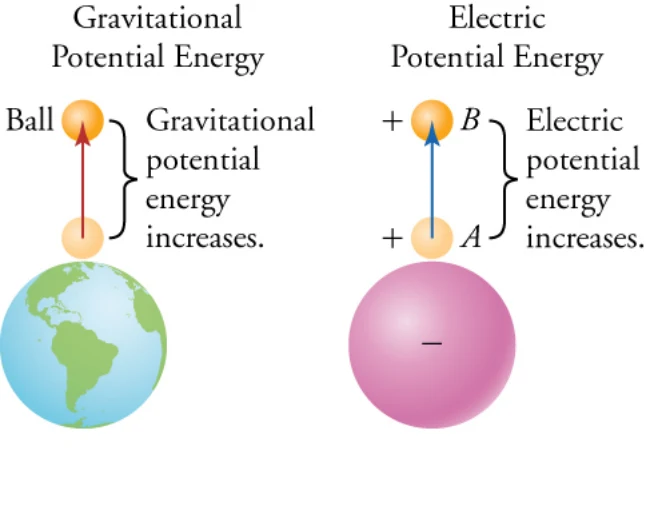
The analogy between gravitational potential energy and electric potential energy is depicted in Figure 18.21. On the left, the ball-Earth system gains gravitational potential energy when the ball is higher in Earth's gravitational field. On the right, the two-charge system gains electric potential energy when the positive charge is farther from the negative charge.
重力による位置エネルギーと電気的な位置エネルギーの類比を図18.21に示す。左では、ボールが地球の重力場の中でより高い位置にあると、ボールと地球の系は重力による位置エネルギーを得る。右では、正の電荷が負の電荷から遠いほど、二電荷の系は電気的な位置エネルギーを得る。
Let’s use the symbol to denote gravitational potential energy. When a mass falls in a gravitational field, its gravitational potential energy decreases. Conservation of energy tells us that the work done by the gravitational field to make the mass accelerate must equal the loss of potential energy of the mass. If we use the symbol to denote this work, then
重力による位置エネルギーを記号で表そう。質量が重力場の中で落ちると、その重力による位置エネルギーは減る。エネルギー保存から、質量を加速させるために重力場がした仕事は、質量の位置エネルギーの減りに等しいはずである。この仕事を記号で表すと、
where the minus sign reflects the fact that the potential energy of the ball decreases.
となる。マイナス符号は、ボールの位置エネルギーが減るという事実を表す。
The work done by gravity on the mass is
質量に重力がする仕事は
where F is the force due to gravity, and and are the initial and final positions of the ball, respectively. The negative sign is because gravity points down, which we consider to be the negative direction. For the constant gravitational field near Earth’s surface, . The change in gravitational potential energy of the mass is
である。ここでFは重力による力、とはそれぞれボールの初めと最後の位置である。マイナス符号は、重力が下を向き、それを負の向きとみなすからである。地表近くの一定の重力場ではである。質量の重力による位置エネルギーの変化は
Note that is just the negative of the height h from which the mass falls, so we usually just write .
である。は質量が落ちる高さhの符号を変えただけなので、ふつうは単にと書く。
We now apply the same reasoning to a charge in an electric field to find the electric potential energy. The change in electric potential energy is the work done by the electric field to move a charge q from an initial position to a final position ( ). The definition of work does not change, except that now the work is done by the electric field: . For a charge that falls through a constant electric field E,
同じ理屈を電場の中の電荷に当てはめて、電気的な位置エネルギーを求めよう。電気的な位置エネルギーの変化は、電荷qを初めの位置から最後の位置()へ動かすために電場がした仕事である。仕事の定義は変わらないが、いまや仕事をするのは電場である。。一定の電場Eの中を落ちる電荷では、
the force applied to the charge by the electric field is . The change in electric potential energy of the charge is thus
電場が電荷に及ぼす力はである。したがって電荷の電気的な位置エネルギーの変化は
or
あるいは
This equation gives the change in electric potential energy of a charge q when it moves from position to position in a constant electric field E.
となる。この式は、一定の電場Eの中で電荷qが位置から位置へ動くときの、その電気的な位置エネルギーの変化を与える。
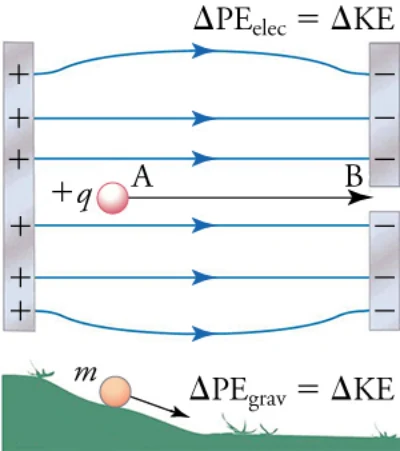
Figure 18.22 shows how this analogy would work if we were close to Earth’s surface, where gravity is constant. The top image shows a charge accelerating due to a constant electric field. Likewise, the round mass in the bottom image accelerates due to a constant gravitation field. In both cases, the potential energy of the particle decreases, and its kinetic energy increases.
図18.22は、重力が一定である地表近くにいる場合に、この類比がどう働くかを示す。上の図は一定の電場によって加速する電荷を示す。同じように、下の図の丸い質量は一定の重力場によって加速する。どちらの場合も粒子の位置エネルギーは減り、運動エネルギーは増える。
Analogy between Gravity and Electricity This video discusses the analogy between gravitational potential energy and electric potential energy. It reviews the concepts of work and potential energy and shows the connection between a mass in a uniform gravitation field, such as on Earth’s surface, and an electric charge in a uniform electric field.
重力と電気の類比 この動画は重力による位置エネルギーと電気的な位置エネルギーの類比を論じる。仕事と位置エネルギーの概念を復習し、地表のような一様な重力場の中の質量と、一様な電場の中の電荷とのつながりを示す。
If the electric field is not constant, then the equation is not valid, and deriving the electric potential energy becomes more involved. For example, consider the electric potential energy of an assembly of two point charges and of the same sign that are initially very far apart. We start by placing charge at the origin of our coordinate system. This takes no electrical energy, because there is no electric field at the origin (because charge is very far away). We then bring charge in from very far away to a distance r from the center of charge . This requires some effort, because the electric field of charge applies a repulsive force on charge . The energy it takes to assemble these two charges can be recuperated if we let them fly apart again. Thus, the charges have potential energy when they are a distance r apart. It turns out that the electric potential energy of a pair of point charges and a distance r apart is
電場が一定でなければ、式は成り立たず、電気的な位置エネルギーを導くのはもっと込み入る。たとえば、はじめとても遠く離れた、同じ符号の二つの点電荷との組の電気的な位置エネルギーを考えよう。まず電荷を座標系の原点に置く。これには電気のエネルギーは要らない。(電荷がとても遠いので)原点に電場がないからである。次に電荷をとても遠くから電荷の中心から距離rのところまで持ってくる。これにはいくらかの労力が要る。電荷の電場が電荷に斥力を及ぼすからである。この二つの電荷を組み立てるのに要ったエネルギーは、ふたたび飛び離れさせれば取り戻せる。したがって、電荷は距離rだけ離れているとき位置エネルギーを持つ。距離rだけ離れた点電荷の組との電気的な位置エネルギーは、次のようになることが分かる。
To recap, if charges and are free to move, they can accumulate kinetic energy by flying apart, and this kinetic energy can be used to do work. The maximum amount of work the two charges can do (if they fly infinitely far from each other) is given by the equation above.
まとめると、電荷とが自由に動けるなら、飛び離れることで運動エネルギーを溜められ、この運動エネルギーは仕事をするのに使える。二つの電荷がなしうる仕事の最大(互いに無限に遠くまで飛べば)は、上の式で与えられる。
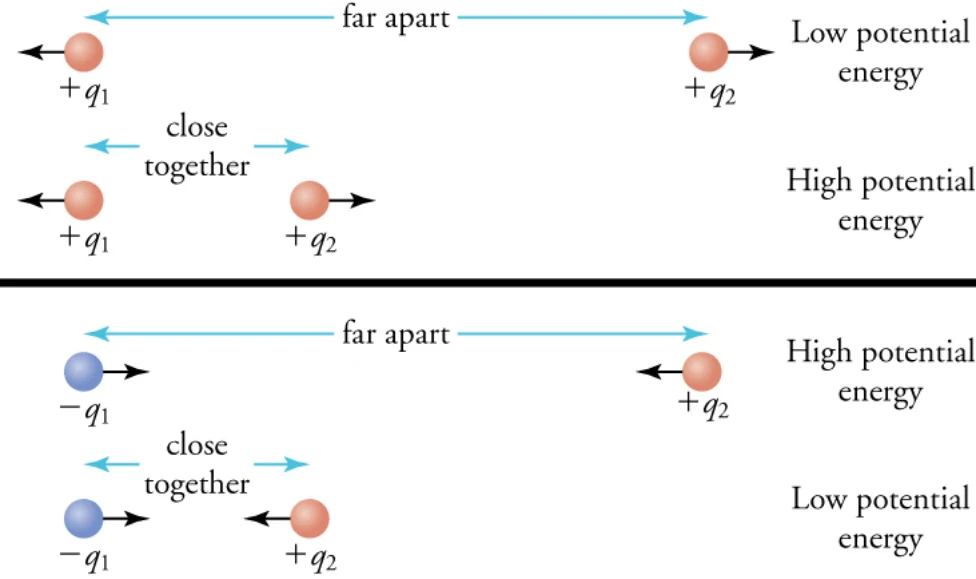
Notice that if the two charges have opposite signs, then the potential energy is negative. This means that the charges have more potential to do work when they are far apart than when they are at a distance r apart. This makes sense: Opposite charges attract, so the charges can gain more kinetic energy if they attract each other from far away than if they start at only a short distance apart. Thus, they have more potential to do work when they are far apart. Figure 18.23 summarizes how the electric potential energy depends on charge and separation.
二つの電荷の符号が逆なら、位置エネルギーは負になることに注目しよう。これは、電荷が遠く離れているときのほうが、距離rだけ離れているときより仕事をする能力が大きいという意味である。これは筋が通る。逆の電荷は引き合うので、短い距離から始めるより遠くから引き合うほうが、より多くの運動エネルギーを得られる。したがって、遠く離れているときのほうが仕事をする能力は大きい。図18.23は、電気的な位置エネルギーが電荷と隔たりにどうよるかをまとめている。
Electric Potential電位
Recall that to find the force applied by a fixed charge Q on any arbitrary test charge q, it was convenient to define the electric field, which is the force per unit charge applied by Q on any test charge that we place in its electric field. The same Strategy is used here with electric potential energy: We now define the electric potential V, which is the electric potential energy per unit charge.
決まった電荷Qが任意の試験電荷qに及ぼす力を求めるのに、電場を定めると便利だったことを思い出そう。電場とは、その電場に置いたどんな試験電荷にもQが及ぼす、単位電荷あたりの力である。ここでも電気的な位置エネルギーについて同じやり方を使う。すなわち電位Vを、単位電荷あたりの電気的な位置エネルギーとして定める。
Normally, the electric potential is simply called the potential or voltage. The units for the potential are J/C, which are given the name volt (V) after the Italian physicist Alessandro Volta (1745–1827). From the equation , the electric potential a distance r from a point charge is
ふつう電位は単に「電位」あるいは「電圧」と呼ばれる。電位の単位はJ/Cで、イタリアの物理学者アレッサンドロ・ボルタ(1745–1827)にちなんでボルト(V)という名が与えられている。式から、点電荷から距離rの電位は
This equation gives the energy required per unit charge to bring a charge from infinity to a distance r from a point charge Mathematically, this is written as
となる。この式は、電荷を無限遠から点電荷の距離rのところまで持ってくるのに要る単位電荷あたりのエネルギーを与える。数式で書くと
Note that this equation actually represents a difference in electric potential. However, because the second term is zero, it is normally not written, and we speak of the electric potential instead of the electric potential difference, or we just say the potential difference, or voltage). Below, when we consider the electric potential energy per unit charge between two points not infinitely far apart, we speak of electric potential difference explicitly. Just remember that electric potential and electric potential difference are really the same thing; the former is used just when the electric potential energy is zero in either the initial or final charge configuration.
となる。この式は実は電位の差を表していることに注意しよう。しかし二つ目の項が0なので、ふつうはそれを書かず、電位差ではなく電位と言う(あるいは単に電位差、電圧と言う)。以下では、無限に遠くない二点間の単位電荷あたりの電気的な位置エネルギーを考えるとき、はっきり電位差と言う。電位と電位差は本当は同じもので、前者は初めか最後の電荷の配置のどちらかで電気的な位置エネルギーが0のときに使うだけだと覚えておこう。
Coming back now to the electric potential a distance r from a point charge , note that can be any arbitrary point charge, so we can drop the subscripts and simply write
さて、点電荷から距離rの電位に戻ると、は任意の点電荷でよいので、添字を落として単に次のように書ける。
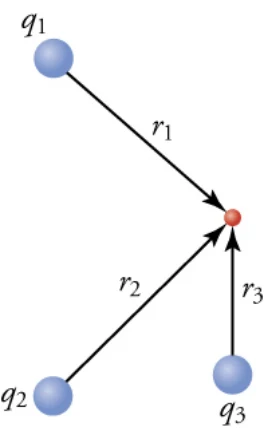
Now consider the electric potential near a group of charges q1, q2, and q3, as drawn in Figure 18.24. The electric potential is derived by considering the electric field. Electric fields follow the principle of superposition and can be simply added together, so the electric potential from different charges also add together. Thus, the electric potential of a point near a group of charges is
次に、図18.24のように電荷q1、q2、q3の集まりの近くの電位を考えよう。電位は電場を考えることで導かれる。電場は重ね合わせの原理に従い、単純に足し合わせられるので、違う電荷からの電位も足し合わせられる。したがって、電荷の集まりの近くの点の電位は
where are the distances from the center of charges to the point of interest, as shown in Figure 18.24.
となる。ここでは、図18.24に示すとおり、電荷の中心から考えている点までの距離である。
Now let’s consider the electric potential in a uniform electric field. From the equation , we see that the potential difference in going from to in a uniform electric field E is
では、一様な電場の中の電位を考えよう。式から、一様な電場Eの中でからへ行くときの電位差は
TIPS FOR SUCCESS Notice from the equation that the electric field can be written as
学習のポイント 式から、電場は
which means that the electric field has units of V/m. Thus, if you know the potential difference between two points, calculating the electric field is very simple—you simply divide the potential difference by the distance!
と書けることに注目しよう。これは電場がV/mの単位を持つことを意味する。したがって、二点間の電位差が分かれば、電場の計算はとても簡単である。電位差を距離で割ればよい。
Notice that a positive charge in a region with high potential will experience a force pushing it toward regions of lower potential. In this sense, potential is like pressure for fluids. Imagine a pipe containing fluid, with the fluid at one end of the pipe under high pressure and the fluid at the other end of the pipe under low pressure. If nothing prevents the fluid from flowing, it will flow from the high-pressure end to the low-pressure end. Likewise, a positive charge that is free to move will move from a region with high potential to a region with lower potential.
電位の高い領域にある正の電荷は、電位のより低い領域へ押しやる力を受けることに注目しよう。この意味で、電位は流体の圧力に似ている。流体の入った管を思い描こう。管の一方の端の流体は高い圧力、もう一方の端の流体は低い圧力にある。流体の流れを妨げるものがなければ、高い圧力の端から低い圧力の端へ流れる。同じように、自由に動ける正の電荷は、電位の高い領域から低い領域へ動く。
Voltage This video starts from electric potential energy and explains how this is related to electric potential (or voltage). The lecturer calculates the electric potential created by a uniform electric field.
電圧 この動画は電気的な位置エネルギーから始めて、それが電位(すなわち電圧)とどう関係するかを説明する。講師は一様な電場が作る電位を計算する。
Voltage | Electric charge, electric force, and voltage | Physics | Khan Academy (https://www.openstax.org/l/ 28voltage)
電圧|電荷、電気の力、電圧|物理|カーンアカデミー(https://www.openstax.org/l/28voltage)
Watch Physics: Voltage. This video explains the difference between electrical potential, or voltage, and electrical potential energy.Access multimedia content (http://openstax.org/books/physics/pages/18-4-electric-potential) A point charge moves from x = 5.0 m to x = 11 m in a 2.0 N/C electric field aligned with the x-direction. What change
物理を見る:電圧。この動画は電位すなわち電圧と、電気的な位置エネルギーの違いを説明する。マルチメディア教材はこちら(http://openstax.org/books/physics/pages/18-4-electric-potential) x方向に沿った2.0 N/Cの電場の中で、点電荷がx = 5.0 mからx = 11 mへ動く。この電荷が経験する
in voltage does the charge experience?a. 0.33 Vb. 6 V
電圧の変化はいくらか。a. 0.33 Vb. 6 V
c. 12 Vd. 32 V
c. 12 Vd. 32 V
Electric Animals Many animals generate and/or detect electric fields. This is useful for activities such as hunting, defense, navigation, communication, and mating. Because salt water is a relatively good conductor, electric fish have evolved in all the world’s oceans. These fish have intrigued humans since the earliest times. In the nineteenth century, parties were even organized where the main attraction was getting a jolt from an electric fish! Scientists also studied electric fish to learn about electricity. Alessandro Volta based his research that led to batteries in 1799 on electric fish. He even referred to batteries as artificial electric organs, because he saw them as imitations of the electric organs of electric fish.
電気を使う動物 多くの動物が電場を作り、あるいは感じ取る。これは狩り、防御、進路の決定、意思の疎通、交尾といった活動に役立つ。塩水はわりあいよい導体なので、電気を出す魚は世界じゅうの海で進化した。この魚は最古の時代から人間の興味を引いてきた。19世紀には、電気を出す魚から衝撃をもらうのが目玉の集まりまで開かれた。科学者も電気を出す魚を研究して電気について学んだ。アレッサンドロ・ボルタは、1799年に電池へとつながる研究を電気を出す魚にもとづいて行った。彼は電池を「人工の発電器官」とさえ呼んだ。電気を出す魚の発電器官の模倣とみなしたからである。
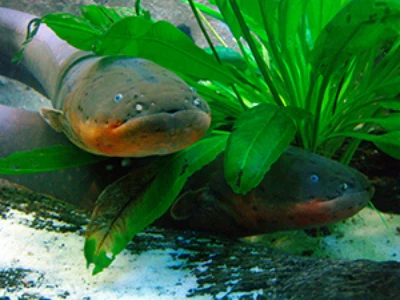
Animals that generate electricity are called electrogenic and those that detect electric fields are called electroreceptive. Most fish that are electrogenic are also electroreceptive. One of the most well-known electric fish is the electric eel (see Figure 18.25), which is both electrogenic and electroreceptive. These fish have three pairs of organs that produce the electric charge: the main organ, Hunter’s organ, and Sach’s organ. Together, these organs account for more than 80percent of the fish’s body.
電気を作る動物は発電性、電場を感じ取る動物は電気受容性と呼ばれる。発電性の魚のほとんどは電気受容性でもある。最もよく知られた電気を出す魚の一つがデンキウナギ(図18.25を見よ)で、発電性でも電気受容性でもある。この魚は電荷を作る三対の器官——主器官、ハンター器官、サックス器官——を持つ。これらの器官を合わせると、魚の体の80パーセント以上を占める。
Electric eels can produce electric discharges of much greater voltage than what you would get from a standard wall socket. These discharges can stun or even kill their prey. They also use low-intensity discharges to navigate. The electric fields they generate reflect off nearby obstacles or animals and are then detected by electroreceptors in the eel’s skin. The three organs that produce electricity contain electrolytes, which are substances that ionize when dissolved in water (or other liquids). An ionized atom or molecule is one that has lost or gained at least one electron, so it carries a net charge. Thus, a liquid solution containing an electrolyte conducts electricity, because the ions in the solution can move if an electric field is applied.
デンキウナギは、ふつうの壁のコンセントから得られるよりずっと高い電圧の放電を作れる。この放電は獲物を気絶させ、殺すことさえできる。また、進路を決めるのに弱い放電も使う。作った電場は近くの障害物や動物で反射し、ウナギの皮膚の電気受容器で感じ取られる。電気を作る三つの器官は電解質を含む。電解質とは、水(や他の液体)に溶けるとイオンになる物質である。イオン化した原子や分子とは、少なくとも一つの電子を失ったか得たもので、したがって正味の電荷を持つ。したがって、電解質を含む液体の溶液は電気を通す。電場をかければ溶液の中のイオンが動けるからである。
To produce large discharges, the main organ is used. It contains approximately 6,000 rows of electroplaques connected in a long chain. Connected this way, the voltage between electroplaques adds up, creating a large final voltage. Each electroplaque consists of a column of cells controlled by an excitor nerve. When triggered by the excitor nerve, the electroplaques allow ionized sodium to flow through them, creating a potential difference between electroplaques. These potentials add up, and a large current can flow through the electrolyte.
大きな放電を作るには主器官が使われる。それはおよそ6,000列の発電板が長い鎖状につながったものを含む。こうつなぐと、発電板どうしの電圧が足し合わされ、大きな最終の電圧ができる。それぞれの発電板は、興奮神経に制御された細胞の柱からなる。興奮神経に引き金を引かれると、発電板はイオン化したナトリウムを通し、発電板どうしの間に電位差を作る。この電位が足し合わされ、電解質を通して大きな電流が流れうる。
This geometry is reflected in batteries, which also use stacks of plates to produce larger potential differences.
この構造は電池にも反映されている。電池も、より大きな電位差を作るために板を積み重ねている。
GRASP CHECK If an electric eel produces 1,000 V, which voltage is produced by each electroplaque in the main organ?a. 0.17 mVb. 1.7 mV
理解の確認 デンキウナギが1,000 Vを作るとき、主器官のそれぞれの発電板が作る電圧はいくらか。a. 0.17 mVb. 1.7 mV
c. 17 mVd. 170 mV
c. 17 mVd. 170 mV
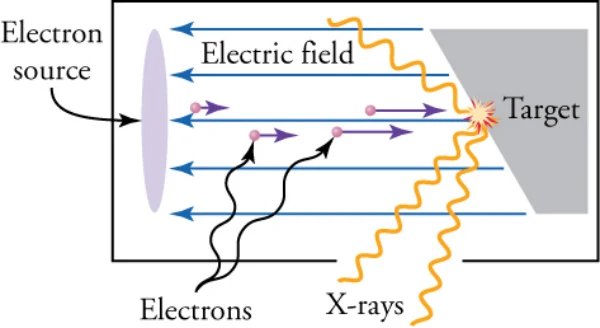
X-ray Tube Dentists use X-rays to image their patients’ teeth and bones. The X-ray tubes that generate X-rays contain an electron source separated by about 10 cm from a metallic target. The electrons are accelerated from the source to the target by a uniform electric field with a magnitude of about 100 kN/C, as drawn in Figure 18.26. When the electrons hit the target, X-rays are produced. (a) What is the potential difference between the electron source and the metallic target? (b) What is the kinetic energy of the electrons when they reach the target, assuming that the electrons start at rest?
X線管 歯科医は患者の歯と骨を写すのにX線を使う。X線を作るX線管には、金属の標的からおよそ10 cm離れた電子源が入っている。図18.26に示すように、電子は大きさおよそ100 kN/Cの一様な電場によって源から標的へ加速される。電子が標的にあたるとX線が生じる。(a)電子源と金属の標的の間の電位差はいくらか。(b)電子が静止から出発するとして、標的に達したときの電子の運動エネルギーはいくらか。
Strategy FOR (A)(a)の方針
Use the equation to find the potential difference given a constant electric field. Define the source position as and the target position as . To accelerate the electrons in the positive x direction, the electric field must point in the negative x direction. This way, the force on the electrons will point in the positive x direction, because both q and E are negative. Thus, .
一定の電場が与えられたときの電位差を求めるのに、式を使う。源の位置を、標的の位置をと定める。電子を正のx方向へ加速するには、電場は負のx方向を指さねばならない。こうすれば、qもEも負なので、電子にはたらく力は正のx方向を指す。したがってである。
Solution for (a)(a)の解答
Using and , the equation tells us that the potential difference between the electron source and the target is
とを使うと、式から、電子源と標的の間の電位差は
Discussion for (a)(a)の考察
The potential difference is positive, so the energy per unit positive charge is higher at the target than at the source. This means that free positive charges would fall from the target to the source. However, electrons are negative charges, so they accelerate from the source toward the target, gaining kinetic energy as they go.
電位差は正なので、単位正電荷あたりのエネルギーは源より標的のほうが高い。これは、自由な正の電荷なら標的から源へ落ちるという意味である。しかし電子は負の電荷なので、源から標的へ加速し、進むにつれて運動エネルギーを得る。
Strategy FOR (B)(b)の方針
Apply conservation of energy to find the final kinetic energy of the electrons. In going from the source to the target, the change in electric potential energy plus the change in kinetic energy of the electrons must be zero, so
エネルギー保存を当てはめて電子の最後の運動エネルギーを求める。源から標的へ行くとき、電気的な位置エネルギーの変化と電子の運動エネルギーの変化の和は0でなければならない。したがって
The change in electric potential energy for moving through a constant electric field is given by the equation
である。一定の電場の中を動くときの電気的な位置エネルギーの変化は式
where the electric field is . Because the electrons start at rest, their initial kinetic energy is zero. Thus, the change in kinetic energy is simply their final kinetic energy, so .
で与えられる。ここで電場はである。電子は静止から出発するので、初めの運動エネルギーは0である。したがって運動エネルギーの変化は単に最後の運動エネルギーであり、である。
Solution for (b)(b)の解答
Again and . The charge of an electron is . Conservation of energy gives
ここでもとである。電子の電荷はである。エネルギー保存から
Inserting the known values into the right-hand side of this equation gives
分かっている値をこの式の右辺に入れると
Discussion for (b)(b)の考察
This is a very small energy. However, electrons are very small, so they are easy to accelerate, and this energy is enough to make an electron go extremely fast. You can find their speed by using the definition of kinetic energy, . The result is that the electrons are moving at more than 100 million miles per hour!
これはとても小さなエネルギーである。しかし電子はとても小さいので加速しやすく、このエネルギーで電子はきわめて速く動く。運動エネルギーの定義を使えばその速さを求められる。結果は、電子が時速1億マイル以上で動いているというものである。
Electric Potential Energy of Doorknob and Dust Speck Consider again the doorknob from the example in the previous section. The doorknob is treated as a spherical conductor with a uniform static charge on its surface. What is the electric potential energy between the doorknob and a speck of dust carrying a charge at 1.0 cm from the front surface of the doorknob? The diameter of the doorknob is 5.0 cm.Strategy
ドアノブと塵の粒の電気的な位置エネルギー 前の節の例のドアノブをもう一度考えよう。ドアノブは、表面に一様な静電気の電荷を持つ球状の導体として扱う。ドアノブの前面から1.0 cmのところにある、電荷を持つ塵の粒とドアノブの間の電気的な位置エネルギーはいくらか。ドアノブの直径は5.0 cmである。方針
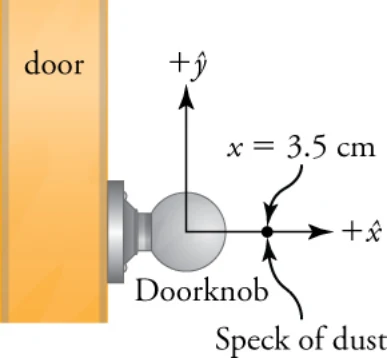
As we did in the previous section, we treat the charge as if it were concentrated at the center of the doorknob. Again, as you will be able to validate in later physics classes, we can make this simplification, because the charge is uniformly distributed over the surface of the spherical object. Make a sketch of the situation and define a coordinate system, as shown in the image below. We use to indicate the outward direction perpendicular to the door, with at the center of the doorknob. If the diameter of the doorknob is 5.0 cm, its radius is 2.5 cm. Thus, the speck of dust 1.0 cm from the surface of the doorknob is a distance from the center of the doorknob. To solve this problem, use the equation .
前の節と同じく、電荷がドアノブの中心に集中しているかのように扱う。ここでもあとの物理の授業で確かめられるように、電荷が球状の物の表面に一様に分布しているのでこの単純化ができる。下の図のように場面の図を描き、座標系を定めよう。ドアの外向きに垂直な向きをで表し、ドアノブの中心をとする。ドアノブの直径が5.0 cmなら、その半径は2.5 cmである。したがってドアノブの表面から1.0 cmの塵の粒は、ドアノブの中心からの距離にある。この問題を解くには式を使う。
Solution解答
The charge on the doorknob is and the charge on the speck of dust is . The distance . Inserting these values into the equation gives
ドアノブの電荷は、塵の粒の電荷はである。距離はである。これらの値を式に入れると
Discussion考察
The energy is negative, which means that the energy will decrease that is, get even more negative as the speck of dust approaches the doorknob. This helps explain why dust accumulates on objects that carry a static charge. However, note that insulators normally collect more static charge than conductors, because any charge that accumulates on insulators cannot move about on the insulator to find a way to escape. They must simply wait to be removed by some passing moist speck of dust or other host.
エネルギーは負であり、塵の粒がドアノブへ近づくにつれてエネルギーが減る、すなわちさらに負になることを意味する。これは、静電気の電荷を帯びた物に塵が溜まる理由を説明する助けになる。ただし、絶縁体のほうがふつう導体より多くの静電気の電荷を集めることに注意しよう。絶縁体に溜まった電荷は、逃げ道を探して絶縁体の上を動くことができないからである。それらはただ、通りかかった湿った塵の粒などの相手に取り去られるのを待つしかない。
Practice Problems練習問題
19What is the electric potential 10 cm from a −10 nC charge?a. 9.0 × 10² Vb. 9.0 × 10³ Vc. 9.0 × 10⁴ Vd. 9.0 × 10⁵ V
19−10 nCの電荷から10 cmのところの電位はいくらか。a. 9.0 × 10² Vb. 9.0 × 10³ Vc. 9.0 × 10⁴ Vd. 9.0 × 10⁵ V
20An electron accelerates from 0 to 10 × 104 m/s in an electric field. Through what potential difference did the electron travel? The mass of an electron is 9.11 × 10⁻³¹ kg, and its charge is −1.60 × 10⁻¹⁹ C.
20電場の中で電子が0から10 × 104 m/sへ加速する。この電子はどれだけの電位差を通ったか。電子の質量は9.11 × 10-31 kg、その電荷は−1.60 × 10⁻¹⁹ Cである。
a. 29 mVb. 290 mV
a. 29 mVb. 290 mV
c. 2,900 mVd. 29 V
c. 2,900 mVd. 29 V
Check Your Understanding理解の確認
21Gravitational potential energy is the potential for two masses to do work by virtue of their positions with respect to each other. What is the analogous definition of electric potential energy?
21重力による位置エネルギーとは、互いに対する位置によって二つの質量が仕事をなしうる能力である。電気的な位置エネルギーの、これに当たる定義はどれか。
a. Electric potential energy is the potential for two charges to do work by virtue of their positions with respect to the origin point.b. Electric potential energy is the potential for two charges to do work by virtue of their positions with respect to infinity.c. Electric potential energy is the potential for two charges to do work by virtue of their positions with respect to each other.d. Electric potential energy is the potential for single charges to do work by virtue of their positions with respect to their final positions.
a. 電気的な位置エネルギーとは、原点に対する位置によって二つの電荷が仕事をなしうる能力である。b. 電気的な位置エネルギーとは、無限遠に対する位置によって二つの電荷が仕事をなしうる能力である。c. 電気的な位置エネルギーとは、互いに対する位置によって二つの電荷が仕事をなしうる能力である。d. 電気的な位置エネルギーとは、最後の位置に対する位置によって一つの電荷が仕事をなしうる能力である。
22A negative charge is 10 m from a positive charge. Where would you have to move the negative charge to increase the potential energy of the system?
22負の電荷が正の電荷から10 mのところにある。この系の位置エネルギーを増やすには、負の電荷をどこへ動かせばよいか。
a. The negative charge should be moved closer to the positive charge.b. The negative charge should be moved farther away from the positive charge.c. The negative charge should be moved to infinity.d. The negative charge should be placed just next to the positive charge.
a. 負の電荷を正の電荷へ近づける。b. 負の電荷を正の電荷から遠ざける。c. 負の電荷を無限遠へ動かす。d. 負の電荷を正の電荷のすぐ隣に置く。