第18章静電気Static Electricity原書 p.567–622
18.5 Capacitors and Dielectrics18.5 コンデンサーと誘電体
SECTION LEARNING OBJECTIVES By the end of this section, you will be able to do the following:
この節の学習目標 この節を終えると、次のことができるようになる。
• Calculate the energy stored in a charged capacitor and the capacitance of a capacitor• Explain the properties of capacitors and dielectrics
・帯電したコンデンサーに蓄えられたエネルギーと、コンデンサーの電気容量を計算する・コンデンサーと誘電体の性質を説明する
Section Key Termsこの節の重要語
capacitordielectric
コンデンサー誘電体
Capacitorsコンデンサー
Consider again the X-ray tube discussed in the previous sample problem. How can a uniform electric field be produced? A single positive charge produces an electric field that points away from it, as in Figure 18.17. This field is not uniform, because the space between the lines increases as you move away from the charge. However, if we combine a positive and a negative charge, we obtain the electric field shown in Figure 18.19(a). Notice that, between the charges, the electric field lines are more equally spaced.
前の例題で論じたX線管をもう一度考えよう。一様な電場はどうやって作れるか。一つの正の電荷は、図18.17のように自分から離れる向きの電場を作る。この場は一様でない。電荷から遠ざかるにつれて線の間隔が広がるからである。しかし正と負の電荷を組み合わせれば、図18.19(a)の電場が得られる。電荷どうしの間では、電気力線の間隔がより等しくなっていることに注目しよう。
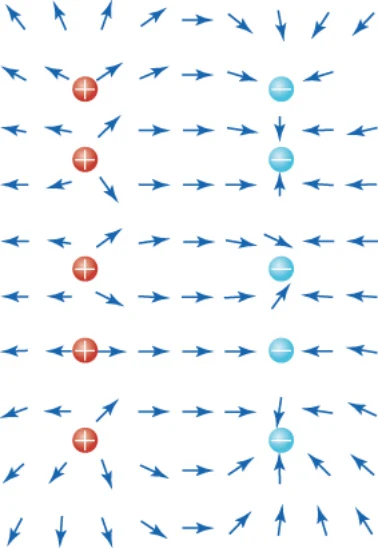
What happens if we place, say, five positive charges in a line across from five negative charges, as in Figure 18.27? Now the region between the lines of charge contains a fairly uniform electric field.
図18.27のように、五つの正の電荷を一列に並べ、その向かいに五つの負の電荷を並べたらどうなるか。いまや電荷の列の間の領域には、かなり一様な電場がある。
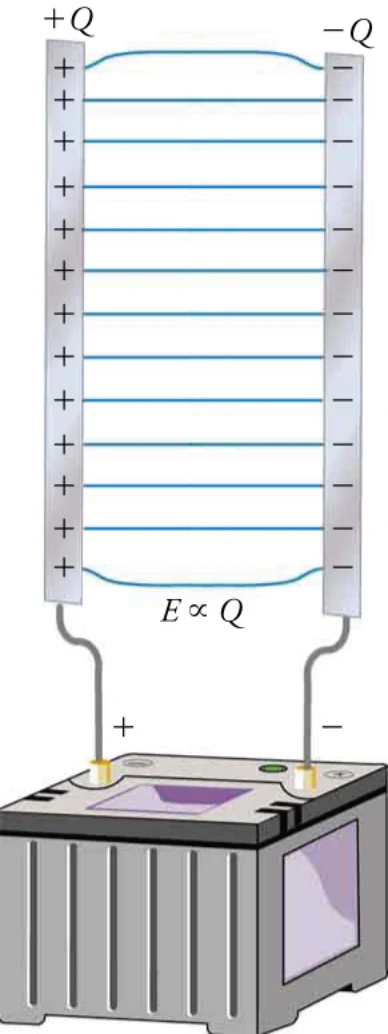
We can extend this idea even further and into two dimensions by placing two metallic plates face to face and charging one with positive charge and the other with an equal magnitude of negative charge. This can be done by connecting one plate to the positive terminal of a battery and the other plate to the negative terminal, as shown in Figure 18.28. The electric field between these charged plates will be extremely uniform.
この考えをさらに広げ、二次元へも広げるには、二枚の金属板を向かい合わせに置き、一方を正の電荷で、もう一方を同じ大きさの負の電荷で帯電させればよい。図18.28に示すように、一方の板を電池の正の端子に、もう一方を負の端子につなげばこれができる。この帯電した板の間の電場はきわめて一様になる。
Let’s think about the work required to charge these plates. Before the plates are connected to the battery, they are neutral—that is, they have zero net charge. Placing the first positive charge on the left plate and the first negative charge on the right plate requires very little work, because the plates are neutral, so no opposing charges are present. Now consider placing a second positive charge on the left plate and a second negative charge on the right plate. Because the first two charges repel the new arrivals, a force must be applied to the two new charges over a distance to put them on the plates. This is the definition of work, which means that, compared with the first pair, more work is required to put the second pair of charges on the plates. To place the third positive and negative charges on the plates requires yet more work, and so on. Where does this work come from? The battery! Its chemical potential energy is converted into the work required to separate the positive and negative charges.
この板を帯電させるのに要る仕事について考えよう。板が電池につながれる前、板は中性、すなわち正味の電荷が0である。最初の正の電荷を左の板に、最初の負の電荷を右の板に置くのにはほとんど仕事が要らない。板は中性なので、逆らう電荷がないからである。次に、二つ目の正の電荷を左の板に、二つ目の負の電荷を右の板に置くことを考えよう。初めの二つの電荷が新しく来るものを反発するので、それを板に置くには、二つの新しい電荷に距離にわたって力を加えねばならない。これが仕事の定義であり、最初の対にくらべて、二つ目の対の電荷を板に置くにはより多くの仕事が要るということである。三つ目の正と負の電荷を板に置くにはさらに多くの仕事が要り、以下同様である。この仕事はどこから来るのか。電池からである。その化学的な位置エネルギーが、正と負の電荷を引き離すのに要る仕事へ変わる。
Although the battery does work, this work remains within the battery-plate system. Therefore, conservation of energy tells us that, if the potential energy of the battery decreases to separate charges, the energy of another part of the system must increase by the same amount. In fact, the energy from the battery is stored in the electric field between the plates. This idea is analogous to considering that the potential energy of a raised hammer is stored in Earth’s gravitational field. If the gravitational field were to disappear, the hammer would have no potential energy. Likewise, if no electric field existed between the plates, no energy would be stored between them.
電池は仕事をするが、この仕事は電池と板からなる系の中にとどまる。したがってエネルギー保存から、電荷を分けるために電池の位置エネルギーが減るなら、系の別の部分のエネルギーが同じだけ増えねばならない。実のところ、電池からのエネルギーは板の間の電場に蓄えられる。この考えは、持ち上げたハンマーの位置エネルギーが地球の重力場に蓄えられていると考えるのに似ている。重力場が消えれば、ハンマーは位置エネルギーを持たないだろう。同じように、板の間に電場がなければ、板の間にエネルギーは蓄えられない。
If we now disconnect the plates from the battery, they will hold the energy. We could connect the plates to a lightbulb, for example, and the lightbulb would light up until this energy was used up. These plates thus have the capacity to store energy. For this reason, an arrangement such as this is called a capacitor. A capacitor is an arrangement of objects that, by virtue of their geometry, can store energy an electric field.
ここで板を電池から外せば、板はエネルギーを保つ。たとえば板を電球につなげば、このエネルギーが使い尽くされるまで電球は光る。したがってこの板はエネルギーを蓄える能力を持つ。このため、このような仕掛けはコンデンサーと呼ばれる。コンデンサーとは、その形のおかげで電場にエネルギーを蓄えられる物の仕掛けである。
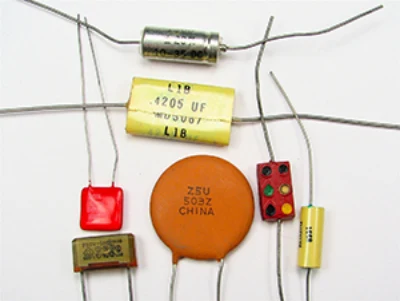
Various real capacitors are shown in Figure 18.29. They are usually made from conducting plates or sheets that are separated by an insulating material. They can be flat or rolled up or have other geometries.
いろいろな実物のコンデンサーを図18.29に示す。ふつうは絶縁体の材料で隔てられた導体の板や薄い膜でできている。平らなものも、巻いたものも、他の形のものもある。
The capacity of a capacitor is defined by its capacitance C, which is given by
コンデンサーの能力は電気容量Cで定められ、それは次で与えられる。
where Q is the magnitude of the charge on each capacitor plate, and V is the potential difference in going from the negative plate to the positive plate. This means that both Q and V are always positive, so the capacitance is always positive. We can see from the equation for capacitance that the units of capacitance are C/V, which are called farads (F) after the nineteenth-century English physicist Michael Faraday.
ここでQはそれぞれのコンデンサーの板の電荷の大きさ、Vは負の板から正の板へ行くときの電位差である。これはQもVもつねに正だということなので、電気容量はつねに正である。電気容量の式から、電気容量の単位はC/Vであり、19世紀のイギリスの物理学者マイケル・ファラデーにちなんでファラド(F)と呼ばれることが分かる。
The equation makes sense: A parallel-plate capacitor (like the one shown in Figure 18.28) the size of a football field could hold a lot of charge without requiring too much work per unit charge to push the charge into the capacitor. Thus, Q would be large, and V would be small, so the capacitance C would be very large. Squeezing the same charge into a capacitor the size of a fingernail would require much more work, so V would be very large, and the capacitance would be much smaller.
式は筋が通っている。フットボール場ほどの大きさの平行板コンデンサー(図18.28のようなもの)は、電荷をコンデンサーへ押し込むのに単位電荷あたりそれほど多くの仕事を要さずに、大量の電荷を保持できる。したがってQは大きく、Vは小さくなり、電気容量Cはとても大きくなる。同じ電荷を爪ほどの大きさのコンデンサーへ押し込むにはずっと多くの仕事が要るので、Vはとても大きくなり、電気容量はずっと小さくなる。
Although the equation makes it seem that capacitance depends on voltage, in fact it does not. For a given capacitor, the ratio of the charge stored in the capacitor to the voltage difference between the plates of the capacitor always remains the same. Capacitance is determined by the geometry of the capacitor and the materials that it is made from. For a parallel-plate capacitor with nothing between its plates, the capacitance is given by
式は電気容量が電圧によるように見せるが、実際はそうではない。決まったコンデンサーでは、蓄えられる電荷とコンデンサーの板の間の電圧差との比はつねに同じである。電気容量は、コンデンサーの形と、それを作っている材料で決まる。板の間に何もない平行板コンデンサーでは、電気容量は次で与えられる。
where A is the area of the plates of the capacitor and d is their separation. We use instead of C, because the capacitor has nothing between its plates (in the next section, we’ll see what happens when this is not the case). The constant read epsilon zero is called the permittivity of free space, and its value is
ここでAはコンデンサーの板の面積、dはその隔たりである。コンデンサーの板の間に何もないので、Cではなくを使う(次の節で、そうでない場合に何が起こるかを見る)。「イプシロン・ゼロ」と読む定数は真空の誘電率と呼ばれ、その値は
Coming back to the energy stored in a capacitor, we can ask exactly how much energy a capacitor stores. If a capacitor is charged by putting a voltage V across it for example, by connecting it to a battery with voltage V—the electrical potential energy stored in the capacitor is
である。コンデンサーに蓄えられるエネルギーに戻ると、コンデンサーが正確にどれだけのエネルギーを蓄えるかを問える。コンデンサーに電圧Vをかけて——たとえば電圧Vの電池につないで——帯電させると、コンデンサーに蓄えられる電気的な位置エネルギーは
Notice that the form of this equation is similar to that for kinetic energy, .
となる。この式の形が運動エネルギーの式に似ていることに注目しよう。
Where does Capacitance Come From? This video shows how capacitance is defined and why it depends only on the geometric properties of the capacitor, not on voltage or charge stored. In so doing, it provides a good review of the concepts of work and electric potential.
電気容量はどこから来るか この動画は電気容量がどう定義され、なぜそれが電圧や蓄えられた電荷ではなくコンデンサーの幾何的な性質だけによるのかを示す。そうしながら、仕事と電位の概念のよい復習にもなっている。
Capacitance | Circuits | Physics | Khan Academy (https://www.openstax.org/l/28capacitance)
電気容量|回路|物理|カーンアカデミー(https://www.openstax.org/l/28capacitance)
GRASP CHECK If you increase the distance between the plates of a capacitor, how does the capacitance change?a. Doubling the distance between capacitor plates will reduce the capacitance four fold.b. Doubling the distance between capacitor plates will reduce the capacitance two fold.
理解の確認 コンデンサーの板の間の距離を増やすと、電気容量はどう変わるか。a. コンデンサーの板の間の距離を2倍にすると、電気容量は4分の1になる。b. コンデンサーの板の間の距離を2倍にすると、電気容量は2分の1になる。
c. Doubling the distance between capacitor plates will increase the capacitance two times.d. Doubling the distance between capacitor plates will increase the capacitance four times.
c. コンデンサーの板の間の距離を2倍にすると、電気容量は2倍になる。d. コンデンサーの板の間の距離を2倍にすると、電気容量は4倍になる。
VIRTUAL PHYSICSシミュレーションCharge your Capacitorコンデンサーを充電する
In this simulation (https://openstax.org/l/28charge-cap), you are presented with a parallel-plate capacitor connected to a variable-voltage battery. The battery is initially at zero volts, so no charge is on the capacitor. Slide the battery slider up and down to change the battery voltage, and observe the charges that accumulate on the plates. Display the capacitance, top-plate charge, and stored energy as you vary the battery voltage. You can also display the electric-field lines in the capacitor. Finally, probe the voltage between different points in this circuit with the help of the voltmeter.
このシミュレーション(https://openstax.org/l/28charge-cap)では、電圧を変えられる電池につないだ平行板コンデンサーが示される。電池ははじめ0ボルトなので、コンデンサーに電荷はない。電池のつまみを上下に動かして電圧を変え、板に溜まる電荷を観察しよう。電池の電圧を変えながら、電気容量、上の板の電荷、蓄えられたエネルギーを表示しよう。コンデンサーの中の電気力線を表示することもできる。最後に、電圧計を使ってこの回路のいろいろな点の間の電圧を調べよう。
GRASP CHECK True or false— In a capacitor, the stored energy is always positive, regardless of whether the top plate is charged with negative or positive charge.
理解の確認 正誤問題——コンデンサーでは、上の板が負に帯電していても正に帯電していても、蓄えられたエネルギーはつねに正である。
a. falseb. true
a. 誤b. 正
Capacitance and Charge Stored in a Parallel Plate Capacitor (a) What is the capacitance of a parallel-plate capacitor with metal plates, each of area 1.00 m2, separated by 0.0010 m? (b) What charge is stored in this capacitor if a voltage of 3.00 × 10³ V is applied to it?Strategy FOR (A)
平行板コンデンサーの電気容量と蓄えられる電荷 (a)面積がそれぞれ1.00 m2の金属板が0.0010 m離れた平行板コンデンサーの電気容量はいくらか。(b)このコンデンサーに3.00 × 10³ Vの電圧をかけたとき、どれだけの電荷が蓄えられるか。(a)の方針
Use the equation .
式を使う。
Solution for (a)(a)の解答
Entering the given values into this equation for the capacitance of a parallel-plate capacitor yields
与えられた値を平行板コンデンサーの電気容量のこの式に入れると
Discussion for (a)(a)の考察
This small value for the capacitance indicates how difficult it is to make a device with a large capacitance. Special techniques help, such as using very-large-area thin foils placed close together or using a dielectric (to be discussed below).
この電気容量の小さな値は、大きな電気容量の装置を作るのがいかに難しいかを示す。とても大きな面積の薄い箔を近づけて置くとか、(下で論じる)誘電体を使うといった特別な手口が役に立つ。
Strategy FOR (B)(b)の方針
Knowing C, find the charge stored by solving the equation , for the charge Q.
Cが分かったので、式を電荷Qについて解いて、蓄えられる電荷を求める。
Solution for (b)(b)の解答
The charge Q on the capacitor is
コンデンサーの電荷Qは
Discussion for (b)(b)の考察
This charge is only slightly greater than typical static electricity charges. More charge could be stored by using a dielectric between the capacitor plates.
この電荷は、典型的な静電気の電荷よりわずかに大きいだけである。コンデンサーの板の間に誘電体を使えば、より多くの電荷を蓄えられる。
What battery is needed to charge a capacitor? Your friend provides you with a capacitor. To store on this capacitor, what voltage battery should you buy? Strategy
コンデンサーを充電するにはどんな電池が要るか 友人がのコンデンサーをくれる。このコンデンサーにを蓄えるには、何ボルトの電池を買えばよいか。 方針
Use the equation to find the voltage needed to charge the capacitor.
式を使って、コンデンサーを充電するのに必要な電圧を求める。
Solution解答
Solving for the voltage gives . Inserting and gives
を電圧について解くとである。とを入れると
Discussion考察
Such a battery should be easy to procure. There is still a question of whether the battery contains enough energy to provide the desired charge. The equation allows us to calculate the required energy.
そうした電池は簡単に手に入るだろう。電池が望みの電荷を与えるのに十分なエネルギーを持つかどうかという問題は残る。式から必要なエネルギーを計算できる。
A typical commercial battery can easily provide this much energy.
市販のふつうの電池なら、これだけのエネルギーは簡単に供給できる。
Practice Problems練習問題
23What is the voltage on a 35 μF with 25 nC of charge?a. 8.75 × 10⁻¹³ Vb. 0.71 × 10⁻³ Vc. 1.4 × 10⁻³ Vd. 1.4 × 10³ V
2325 nCの電荷を持つ35 μFのコンデンサーの電圧はいくらか。a. 8.75 × 10⁻¹³ Vb. 0.71 × 10⁻³ Vc. 1.4 × 10⁻³ Vd. 1.4 × 10³ V
24Which voltage is across a 100 μF capacitor that stores 10 J of energy?a. −4.5 × 10² Vb. 4.5 × 10² Vc. ±4.5 × 10² Vd. ±9 × 10² V
2410 Jのエネルギーを蓄える100 μFのコンデンサーにかかっている電圧はいくらか。a. −4.5 × 10² Vb. 4.5 × 10² Vc. ±4.5 × 10² Vd. ±9 × 10² V
Dielectrics誘電体
Before working through some sample problems, let’s look at what happens if we put an insulating material between the plates of a capacitor that has been charged and then disconnected from the charging battery, as illustrated in
いくつか例題を解く前に、充電してから充電用の電池から外したコンデンサーの板の間に絶縁体の材料を入れると何が起こるかを見よう。
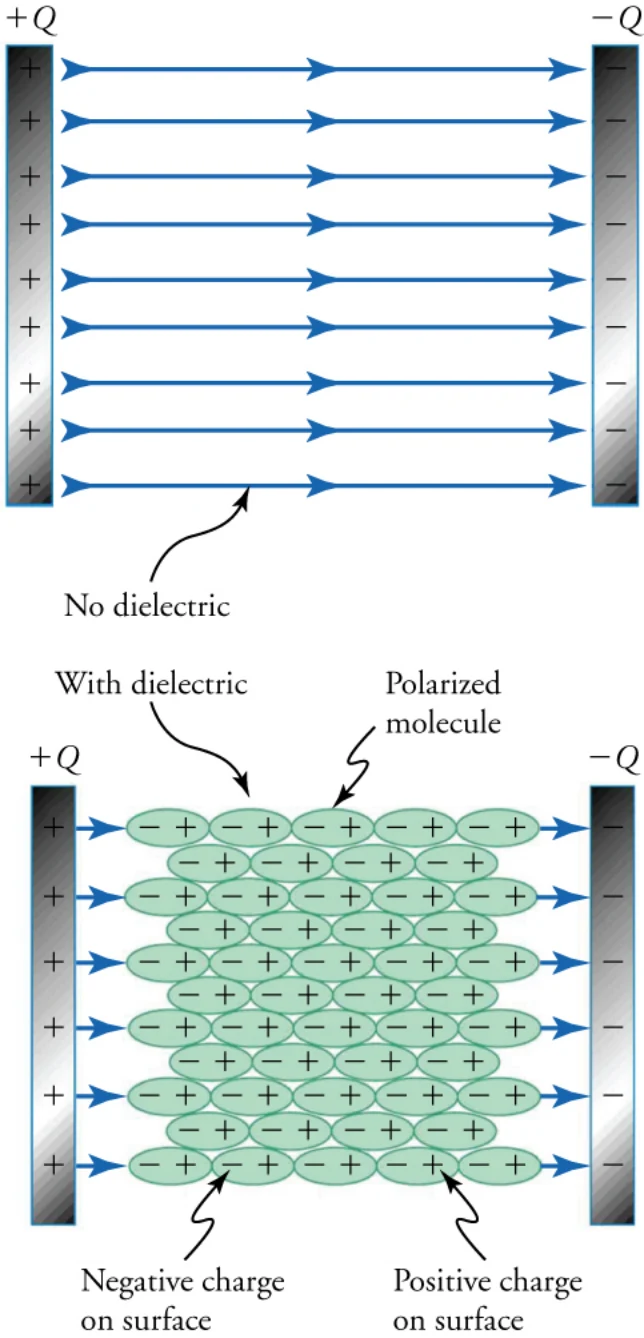
Figure 18.30. Because the material is insulating, the charge cannot move through it from one plate to the other, so the charge Q on the capacitor does not change. An electric field exists between the plates of a charged capacitor, so the insulating material becomes polarized, as shown in the lower part of the figure. An electrically insulating material that becomes polarized in an electric field is called a dielectric.
図18.30に示す。材料は絶縁体なので、電荷はそれを通って一方の板からもう一方へ動けず、コンデンサーの電荷Qは変わらない。帯電したコンデンサーの板の間には電場があるので、図の下の部分に示すように絶縁体の材料は分極する。電場の中で分極する電気的な絶縁体の材料を誘電体という。
Figure 18.30 shows that the negative charge in the molecules in the material shifts to the left, toward the positive charge of the capacitor. This shift is due to the electric field, which applies a force to the left on the electrons in the molecules of the dielectric. The right sides of the molecules are now missing a bit of negative charge, so their net charge is positive.
図18.30は、材料の中の分子の負の電荷が左へ、コンデンサーの正の電荷のほうへずれることを示す。このずれは電場によるもので、電場は誘電体の分子の中の電子に左向きの力を及ぼす。分子の右側はいまや負の電荷が少し足りないので、正味の電荷は正になる。
All electrically insulating materials are dielectrics, but some are better dielectrics than others. A good dielectric is one whose molecules allow their electrons to shift strongly in an electric field. In other words, an electric field pulls their electrons a fair bit away from their atom, but they do not escape completely from their atom (which is why they are insulators).
電気的な絶縁体の材料はすべて誘電体だが、他より優れた誘電体もある。よい誘電体とは、電場の中で分子が電子を大きくずらせるものである。言い換えれば、電場が電子を原子からかなり引き離すが、電子は原子から完全には逃げない(だからこそ絶縁体なのである)。
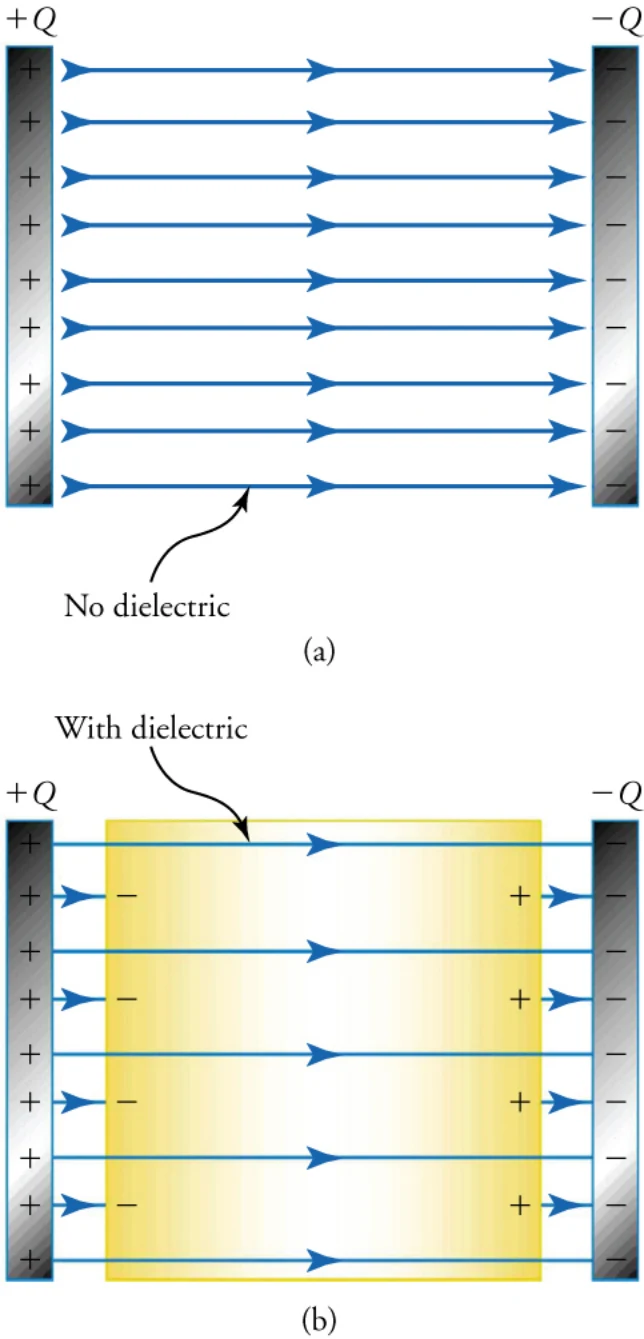
Figure 18.31 shows a macroscopic view of a dielectric in a charged capacitor. Notice that the electric-field lines in the capacitor with the dielectric are spaced farther apart than the electric-field lines in the capacitor with no dielectric. This means that the electric field in the dielectric is weaker, so it stores less electrical potential energy than the electric field in the capacitor with no dielectric.
図18.31は、帯電したコンデンサーの中の誘電体の巨視的な様子を示す。誘電体の入ったコンデンサーの電気力線が、誘電体のないコンデンサーの電気力線より広い間隔になっていることに注目しよう。これは誘電体の中の電場が弱いという意味であり、したがって誘電体のないコンデンサーの電場より蓄える電気的な位置エネルギーが少ない。
Where has this energy gone? In fact, the molecules in the dielectric act like tiny springs, and the energy in the electric field goes into stretching these springs. With the electric field thus weakened, the voltage difference between the two sides of the capacitor is smaller, so it becomes easier to put more charge on the capacitor. Placing a dielectric in a capacitor before charging it therefore allows more charge and potential energy to be stored in the capacitor. A parallel plate with a dielectric has a capacitance of
このエネルギーはどこへ行ったのか。実のところ、誘電体の中の分子は小さなばねのようにふるまい、電場のエネルギーがこのばねを伸ばすのに使われる。こうして電場が弱まると、コンデンサーの両側の電圧差が小さくなり、コンデンサーにより多くの電荷を入れるのが簡単になる。したがって、充電する前にコンデンサーに誘電体を入れておけば、より多くの電荷と位置エネルギーをコンデンサーに蓄えられる。誘電体の入った平行板コンデンサーの電気容量は
where (kappa) is a dimensionless constant called the dielectric constant. Because is greater than 1 for dielectrics, the capacitance increases when a dielectric is placed between the capacitor plates. The dielectric constant of several materials is shown in Table 18.1.
となる。ここで(カッパ)は比誘電率と呼ばれる無次元の定数である。誘電体ではが1より大きいので、コンデンサーの板の間に誘電体を入れると電気容量は増える。いくつかの材料の比誘電率を表18.1に示す。
Capacitor for Camera Flash A typical flash for a point-and-shoot camera uses a capacitor of about . (a) If the potential difference between the capacitor plates is 100 V—that is, 100 V is placed “across the capacitor,” how much energy is stored in the capacitor? (b) If the dielectric used in the capacitor were a 0.010-mm-thick sheet of nylon, what would be the surface area of the capacitor plates?Strategy FOR (A)
カメラのフラッシュ用のコンデンサー コンパクトカメラの典型的なフラッシュは、およそのコンデンサーを使う。(a)コンデンサーの板の間の電位差が100 V——すなわち100 Vが「コンデンサーにかかっている」——のとき、コンデンサーにはどれだけのエネルギーが蓄えられているか。(b)このコンデンサーに使う誘電体が厚さ0.010 mmのナイロンの薄膜だとすると、コンデンサーの板の表面積はいくらになるか。(a)の方針
Given that and , we can use the equation , to find the electric potential energy stored in the capacitor.
とが与えられているので、式を使って、コンデンサーに蓄えられた電気的な位置エネルギーを求められる。
Solution for (a)(a)の解答
Inserting the given quantities into gives
与えられた量をに入れると
Discussion for (a)(a)の考察
This is enough energy to lift a 1-kg ball about 1 m up from the ground. The flash lasts for about 0.001 s, so the power delivered by the capacitor during this brief time is . Considering that a car engine delivers about 100 kW of power, this is not bad for a little capacitor!
これは1 kgのボールを地面からおよそ1 m持ち上げるのに十分なエネルギーである。フラッシュはおよそ0.001 s続くので、この短い時間にコンデンサーが送り出す仕事率はである。自動車のエンジンがおよそ100 kWの仕事率を出すことを考えれば、小さなコンデンサーとしては悪くない。
Strategy FOR (B)(b)の方針
Because the capacitor plates are in contact with the dielectric, we know that the spacing between the capacitor plates is . From the previous table, the dielectric constant of nylon is . We can now use the equation to find the area A of the capacitor.
コンデンサーの板が誘電体と接しているので、コンデンサーの板の間隔はだと分かる。前の表から、ナイロンの比誘電率はである。これで式を使ってコンデンサーの面積Aを求められる。
Solution (b)(b)の解答
Solving the equation for the area A and inserting the known quantities gives
式を面積Aについて解き、分かっている量を入れると
Discussion for (b)(b)の考察
This is much too large an area to roll into a capacitor small enough to fit in a handheld camera. This is why these capacitors don’t use simple dielectrics but a more advanced technology to obtain a high capacitance.
これは、手持ちのカメラに収まるほど小さなコンデンサーへ巻き込むには大きすぎる面積である。だからこの種のコンデンサーは単純な誘電体を使わず、高い電気容量を得るためにより進んだ技術を使う。
Practice Problems練習問題
25With 12 V across a capacitor, it accepts 10 mC of charge. What is its capacitance?a. 0.83 μFb. 83 μF
25コンデンサーに12 Vをかけると10 mCの電荷を蓄える。その電気容量はいくらか。a. 0.83 μFb. 83 μF
c. 120 μFd. 830 μF
c. 120 μFd. 830 μF
26A parallel-plate capacitor has an area of 10 cm2 and the plates are separated by 100 μm . If the capacitor contains paper between the plates, what is its capacitance?a. 3.3 × 10⁻¹⁰ Fb. 3.3 × 10⁻⁸ Fc. 3.3 × 10⁻⁶ Fd. 3.3 × 10⁻⁴ F
26ある平行板コンデンサーの面積は10 cm2で、板は100 μm離れている。板の間に紙が入っているとき、その電気容量はいくらか。a. 3.3 × 10⁻¹⁰ Fb. 3.3 × 10⁻⁸ Fc. 3.3 × 10⁻⁶ Fd. 3.3 × 10⁻⁴ F
Check Your Understanding理解の確認
27If the area of a parallel-plate capacitor doubles, how is the capacitance affected?a. The capacitance will remain the same.b. The capacitance will double.
27平行板コンデンサーの面積が2倍になると、電気容量はどうなるか。a. 電気容量は変わらない。b. 電気容量は2倍になる。
c. The capacitance will increase four times.d. The capacitance will increase eight times.
c. 電気容量は4倍になる。d. 電気容量は8倍になる。
28If you double the area of a parallel-plate capacitor and reduce the distance between the plates by a factor of four, how is the capacitance affected?
28平行板コンデンサーの面積を2倍にし、板の間の距離を4分の1にすると、電気容量はどうなるか。
a. It will increase by a factor of two.b. It will increase by a factor of four.
a. 2倍になる。b. 4倍になる。
c. It will increase by a factor of six.d. It will increase by a factor of eight.
c. 6倍になる。d. 8倍になる。