第18章静電気Static Electricity原書 p.567–622
18.1 Electrical Charges, Conservation of Charge, and Transfer of Charge18.1 電荷、電荷の保存、電荷の移動
SECTION LEARNING OBJECTIVES By the end of this section, you will be able to do the following:
この節の学習目標 この節を終えると、次のことができるようになる。
• Describe positive and negative electric charges• Use conservation of charge to calculate quantities of charge transferred between objects• Characterize materials as conductors or insulators based on their electrical properties• Describe electric polarization and charging by induction
・正の電荷と負の電荷を述べる・電荷の保存を使って、物どうしの間で移る電荷の量を計算する・電気的な性質にもとづいて材料を導体と絶縁体に分ける・電気的な分極と誘導による帯電を述べる
Section Key Termsこの節の重要語
conductionconductorelectroninductioninsulatorlaw of conservation of chargepolarizationproton
伝導導体電子誘導絶縁体電荷保存の法則分極陽子
Electric Charge電荷
You may know someone who has an electric personality, which usually means that other people are attracted to this person. This saying is based on electric charge, which is a property of matter that causes objects to attract or repel each other. Electric charge comes in two varieties, which we call positive and negative. Like charges repel each other, and unlike charges attract each other. Thus, two positive charges repel each other, as do two negative charges. A positive charge and a negative charge attract each other.
英語には、人を強く引きつける魅力を electric personality と表す言い回しがある。ここでは、その「引きつける」というイメージから電荷を考えてみよう。電荷は、物体どうしに電気的な引力や斥力を生じさせる性質である。電荷には正と負の2種類がある。同じ符号の電荷どうしは反発し、異なる符号の電荷どうしは引き合う。正と正、負と負なら反発し、正と負なら引き合う。
How do we know there are two types of electric charge? When various materials are rubbed together in controlled ways, certain combinations of materials always result in a net charge of one type on one material and a net charge of the opposite type on the other material. By convention, we call one type of charge positive and the other type negative. For example, when glass is rubbed with silk, the glass becomes positively charged and the silk negatively charged. Because the glass and silk have opposite charges, they attract one another like clothes that have rubbed together in a dryer. Two glass rods rubbed with silk in this manner will repel one another, because each rod has positive charge on it. Similarly, two silk cloths rubbed in this manner will repel each other, because both cloths have negative charge. Figure 18.2 shows how these simple materials can be used to explore the nature of the force between charges.
電荷が2種類あることは、どう確かめられるだろうか。決まった条件で異なる物質をこすり合わせると、一方はある種類の電荷を、もう一方は反対の種類の電荷を持つようになる。この2種類を、約束によって正と負と呼ぶ。たとえば、ガラス棒を絹でこすると、ガラス棒は正に、絹は負に帯電し、互いに引き合う。乾燥機の中で衣服どうしがこすれ、くっつくのと同じような現象である。絹でこすった2本のガラス棒どうしは、どちらも正に帯電しているので反発する。同様に、ガラスとこすり合わせた2枚の絹も、どちらも負に帯電しているので反発する。図18.2では、こうした身近な材料を使って、電荷間に働く力を調べている。
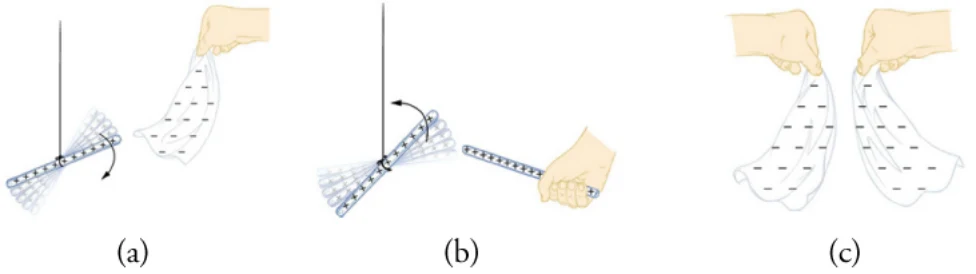
It took scientists a long time to discover what lay behind these two types of charges. The word electric itself comes from the Greek word elektron for amber, because the ancient Greeks noticed that amber, when rubbed by fur, attracts dry straw. Almost 2,000 years later, the English physicist William Gilbert proposed a model that explained the effect of electric charge as being due to a mysterious electrical fluid that would pass from one object to another. This model was debated for several hundred years, but it was finally put to rest in 1897 by the work of the English physicist J. J. Thomson and French physicist Jean Perrin. Along with many others, Thomson and Perrin were studying the mysterious cathode rays that were known at the time to consist of particles smaller than the smallest atom. Perrin showed that cathode rays actually carried negative electrical charge. Later, Thomson’s work led him to declare, “I can see no escape from the conclusion that [cathode rays] are charges of negative electricity carried by particles of matter.”
この二種類の電荷の背後にあるものを突き止めるのに、科学者は長い時間を要した。電気(electric)という語そのものが、琥珀を意味するギリシャ語elektronから来ている。古代ギリシャ人が、毛皮でこすった琥珀が乾いた藁を引きつけることに気づいたからである。それからほぼ2,000年後、イギリスの物理学者ウィリアム・ギルバートは、電荷の効果を、ある物から別の物へ移る謎の電気の流体によるものとして説明するモデルを提案した。このモデルは数百年にわたって論じられたが、1897年、イギリスの物理学者J. J. トムソンとフランスの物理学者ジャン・ペランの仕事によってついに退けられた。他の多くの人とともに、トムソンとペランは、当時最小の原子より小さい粒子からなると知られていた謎の陰極線を研究していた。ペランは陰極線が実際に負の電荷を運ぶことを示した。のちにトムソンの仕事は彼にこう宣言させた。「〔陰極線は〕物質の粒子が運ぶ負の電気の電荷であるという結論から逃れる道は見えない。」
It took several years of further experiments to confirm Thomson’s interpretation of the experiments, but science had in fact discovered the particle that carries the fundamental unit of negative electrical charge. We now know this particle as the electron.
トムソンの実験の解釈を確かめるにはさらに数年の実験を要したが、科学は実のところ、負の電荷の基本単位を運ぶ粒子を見つけていたのである。私たちはいまこの粒子を電子と呼ぶ。
Atoms, however, were known to be electrically neutral, which means that they carry the same amount of positive and negative charge, so their net charge is zero. Because electrons are negative, some other part of the atom must contain positive charge. Thomson put forth what is called the plum pudding model, in which he described atoms as being made of thousands of electrons swimming around in a nebulous mass of positive charge, as shown by the left-side image of Figure 18.3. His student, Ernest Rutherford, originally believed that this model was correct and used it (along with other models) to try to understand the results of his experiments bombarding gold foils with alpha particles (i.e., helium atoms stripped of their electrons). The results, however, did not confirm Thomson’s model but rather destroyed it! Rutherford found that most of the space occupied by the gold atoms was actually empty and that almost all of the matter of each atom was concentrated into a tiny, extremely dense nucleus, as shown by the right-side image of Figure 18.3. The atomic nucleus was later found to contain particles called protons, each of which carries a unit of positive electric charge.1
しかし原子は電気的に中性であること、すなわち同じ量の正の電荷と負の電荷を持ち、正味の電荷が0であることが知られていた。電子は負なので、原子の他の部分が正の電荷を含んでいるはずである。トムソンは、いわゆるブドウパン模型を提出した。図18.3の左の絵に示すように、原子が何千もの電子がぼんやりした正の電荷の塊の中を泳いでいるものだと述べたのである。彼の学生アーネスト・ラザフォードは、はじめこのモデルが正しいと信じ、金箔にアルファ粒子(すなわち電子をはぎ取られたヘリウム原子)をぶつける実験の結果を理解しようと、(他のモデルとともに)これを使った。しかし結果はトムソンのモデルを裏づけず、むしろそれを壊した。ラザフォードは、金の原子が占める空間の大半が実は空っぽで、それぞれの原子の物質のほとんどすべてが、図18.3の右の絵に示すような、きわめて密度の高い小さな原子核に集中していることを見いだした。原子核はのちに陽子と呼ばれる粒子を含むことが分かり、その一つひとつが正の電荷の単位を運ぶ。1
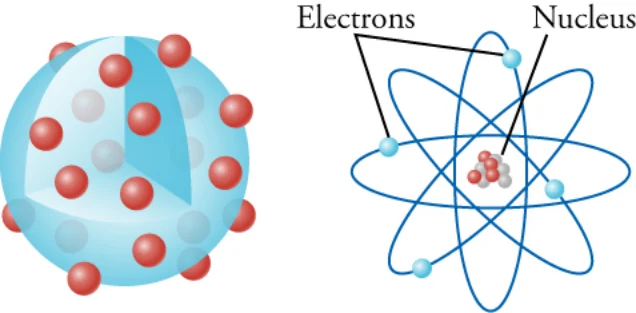
Protons and electrons are thus the fundamental particles that carry electric charge. Each proton carries one unit of positive charge, and each electron carries one unit of negative charge. To the best precision that modern technology can provide, the charge carried by a proton is exactly the opposite of that carried by an electron. The SI unit for electric charge is the coulomb (abbreviated as “C”), which is named after the French physicist Charles Augustin de Coulomb, who studied the force between charged objects. The proton carries and the electron carries . The number n of protons required to make +1.00 C is
したがって陽子と電子が、電荷を運ぶ基本の粒子である。それぞれの陽子は正の電荷の単位を一つ、それぞれの電子は負の電荷の単位を一つ運ぶ。現代の技術が与えうる最高の精度では、陽子が運ぶ電荷は電子が運ぶ電荷のちょうど逆である。電荷のSI単位はクーロン(Cと略す)で、帯電した物どうしの力を研究したフランスの物理学者シャルル・オーギュスタン・ド・クーロンにちなむ。陽子はを、電子はを運ぶ。+1.00 Cを作るのに必要な陽子の数nは
The same number of electrons is required to make −1.00 C of electric charge. The fundamental unit of charge is often represented as e. Thus, the charge on a proton is e, and the charge on an electron is −e. Mathematically,
である。−1.00 Cの電荷を作るのにも同じ数の電子が要る。電荷の基本単位はしばしばeで表される。したがって陽子の電荷はe、電子の電荷は−eである。式で書くと、
Measuring the Fundamental Electric Charge The American physicist Robert Millikan (1868–1953) and his student Harvey Fletcher (1884–1981) were the first to make a relatively accurate measurement of the fundamental unit of charge on the electron. They designed what is now a classic experiment performed by students. The Millikan oil-drop experiment is shown in Figure 18.4. The experiment involves some concepts that will be introduced later, but the basic idea is that a fine oil mist is sprayed between two plates that can be charged with a known amount of opposite charge. Some oil drops accumulate some excess negative charge when being sprayed and are attracted to the positive charge of the upper plate and repelled by the negative charge on the lower plate. By tuning the charge on these plates until the weight of the oil drop is balanced by the electric forces, the net charge on the oil drop can be determined quite precisely.
基本の電荷を測る アメリカの物理学者ロバート・ミリカン(1868–1953)とその学生ハーヴェイ・フレッチャー(1884–1981)は、電子の電荷の基本単位をわりあい正確に測った最初の人たちである。彼らは、いまや学生が行う古典となった実験を設計した。ミリカンの油滴の実験を図18.4に示す。この実験には、あとで導く概念がいくつか関わるが、基本的な考えはこうである。既知の量の逆の電荷を帯びさせられる二枚の板の間に、細かい油の霧を吹き付ける。油滴の一部は吹き付けられるときに余分な負の電荷を帯び、上の板の正の電荷に引かれ、下の板の負の電荷に反発される。油滴の重さが電気の力と釣り合うまで板の電荷を調節すれば、油滴の正味の電荷をかなり正確に決められる。
1 Protons were later found to contain sub particles called quarks, which have fractional electric charge. But that is another story that we leave for subsequent physics courses.
1 陽子はのちに、分数の電荷を持つクォークという下位の粒子を含むことが分かった。しかしそれは、これから先の物理の授業に譲る別の物語である。
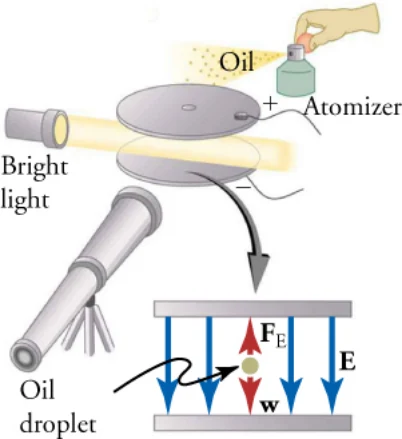
Millikan and Fletcher found that the drops would accumulate charge in discrete units of about which is within 1 percent of the modern value of Although this difference may seem quite small, it is actually five times greater than the possible error Millikan reported for his results!
ミリカンとフレッチャーは、油滴がおよそという離散的な単位で電荷を帯びることを見いだした。これは現代の値の1パーセント以内である。この差はごく小さく思えるかもしれないが、実はミリカンが自分の結果について報告したありうる誤差の5倍も大きい。
Because the charge on the electron is a fundamental constant of nature, determining its precise value is very important for all of science. This created pressure on Millikan and others after him that reveals some equally important aspects of human nature.
電子の電荷は自然の基本定数なので、その正確な値を決めることは科学全体にとってとても重要である。このことがミリカンとその後の人々に圧力を生み、それが同じくらい重要な人間の性質のいくつかの面を露わにした。
First, Millikan took sole credit for the experiment and was awarded the 1923 Nobel Prize in physics for this work, although his student Harvey Fletcher apparently contributed in significant ways to the work. Just before his death in 1981, Fletcher divulged that Millikan coerced him to give Millikan sole credit for the work, in exchange for which Millikan promoted Fletcher’s career at Bell Labs.
第一に、ミリカンはこの実験の功績を独り占めし、この仕事で1923年のノーベル物理学賞を受けた。学生のハーヴェイ・フレッチャーもこの仕事に大きく貢献していたにもかかわらず、である。1981年の死の直前、フレッチャーは、ミリカンが彼に功績を独り占めさせるよう強い、その見返りにベル研究所でのフレッチャーの経歴を後押ししたと明かした。
Another great scientist, Richard Feynman, points out that many scientists who measured the fundamental charge after Millikan were reluctant to report values that differed much from Millikan’s value. History shows that later measurements slowly crept up from Millikan’s value until settling on the modern value. Why did they not immediately find the error and correct the value, asks Feynman. Apparently, having found a value higher than the much-respected value found by Millikan, scientists would look for possible mistakes that might lower their value to make it agree better with Millikan’s value. This reveals the important psychological weight carried by preconceived notions and shows how hard it is to refute them. Scientists, however devoted to logic and data they may be, are apparently just as vulnerable to this aspect of human nature as everyone else. The lesson here is that, although it is good to be skeptical of new results, you should not discount them just because they do not agree with conventional wisdom. If your reasoning is sound and your data are reliable, the conclusion demanded by the data must be seriously considered, even if that conclusion disagrees with the commonly accepted truth.
もう一人の偉大な科学者リチャード・ファインマンは、ミリカンのあとに基本の電荷を測った多くの科学者が、ミリカンの値と大きく違う値を報告するのをためらったと指摘する。歴史は、のちの測定がミリカンの値からゆっくり這い上がって、現代の値に落ち着いたことを示している。なぜ彼らはすぐに誤りを見つけて値を正さなかったのか、とファインマンは問う。どうやら、大いに敬われたミリカンの値より高い値を得た科学者は、ミリカンの値によりよく合うように値を下げうる間違いを探したらしい。これは、先入観が持つ重要な心理的重みを露わにし、それを覆すことがいかに難しいかを示す。科学者は、どれほど論理とデータに献身していようと、人間の性質のこの面にはどうやら他の誰とも同じく弱いのである。ここでの教訓は、新しい結果に懐疑的であるのはよいことだが、それが通念に合わないというだけで切り捨ててはならないということである。あなたの推論が健全でデータが信頼できるなら、そのデータが要求する結論は、たとえそれが広く受け入れられた真理と食い違っても、真剣に考えねばならない。
GRASP CHECK Suppose that Millikan observed an oil drop carrying three fundamental units of charge. What would be the net charge on this oil drop?a. −4.81 × 10⁻¹⁹ Cb. −1.602 × 10⁻¹⁹ Cc. 1.602 × 10⁻¹⁹ Cd. 4.81 × 10⁻¹⁹ C
理解の確認 ミリカンが、電荷の基本単位を三つ持つ油滴を観測したとする。この油滴の正味の電荷はいくらか。a. −4.81 × 10⁻¹⁹ Cb. −1.602 × 10⁻¹⁹ Cc. 1.602 × 10⁻¹⁹ Cd. 4.81 × 10⁻¹⁹ C
SNAP LAB身近な実験Like and Unlike Charges同じ電荷と違う電荷
This activity investigates the repulsion and attraction caused by static electrical charge.
この活動では、静電気の電荷による反発と引力を調べる。
• Adhesive tape• Nonconducting surface, such as a plastic table or chair
・粘着テープ・プラスチックの机や椅子のような、電気を通さない面
Instructions
手引き
Procedure for Part (a)(a)の手順
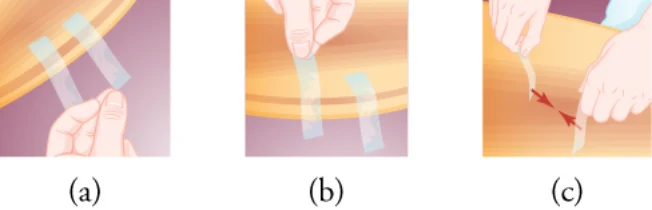
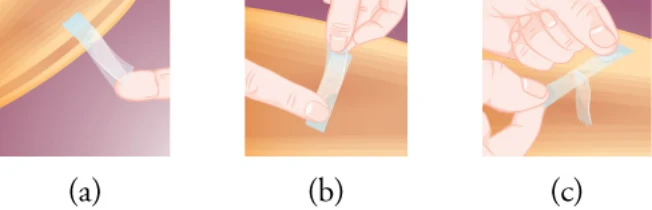
1. Prepare two pieces of tape about 4 cm long. To make a handle, double over about 0.5 cm at one end so that the sticky side sticks together.2. Attach the pieces of tape side by side onto a nonmetallic surface, such as a tabletop or the seat of a chair, as shown in Figure 18.5(a).3. Peel off both pieces of tape and hang them downward, holding them by the handles, as shown in Figure 18.5(b). If the tape bends upward and sticks to your hand, try using a shorter piece of tape, or simply shake the tape so that it no longer sticks to your hand.4. Now slowly bring the two pieces of tape together, as shown in Figure 18.5(c). What happens?
1. 長さおよそ4 cmのテープを二片用意する。持ち手を作るため、片方の端を0.5 cmほど折り返して粘着面どうしを貼り合わせる。2. 図18.5(a)のように、机の天板や椅子の座面のような金属でない面に、テープを並べて貼る。3. 図18.5(b)のように、両方のテープをはがし、持ち手を持って下に垂らす。テープが上へ曲がって手にくっつくなら、もっと短いテープを使うか、単にテープを振って手にくっつかないようにする。4. 次に、図18.5(c)のように二片のテープをゆっくり近づける。何が起こるか。
Procedure for Part (b)(b)の手順
5. Stick one piece of tape on the nonmetallic surface, and stick the second piece of tape on top of the first piece, as shown in Figure 18.6(a).6. Slowly peel off the two pieces by pulling on the handle of the bottom piece.7. Gently stroke your finger along the top of the second piece of tape (i.e., the nonsticky side), as shown in Figure 18.6(b).8. Peel the two pieces of tape apart by pulling on their handles, as shown in Figure 18.6(c).9. Slowly bring the two pieces of tape together. What happens?
5. 図18.6(a)のように、金属でない面に一片のテープを貼り、その上に二片目のテープを貼る。6. 下のテープの持ち手を引いて、二片をゆっくりはがす。7. 図18.6(b)のように、二片目のテープの上面(粘着面でない側)を指でそっとなでる。8. 図18.6(c)のように、持ち手を引いて二片のテープをはがす。9. 二片のテープをゆっくり近づける。何が起こるか。
GRASP CHECK In step 4, why did the two pieces of tape repel each other? In step 9, why did they attract each other?a. Like charges attract, while unlike charges repel each other.b. Like charges repel, while unlike charges attract each other.
理解の確認 手順4で、二片のテープが反発し合ったのはなぜか。手順9で引き合ったのはなぜか。a. 同じ電荷は引き合い、違う電荷は反発し合うから。b. 同じ電荷は反発し合い、違う電荷は引き合うから。
c. Tapes having positive charge repel, while tapes having negative charge attract each other.d. Tapes having negative charge repel, while tapes having positive charge attract each other.
c. 正の電荷を持つテープは反発し合い、負の電荷を持つテープは引き合うから。d. 負の電荷を持つテープは反発し合い、正の電荷を持つテープは引き合うから。
Conservation of Charge電荷の保存
572Because the fundamental positive and negative units of charge are carried on protons and electrons, we would expect that the total charge cannot change in any system that we define. In other words, although we might be able to move charge around, we cannot create or destroy it. This should be true provided that we do not create or destroy protons or electrons in our system. In the twentieth century, however, scientists learned how to create and destroy electrons and protons, but they found that charge is still conserved. Many experiments and solid theoretical arguments have elevated this idea to the status of a law. The law of conservation of charge says that electrical charge cannot be created or destroyed.
正と負の電荷の基本単位は陽子と電子が運ぶので、私たちが定める系の中で全電荷は変わりえないと予想される。言い換えれば、電荷を動かすことはできても、生み出したり消したりはできない。これは、系の中で陽子や電子を生み出したり消したりしない限り成り立つはずである。しかし20世紀に、科学者は電子と陽子を生み出し消す方法を学んだ。それでも電荷は保存されることが分かった。多くの実験と堅固な理論の議論が、この考えを法則の地位まで押し上げた。電荷保存の法則は、電荷は生み出すことも消すこともできないと述べる。
The law of conservation of charge is very useful. It tells us that the net charge in a system is the same before and after any interaction within the system. Of course, we must ensure that no external charge enters the system during the interaction and that no internal charge leaves the system. Mathematically, conservation of charge can be expressed as
電荷保存の法則はとても役に立つ。系の中の正味の電荷が、系の中でのどんな相互作用の前後でも同じであることを教えてくれる。もちろん、相互作用のあいだに外部の電荷が系へ入らず、内部の電荷が系から出ないことを確かめねばならない。式で書けば、電荷の保存は次のように表せる。
where is the net charge of the system before the interaction, and is the net charge after the interaction.
ここでは相互作用の前の系の正味の電荷、は相互作用の後の正味の電荷である。
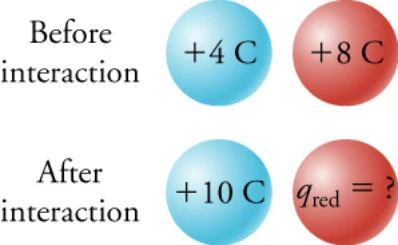
What is the missing charge?Figure 18.7 shows two spheres that initially have +4 C and +8 C of charge. After an interaction (which could simply be that they touch each other), the blue sphere has +10 C of charge, and the red sphere has an unknown quantity of charge. Use the law of conservation of charge to find the final charge on the red sphere.Strategy
足りない電荷はいくらか図18.7は、はじめ+4 Cと+8 Cの電荷を持つ二つの球を示す。相互作用(単に触れ合うだけでもよい)のあと、青い球は+10 Cの電荷を持ち、赤い球の電荷は分からない。電荷保存の法則を使って、赤い球の最後の電荷を求めよ。方針
The net initial charge of the system is . The net final charge of the system is , where is the final charge on the red sphere. Conservation of charge tells us that , so we can solve for .
系の初めの正味の電荷はである。系の最後の正味の電荷はで、が赤い球の最後の電荷である。電荷の保存からなので、について解ける。
Solution解答
Equating and and solving for gives
とを等しいとおいてについて解くと
The red sphere has +2 C of charge.
赤い球は+2 Cの電荷を持つ。
Discussion考察
Like all conservation laws, conservation of charge is an accounting scheme that helps us keep track of electric charge.
あらゆる保存則と同じく、電荷の保存は電荷を追いかけるのに役立つ帳簿の仕組みである。
Practice Problems練習問題
1Which equation describes conservation of charge?a. qinitial = qfinal = constantb. qinitial = qfinal = 0
1電荷の保存を表す式はどれか。a. qinitial = qfinal = 一定b. qinitial = qfinal = 0
c. qinitial − qfinal = 0d. qinitial/qfinal = constant
c. qinitial − qfinal = 0d. qinitial/qfinal = 一定
2An isolated system contains two objects with charges and . If object 1 loses half of its charge, what is the final charge on object 2?
2孤立した系に、電荷との二つの物がある。物1がその電荷の半分を失ったとき、物2の最後の電荷はいくらか。
Conductors and Insulators導体と絶縁体
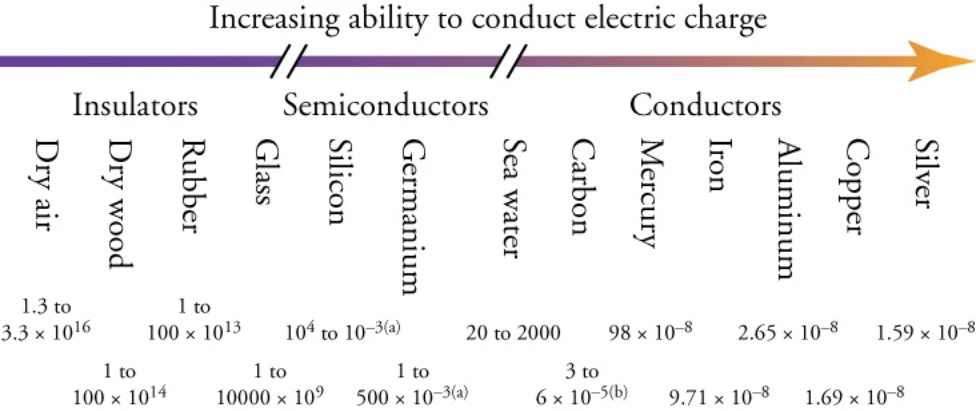
Materials can be classified depending on whether they allow charge to move. If charge can easily move through a material, such as metals, then these materials are called conductors. This means that charge can be conducted (i.e., move) through the material rather easily. If charge cannot move through a material, such as rubber, then this material is called an insulator.
材料は、電荷が動けるかどうかで分けられる。金属のように電荷が材料の中を簡単に動けるなら、そうした材料を導体という。これは、電荷が材料の中をわりあい簡単に伝導する(すなわち動く)という意味である。ゴムのように電荷が材料の中を動けないなら、その材料を絶縁体という。
Most materials are insulators. Their atoms and molecules hold on more tightly to their electrons, so it is difficult for electrons to move between atoms. However, it is not impossible. With enough energy, it is possible to force electrons to move through an insulator. However, the insulator is often physically destroyed in the process. In metals, the outer electrons are loosely bound to their atoms, so not much energy is required to make electrons move through metal. Such metals as copper, silver, and aluminum are good conductors. Insulating materials include plastics, glass, ceramics, and wood.
たいていの材料は絶縁体である。その原子と分子は電子をより固く保持しているので、電子が原子の間を動くのは難しい。しかし不可能ではない。十分なエネルギーがあれば、絶縁体の中を電子に無理やり動かせる。ただし、その過程で絶縁体は物理的に壊れてしまうことが多い。金属では、外側の電子が原子にゆるく結びついているので、電子を金属の中で動かすのに大したエネルギーは要らない。銅・銀・アルミニウムのような金属はよい導体である。絶縁体の材料には、プラスチック、ガラス、陶器、木がある。
The conductivity of some materials is intermediate between conductors and insulators. These are called semiconductors. They can be made conductive under the right conditions, which can involve temperature, the purity of the material, and the force applied to push electrons through them. Because we can control whether semiconductors are conductors or insulators, these materials are used extensively in computer chips. The most commonly used semiconductor is silicon. Figure 18.8 shows various materials arranged according to their ability to conduct electrons.
導体と絶縁体の中間の伝導性を持つ材料もある。それらは半導体と呼ばれる。適切な条件——温度、材料の純度、電子を押し通す力が関わりうる——のもとで伝導させられる。半導体は導体にするか絶縁体にするかを制御できるので、コンピューターのチップに広く使われている。最もよく使われる半導体はシリコンである。図18.8は、電子を伝える能力に応じて並べたさまざまな材料を示す。
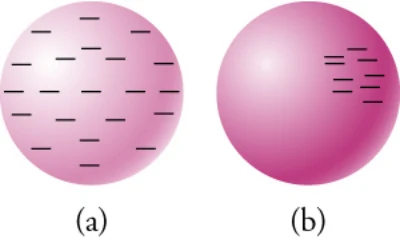
What happens if an excess negative charge is placed on a conducting object? Because like charges repel each other, they will push against each other until they are as far apart as they can get. Because the charge can move in a conductor, it moves to the outer surfaces of the object. Figure 18.9(a) shows schematically how an excess negative charge spreads itself evenly over the outer surface of a metal sphere.
導体の物に余分な負の電荷を置くとどうなるか。同じ符号の電荷は互いに反発するので、できるだけ離れるまで互いを押しやる。導体では電荷が動けるので、電荷は物の外表面へ動く。図18.9(a)は、余分な負の電荷が金属球の外表面に一様に広がる様子を模式的に示す。
What happens if the same is done with an insulating object? The electrons still repel each other, but they are not able to move, because the material is an insulator. Thus, the excess charge stays put and does not distribute itself over the object. Figure 18.9(b) shows this situation.
同じことを絶縁体の物でしたらどうなるか。電子は互いに反発するが、材料が絶縁体なので動けない。したがって余分な電荷はその場にとどまり、物の上に広がらない。図18.9(b)がこの様子を示す。
Transfer and Separation of Charge電荷の移動と分離
Most objects we deal with are electrically neutral, which means that they have the same amount of positive and negative charge. However, transferring negative charge from one object to another is fairly easy to do. When negative charge is transferred from one object to another, an excess of positive charge is left behind. How do we know that the negative charge is the mobile charge? The positive charge is carried by the proton, which is stuck firmly in the nucleus of atoms, and the atoms are stuck in place in solid materials. Electrons, which carry the negative charge, are much easier to remove from their atoms or molecules and can therefore be transferred more easily.
私たちが扱うたいていの物は電気的に中性で、同じ量の正の電荷と負の電荷を持つ。しかし、負の電荷をある物から別の物へ移すのはかなり簡単である。負の電荷がある物から別の物へ移ると、あとに正の電荷の過剰が残る。動けるのが負の電荷であることは、どうして分かるのか。正の電荷は陽子が運び、陽子は原子の核にしっかり留まっており、固体の材料では原子もその場に留まっている。負の電荷を運ぶ電子は、原子や分子から取り除くのがずっと簡単で、したがってより簡単に移せる。
Electric charge can be transferred in several manners. One of the simplest ways to transfer charge is charging by contact, in which the surfaces of two objects made of different materials are placed in close contact. If one of the materials holds electrons more tightly than the other, then it takes some electrons with it when the materials are separated. Rubbing two surfaces together increases the transfer of electrons, because it creates a closer contact between the materials. It also serves to present fresh material with a full supply of electrons to the other material. Thus, when you walk across a carpet on a dry day, your shoes rub against the carpet, and some electrons are removed from the carpet by your shoes. The result is that you have an excess of negative charge on your shoes. When you then touch a doorknob, some of your excess of electrons transfer to the neutral doorknob, creating a small spark.
電荷はいくつものやり方で移せる。最も単純なやり方の一つが接触による帯電で、違う材料でできた二つの物の面を密着させる。一方の材料が他方より電子を強く保持していれば、材料を引き離すときにいくらかの電子を持っていく。二つの面をこすり合わせると、材料どうしがより密に接するので、電子の移動が増える。また、相手の材料に、電子を十分に持った新しい面を差し出すことにもなる。だから、乾いた日にカーペットの上を歩くと、靴がカーペットとこすれ、いくらかの電子が靴によってカーペットから取り除かれる。その結果、靴に負の電荷が過剰にある状態になる。それからドアノブに触れると、余分な電子の一部が中性のドアノブへ移り、小さな火花が生じる。
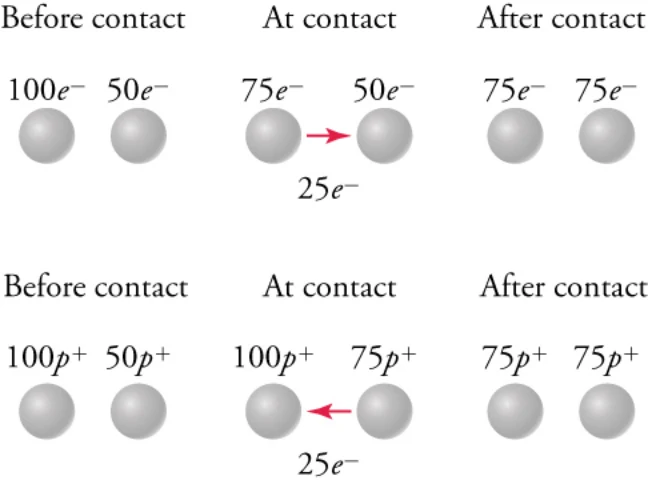
Touching the doorknob with your hand demonstrates a second way to transfer electric charge, which is charging by conduction. This transfer happens because like charges repel, and so the excess electrons that you picked up from the carpet want to be as far away from each other as possible. Some of them move to the doorknob, where they will distribute themselves over the outer surface of the metal. Another example of charging by conduction is shown in the top row of Figure 18.10. A metal sphere with 100 excess electrons touches a metal sphere with 50 excess electrons, so 25 electrons from the first sphere transfer to the second sphere. Each sphere finishes with 75 excess electrons.
手でドアノブに触れることは、電荷を移す二つ目のやり方、すなわち伝導による帯電を示している。この移動が起こるのは、同じ電荷が反発するために、カーペットから拾った余分な電子ができるだけ互いに離れようとするからである。その一部がドアノブへ移り、そこで金属の外表面に広がる。伝導による帯電のもう一つの例を図18.10の上の列に示す。100個の余分な電子を持つ金属球が、50個の余分な電子を持つ金属球に触れ、一つ目の球から25個の電子が二つ目の球へ移る。それぞれの球は最後に75個の余分な電子を持つ。
The same reasoning applies to the transfer of positive charge. However, because positive charge essentially cannot move in solids, it is transferred by moving negative charge in the opposite direction. For example, consider the bottom row of Figure 18.10. The first metal sphere has 100 excess protons and touches a metal sphere with 50 excess protons, so the second sphere transfers 25 electrons to the first sphere. These 25 extra electrons will electrically cancel 25 protons so that the first metal sphere is left with 75 excess protons. This is shown in the bottom row of Figure 18.10. The second metal sphere lost 25 electrons so it has 25 more excess protons, for a total of 75 excess protons. The end result is the same if we consider that the first ball transferred a net positive charge equal to that of 25 protons to the first ball.
同じ理屈が正の電荷の移動にも当てはまる。しかし、正の電荷は固体の中では実質的に動けないので、負の電荷を逆向きに動かすことで移される。たとえば図18.10の下の列を考えよう。一つ目の金属球は100個の余分な陽子を持ち、50個の余分な陽子を持つ金属球に触れるので、二つ目の球が25個の電子を一つ目の球へ移す。この余分な25個の電子は25個の陽子を電気的に打ち消すので、一つ目の金属球には75個の余分な陽子が残る。これを図18.10の下の列に示す。二つ目の金属球は25個の電子を失ったので、余分な陽子が25個増え、合わせて75個の余分な陽子を持つ。一つ目の球が陽子25個ぶんの正味の正の電荷を移したと考えても、最後の結果は同じである。
In this discussion, you may wonder how the excess electrons originally got from your shoes to your hand to create the spark when you touched the doorknob. The answer is that no electrons actually traveled from your shoes to your hands. Instead, because like charges repel each other, the excess electrons on your shoe simply pushed away some of the electrons in your feet. The electrons thus dislodged from your feet moved up into your leg and in turn pushed away some electrons in your leg. This process continued through your whole body until a distribution of excess electrons covered the extremities of your body. Thus your head, your hands, the tip of your nose, and so forth all received their doses of excess electrons that had been pushed out of their normal positions. All this was the result of electrons being pushed out of your feet by the excess electrons on your shoes.
この話で、ドアノブに触れたときに火花を生む余分な電子が、どうやって靴から手まで来たのか不思議に思うかもしれない。答えは、実際には電子が靴から手まで旅したのではない、ということである。同じ電荷は互いに反発するので、靴の余分な電子は単に足の中の電子の一部を押しやった。こうして足から追い出された電子は脚へ上り、こんどは脚の中の電子の一部を押しやった。この過程が体じゅうで続き、ついには余分な電子の分布が体の末端を覆った。こうして頭も、手も、鼻の先も、それぞれが本来の位置から押し出された余分な電子を受け取った。これらすべては、靴の余分な電子が足から電子を押し出した結果である。
This type of charge separation is called polarization. As soon as the excess electrons leave your shoes (by rubbing off onto the floor or being carried away in humid air), the distribution of electrons in your body returns to normal. Every part of your body is again electrically neutral (i.e., zero excess charge).
この型の電荷の分離を分極という。(床にこすり落とされたり湿った空気に運び去られたりして)余分な電子が靴から去るとすぐ、体の中の電子の分布は正常に戻る。体のどの部分もふたたび電気的に中性(すなわち余分な電荷が0)になる。
The phenomenon of polarization is seen in Figure 18.1. The child has accumulated excess positive charge by sliding on the slide. This excess charge repels itself and so becomes distributed over the extremities of the child’s body, notably in his hair. As a result, the hair stands on end, because the excess negative charge on each strand repels the excess negative charge on neighboring strands.
分極の現象は図18.1に見られる。この子どもは滑り台を滑って余分な正の電荷を溜めた。この余分な電荷は自ら反発し合い、体の末端、とくに髪へ広がる。その結果、一本一本の余分な負の電荷が隣の一本の余分な負の電荷を反発するので、髪が逆立つ。
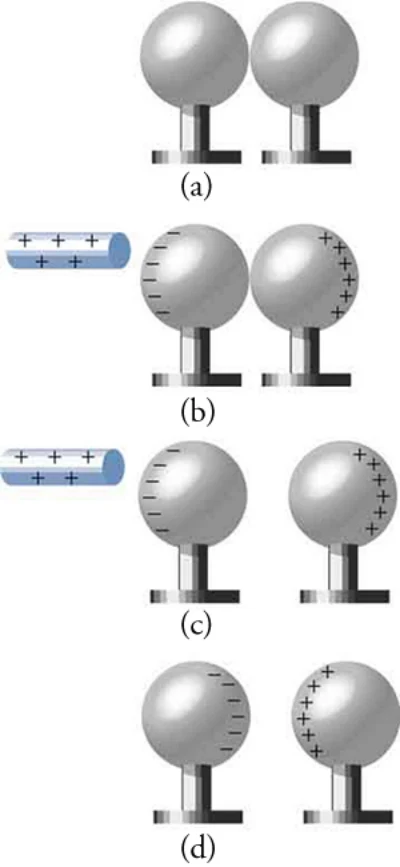
Polarization can be used to charge objects. Consider the two metallic spheres shown in Figure 18.11. The spheres are electrically neutral, so they carry the same amounts of positive and negative charge. In the top picture (Figure 18.11(a)), the two spheres are touching, and the positive and negative charge is evenly distributed over the two spheres. We then approach a glass rod that carries an excess positive charge, which can be done by rubbing the glass rod with silk, as shown in Figure 18.11(b). Because opposite charges attract each other, the negative charge is attracted to the glass rod, leaving an excess positive charge on the opposite side of the right sphere. This is an example of charging by induction, whereby a charge is created by approaching a charged object with a second object to create an unbalanced charge in the second object. If we then separate the two spheres, as shown in Figure 18.11(c), the excess charge is stuck on each sphere. The left sphere now has an excess negative charge, and the right sphere has an excess positive charge. Finally, in the bottom picture, the rod is removed, and the opposite charges attract each other, so they move as close together as they can get.
分極は物を帯電させるのに使える。図18.11の二つの金属球を考えよう。球は電気的に中性で、同じ量の正の電荷と負の電荷を持つ。上の絵(図18.11(a))では二つの球が触れ合っており、正と負の電荷は二つの球に一様に広がっている。次に、図18.11(b)のように、余分な正の電荷を持つガラス棒を近づける。この電荷はガラス棒を絹でこすれば作れる。逆の電荷は引き合うので、負の電荷はガラス棒に引きつけられ、右の球の反対側に余分な正の電荷が残る。これが誘導による帯電の例で、帯電した物を二つ目の物に近づけて、二つ目の物の中に電荷の偏りを作ることで電荷を生む。次に図18.11(c)のように二つの球を離せば、余分な電荷はそれぞれの球に留まる。左の球はいまや余分な負の電荷を、右の球は余分な正の電荷を持つ。最後に一番下の絵で棒が取り去られ、逆の電荷は引き合うので、できるだけ近づくように動く。
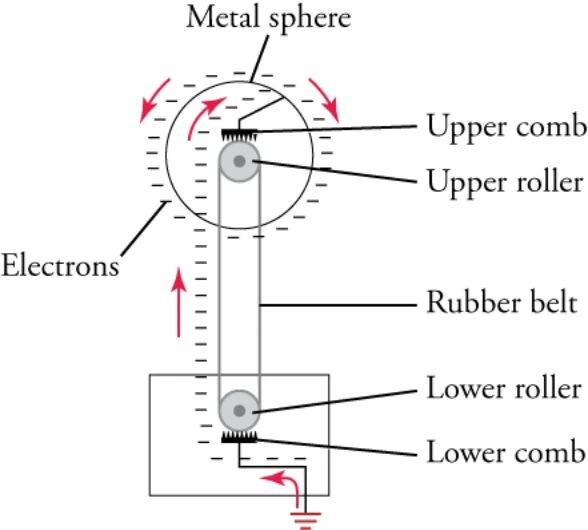
Create a Spark in a Science Fair Van de Graaff generators are devices that are used not only for serious physics research but also for demonstrating the physics of static electricity at science fairs and in classrooms. Because they deliver relatively little electric current, they can be made safe for use in such environments. The first such generator was built by Robert Van de Graaff in 1931 for use in nuclear physics research. Figure 18.12 shows a simplified sketch of a Van de Graaff generator.
科学フェアで火花を作る ヴァン・デ・グラーフ起電機は、本格的な物理の研究だけでなく、科学フェアや教室で静電気の物理を実演するのにも使われる装置である。流す電流がわりあい小さいので、そうした場で安全に使えるように作れる。最初のこの種の起電機は、1931年にロバート・ヴァン・デ・グラーフが原子核物理の研究のために作った。図18.12にヴァン・デ・グラーフ起電機の簡略図を示す。
Van de Graaff generators use smooth and pointed surfaces and conductors and insulators to generate large static charges. In the version shown in Figure 18.12, electrons are “sprayed” from the tips of the lower comb onto a moving belt, which is made of an insulating material like, such as rubber. This technique of charging the belt is akin to charging your shoes with electrons by walking across a carpet. The belt raises the charges up to the upper comb, where they transfer again, akin to your touching the doorknob and transferring your charge to it. Because like charges repel, the excess electrons all rush to the outer surface of the globe, which is made of metal (a conductor). Thus, the comb itself never accumulates too much charge, because any charge it gains is quickly depleted by the charge moving to the outer surface of the globe.
ヴァン・デ・グラーフ起電機は、なめらかな面と尖った面、そして導体と絶縁体を使って大きな静電気の電荷を作る。図18.12の型では、電子が下の櫛の先端から、ゴムのような絶縁体でできた動くベルトへ「吹き付け」られる。このベルトを帯電させる手口は、カーペットの上を歩いて靴を電子で帯電させるのに似ている。ベルトは電荷を上の櫛まで運び上げ、そこでまた移す。これはドアノブに触れて電荷を移すのに似ている。同じ電荷は反発するので、余分な電子はすべて金属(導体)でできた球の外表面へ殺到する。したがって櫛そのものは電荷を溜めすぎない。得た電荷は、球の外表面へ移ることですぐに減るからである。
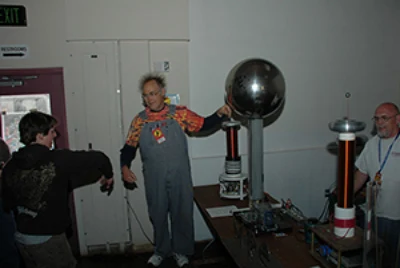
Van de Graaff generators are used to demonstrate many interesting effects caused by static electricity. By touching the globe, a person gains excess charge, so his or her hair stands on end, as shown in Figure 18.13. You can also create mini lightning bolts by moving a neutral conductor toward the globe. Another favorite is to pile up aluminum muffin tins on top of the uncharged globe, then turn on the generator. Being made of conducting material, the tins accumulate excess charge. They then repel each other and fly off the globe one by one. A quick Internet search will show many examples of what you can do with a Van de Graaff generator.
ヴァン・デ・グラーフ起電機は、静電気による多くの面白い効果を実演するのに使われる。球に触れると余分な電荷を得るので、図18.13のように髪が逆立つ。中性の導体を球へ近づけて小さな稲妻を作ることもできる。もう一つの人気の実験は、帯電していない球の上にアルミのマフィン型を積み上げ、それから起電機を入れることである。導体でできているので、型は余分な電荷を溜める。そして互いに反発し合い、一枚ずつ球から飛んでいく。インターネットで少し探せば、ヴァン・デ・グラーフ起電機でできることの例が数多く見つかる。
GRASP CHECK Why don’t the electrons stay on the rubber belt when they reach the upper comb?
理解の確認 電子が上の櫛に達したとき、ゴムのベルトに留まらないのはなぜか。
a. The upper comb has no excess electrons, and the excess electrons in the rubber belt get transferred to the comb by contact.b. The upper comb has no excess electrons, and the excess electrons in the rubber belt get transferred to the comb by conduction.c. The upper comb has excess electrons, and the excess electrons in the rubber belt get transferred to the comb by conduction.d. The upper comb has excess electrons, and the excess electrons in the rubber belt get transferred to the comb by contact.
a. 上の櫛には余分な電子がなく、ゴムのベルトの余分な電子が接触によって櫛へ移るから。b. 上の櫛には余分な電子がなく、ゴムのベルトの余分な電子が伝導によって櫛へ移るから。c. 上の櫛には余分な電子があり、ゴムのベルトの余分な電子が伝導によって櫛へ移るから。d. 上の櫛には余分な電子があり、ゴムのベルトの余分な電子が接触によって櫛へ移るから。
VIRTUAL PHYSICSシミュレーションBalloons and Static Electricity風船と静電気
Access multimedia content (http://openstax.org/books/physics/pages/18-1-electrical-charges-conservation-of-charge-and-transfer-of-charge) This simulation allows you to observe negative charge accumulating on a balloon as you rub it against a sweater. You can then observe how two charged balloons interact and how they cause polarization in a wall.
マルチメディア教材はこちら(http://openstax.org/books/physics/pages/18-1-electrical-charges-conservation-of-charge-and-transfer-of-charge)このシミュレーションでは、セーターに風船をこすりつけると負の電荷が風船に溜まっていく様子を観察できる。それから、帯電した二つの風船がどう作用し合うか、また壁にどう分極を起こすかを観察できる。
GRASP CHECK Click the reset button, and start with two balloons. Charge a first balloon by rubbing it on the sweater, and then move it toward the second balloon. Why does the second balloon not move?
理解の確認 リセットのボタンを押し、風船二つから始めよう。一つ目の風船をセーターにこすって帯電させ、それから二つ目の風船へ近づける。二つ目の風船が動かないのはなぜか。
a. The second balloon has an equal number of positive and negative charges.b. The second balloon has more positive charges than negative charges.
a. 二つ目の風船は正の電荷と負の電荷を同じ数だけ持つから。b. 二つ目の風船は負の電荷より正の電荷を多く持つから。
c. The second balloon has more negative charges than positive charges.d. The second balloon is positively charged and has polarization.
c. 二つ目の風船は正の電荷より負の電荷を多く持つから。d. 二つ目の風船は正に帯電し分極しているから。
SNAP LAB身近な実験Polarizing Tap Water水道水を分極させる
This lab will demonstrate how water molecules can easily be polarized.
この実験は、水の分子が簡単に分極されうることを示す。
• Plastic object of small dimensions, such as comb or plastic stirrer• Source of tap water
・櫛やプラスチックのマドラーのような小さなプラスチックの物・水道の水
Instructions
手引き
Procedure手順
1. Thoroughly rub the plastic object with a dry cloth.2. Open the faucet just enough to let a smooth filament of water run from the tap.3. Move an edge of the charged plastic object toward the filament of running water.
1. 乾いた布でプラスチックの物をよくこする。2. 蛇口から水がなめらかな糸のように流れる程度に、蛇口を少しだけ開ける。3. 帯電したプラスチックの物の縁を、流れる水の糸へ近づける。
What do you observe? What happens when the plastic object touches the water filament? Can you explain your observations?
何が観察されるか。プラスチックの物が水の糸に触れると何が起こるか。観察したことを説明できるか。
Why does the water curve around the charged object?
帯電した物のまわりで水が曲がるのはなぜか。
a. The charged object induces uniform positive charge on the water molecules.b. The charged object induces uniform negative charge on the water molecules.
a. 帯電した物が水の分子に一様な正の電荷を誘導するから。b. 帯電した物が水の分子に一様な負の電荷を誘導するから。
c. The charged object attracts the polarized water molecules and ions that are dissolved in the water.d. The charged object depolarizes the water molecules and the ions dissolved in the water.
c. 帯電した物が、分極した水の分子と水に溶けたイオンを引きつけるから。d. 帯電した物が、水の分子と水に溶けたイオンの分極を解くから。
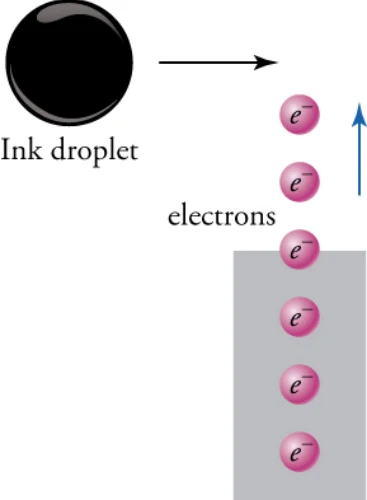
Charging Ink Droplets Electrically neutral ink droplets in an ink-jet printer pass through an electron beam created by an electron gun, as shown in Figure 18.14. Some electrons are captured by the ink droplet, so that it becomes charged. After passing through the electron beam, the net charge of the ink droplet is . How many electrons are captured by the ink droplet?
インクの液滴を帯電させる インクジェットプリンターの中で、電気的に中性のインクの液滴が、電子銃の作る電子線を通り抜ける。図18.14を見よ。一部の電子が液滴に捕まり、液滴は帯電する。電子線を通り抜けたあと、インクの液滴の正味の電荷はである。インクの液滴に捕まった電子は何個か。
Strategy方針
A single electron carries a charge of . Dividing the net charge of the ink droplet by the charge of a single electron will give the number of electrons captured by the ink droplet.
電子1個はの電荷を運ぶ。インクの液滴の正味の電荷を電子1個の電荷で割れば、インクの液滴に捕まった電子の数が得られる。
Solution解答
The number n of electrons captured by the ink droplet are
インクの液滴に捕まった電子の数nは
Discussion考察
This is almost a billion electrons! It seems like a lot, but it is quite small compared to the number of atoms in an ink droplet, which number about Thus, each extra electron is shared between about
ほぼ10億個の電子である。多いように思えるが、インクの液滴の中の原子の数——およそ個——にくらべればかなり少ない。したがって、余分な電子1個はおよそ個の
atoms.
原子に一つの割合である。
Practice Problems練習問題
3How many protons are needed to make 1 nC of charge? 1 nC = 10−9 Ca. 1.6 × 10⁻²⁸b. 1.6 × 10⁻¹⁰c. 3 × 10⁹d. 6 × 10⁹
31 nCの電荷を作るには何個の陽子が必要か。1 nC = 10-9 Ca. 1.6 × 10⁻²⁸b. 1.6 × 10⁻¹⁰c. 3 × 10⁹d. 6 × 10⁹
4In a physics lab, you charge up three metal spheres, two with and one with . When you bring all three spheres together so that they all touch one another, what is the total charge on the three spheres?
4物理の実験で三つの金属球を帯電させる。二つは、一つはである。三つの球をすべて触れ合うように近づけたとき、三つの球の全電荷はいくらか。
Check Your Understanding理解の確認
5How many types of electric charge exist?a. one typeb. two types
5電荷は何種類あるか。a. 1種類b. 2種類
c. three typesd. four types
c. 3種類d. 4種類
6Which are the two main electrical classifications of materials based on how easily charges can move through them?
6電荷がどれだけ簡単に材料の中を動けるかにもとづく、材料のおもな二つの電気的な分類はどれか。
a. conductor and insulatorb. semiconductor and insulator
a. 導体と絶縁体b. 半導体と絶縁体
c. conductor and superconductord. conductor and semiconductor
c. 導体と超伝導体d. 導体と半導体
7True or false—A polarized material must have a nonzero net electric charge.a. trueb. false
7正誤問題——分極した材料は0でない正味の電荷を持たねばならない。a. 正b. 誤
8Describe the force between two positive point charges that interact.a. The force is attractive and acts along the line joining the two point charges.b. The force is attractive and acts tangential to the line joining the two point charges.c. The force is repulsive and acts along the line joining the two point charges.d. The force is repulsive and acts tangential to the line joining the two point charges.
8作用し合う二つの正の点電荷の間の力について述べよ。a. 力は引力で、二つの点電荷を結ぶ線に沿ってはたらく。b. 力は引力で、二つの点電荷を結ぶ線に接する向きにはたらく。c. 力は斥力で、二つの点電荷を結ぶ線に沿ってはたらく。d. 力は斥力で、二つの点電荷を結ぶ線に接する向きにはたらく。
9How does a conductor differ from an insulator?a. Electric charges move easily in an insulator but not in a conducting material.b. Electric charges move easily in a conductor but not in an insulator.
9導体は絶縁体とどう違うか。a. 電荷は絶縁体の中では簡単に動くが、導体の材料の中では動かない。b. 電荷は導体の中では簡単に動くが、絶縁体の中では動かない。
c. A conductor has a large number of electrons.d. More charges are in an insulator than in a conductor.
c. 導体は電子を多数持つ。d. 絶縁体のほうが導体より電荷が多い。
10True or false—Charging an object by polarization requires touching it with an object carrying excess charge.a. trueb. false
10正誤問題——分極によって物を帯電させるには、余分な電荷を持つ物でそれに触れる必要がある。a. 正b. 誤