第18章静電気Static Electricity原書 p.567–622
18.3 Electric Field18.3 電場
SECTION LEARNING OBJECTIVES By the end of this section, you will be able to do the following:• Calculate the strength of an electric field• Create and interpret drawings of electric fields
この節の学習目標 この節を終えると、次のことができるようになる。・電場の強さを計算する・電場の図を描き、解釈する
Section Key Termsこの節の重要語
You may have heard of a force field in science fiction movies, where such fields apply forces at particular positions in space to keep a villain trapped or to protect a spaceship from enemy fire. The concept of a field is very useful in physics, although it differs somewhat from what you see in movies.
SF映画で「フォースフィールド」を聞いたことがあるかもしれない。悪役を閉じ込めたり、宇宙船を敵の砲撃から守ったりするために、空間の特定の位置に力を及ぼす場である。場という概念は物理でとても役に立つが、映画で見るものとはいくぶん違う。
electric fieldtest charge
電場試験電荷
A field is a way of conceptualizing and mapping the force that surrounds any object and acts on another object at a distance without apparent physical connection. For example, the gravitational field surrounding Earth and all other masses represents the gravitational force that would be experienced if another mass were placed at a given point within the field. Michael Faraday, an English physicist of the nineteenth century, proposed the concept of an electric field. If you know the electric field, then you can easily calculate the force (magnitude and direction) applied to any electric charge that you place in the field.
場は、離れた物体に働く力を、空間の各点の性質として表す考え方である。たとえば、地球などの質量を持つ物体のまわりの重力場は、各点に別の物体を置いたときに受ける重力を記述する。19世紀の英国の物理学者マイケル・ファラデーは、電場という概念を提案した。ある場所の電場が分かれば、そこに置いた電荷に働く力の大きさと向きを計算できる。
An electric field is generated by electric charge and tells us the force per unit charge at all locations in space around a charge distribution. The charge distribution could be a single point charge; a distribution of charge over, say, a flat plate; or a more complex distribution of charge. The electric field extends into space around the charge distribution. Now consider placing a test charge in the field. A test charge is a positive electric charge whose charge is so small that it does not significantly disturb the charges that create the electric field. The electric field exerts a force on the test charge in a given direction. The force exerted is proportional to the charge of the test charge. For example, if we double the charge of the test charge, the force exerted on it doubles. Mathematically, saying that electric field is the force per unit charge is written as
電場は電荷が生むもので、電荷の分布のまわりの空間のあらゆる場所で、単位電荷あたりの力を教える。電荷の分布は、一つの点電荷でも、たとえば平らな板の上に広がった電荷でも、もっと複雑な電荷の分布でもよい。電場は電荷の分布のまわりの空間へ広がっている。ここでこの場に試験電荷を置くことを考えよう。試験電荷とは、電場を作っている電荷を目立って乱さないほど電荷が小さい、正の電荷である。電場は試験電荷にある向きの力を及ぼす。及ぼされる力は試験電荷の電荷に比例する。たとえば試験電荷の電荷を2倍にすれば、それにはたらく力も2倍になる。電場が単位電荷あたりの力であることを数式で書くと
where we are considering only electric forces. Note that the electric field is a vector field that points in the same direction as the force on the positive test charge. The units of electric field are N/C.
となる。ここでは電気の力だけを考えている。電場はベクトル場であり、正の試験電荷にはたらく力と同じ向きを指すことに注意しよう。電場の単位はN/Cである。
If the electric field is created by a point charge or a sphere of uniform charge, then the magnitude of the force between this point charge Q and the test charge is given by Coulomb’s law
電場が点電荷または一様に帯電した球によって作られるなら、この点電荷Qと試験電荷の間の力の大きさはクーロンの法則
where the absolute value is used, because we only consider the magnitude of the force. The magnitude of the electric field is then
で与えられる。ここでは力の大きさだけを考えるので絶対値を使う。すると電場の大きさは
This equation gives the magnitude of the electric field created by a point charge Q. The distance r in the denominator is the distance from the point charge, Q, or from the center of a spherical charge, to the point of interest.
となる。この式は点電荷Qが作る電場の大きさを与える。分母の距離rは、点電荷Q、あるいは球状の電荷の中心から、考えている点までの距離である。
If the test charge is removed from the electric field, the electric field still exists. To create a three-dimensional map of the electric field, imagine placing the test charge in various locations in the field. At each location, measure the
試験電荷を電場から取り除いても、電場は存在し続ける。電場の三次元の地図を作るには、場のいろいろな場所に試験電荷を置くことを思い描こう。それぞれの場所で
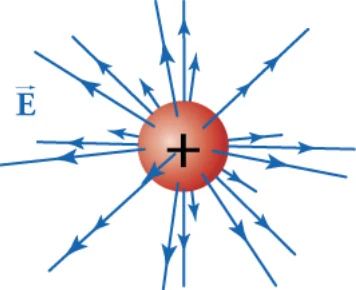
force on the charge, and use the vector equation to calculate the electric field. Draw an arrow at each point where you place the test charge to represent the strength and the direction of the electric field. The length of the arrows should be proportional to the strength of the electric field. If you join together these arrows, you obtain lines. Figure 18.17 shows an image of the three-dimensional electric field created by a positive charge.
電荷にはたらく力を測り、ベクトルの式を使って電場を計算する。試験電荷を置いたそれぞれの点に、電場の強さと向きを表す矢印を描く。矢印の長さは電場の強さに比例させる。これらの矢印をつなげば線が得られる。図18.17は正の電荷が作る三次元の電場の図である。
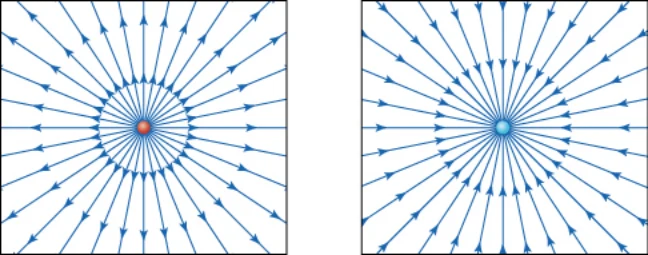
Just drawing the electric field lines in a plane that slices through the charge gives the two-dimensional electric-field maps shown in Figure 18.18. On the left is the electric field created by a positive charge, and on the right is the electric field created by a negative charge.
電荷を通る平面で電気力線を描けば、図18.18の二次元の電場の地図が得られる。左は正の電荷が作る電場、右は負の電荷が作る電場である。
Notice that the electric field lines point away from the positive charge and toward the negative charge. Thus, a positive test charge placed in the electric field of the positive charge will be repelled. This is consistent with Coulomb’s law, which says that like charges repel each other. If we place the positive charge in the electric field of the negative charge, the positive charge is attracted to the negative charge. The opposite is true for negative test charges. Thus, the direction of the electric field lines is consistent with what we find by using Coulomb’s law.
電気力線が正の電荷から離れる向き、負の電荷へ向かう向きを指していることに注目しよう。したがって、正の電荷の電場に置かれた正の試験電荷は反発される。これは、同じ電荷が互いに反発するというクーロンの法則と辻褄が合う。正の電荷を負の電荷の電場に置けば、正の電荷は負の電荷に引きつけられる。負の試験電荷では逆になる。したがって電気力線の向きは、クーロンの法則から分かることと辻褄が合う。
The equation says that the electric field gets stronger as we approach the charge that generates it. For example, at 2 cm from the charge Q (r = 2 cm), the electric field is four times stronger than at 4 cm from the charge (r = 4 cm). Looking at Figure 18.17 and Figure 18.18 again, we see that the electric field lines become denser as we approach the charge that generates it. In fact, the density of the electric field lines is proportional to the strength of the electric field!
式は、電場を生む電荷に近づくほど電場が強くなることを言っている。たとえば電荷Qから2 cm(r = 2 cm)のところでは、電荷から4 cm(r = 4 cm)のところの4倍電場が強い。図18.17と図18.18をもう一度見ると、電場を生む電荷に近づくほど電気力線が密になっているのが分かる。実のところ、電気力線の密度は電場の強さに比例する。
Electric-field maps can be made for several charges or for more complicated charge distributions. The electric field due to multiple charges may be found by adding together the electric field from each individual charge. Because this sum can only be a single number, we know that only a single electric-field line can go through any given point. In other words, electric-field lines cannot cross each other.
電場の地図は、いくつもの電荷や、もっと複雑な電荷の分布についても作れる。複数の電荷による電場は、個々の電荷からの電場を足し合わせれば求まる。この和は一つの数にしかならないので、どの点を通る電気力線も一本だけである。言い換えれば、電気力線は互いに交わらない。
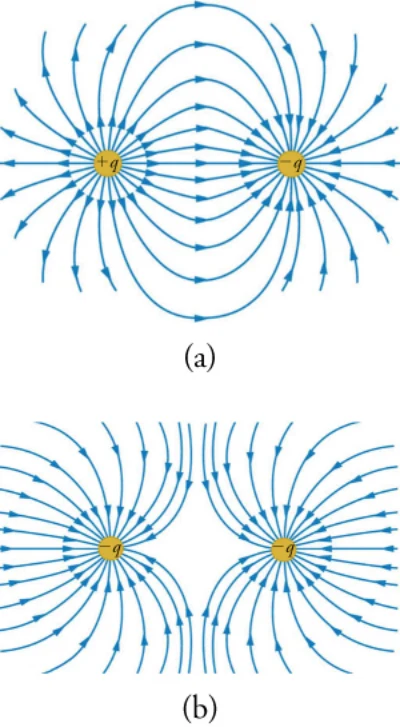
Figure 18.19(a) shows a two-dimensional map of the electric field generated by a charge of +q and a nearby charge of −q. The three-dimensional version of this map is obtained by rotating this map about the axis that goes through both charges. A positive test charge placed in this field would experience a force in the direction of the field lines at its location. It would thus be repelled from the positive charge and attracted to the negative charge. Figure 18.19(b) shows the electric field generated by two charges of −q. Note how the field lines tend to repel each other and do not overlap. A positive test charge placed in this field would be attracted to both charges. If you are far from these two charges, where far means much farther than the distance between the charges, the electric field looks like the electric field from a single charge of −2q.
図18.19(a)は、+qの電荷と近くの−qの電荷が生む電場の二次元の地図を示す。この地図を、両方の電荷を通る軸のまわりに回せば三次元の版が得られる。この場に置かれた正の試験電荷は、その場所の力線の向きの力を受ける。したがって正の電荷から反発され、負の電荷に引きつけられる。図18.19(b)は−qの二つの電荷が生む電場を示す。力線が互いに反発し合い、重ならない様子に注目しよう。この場に置かれた正の試験電荷は両方の電荷に引きつけられる。この二つの電荷から遠く——電荷どうしの距離よりずっと遠く——にいれば、電場は−2qの一つの電荷からの電場のように見える。
VIRTUAL PHYSICSシミュレーションProbing an Electric Field電場を探る
This simulation (https://openstax.org/l/28charge-field) shows you the electric field due to charges that you place on the screen. Start by clicking the top checkbox in the options panel on the right-hand side to show the electric field. Drag charges from the buckets onto the screen, move them around, and observe the electric field that they form. To see more precisely the magnitude and direction of the electric field, drag an electric-field sensor, or E-field sensor from the bottom bucket, and move it around the screen.
このシミュレーション(https://openstax.org/l/28charge-field)は、画面に置いた電荷による電場を見せてくれる。まず右側の選択肢の一番上のチェックボックスを押して電場を表示しよう。バケツから電荷を画面へドラッグし、動かして、できる電場を観察しよう。電場の大きさと向きをより正確に見るには、下のバケツから電場のセンサー(E-fieldセンサー)をドラッグし、画面で動かしてみよう。
PhET Explorations: Charges and Fields. Move point charges around on the playing field and then view the electric field, voltages, equipotential lines, and more.Access multimedia content (http://openstax.org/books/physics/pages/18-3-electric-field) Two positive charges are placed on a screen. Which statement describes the electric field produced by the charges?
PhET探究:電荷と場。点電荷を場の上で動かし、電場・電圧・等電位線などを見よう。マルチメディア教材はこちら(http://openstax.org/books/physics/pages/18-3-electric-field) 二つの正の電荷を画面に置く。この電荷が作る電場を述べているのはどれか。
a. It is constant everywhere.b. It is zero near each charge.
a. どこでも一定である。b. それぞれの電荷の近くで0である。
c. It is zero halfway between the charges.d. It is strongest halfway between the charges.
c. 電荷のちょうど中間で0である。d. 電荷のちょうど中間で最も強い。
Electrostatics (part 2): Interpreting electric field This video explains how to calculate the electric field of a point charge and how to interpret electric-field maps in general. Note that the lecturer uses d for the distance between particles instead of r. Note that the point charges are infinitesimally small, so all their charges are focused at a point. When larger charged objects are considered, the distance between the objects must be measured between the center of the objects.
静電気学(その2):電場を読む この動画は、点電荷の電場をどう計算するか、また電場の地図を一般にどう読むかを説明する。講師が粒子どうしの距離にrでなくdを使っていることに注意しよう。点電荷は無限に小さいので、その電荷はすべて一点に集中していることに注意しよう。より大きな帯電した物を考えるときは、物どうしの距離を物の中心の間で測らねばならない。
Electric field | Electric charge, electric force, and voltage | Physics | Khan Academy (https://www.youtube.com/ embed/0YOGrTNgGhE)
電場|電荷、電気の力、電圧|物理|カーンアカデミー(https://www.youtube.com/embed/0YOGrTNgGhE)
GRASP CHECK True or false—If a point charge has electric field lines that point into it, the charge must be positive.a. trueb. false
理解の確認 正誤問題——ある点電荷に向かって入っていく電気力線があるなら、その電荷は正であるはずである。a. 正b. 誤
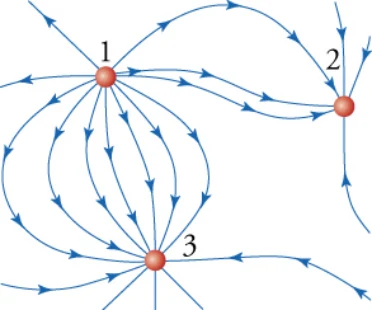
What is the charge? Look at the drawing of the electric field in Figure 18.20. What is the relative strength and sign of the three charges?
電荷はいくらか 図18.20の電場の図を見よ。三つの電荷の相対的な強さと符号はどうか。
Strategy方針
We know the electric field extends out from positive charge and terminates on negative charge. We also know that the number of electric field lines that touch a charge is proportional to the charge. Charge 1 has 12 fields coming out of it. Charge 2 has six field lines going into it. Charge 3 has 12 field lines going into it.
電場は正の電荷から出て負の電荷で終わることが分かっている。また、電荷に触れる電気力線の数が電荷に比例することも分かっている。電荷1からは12本の力線が出ている。電荷2には6本の力線が入っている。電荷3には12本の力線が入っている。
Solution解答
The electric-field lines come out of charge 1, so it is a positive charge. The electric-field lines go into charges 2 and 3, so they are negative charges. The ratio of the charges is . Thus, magnitude of charges 1 and 3 is twice that of charge 2.
電気力線は電荷1から出ているので、これは正の電荷である。電気力線は電荷2と3へ入っているので、これらは負の電荷である。電荷の比はである。したがって電荷1と3の大きさは電荷2の2倍である。
Discussion考察
Although we cannot determine the precise charge on each particle, we can get a lot of information from the electric field regarding the magnitude and sign of the charges and where the force on a test charge would be greatest (or least).
それぞれの粒子の電荷を正確に決めることはできないが、電場から、電荷の大きさと符号、そして試験電荷にはたらく力がどこで最大(あるいは最小)になるかについて、多くの情報が得られる。
Electric field from doorknob A doorknob, which can be taken to be a spherical metal conductor, acquires a static electricity charge of
ドアノブからの電場 球状の金属の導体とみなせるドアノブが、
What is the electric field 1.0 cm in front of the doorknob? The diameter of the doorknob is 5.0 cm. Strategy
の静電気の電荷を帯びた。ドアノブの1.0 cm手前の電場はいくらか。ドアノブの直径は5.0 cmである。 方針
Because the doorknob is a conductor, the entire charge is distributed on the outside surface of the metal. In addition, because the doorknob is assumed to be perfectly spherical, the charge on the surface is uniformly distributed, so we can treat the doorknob as if all the charge were located at the center of the doorknob. The validity of this simplification will be proved in a later physics course. Now sketch the doorknob, and define your coordinate system. Use to indicate the outward direction perpendicular to the door, with at the center of the doorknob (as shown in the figure below).
ドアノブは導体なので、電荷はすべて金属の外表面に分布する。さらに、ドアノブは完全な球とみなすので、表面の電荷は一様に分布し、したがって電荷がすべてドアノブの中心にあるかのように扱える。この単純化が正しいことは、あとの物理の授業で証明される。では、ドアノブの図を描き、座標系を定めよう。ドアの外向きに垂直な向きをで表し、ドアノブの中心をとする(下の図のとおり)。
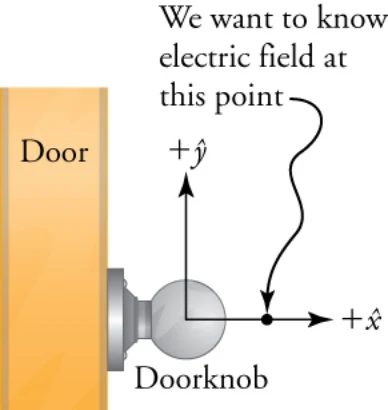
If the diameter of the doorknob is 5.0 cm, its radius is 2.5 cm. We want to know the electric field 1.0 cm from the surface of the doorknob, which is a distance from the center of the doorknob. We can use the equation to find the magnitude of the electric field. The direction of the electric field is determined by the sign of the charge, which is negative in this case.
ドアノブの直径が5.0 cmなら、その半径は2.5 cmである。ドアノブの表面から1.0 cmの電場が知りたいので、これはドアノブの中心からの距離である。式を使って電場の大きさを求められる。電場の向きは電荷の符号で決まり、この場合は負である。
Solution解答
Inserting the charge and the distance into the equation
電荷と距離を式に入れると
Because the charge is negative, the electric-field lines point toward the center of the doorknob. Thus, the electric field at is .
電荷が負なので、電気力線はドアノブの中心へ向かう。したがってでの電場はである。
Discussion考察
This seems like an enormous electric field. Luckily, it takes an electric field roughly 100 times stronger ( ) to cause air to break down and conduct electricity. Also, the weight of an adult is about , so why don’t you feel a force on the protons in your hand as you reach for the doorknob? The reason is that your hand contains an equal amount of negative charge, which repels the negative charge in the doorknob. A very small force might develop from polarization in your hand, but you would never notice it.
これは途方もない電場に思える。幸い、空気が絶縁を破って電気を通すには、およそ100倍強い電場()が要る。また、大人の体重はおよそなのに、ドアノブへ手を伸ばすとき、手の中の陽子にはたらく力を感じないのはなぜか。それは、手が同じ量の負の電荷を含んでいて、それがドアノブの負の電荷を反発するからである。手の分極からごく小さな力が生じるかもしれないが、決して気づかないだろう。
Practice Problems練習問題
15What is the magnitude of the electric field from 20 cm from a point charge of q = 33 nC?a. 7.4 × 10³ N/Cb. 1.48 × 10³ N / Cc. 7.4 × 10¹² N / Cd. 0
15q = 33 nCの点電荷から20 cmのところの電場の大きさはいくらか。a. 7.4 × 10³ N/Cb. 1.48 × 10³ N/Cc. 7.4 × 10¹² N/Cd. 0
16A −10 nC charge is at the origin. In which direction does the electric field from the charge point at x + 10 cm ?a. The electric field points away from negative charges.b. The electric field points toward negative charges.
16−10 nCの電荷が原点にある。x + 10 cmで、この電荷からの電場はどちらを向くか。a. 電場は負の電荷から離れる向きを指す。b. 電場は負の電荷へ向かう向きを指す。
c. The electric field points toward positive charges.d. The electric field points away from positive charges.
c. 電場は正の電荷へ向かう向きを指す。d. 電場は正の電荷から離れる向きを指す。
Check Your Understanding理解の確認
17When electric field lines get closer together, what does that tell you about the electric field?a. The electric field is inversely proportional to the density of electric field lines.b. The electric field is directly proportional to the density of electric field lines.
17電気力線が互いに近づくとき、それは電場について何を教えるか。a. 電場は電気力線の密度に反比例する。b. 電場は電気力線の密度に正比例する。
c. The electric field is not related to the density of electric field lines.d. The electric field is inversely proportional to the square root of density of electric field lines.
c. 電場は電気力線の密度と関係しない。d. 電場は電気力線の密度の平方根に反比例する。
18If five electric-field lines come out of a +5 nC charge, how many electric-field lines should come out of a +20 nC charge?
18+5 nCの電荷から5本の電気力線が出ているなら、+20 nCの電荷からは何本の電気力線が出るはずか。
a. five field linesb. 10 field linesc. 15 field linesd. 20 field lines
a. 5本b. 10本c. 15本d. 20本