第18章静電気Static Electricity原書 p.567–622
18.2 Coulomb's law18.2 クーロンの法則
SECTION LEARNING OBJECTIVES By the end of this section, you will be able to do the following:• Describe Coulomb’s law verbally and mathematically• Solve problems involving Coulomb’s law
この節の学習目標 この節を終えると、次のことができるようになる。・クーロンの法則を言葉と数式で述べる・クーロンの法則に関する問題を解く
Section Key Termsこの節の重要語
More than 100 years before Thomson and Rutherford discovered the fundamental particles that carry positive and negative electric charges, the French scientist Charles-Augustin de Coulomb mathematically described the force between charged objects. Doing so required careful measurements of forces between charged spheres, for which he built an ingenious device called a torsion balance.
トムソンとラザフォードが正と負の電荷を運ぶ基本の粒子を見つける100年以上前に、フランスの科学者シャルル・オーギュスタン・ド・クーロンが、帯電した物どうしの力を数学的に述べた。そのためには帯電した球どうしの力を注意深く測る必要があり、彼はねじり天びんという巧妙な装置を作った。
Coulomb’s lawinverse-square law
クーロンの法則逆二乗の法則
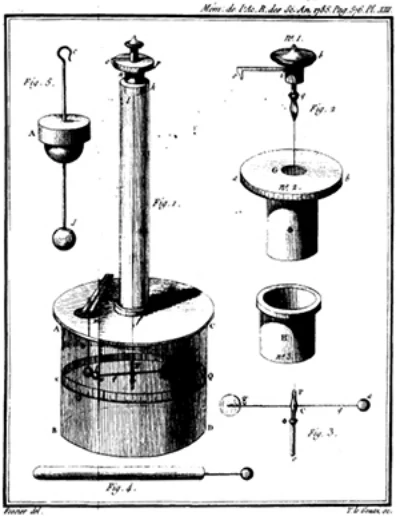
This device, shown in Figure 18.15, contains an insulating rod that is hanging by a thread inside a glass-walled enclosure. At one end of the rod is the metallic sphereA. When no charge is on this sphere, it touches sphereB. Coulomb would touch the spheres with a third metallic ball (shown at the bottom of the diagram) that was charged. An unknown amount of charge would distribute evenly between spheres A and B, which would then repel each other, because like charges repel. This force would cause sphere A to rotate away from sphere B, thus twisting the wire until the torsion in the wire balanced the electrical force. Coulomb then turned the knob at the top, which allowed him to rotate the thread, thus bringing sphere A closer to sphere B. He found that bringing sphere A twice as close to sphere B required increasing the torsion by a factor of four. Bringing the sphere three times closer required a ninefold increase in the torsion. From this type of measurement, he deduced that the electrical force between the spheres was inversely proportional to the distance squared between the spheres. In other words,
図18.15に示すこの装置には、ガラスの囲いの中で糸で吊られた絶縁体の棒がある。棒の一方の端に金属球Aがある。この球に電荷がないとき、球Bに触れている。クーロンは、帯電させた三つ目の金属球(図の下に示す)で球に触れる。未知の量の電荷が球AとBに均等に分かれ、同じ電荷は反発するので、両者は反発し合う。この力は球Aを球Bから回して遠ざけ、線のねじれが電気の力と釣り合うまで線をねじる。それからクーロンは上のつまみを回し、糸を回して球Aを球Bへ近づけた。彼は、球Aを球Bへ2倍近づけるには、ねじれを4倍にする必要があることを見いだした。球を3倍近づけるには、ねじれを9倍にする必要があった。この種の測定から、彼は球どうしの間の電気の力が、球どうしの距離の2乗に反比例すると推論した。言い換えれば、
where r is the distance between the spheres.
ここでrは球どうしの距離である。
An electrical charge distributes itself equally between two conducting spheres of the same size. Knowing this allowed Coulomb to divide an unknown charge in half. Repeating this process would produce a sphere with one quarter of the initial charge, and so on. Using this technique, he measured the force between spheres A and B when they were charged with different amounts of charge. These measurements led him to deduce that the force was proportional to the charge on each sphere, or
電荷は、同じ大きさの二つの導体の球の間で均等に分かれる。これを知っていたので、クーロンは未知の電荷を半分にできた。この過程を繰り返せば、初めの電荷の4分の1を持つ球ができ、以下同様である。この手口を使って、彼は球AとBが違う量の電荷を帯びているときの両者の力を測った。この測定から、彼は力がそれぞれの球の電荷に比例すると推論した。すなわち
where is the charge on sphere A, and is the charge on sphere B.
ここでは球Aの電荷、は球Bの電荷である。
Combining these two proportionalities, he proposed the following expression to describe the force between the charged spheres.
この二つの比例関係を組み合わせて、彼は帯電した球どうしの力を述べる次の式を提案した。
This equation is known as Coulomb’s law, and it describes the electrostatic force between charged objects. The constant of proportionality k is called Coulomb’s constant. In SI units, the constant k has the value
この式はクーロンの法則として知られ、帯電した物どうしの静電気の力を述べる。比例定数kはクーロン定数と呼ばれる。SI単位では定数kは次の値を持つ。
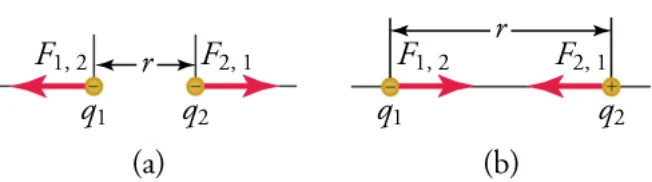
The direction of the force is along the line joining the centers of the two objects. If the two charges are of opposite signs, Coulomb’s law gives a negative result. This means that the force between the particles is attractive. If the two charges have the same signs, Coulomb’s law gives a positive result. This means that the force between the particles is repulsive. For example, if both and are negative or if both are positive, the force between them is repulsive. This is shown in Figure 18.16(a). If is a negative charge and is a positive charge (or vice versa), then the charges are different, so the force between them is attractive. This is shown in Figure 18.16(b).
力の向きは二つの物の中心を結ぶ線に沿う。二つの電荷の符号が逆なら、クーロンの法則は負の結果を与える。これは粒子どうしの力が引力であることを意味する。二つの電荷が同じ符号なら、クーロンの法則は正の結果を与える。これは粒子どうしの力が斥力であることを意味する。たとえばとがどちらも負、あるいはどちらも正なら、両者の間の力は斥力である。これを図18.16(a)に示す。が負の電荷、が正の電荷(あるいはその逆)なら、電荷は違うので両者の間の力は引力である。これを図18.16(b)に示す。
Note that Coulomb’s law applies only to charged objects that are not moving with respect to each other. The law says that the force is proportional to the amount of charge on each object and inversely proportional to the square of the distance between the objects. If we double the charge , for instance, then the force is doubled. If we double the distance between the objects, then the force between them decreases by a factor of . Although Coulomb’s law is true in general, it is easiest to apply to spherical objects or to objects that are much smaller than the distance between the objects (in which case, the objects can be approximated as spheres).
クーロンの法則は、互いに対して動いていない帯電した物にしか当てはまらないことに注意しよう。この法則は、力がそれぞれの物の電荷の量に比例し、物どうしの距離の2乗に反比例すると述べる。たとえば電荷を2倍にすれば力は2倍になる。物どうしの距離を2倍にすれば、両者の間の力は分の1に減る。クーロンの法則は一般に成り立つが、球形の物や、物どうしの距離よりずっと小さい物(その場合、物は球として近似できる)に当てはめるのが最も簡単である。
Coulomb’s law is an example of an inverse-square law, which means the force depends on the square of the denominator. Another inverse-square law is Newton’s law of universal gravitation, which is .Although these laws are similar, they differ in two important respects: (i) The gravitational constant G is much, much smaller than k ( ); and (ii) only one type of mass exists, whereas two types of electric charge exist. These two differences explain why gravity is so much weaker than the electrostatic force and why gravity is only attractive, whereas the electrostatic force can be attractive or repulsive.
クーロンの法則は逆二乗の法則の例であり、力が分母の2乗による。もう一つの逆二乗の法則がニュートンの万有引力の法則である。これらの法則は似ているが、二つの重要な点で違う。(i)重力定数Gはkよりはるかにはるかに小さい()。(ii)質量は1種類しかないが、電荷は2種類ある。この二つの違いが、重力が静電気の力よりはるかに弱い理由と、重力が引力だけであるのに対して静電気の力が引力にも斥力にもなりうる理由を説明する。
Finally, note that Coulomb measured the distance between the spheres from the centers of each sphere. He did not explain this assumption in his original papers, but it turns out to be valid. From outside a uniform spherical distribution of charge, it can be treated as if all the charge were located at the center of the sphere.
最後に、クーロンは球どうしの距離をそれぞれの球の中心から測ったことに注意しよう。彼は最初の論文でこの仮定を説明しなかったが、これは正しいことが分かる。一様な球状の電荷の分布は、外から見れば、すべての電荷が球の中心にあるかのように扱える。
Electrostatics (part 1): Introduction to charge and Coulomb's law This video explains the basics of Coulomb’s law. Note that the lecturer uses d for the distance between the center of the particles instead of r.
静電気学(その1):電荷とクーロンの法則の導入 この動画はクーロンの法則の基本を説明する。講師が粒子の中心どうしの距離にrでなくdを使っていることに注意しよう。
Electrostatics (part 1): Introduction to Charge and Coulomb's Law (https://www.openstax.org/l/28coulomb)
静電気学(その1):電荷とクーロンの法則の導入(https://www.openstax.org/l/28coulomb)
GRASP CHECK True or false—If one particle carries a positive charge and another carries a negative charge, then the force between them is attractive.
理解の確認 正誤問題——一方の粒子が正の電荷を、もう一方が負の電荷を持つなら、両者の間の力は引力である。
a. trueb. false
a. 正b. 誤
SNAP LAB身近な実験Hovering plastic浮かぶプラスチック
In this lab, you will use electrostatics to hover a thin piece of plastic in the air.
この実験では、静電気を使って薄いプラスチックを空中に浮かせる。
• Balloon• Light plastic bag (e.g., produce bag from grocery store)
・風船・軽いビニール袋(たとえばスーパーの野菜用の袋)
Instructions
手引き
Procedure手順
1. Cut the plastic bag to make a plastic loop about 2 inches wide.2. Inflate the balloon.3. Charge the balloon by rubbing it on your clothes.4. Charge the plastic loop by placing it on a nonmetallic surface and rubbing it with a cloth.5. Hold the balloon in one hand, and in the other hand hold the plastic loop above the balloon. If the loop clings too much to your hand, recruit a friend to hold the strip above the balloon with both hands. Now let go of the plastic loop, and maneuver the balloon under the plastic loop to keep it hovering in the air above the balloon.
1. ビニール袋を切って、幅2インチほどの輪を作る。2. 風船をふくらませる。3. 風船を衣服にこすって帯電させる。4. プラスチックの輪を金属でない面に置き、布でこすって帯電させる。5. 片手で風船を持ち、もう一方の手でプラスチックの輪を風船の上に持つ。輪が手にくっつきすぎるなら、友達に両手で風船の上に輪を持ってもらう。そしてプラスチックの輪を放し、その下で風船を動かして、輪を風船の上の空中に浮かせ続ける。
GRASP CHECK How does the balloon keep the plastic loop hovering?
理解の確認 風船はどうやってプラスチックの輪を浮かせているか。
a. The balloon and the loop are both negatively charged. This will help the balloon keep the plastic loop hovering.b. The balloon is charged, while the plastic loop is neutral.This will help the balloon keep the plastic loop hovering.c. The balloon and the loop are both positively charged. This will help the balloon keep the plastic loop hovering.d. The balloon is positively charged, while the plastic loop is negatively charged. This will help the balloon keep the plastic loop hovering.
a. 風船も輪もどちらも負に帯電している。これが風船にプラスチックの輪を浮かせ続けさせる。b. 風船は帯電しており、プラスチックの輪は中性である。これが風船にプラスチックの輪を浮かせ続けさせる。c. 風船も輪もどちらも正に帯電している。これが風船にプラスチックの輪を浮かせ続けさせる。d. 風船は正に帯電し、プラスチックの輪は負に帯電している。これが風船にプラスチックの輪を浮かせ続けさせる。
Using Coulomb’s law to find the force between charged objects Suppose Coulomb measures a force of between the two charged spheres when they are separated by 5.0 cm. By turning the dial at the top of the torsion balance, he approaches the spheres so that they are separated by 3.0 cm. Which force does he measure now?Strategy
クーロンの法則で帯電した物どうしの力を求める クーロンが、5.0 cm離れた二つの帯電した球の間にの力を測ったとする。ねじり天びんの上のつまみを回して、球を3.0 cmの隔たりまで近づける。こんど彼が測る力はいくらか。方針
Apply Coulomb’s law to the situation before and after the spheres are brought closer together. Although we do not know the charges on the spheres, we do know that they remain the same. We call these unknown but constant charges and . Because these charges appear as a product in Coulomb’s law, they form a single unknown. We thus have two equations and two unknowns, which we can solve. The first unknown is the force (which we call ) when the spheres are 3.0 cm apart, and the second is .
球を近づける前と後の場面にクーロンの法則を当てはめる。球の電荷は分からないが、それが変わらないことは分かっている。この未知だが一定の電荷をとと呼ぶ。これらの電荷はクーロンの法則に積として現れるので、一つの未知数をなす。したがって二つの式と二つの未知数があり、解ける。一つ目の未知数は球が3.0 cm離れているときの力(と呼ぶ)、二つ目はである。
Use the following notation: When the charges are 5.0 cm apart, the force is and , where the subscript i means initial. Once the charges are brought closer together, we know , where the subscript f means final.
次の書き方を使う。電荷が5.0 cm離れているとき、力は、である。ここで添字iは初めを意味する。電荷を近づけたあとはである。ここで添字fは最後を意味する。
Solution解答
Coulomb’s law applied to the spheres in their initial positions gives
初めの位置の球にクーロンの法則を当てはめると
Coulomb’s law applied to the spheres in their final positions gives
最後の位置の球にクーロンの法則を当てはめると
Dividing the second equation by the first and solving for the final force leads to
二つ目の式を一つ目で割り、最後の力について解くと
Inserting the known quantities yields
分かっている量を入れると
The force acts along the line joining the centers of the spheres. Because the same type of charge is on each sphere, the force is repulsive.
力は球の中心を結ぶ線に沿ってはたらく。それぞれの球に同じ型の電荷があるので、力は斥力である。
Discussion考察
As expected, the force between the charges is greater when they are 3.0 cm apart than when they are 5.0 cm apart. Note that although it is a good habit to convert cm to m (because the constant k is in SI units), it is not necessary in this problem, because the distances cancel out.
予想どおり、電荷どうしの力は5.0 cm離れているときより3.0 cm離れているときのほうが大きい。(定数kがSI単位なので)cmをmに直すのはよい習慣だが、この問題では距離が打ち消し合うので必要ないことに注意しよう。
We can also solve for the second unknown . By using the first equation, we find
二つ目の未知数についても解ける。一つ目の式を使うと
Note how the units cancel in the second-to-last line. Had we not converted cm to m, this would not occur, and the result would be incorrect. Finally, because the charge on each sphere is the same, we can further deduce that
最後から二行目で単位が打ち消し合うことに注目しよう。cmをmに直していなければこうはならず、結果は間違いになる。最後に、それぞれの球の電荷は同じなので、さらに次のことが分かる。
Using Coulomb’s law to find the distance between charged objects An engineer measures the force between two ink drops by measuring their acceleration and their diameter. She finds that each member of a pair of ink drops exerts a repulsive force of on its partner. If each ink drop carries a charge , how far apart are the ink drops?Strategy
クーロンの法則で帯電した物どうしの距離を求める ある技術者が、二つのインクの液滴の加速度と直径を測って、両者の力を測る。彼女は、対になった液滴のそれぞれが相手にの斥力を及ぼしていることを見いだす。それぞれのインクの液滴が電荷を運ぶとき、液滴どうしはどれだけ離れているか。方針
We know the force and the charge on each ink drop, so we can solve Coulomb’s law for the distance r between the ink drops. Do not forget to convert the force into SI units:
力とそれぞれのインクの液滴の電荷が分かっているので、クーロンの法則を液滴どうしの距離rについて解ける。力をSI単位に直すのを忘れないこと。
Solution解答
The charges in Coulomb’s law are so the numerator in Coulomb’s law takes the form
クーロンの法則の電荷はなので、クーロンの法則の分子は次の形をとる。
. Inserting this into Coulomb’s law and solving for the distance r gives
これをクーロンの法則に入れて距離rについて解くと
or 130 microns (about one-tenth of a millimeter).
すなわち130ミクロン(1ミリメートルのおよそ10分の1)である。
Discussion考察
The plus-minus sign means that we do not know which ink drop is to the right and which is to the left, but that is not important, because both ink drops are the same.
プラスマイナスの符号は、どちらのインクの液滴が右でどちらが左かは分からないという意味だが、二つの液滴は同じなのでそれは重要でない。
Practice Problems練習問題
11A charge of −4 × 10⁻⁹ C is a distance of 3 cm from a charge of 3 × 10⁻⁹ C . What is the magnitude and direction of the force between them?a. 1.2 × 10⁻⁴ N, and the force is attractiveb. 1.2 × 10¹⁴ N, and the force is attractivec. 6.74 × 10²³ N, and the force is attractived. −ŷ, and the force is attractive
11−4 × 10⁻⁹ Cの電荷が、3 × 10⁻⁹ Cの電荷から3 cmのところにある。両者の間の力の大きさと向きはどうか。a. 1.2 × 10⁻⁴ Nで、力は引力b. 1.2 × 10¹⁴ Nで、力は引力c. 6.74 × 10²³ Nで、力は引力d. −ŷで、力は引力
12Two charges are repelled by a force of 2.0 N. If the distance between them triples, what is the force between the charges?
12二つの電荷が2.0 Nの力で反発している。両者の距離が3倍になったら、電荷どうしの力はいくらか。
a. 0.22 Nb. 0.67 Nc. 2.0 Nd. 18.0 N
a. 0.22 Nb. 0.67 Nc. 2.0 Nd. 18.0 N
Check Your Understanding理解の確認
13How are electrostatic force and charge related?a. The force is proportional to the product of two charges.b. The force is inversely proportional to the product of two charges.
13静電気の力と電荷はどう関係するか。a. 力は二つの電荷の積に比例する。b. 力は二つの電荷の積に反比例する。
c. The force is proportional to any one of the charges between which the force is acting.d. The force is inversely proportional to any one of the charges between which the force is acting.
c. 力は、その力がはたらいている電荷のどちらか一方に比例する。d. 力は、その力がはたらいている電荷のどちらか一方に反比例する。
14Why is Coulomb’s law called an inverse-square law?a. because the force is proportional to the inverse of the distance squared between chargesb. because the force is proportional to the product of two charges
14クーロンの法則が逆二乗の法則と呼ばれるのはなぜか。a. 力が電荷どうしの距離の2乗の逆数に比例するからb. 力が二つの電荷の積に比例するから
c. because the force is proportional to the inverse of the product of two chargesd. because the force is proportional to the distance squared between charges
c. 力が二つの電荷の積の逆数に比例するからd. 力が電荷どうしの距離の2乗に比例するから