第7章ニュートンの万有引力の法則Newton's Law of Gravitation原書 p.235–258
7.2 Newton's Law of Universal Gravitation and Einstein's Theory of General Relativity7.2 ニュートンの万有引力の法則とアインシュタインの一般相対性理論
SECTION LEARNING OBJECTIVES By the end of this section, you will be able to do the following:
この節の学習目標 この節を終えると、次のことができるようになる。
• Explain Newton’s law of universal gravitation and compare it to Einstein’s theory of general relativity• Perform calculations using Newton’s law of universal gravitation
・ニュートンの万有引力の法則を説明し、アインシュタインの一般相対性理論と比べる・ニュートンの万有引力の法則を使って計算する
Section Key Termsこの節の重要語
Einstein’s theory of general relativitygravitational constantNewton’s universal law of gravitation
アインシュタインの一般相対性理論万有引力定数ニュートンの万有引力の法則
Concepts Related to Newton’s Law of Universal Gravitationニュートンの万有引力の法則に関わる考え
Sir Isaac Newton was the first scientist to precisely define the gravitational force, and to show that it could explain both falling bodies and astronomical motions. See Figure 7.7. But Newton was not the first to suspect that the same force caused both our weight and the motion of planets. His forerunner, Galileo Galilei, had contended that falling bodies and planetary motions had the same cause. Some of Newton’s contemporaries, such as Robert Hooke, Christopher Wren, and Edmund Halley, had also made some progress toward understanding gravitation. But Newton was the first to propose an exact mathematical form and to use that form to show that the motion of heavenly bodies should be conic sections—circles, ellipses, parabolas, and hyperbolas. This theoretical prediction was a major triumph. It had been known for some time that moons, planets, and comets follow such paths, but no one had been able to propose an explanation of the mechanism that caused them to follow these paths and not others.
アイザック・ニュートンは、重力を厳密に定義し、それが落下する物体の運動と天文学的な運動の両方を説明できることを示した最初の科学者である。図7.7を見よ。しかし、私たちの体重と惑星の運動の両方が同じ力によって生じると疑ったのはニュートンが最初ではない。先人のガリレオ・ガリレイは、落下する物体の運動と惑星の運動には同じ原因があると主張していた。ロバート・フック、クリストファー・レン、エドモンド・ハレーといったニュートンの同時代人も、重力の理解に向けていくらか前進していた。しかし、正確な数学的形式を提案し、それを使って天体の運動が円錐曲線——円・楕円・放物線・双曲線——になるはずだと示したのはニュートンが最初だった。この理論的な予測は大きな勝利だった。衛星や惑星や彗星がそうした道筋をたどることはしばらく前から知られていたが、なぜ他の道筋ではなくその道筋をたどるのか、その仕組みを説明できた者はいなかったのである。
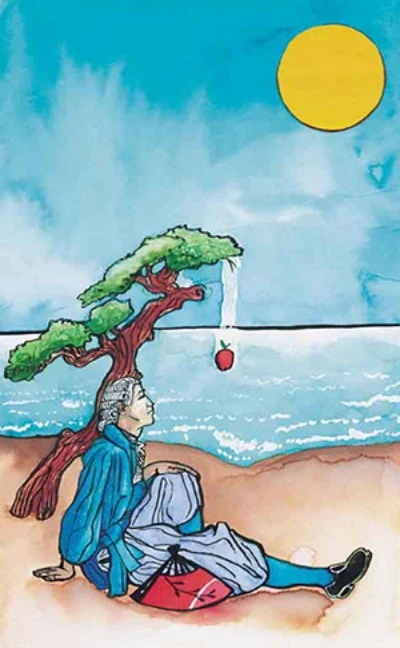
on the head has an element of truth in it. A more probable account is that he was walking through an orchard and wondered why all the apples fell in the same direction with the same acceleration. Great importance is attached to it because Newton’s universal law of gravitation and his laws of motion answered very old questions about nature and gave tremendous support to the notion of underlying simplicity and unity in nature. Scientists still expect underlying simplicity to emerge from their ongoing inquiries into nature.
いくらか真実の要素がある。より確からしい話は、彼が果樹園を歩きながら、なぜリンゴがどれも同じ向きに同じ加速度で落ちるのだろうと考えた、というものである。この話が重んじられるのは、ニュートンの万有引力の法則と運動の法則が、自然についての非常に古い問いに答え、自然の底にある単純さと統一という考えに絶大な支持を与えたからである。科学者たちは今も、自然への探究の中から底にある単純さが現れることを期待している。
The gravitational force is relatively simple. It is always attractive, and it depends only on the masses involved and the distance between them. Expressed in modern language, Newton’s universal law of gravitation states that every object in the universe attracts every other object with a force that is directed along a line joining them. The force is directly proportional to the product of their masses and inversely proportional to the square of the distance between them. This attraction is illustrated by Figure 7.8.
重力は比較的単純である。つねに引き合う力であり、関わる質量とその間の距離だけによって決まる。現代の言葉で言えば、ニュートンの万有引力の法則は、宇宙のあらゆる物体が、他のあらゆる物体を、両者を結ぶ直線に沿った向きの力で引きつける、と述べる。この力は両者の質量の積に比例し、両者の距離の2乗に反比例する。この引力を図7.8に示す。
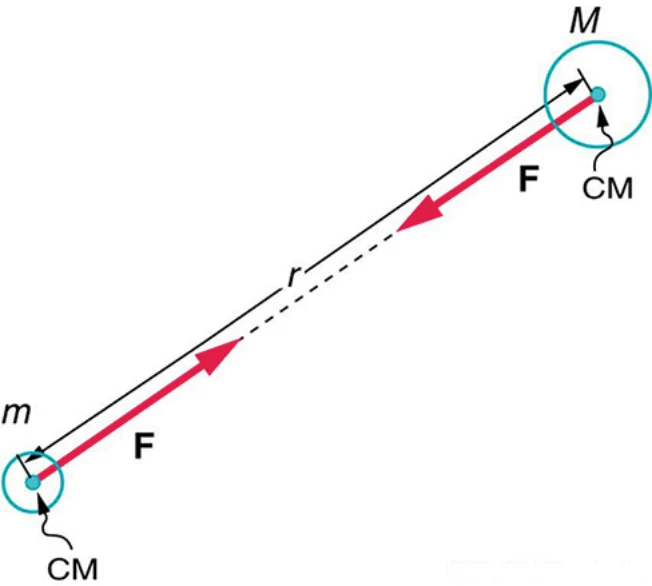
For two bodies having masses m and M with a distance r between their centers of mass, the equation for Newton’s universal law of gravitation is
重心間の距離がrの、質量mとMの二つの物体について、ニュートンの万有引力の法則の式は次のとおりである。
where F is the magnitude of the gravitational force and G is a proportionality factor called the gravitational constant. G is a universal constant, meaning that it is thought to be the same everywhere in the universe. It has been measured experimentally to be .
ここでFは重力の大きさ、Gは万有引力定数と呼ばれる比例の因子である。Gは普遍定数であり、宇宙のどこでも同じだと考えられている。実験で測られた値はである。
If a person has a mass of 60.0 kg, what would be the force of gravitational attraction on him at Earth’s surface? G is given above, Earth’s mass M is 5.97 × 1024 kg, and the radius r of Earth is 6.38 × 10⁶ m. Putting these values into Newton’s universal law of gravitation gives
質量60.0 kgの人が地表で受ける重力による引力はいくらか。Gは上に与えられており、地球の質量Mは5.97 × 1024 kg、地球の半径rは6.38 × 10⁶ mである。これらの値をニュートンの万有引力の法則に入れると、次が得られる。
You may remember that g, the acceleration due to gravity, is another important constant related to gravity. By substituting g for a in the equation for Newton’s second law of motion we get . Combining this with the equation for universal gravitation gives
重力加速度gも重力に関わる重要な定数だったことを思い出すだろう。ニュートンの運動の第二法則の式でaをgに置き換えるとが得られる。これを万有引力の式と組み合わせると、次が得られる。
Cancelling the mass m on both sides of the equation and filling in the values for the gravitational constant and mass and radius of the Earth, gives the value of g, which may look familiar.
式の両辺で質量mを約分し、万有引力定数と地球の質量・半径の値を入れると、見慣れているはずのgの値が得られる。
This is a good point to recall the difference between mass and weight. Mass is the amount of matter in an object; weight is the force of attraction between the mass within two objects. Weight can change because g is different on every moon and planet. An object’s mass m does not change but its weight mg can.
ここで、質量と重さの違いを思い出しておくとよい。質量は物体に含まれる物質の量であり、重さは二つの物体の質量の間にはたらく引力である。gは衛星や惑星ごとに違うので、重さは変わりうる。物体の質量mは変わらないが、その重さmgは変わりうる。
VIRTUAL PHYSICSシミュレーションGravity and Orbits重力と軌道
Move the sun, Earth, moon and space station in this simulation (https://openstax.org/l/28gravityorbit) to see how it affects their gravitational forces and orbital paths. Visualize the sizes and distances between different heavenly bodies. Turn off gravity to see what would happen without it!
このシミュレーション(https://openstax.org/l/28gravityorbit)で、太陽・地球・月・宇宙ステーションを動かして、それが重力と軌道の道筋にどう影響するかを見よう。さまざまな天体の大きさと距離を目で確かめられる。重力を切って、重力がなければどうなるかも見てみよう。
Access multimedia content (http://openstax.org/books/physics/pages/7-2-newtons-law-of-universal-gravitation-and-einsteins-theory-of-general-relativity) Why doesn’t the Moon travel in a smooth circle around the Sun?
マルチメディア教材はこちら(http://openstax.org/books/physics/pages/7-2-newtons-law-of-universal-gravitation-and-einsteins-theory-of-general-relativity) 月が太陽のまわりをなめらかな円で進まないのはなぜか。
a. The Moon is not affected by the gravitational field of the Sun.b. The Moon is not affected by the gravitational field of the Earth.
a. 月は太陽の重力場の影響を受けないから。b. 月は地球の重力場の影響を受けないから。
c. The Moon is affected by the gravitational fields of both the Earth and the Sun, which are always additive.d. The moon is affected by the gravitational fields of both the Earth and the Sun, which are sometimes additive and sometimes opposite.
c. 月は地球と太陽の両方の重力場の影響を受け、それらはつねに足し合わさるから。d. 月は地球と太陽の両方の重力場の影響を受け、それらは足し合わさることもあれば逆向きになることもあるから。
SNAP LAB身近な実験Take-Home Experiment: Falling Objects家庭でできる実験:落下する物体
In this activity you will study the effects of mass and air resistance on the acceleration of falling objects. Make predictions (hypotheses) about the outcome of this experiment. Write them down to compare later with results.
この活動では、質量と空気抵抗が落下する物体の加速度に及ぼす影響を調べる。この実験の結果について予想(仮説)を立てよ。あとで結果と比べられるよう書き留めておくこと。
• Four sheets of -inch paper
・インチの紙4枚
Procedure手順
• Take four identical pieces of paper. ◦ Crumple one up into a small ball. ◦ Leave one uncrumpled. ◦ Take the other two and crumple them up together, so that they make a ball of exactly twice the mass of the other crumpled ball. ◦ Now compare which ball of paper lands first when dropped simultaneously from the same height.1. Compare crumpled one-paper ball with crumpled two-paper ball.2. Compare crumpled one-paper ball with uncrumpled paper.
・同じ紙を4枚用意する。 ◦1枚を小さな球に丸める。 ◦1枚は丸めずにおく。 ◦残り2枚は一緒に丸めて、先の球のちょうど2倍の質量の球にする。 ◦次に、同じ高さから同時に落として、どちらの紙の球が先に着くかを比べる。1. 1枚を丸めた球と2枚を丸めた球を比べる。2. 1枚を丸めた球と丸めていない紙を比べる。
Why do some objects fall faster than others near the surface of the Earth if the force of gravity is proportional to the mass?
重力が質量に比例するなら、地表付近で他より速く落ちる物があるのはなぜか。
a. Some objects fall faster because of air resistance, which acts in the direction of the motion of the object and exerts more force on objects with less surface area.b. Some objects fall faster because of air resistance, which acts in the direction opposite the motion of the object and exerts more force on objects with less surface area.c. Some objects fall faster because of air resistance, which acts in the direction of motion of the object and exerts more force on objects with more surface area.d. Some objects fall faster because of air resistance, which acts in the direction opposite the motion of the object and exerts more force on objects with more surface area.
a. 空気抵抗のせいで速く落ちる物がある。空気抵抗は物体の運動の向きにはたらき、表面積の小さい物体により大きな力を及ぼすから。b. 空気抵抗のせいで速く落ちる物がある。空気抵抗は物体の運動と逆向きにはたらき、表面積の小さい物体により大きな力を及ぼすから。c. 空気抵抗のせいで速く落ちる物がある。空気抵抗は物体の運動の向きにはたらき、表面積の大きい物体により大きな力を及ぼすから。d. 空気抵抗のせいで速く落ちる物がある。空気抵抗は物体の運動と逆向きにはたらき、表面積の大きい物体により大きな力を及ぼすから。
It is possible to derive Kepler’s third law from Newton’s law of universal gravitation. Applying Newton’s second law of motion to angular motion gives an expression for centripetal force, which can be equated to the expression for force in the universal gravitation equation. This expression can be manipulated to produce the equation for Kepler’s third law. We saw earlier that the expression r3/T2 is a constant for satellites orbiting the same massive object. The derivation of Kepler’s third law from Newton’s law of universal gravitation and Newton’s second law of motion yields that constant:
ニュートンの万有引力の法則から、ケプラーの第三法則を導くことができる。ニュートンの第二法則を当てはめると、角運動に向けたニュートンの運動の第二法則から向心力の式が得られ、それを万有引力の式の力と等しいと置ける。この式を変形すればケプラーの第三法則の式が得られる。同じ重い天体を回る衛星について、r3/T2という式が一定になることは先に見た。ニュートンの万有引力の法則と運動の第二法則からケプラーの第三法則を導くと、その定数は次のようになる。
where M is the mass of the central body about which the satellites orbit (for example, the sun in our solar system). The usefulness of this equation will be seen later.
ここでMは、衛星が回っている中心天体の質量である(たとえば私たちの太陽系なら太陽)。この式の使いどころはあとで見る。
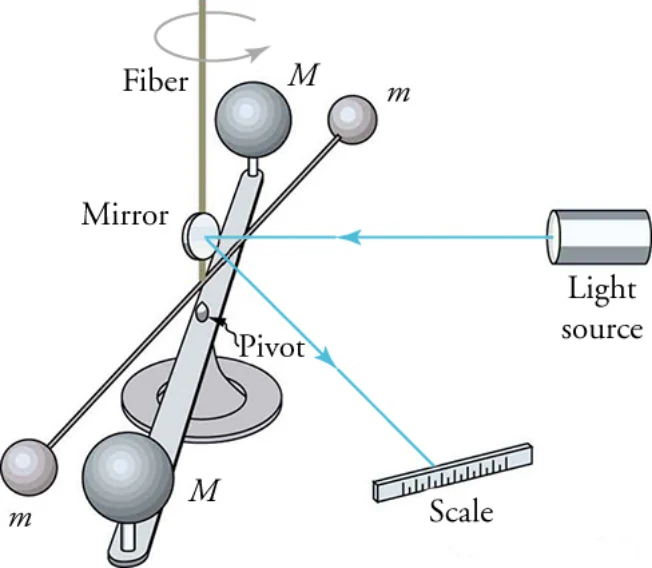
The universal gravitational constant G is determined experimentally. This determination was first done accurately in 1798 by English scientist Henry Cavendish (1731–1810), more than 100 years after Newton published his universal law of gravitation. The measurement of G is very basic and important because it determines the strength of one of the four forces in nature. Cavendish’s experiment was very difficult because he measured the tiny gravitational attraction between two ordinary-sized masses (tens of kilograms at most) by using an apparatus like that in Figure 7.9. Remarkably, his value for G differs by less than 1% from the modern value.
万有引力定数Gは実験で決められる。この決定を初めて正確に行ったのは、1798年、イギリスの科学者ヘンリー・キャヴェンディッシュ(1731–1810)であり、ニュートンが万有引力の法則を発表してから100年以上あとのことだった。Gの測定は、自然界の四つの力の一つの強さを決めるので、きわめて基本的で重要である。キャヴェンディッシュの実験は非常に難しかった。図7.9のような装置を使って、ふつうの大きさの二つの質量(せいぜい数十キログラム)の間にはたらくごく小さな引力を測ったからである。驚くべきことに、彼の得たGの値は現代の値と1パーセントも違わない。
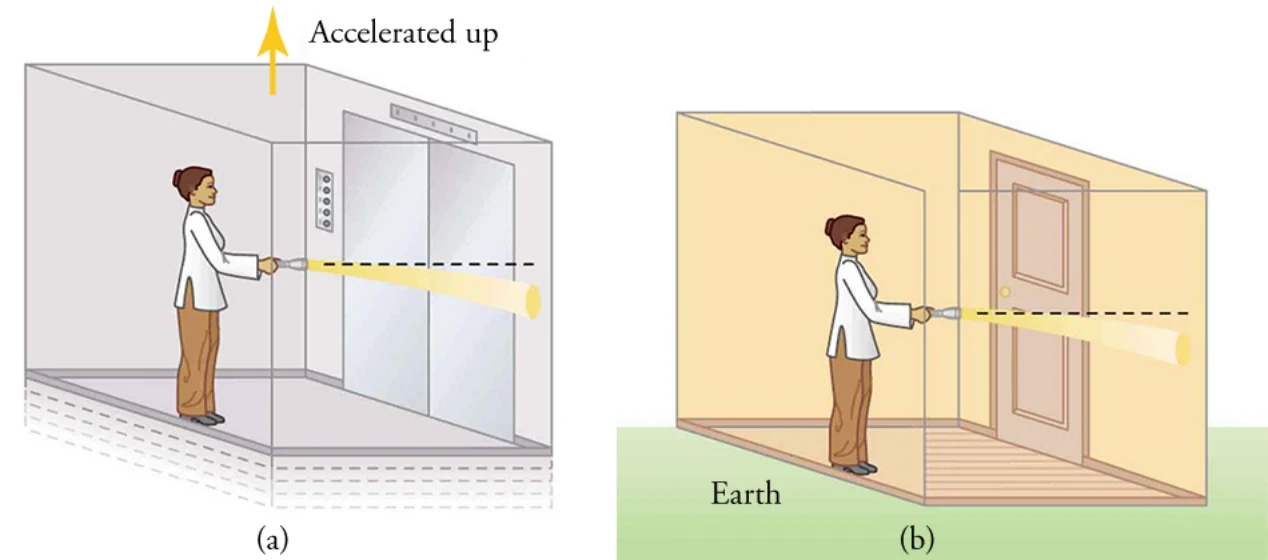
Einstein’s Theory of General Relativity Einstein’s theory of general relativity explained some interesting properties of gravity not covered by Newton’s theory. Einstein based his theory on the postulate that acceleration and gravity have the same effect and cannot be distinguished from each other. He concluded that light must fall in both a gravitational field and in an accelerating reference frame. Figure 7.10 shows this effect (greatly exaggerated) in an accelerating elevator. In Figure 7.10 (a), the elevator accelerates upward in zero gravity. In Figure 7.10 (b), the room is not accelerating but is subject to gravity. The effect on light is the same: it “falls” downward in both situations. The person in the elevator cannot tell whether the elevator is accelerating in zero gravity or is stationary and subject to gravity. Thus, gravity affects the path of light, even though we think of gravity as acting between masses, while photons are massless.
アインシュタインの一般相対性理論 アインシュタインの一般相対性理論は、ニュートンの理論では扱えなかった重力の興味深い性質をいくつか説明した。アインシュタインはこの理論を、加速度と重力は同じ効果を持ち互いに区別できない、という前提の上に築いた。彼は、光は重力場の中でも、加速する基準系の中でも落ちるはずだと結論した。図7.10は、加速するエレベーターの中でのこの効果を(大きく誇張して)示している。図7.10(a)では、無重力の中でエレベーターが上向きに加速している。図7.10(b)では、部屋は加速していないが重力を受けている。光への効果は同じで、どちらの場合も光は下へ「落ちる」。エレベーターの中の人には、無重力の中でエレベーターが加速しているのか、静止していて重力を受けているのかを見分けられない。したがって重力は光の道筋に影響する。私たちは重力を質量どうしの間にはたらくものと考えているのに、光子には質量がないにもかかわらず、である。
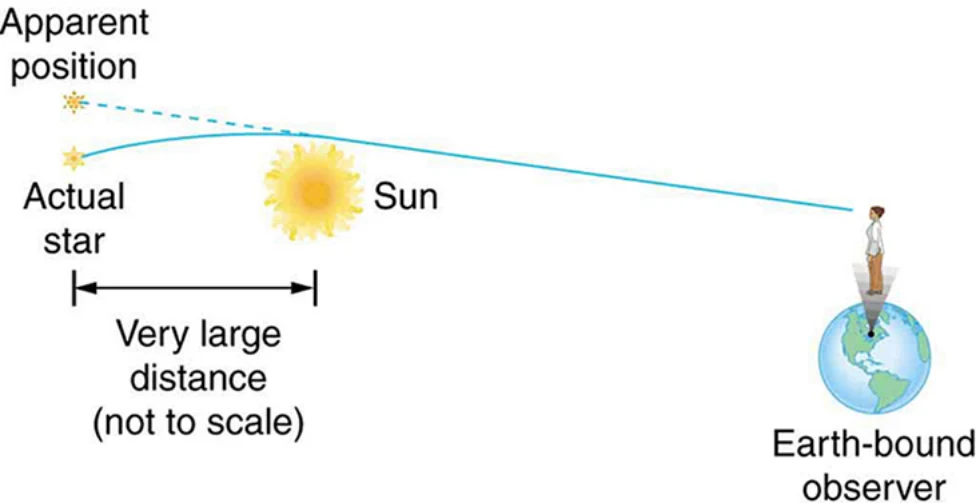
Einstein’s theory of general relativity got its first verification in 1919 when starlight passing near the sun was observed during a solar eclipse. (See Figure 7.11.) During an eclipse, the sky is darkened and we can briefly see stars. Those on a line of sight nearest the sun should have a shift in their apparent positions. Not only was this shift observed, but it agreed with Einstein’s predictions well within experimental uncertainties. This discovery created a scientific and public sensation. Einstein was now a folk hero as well as a very great scientist. The bending of light by matter is equivalent to a bending of space itself, with light following the curve. This is another radical change in our concept of space and time. It is also another connection that any particle with mass or energy (e.g., massless photons) is affected by gravity.
アインシュタインの一般相対性理論が最初に検証されたのは1919年、日食の間に太陽の近くを通る星の光が観測されたときである(図7.11を見よ)。日食の間は空が暗くなり、しばらく星を見ることができる。太陽に最も近い視線上にある星は、見かけの位置がずれるはずである。このずれが観測されただけでなく、その量は実験の不確かさの範囲でアインシュタインの予測とよく一致した。この発見は科学界にも世間にも大きな衝撃を与えた。アインシュタインは、きわめて偉大な科学者であるだけでなく、時の人にもなった。物質による光の曲がりは、空間そのものの曲がりと同じことであり、光はその曲がりに沿って進む。これもまた、空間と時間についての私たちの考えの根底からの変更である。そしてこれは、質量やエネルギーを持つあらゆる粒子(たとえば質量のない光子)が重力の影響を受けるという、もう一つのつながりでもある。
To summarize the two views of gravity, Newton envisioned gravity as a tug of war along the line connecting any two objects in the universe. In contrast, Einstein envisioned gravity as a bending of space-time by mass.
重力についての二つの見方をまとめると、ニュートンは重力を、宇宙の任意の二つの物体を結ぶ直線に沿った綱引きとして思い描いた。これに対しアインシュタインは、重力を質量による時空の曲がりとして思い描いた。
NASA gravity probe B NASA’s Gravity Probe B (GP-B) mission has confirmed two key predictions derived from Albert Einstein’s general theory of relativity. The probe, shown in Figure 7.12 was launched in 2004. It carried four ultra-precise gyroscopes designed to measure two effects hypothesized by Einstein’s theory:
NASAの重力探査機B NASAの重力探査機B(GP-B)計画は、アルベルト・アインシュタインの一般相対性理論から導かれる二つの重要な予測を確かめた。図7.12に示すこの探査機は2004年に打ち上げられた。アインシュタインの理論が予想する二つの効果を測るために設計された、四台の超精密ジャイロスコープを積んでいた。
• The geodetic effect, which is the warping of space and time by the gravitational field of a massive body (in this case, Earth)• The frame-dragging effect, which is the amount by which a spinning object pulls space and time with it as it rotates
・測地効果。重い天体(この場合は地球)の重力場による時空のゆがみ・慣性系の引きずり効果。回転する天体が、回りながら時空をどれだけ引きずるか
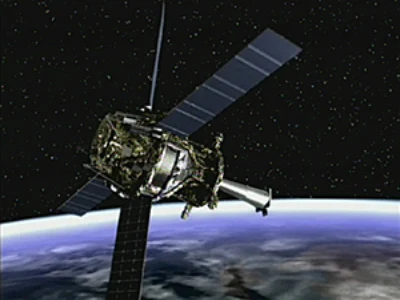
Both effects were measured with unprecedented precision. This was done by pointing the gyroscopes at a single star while orbiting Earth in a polar orbit. As predicted by relativity theory, the gyroscopes experienced very small, but measureable, changes in the direction of their spin caused by the pull of Earth’s gravity.
どちらの効果も、かつてない精度で測定された。それは、極軌道で地球を回りながら、ジャイロスコープを一つの星に向け続けることで行われた。相対性理論が予測したとおり、ジャイロスコープは地球の重力に引かれて、回転軸の向きにごく小さな、しかし測定できる変化を受けた。
The principle investigator suggested imagining Earth spinning in honey. As Earth rotates it drags space and time with it as it would a surrounding sea of honey.
主任研究者は、地球が蜂蜜の中で回っているところを想像するとよいと言った。地球は自転しながら、まわりの蜂蜜の海を引きずるように、時空を引きずっていくのである。
According to the general theory of relativity, a gravitational field bends light. What does this have to do with time and space?
一般相対性理論によれば、重力場は光を曲げる。これは時間と空間とどう関係するか。
a. Gravity has no effect on the space-time continuum, and gravity only affects the motion of light.b. The space-time continuum is distorted by gravity, and gravity has no effect on the motion of light.c. Gravity has no effect on either the space-time continuum or on the motion of light.d. The space-time continuum is distorted by gravity, and gravity affects the motion of light.
a. 重力は時空連続体に影響せず、光の運動だけに影響する。b. 時空連続体は重力にゆがめられ、重力は光の運動に影響しない。c. 重力は時空連続体にも光の運動にも影響しない。d. 時空連続体は重力にゆがめられ、重力は光の運動にも影響する。
Calculations Based on Newton’s Law of Universal Gravitationニュートンの万有引力の法則にもとづく計算
TIPS FOR SUCCESS When performing calculations using the equations in this chapter, use units of kilograms for mass, meters for distances, newtons for force, and seconds for time.
学習のポイント この章の式を使って計算するときは、質量にキログラム、距離にメートル、力にニュートン、時間に秒の単位を使うこと。
The mass of an object is constant, but its weight varies with the strength of the gravitational field. This means the value of g varies from place to place in the universe. The relationship between force, mass, and acceleration from the second law of motion can be written in terms of g.
物体の質量は一定だが、その重さは重力場の強さによって変わる。つまりgの値は宇宙の場所ごとに変わる。運動の第二法則における力・質量・加速度の関係は、gを使って書ける。
In this case, the force is the weight of the object, which is caused by the gravitational attraction of the planet or moon on which the object is located. We can use this expression to compare weights of an object on different moons and planets.
この場合、力は物体の重さであり、それは物体がある惑星や衛星の重力による引力によって生じる。この式を使えば、違う衛星や惑星における物体の重さを比べられる。
Mass and Weight Clarification This video shows the mathematical basis of the relationship between mass and weight. The distinction between mass and weight are clearly explained. The mathematical relationship between mass and weight are shown mathematically in terms of the equation for Newton’s law of universal gravitation and in terms of his second law of motion.
質量と重さの整理 この動画は、質量と重さの関係の数学的な根拠を示す。質量と重さの区別がはっきり説明されている。質量と重さの数学的な関係が、ニュートンの万有引力の法則の式と運動の第二法則の式によって示される。
Mass and weight clarification | Centripetal force and gravitation | Physics | Khan Academy (https://openstax.org/l/ 28massweight)
質量と重さの整理|向心力と重力|物理|カーンアカデミー(https://openstax.org/l/28massweight)
GRASP CHECK Would you have the same mass on the moon as you do on Earth? Would you have the same weight?
理解の確認 月面での質量は地球上と同じか。重さは同じか。
a. You would weigh more on the moon than on Earth because gravity on the moon is stronger than gravity on Earth.b. You would weigh less on the moon than on Earth because gravity on the moon is weaker than gravity on
a. 月の重力は地球より強いので、月では地球より重くなる。b. 月の重力は地球より弱いので、月では地球より
Earth.c. You would weigh less on the moon than on Earth because gravity on the moon is stronger than gravity on Earth.d. You would weigh more on the moon than on Earth because gravity on the moon is weaker than gravity on Earth.
軽くなる。c. 月の重力は地球より強いので、月では地球より軽くなる。d. 月の重力は地球より弱いので、月では地球より重くなる。
Two equations involving the gravitational constant, G, are often useful. The first is Newton’s equation, .
万有引力定数Gを含む二つの式が役に立つことが多い。一つ目はニュートンの式である。
Several of the values in this equation are either constants or easily obtainable. F is often the weight of an object on the surface of a large object with mass M, which is usually known. The mass of the smaller object, m, is often known, and G is a universal constant with the same value anywhere in the universe. This equation can be used to solve problems involving an object on or orbiting Earth or other massive celestial object. Sometimes it is helpful to equate the right-hand side of the equation to mg and cancel the m on both sides.
この式に出てくる値のいくつかは、定数であるか簡単に得られる。Fはたいてい、質量Mの大きな天体の表面にある物体の重さであり、Mはふつう分かっている。小さいほうの物体の質量mも分かっていることが多く、Gは宇宙のどこでも同じ値をとる普遍定数である。この式は、地球や他の重い天体の上にある、あるいはそれを回っている物体に関する問題を解くのに使える。式の右辺をmgと等しいと置き、両辺のmを約分すると便利なこともある。
The equation is also useful for problems involving objects in orbit. Note that there is no need to know the mass of the object. Often, we know the radius r or the period T and want to find the other. If these are both known, we can use the equation to calculate the mass of a planet or star.
式も、軌道上の物体に関する問題に役立つ。この式には物体の質量を知る必要がないことに注意しよう。半径rか周期Tのどちらかが分かっていて、もう一方を求めたいことが多い。両方が分かっていれば、この式を使って惑星や恒星の質量を計算できる。
Mass and Weight Clarification This video demonstrates calculations involving Newton’s universal law of gravitation.
質量と重さの整理 この動画は、ニュートンの万有引力の法則を使った計算を実演する。
Introduction to Newton's law of gravitation | Physics | Khan Academy (https://openstax.org/l/02newlawgrav)
ニュートンの万有引力の法則の入門|物理|カーンアカデミー(https://openstax.org/l/02newlawgrav)
What is the difference between g and G?
gとGの違いは何か。
a. g and G are both unchanging constants but have different units.b. G is a universal constant that relates force with a pair of masses at a distance, while g relates force with mass and varies with location.c. g describes acceleration while G describes gravitational force.d. g describes gravitational force while G describes acceleration.
a. gもGも変わらない定数だが、単位が違う。b. Gは、離れた二つの質量と力を結びつける普遍定数であり、gは質量と力を結びつけ、場所によって変わる。c. gは加速度を、Gは重力を表す。d. gは重力を、Gは加速度を表す。
Change in g The value of g on the planet Mars is 3.71 m/s2. If you have a mass of 60.0 kg on Earth, what would be your mass on Mars? What would be your weight on Mars? Strategy
gの違い 火星でのgの値は3.71 m/s2である。地球上での質量が60.0 kgなら、火星での質量はいくらか。火星での重さはいくらか。 方針
Weight equals acceleration due to gravity times mass: . An object’s mass is constant. Call acceleration due to gravity on Mars gM and weight on Mars WM.
重さは重力加速度に質量を掛けたもの、すなわちである。物体の質量は一定である。火星での重力加速度をgM、火星での重さをWMと書くことにする。
Solution解答
Mass on Mars would be the same, 60 kg.
火星での質量も同じ60 kgである。
Discussion考察
The value of g on any planet depends on the mass of the planet and the distance from its center. If the material below the surface varies from point to point, the value of g will also vary slightly.
どの惑星でも、gの値はその惑星の質量と中心からの距離によって決まる。地表の下の物質が場所によって違えば、gの値もわずかに変わる。
Earth’s g at the Moon Find the acceleration due to Earth’s gravity at the distance of the moon.
月の位置での地球のg 月までの距離における、地球の重力による加速度を求めよ。
Express the force of gravity in terms of g.
重力をgで表す。
Combine with the equation for universal gravitation.
万有引力の式と組み合わせる。
Solution解答
Cancel m and substitute.
mを約分して代入する。
Discussion考察
The value of g for the moon is 1.62 m/s2. Comparing this value to the answer, we see that Earth’s gravitational influence on an object on the moon’s surface would be insignificant.
月のgの値は1.62 m/s2である。この値を答えと比べると、月面上の物体に対する地球の重力の影響は無視できるほど小さいことが分かる。
Check Your Understanding理解の確認
8Some of Newton’s predecessors and contemporaries also studied gravity and proposed theories. What important advance did Newton make in the study of gravity that the other scientists had failed to do?
8ニュートンの先人や同時代人にも重力を研究し理論を提案した者がいた。他の科学者がなしえなかった、重力の研究におけるニュートンの重要な前進とは何か。
a. He gave an exact mathematical form for the theory.b. He added a correction term to a previously existing formula.
a. 理論に正確な数学的形式を与えた。b. すでにあった式に補正項を加えた。
c. Newton found the value of the universal gravitational constant.d. Newton showed that gravitational force is always attractive.
c. ニュートンは万有引力定数の値を求めた。d. ニュートンは重力がつねに引力であることを示した。
9State the law of universal gravitation in words only.a. Gravitational force between two objects is directly proportional to the sum of the squares of their masses and inversely proportional to the square of the distance between them.b. Gravitational force between two objects is directly proportional to the product of their masses and inversely proportional to the square of the distance between them.c. Gravitational force between two objects is directly proportional to the sum of the squares of their masses and inversely proportional to the distance between them.d. Gravitational force between two objects is directly proportional to the product of their masses and inversely proportional to the distance between them.
9万有引力の法則を言葉だけで述べよ。a. 二つの物体の間の重力は、両者の質量の2乗の和に比例し、両者の距離の2乗に反比例する。b. 二つの物体の間の重力は、両者の質量の積に比例し、両者の距離の2乗に反比例する。c. 二つの物体の間の重力は、両者の質量の2乗の和に比例し、両者の距離に反比例する。d. 二つの物体の間の重力は、両者の質量の積に比例し、両者の距離に反比例する。
10Newton’s law of universal gravitation explains the paths of what?a. A charged particleb. A ball rolling on a plane surface
10ニュートンの万有引力の法則は、何の道筋を説明するか。a. 帯電した粒子b. 平らな面を転がるボール
c. A planet moving around the sund. A stone tied to a string and whirled at constant speed in a horizontal circle
c. 太陽のまわりを動く惑星d. 糸に結んで水平な円を一定の速さで振り回す石