第7章ニュートンの万有引力の法則Newton's Law of Gravitation原書 p.235–258
7.1 Kepler's Laws of Planetary Motion7.1 ケプラーの惑星運動の法則
SECTION LEARNING OBJECTIVES By the end of this section, you will be able to do the following:• Explain Kepler’s three laws of planetary motion• Apply Kepler’s laws to calculate characteristics of orbits
この節の学習目標 この節を終えると、次のことができるようになる。・ケプラーの惑星運動の三法則を説明する・ケプラーの法則を使って軌道の性質を計算する
Section Key Termsこの節の重要語
aphelionCopernican modeleccentricityKepler’s laws of planetary motionperihelionPtolemaic model
遠日点コペルニクスのモデル離心率ケプラーの惑星運動の法則近日点プトレマイオスのモデル
Concepts Related to Kepler’s Laws of Planetary Motionケプラーの惑星運動の法則に関わる考え
Examples of orbits abound. Hundreds of artificial satellites orbit Earth together with thousands of pieces of debris. The moon’s orbit around Earth has intrigued humans from time immemorial. The orbits of planets, asteroids, meteors, and comets around the sun are no less interesting. If we look farther, we see almost unimaginable numbers of stars, galaxies, and other celestial objects orbiting one another and interacting through gravity.
軌道の例はいくらでもある。何百もの人工衛星が、何千もの破片とともに地球を回っている。地球のまわりを回る月の軌道は、太古から人類の心を引きつけてきた。太陽のまわりを回る惑星、小惑星、流星、彗星の軌道も同じくらい興味深い。もっと遠くを見れば、想像もつかない数の恒星、銀河、その他の天体が互いのまわりを回り、重力を通じて作用し合っている。
All these motions are governed by gravitational force. The orbital motions of objects in our own solar system are simple enough to describe with a few fairly simple laws. The orbits of planets and moons satisfy the following two conditions:
これらの運動はすべて重力に支配されている。私たちの太陽系にある天体の軌道運動は、いくつかのかなり単純な法則で記述できるほど単純である。惑星と衛星の軌道は、次の二つの条件を満たす。
• The mass of the orbiting object, m, is small compared to the mass of the object it orbits, M.• The system is isolated from other massive objects.
・回る物体の質量mが、回られる物体の質量Mに比べて小さいこと。・その系が他の重い天体から孤立していること。
Based on the motion of the planets about the sun, Kepler devised a set of three classical laws, called Kepler’s laws of planetary motion, that describe the orbits of all bodies satisfying these two conditions:
太陽のまわりの惑星の運動にもとづいて、ケプラーは三つの古典的な法則、すなわちケプラーの惑星運動の法則を作り上げた。これらはこの二つの条件を満たすあらゆる天体の軌道を記述する。
1. The orbit of each planet around the sun is an ellipse with the sun at one focus.2. Each planet moves so that an imaginary line drawn from the sun to the planet sweeps out equal areas in equal times.3. The ratio of the squares of the periods of any two planets about the sun is equal to the ratio of the cubes of their average distances from the sun.
1. 各惑星の太陽のまわりの軌道は、太陽を一つの焦点とする楕円である。2. 各惑星は、太陽から惑星へ引いた仮想の線が等しい時間に等しい面積を掃くように動く。3. 太陽のまわりを回る任意の二つの惑星について、周期の2乗の比は、太陽からの平均距離の3乗の比に等しい。
These descriptive laws are named for the German astronomer Johannes Kepler (1571–1630). He devised them after careful study (over some 20 years) of a large amount of meticulously recorded observations of planetary motion done by Tycho Brahe (1546–1601). Such careful collection and detailed recording of methods and data are hallmarks of good science. Data constitute the evidence from which new interpretations and meanings can be constructed. Let’s look closer at each of these laws.
これらの記述的な法則は、ドイツの天文学者ヨハネス・ケプラー(1571–1630)にちなんで名づけられた。彼はティコ・ブラーエ(1546–1601)が丹念に記録した大量の惑星運動の観測を(20年ほどかけて)注意深く研究したすえに、これらを作り上げた。このような入念な収集と、方法とデータの詳細な記録は、よい科学の証である。データこそ、新しい解釈と意味を組み立てるもとになる証拠である。それぞれの法則をもう少し詳しく見よう。
Kepler’s First Law The orbit of each planet about the sun is an ellipse with the sun at one focus, as shown in Figure 7.2. The planet’s closest approach to the sun is called perihelion and its farthest distance from the sun is called aphelion.
ケプラーの第一法則 図7.2に示すとおり、各惑星の太陽のまわりの軌道は、太陽を一つの焦点とする楕円である。惑星が太陽に最も近づく点を近日点、太陽から最も遠ざかる点を遠日点という。
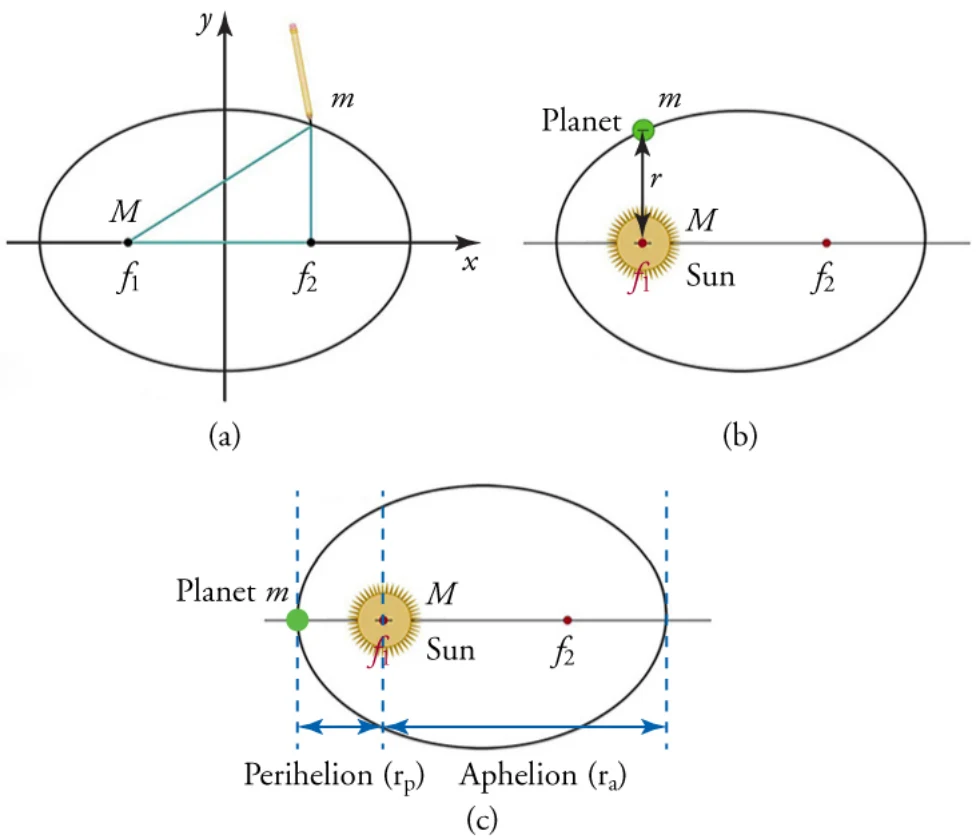
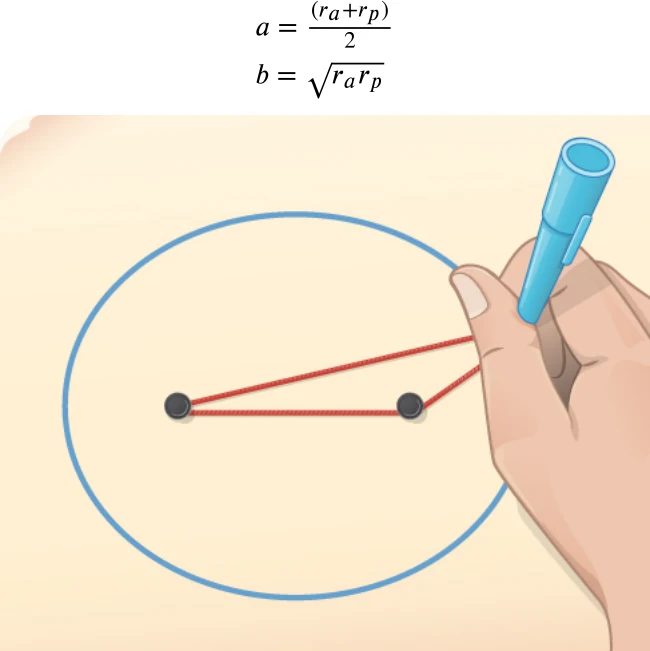
If you know the aphelion (ra) and perihelion (rp) distances, then you can calculate the semi-major axis (a) and semi-minor axis (b).
遠日点距離(ra)と近日点距離(rp)が分かっていれば、半長軸(a)と半短軸(b)を計算できる。
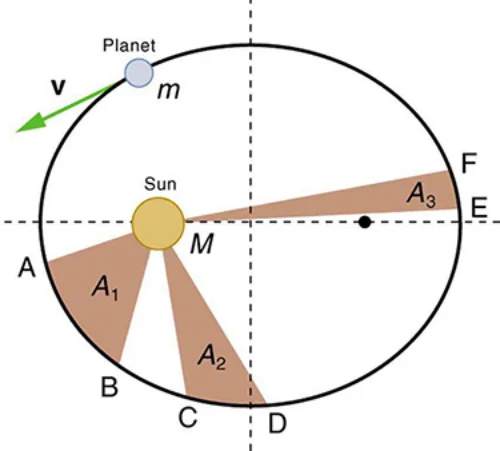
Kepler’s Second Law Each planet moves so that an imaginary line drawn from the sun to the planet sweeps out equal areas in equal times, as shown in Figure 7.4.
ケプラーの第二法則 図7.4に示すとおり、各惑星は、太陽から惑星へ引いた仮想の線が等しい時間に等しい面積を掃くように動く。
TIPS FOR SUCCESS Note that while, for historical reasons, Kepler’s laws are stated for planets orbiting the sun, they are actually valid for all bodies satisfying the two previously stated conditions.
学習のポイント ケプラーの法則は歴史的な事情から太陽を回る惑星について述べられているが、実際には先に述べた二つの条件を満たすあらゆる天体について成り立つことに注意しよう。
Kepler’s Third Law The ratio of the periods squared of any two planets around the sun is equal to the ratio of their average distances from the sun cubed. In equation form, this is
ケプラーの第三法則 太陽のまわりを回る任意の二つの惑星について、周期の2乗の比は、太陽からの平均距離の3乗の比に等しい。式で書けば次のとおりである。
where T is the period (time for one orbit) and r is the average distance (also called orbital radius). This equation is valid only for comparing two small masses orbiting a single large mass. Most importantly, this is only a descriptive equation; it gives no information about the cause of the equality.
ここでTは周期(1回転にかかる時間)、rは平均距離(軌道半径ともいう)である。この式は、一つの大きな質量のまわりを回る二つの小さな質量を比べる場合にだけ成り立つ。何より大切なのは、これが記述的な式にすぎないことである。この等式がなぜ成り立つのかについては何も語っていない。
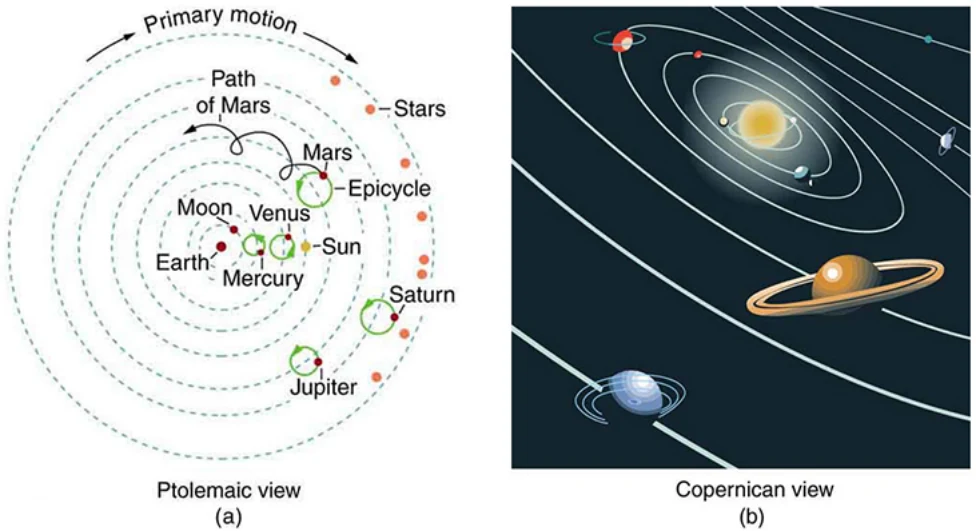
History: Ptolemy vs. Copernicus Before the discoveries of Kepler, Copernicus, Galileo, Newton, and others, the solar system was thought to revolve around Earth as shown in Figure 7.5 (a). This is called the Ptolemaic model, named for the Greek philosopher Ptolemy who lived in the second century AD. The Ptolemaic model is characterized by a list of facts for the motions of planets, with no explanation of cause and effect. There tended to be a different rule for each heavenly body and a general lack of simplicity.
歴史:プトレマイオス対コペルニクス ケプラー、コペルニクス、ガリレオ、ニュートンらの発見以前、太陽系は図7.5(a)のように地球のまわりを回っていると考えられていた。これをプトレマイオスのモデルといい、2世紀に生きたギリシャの哲学者プトレマイオスにちなむ。プトレマイオスのモデルは、惑星の運動についての事実の一覧という性格を持ち、原因と結果の説明がなかった。天体ごとに違う規則があり、全体として単純さを欠く傾向があった。
Figure 7.5 (b) represents the modern or Copernican model. In this model, a small set of rules and a single underlying force explain not only all planetary motion in the solar system, but also all other situations involving gravity. The breadth and simplicity of the laws of physics are compelling.
図7.5(b)は近代の、すなわちコペルニクスのモデルを表す。このモデルでは、少数の規則と一つの根本的な力によって、太陽系のあらゆる惑星の運動だけでなく、重力の関わる他のすべての場面も説明される。物理法則の広さと単純さは、人を惹きつけずにおかない。
Nicolaus Copernicus (1473–1543) first had the idea that the planets circle the sun, in about 1514. It took him almost 20 years to work out the mathematical details for his model. He waited another 10 years or so to publish his work. It is thought he hesitated because he was afraid people would make fun of his theory. Actually, the reaction of many people was more one of fear and anger. Many people felt the Copernican model threatened their basic belief system. About 100 years later, the astronomer Galileo was put under house arrest for providing evidence that planets, including Earth, orbited the sun. In all, it took almost 300 years for everyone to admit that Copernicus had been right all along.
ニコラウス・コペルニクス(1473–1543)が、惑星が太陽のまわりを回るという考えに最初に至ったのは1514年ごろである。彼はこのモデルの数学的な細部を仕上げるのに20年近くを費やした。そして仕事を公にするまでにさらに10年ほど待った。人々に理論を笑われるのを恐れてためらったのだと考えられている。実際には、多くの人の反応は嘲笑よりもむしろ恐れと怒りだった。多くの人は、コペルニクスのモデルが自分たちの基本的な信念の体系を脅かすと感じたのである。約100年後、天文学者ガリレオは、地球を含む惑星が太陽のまわりを回っている証拠を示したために自宅軟禁に置かれた。結局、コペルニクスがずっと正しかったと誰もが認めるまでには、およそ300年かかった。
GRASP CHECK Explain why Earth does actually appear to be the center of the solar system.
理解の確認 なぜ地球が実際に太陽系の中心であるかのように見えるのかを説明せよ。
a. Earth appears to be the center of the solar system because Earth is at the center of the universe, and everything revolves around it in a circular orbit.b. Earth appears to be the center of the solar system because, in the reference frame of Earth, the sun, moon, and planets all appear to move across the sky as if they were circling Earth.c. Earth appears to be at the center of the solar system because Earth is at the center of the solar system and all the heavenly bodies revolve around it.d. Earth appears to be at the center of the solar system because Earth is located at one of the foci of the elliptical orbit of the sun, moon, and other planets.
a. 地球が宇宙の中心にあり、あらゆるものが円軌道でそのまわりを回っているので、地球が太陽系の中心に見える。b. 地球の基準系では、太陽・月・惑星がどれも、地球のまわりを回っているかのように空を横切って動いて見えるので、地球が太陽系の中心に見える。c. 地球が太陽系の中心にあり、すべての天体がそのまわりを回っているので、地球が中心に見える。d. 地球が、太陽・月・その他の惑星の楕円軌道の一つの焦点に位置しているので、地球が中心に見える。
VIRTUAL PHYSICSシミュレーションAcceleration加速度
This simulation allows you to create your own solar system so that you can see how changing distances and masses determines the orbits of planets. Click Help for instructions.
このシミュレーションでは自分の太陽系を作れるので、距離と質量を変えると惑星の軌道がどう決まるかを見られる。使い方はHelpをクリックすれば分かる。
Access multimedia content (http://openstax.org/books/physics/pages/7-1-keplers-laws-of-planetary-motion) When the central object is off center, how does the speed of the orbiting object vary?
マルチメディア教材はこちら(http://openstax.org/books/physics/pages/7-1-keplers-laws-of-planetary-motion) 中心の天体が中心からずれているとき、回る天体の速さはどう変わるか。
a. The orbiting object moves fastest when it is closest to the central object and slowest when it is farthest away.b. The orbiting object moves slowest when it is closest to the central object and fastest when it is farthest away.c. The orbiting object moves with the same speed at every point on the circumference of the elliptical orbit.d. There is no relationship between the speed of the object and the location of the planet on the
a. 回る天体は、中心の天体に最も近いところで最も速く、最も遠いところで最も遅く動く。b. 回る天体は、中心の天体に最も近いところで最も遅く、最も遠いところで最も速く動く。c. 回る天体は、楕円軌道の周のどの点でも同じ速さで動く。d. 天体の速さと、軌道の周における
circumference of the orbit.
惑星の位置との間に関係はない。
Calculations Related to Kepler’s Laws of Planetary Motionケプラーの惑星運動の法則に関わる計算
Kepler’s First Law Refer back to Figure 7.2 (a). Notice which distances are constant. The foci are fixed, so distance is a constant. The definition of an ellipse states that the sum of the distances is also constant. These two facts taken together mean that the perimeter of triangle must also be constant. Knowledge of these constants will help you determine positions and distances of objects in a system that includes one object orbiting another.
ケプラーの第一法則 図7.2(a)に戻ろう。どの距離が一定かに注目してほしい。焦点は固定されているので、距離は一定である。楕円の定義から、距離の和も一定である。この二つを合わせると、三角形の周長も一定でなければならないことになる。これらの一定量を知っていれば、ある天体が別の天体を回る系における位置と距離を決めるのに役立つ。
Kepler’s Second Law Refer back to Figure 7.4. The second law says that the segments have equal area and that it takes equal time to sweep through each segment. That is, the time it takes to travel from A to B equals the time it takes to travel from C to D, and so forth. Velocity v equals distance d divided by time t: . Then, , so distance divided by velocity is also a constant. For example, if we know the average velocity of Earth on June 21 and December 21, we can compare the distance Earth travels on those days.
ケプラーの第二法則 図7.4に戻ろう。第二法則は、各扇形の面積が等しく、それぞれを掃くのにかかる時間も等しいと述べている。すなわち、AからBまで進むのにかかる時間は、CからDまで進むのにかかる時間に等しい、というぐあいである。速度vは距離dを時間tで割ったもの、すなわちである。したがってとなり、距離を速度で割ったものも一定である。たとえば6月21日と12月21日の地球の平均速度が分かっていれば、その両日に地球が進む距離を比べられる。
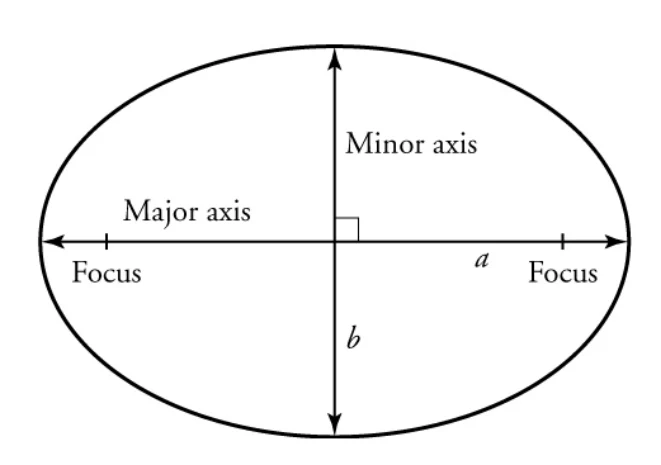
The degree of elongation of an elliptical orbit is called its eccentricity (e). Eccentricity is calculated by dividing the distance f from the center of an ellipse to one of the foci by half the long axis a.
楕円軌道がどれだけ細長いかの度合いを離心率(e)という。離心率は、楕円の中心から一方の焦点までの距離fを、長軸の半分aで割って求める。
When , the ellipse is a circle.
のとき、この楕円は円になる。
The area of an ellipse is given by , where b is half the short axis. If you know the axes of Earth’s orbit and the area Earth sweeps out in a given period of time, you can calculate the fraction of the year that has elapsed.
楕円の面積はで与えられる。ここでbは短軸の半分である。地球の軌道の軸と、ある期間に地球が掃く面積が分かっていれば、1年のうちどれだけの割合が経過したかを計算できる。
Kepler’s First Law At its closest approach, a moon comes within 200,000 km of the planet it orbits. At that point, the moon is 300,000 km from the other focus of its orbit, f2. The planet is focus f1 of the moon’s elliptical orbit. How far is the moon from the planet when it is 260,000 km from f2?Strategy
ケプラーの第一法則 ある衛星は、最も近づいたとき、回っている惑星から200,000 kmのところまで来る。その時点で、この衛星は軌道のもう一方の焦点f2から300,000 kmのところにある。惑星は衛星の楕円軌道の焦点f1である。この衛星がf2から260,000 kmのところにあるとき、惑星からはどれだけ離れているか。方針
Show and label the ellipse that is the orbit in your solution. Picture the triangle f1mf2 collapsed along the major axis and add up the lengths of the three sides. Find the length of the unknown side of the triangle when the moon is 260,000 km from f2.
解答では、軌道である楕円を描いて記号を書き入れること。三角形f1mf2を長軸に沿ってつぶしたところを思い描き、三辺の長さを足す。衛星がf2から260,000 kmのところにあるときの、三角形の未知の辺の長さを求める。
Solution解答
Discussion考察
The perimeter of triangle f1mf2 must be constant because the distance between the foci does not change and Kepler’s first law says the orbit is an ellipse. For any ellipse, the sum of the two sides of the triangle, which are f1m and mf2, is constant.
焦点どうしの距離は変わらず、ケプラーの第一法則が軌道は楕円だと言うので、三角形f1mf2の周長は一定でなければならない。どんな楕円でも、三角形の二辺f1mとmf2の和は一定である。
Kepler’s Second Law Figure 7.6 shows the major and minor axes of an ellipse. The semi-major and semi-minor axes are half of these, respectively.
ケプラーの第二法則 図7.6に楕円の長軸と短軸を示す。半長軸と半短軸は、それぞれその半分である。
Earth’s orbit is very slightly elliptical, with a semi-major axis of 1.49598 × 10⁸ km and a semi-minor axis of 1.49577 × 10⁸ km. If Earth’s period is 365.26 days, what area does an Earth-to-sun line sweep past in one day? Strategy
地球の軌道はごくわずかに楕円で、半長軸は1.49598 × 10⁸ km、半短軸は1.49577 × 10⁸ kmである。地球の周期が365.26日だとすると、地球と太陽を結ぶ線は1日にどれだけの面積を掃くか。 方針
Each day, Earth sweeps past an equal-sized area, so we divide the total area by the number of days in a year to find the area swept past in one day. For total area use . Calculate A, the area inside Earth’s orbit and divide by the number of days in a year (i.e., its period).
地球は毎日等しい面積を掃くので、全面積を1年の日数で割れば1日に掃く面積が得られる。全面積にはを使う。地球の軌道の内側の面積Aを計算し、1年の日数(すなわち周期)で割る。
Solution解答
The area swept out in one day is thus .
したがって1日に掃く面積はである。
Discussion考察
The answer is based on Kepler’s law, which states that a line from a planet to the sun sweeps out equal areas in equal times.
この答えは、惑星から太陽へ引いた線が等しい時間に等しい面積を掃くというケプラーの法則にもとづいている。
Kepler’s Third Law Kepler’s third law states that the ratio of the squares of the periods of any two planets (T1, T2) is equal to the ratio of the cubes of their average orbital distance from the sun (r1, r2). Mathematically, this is represented by
ケプラーの第三法則 ケプラーの第三法則は、任意の二つの惑星の周期(T1、T2)の2乗の比が、太陽からの平均軌道距離(r1、r2)の3乗の比に等しい、と述べる。数式では次のように表される。
From this equation, it follows that the ratio r3/T2 is the same for all planets in the solar system. Later we will see how the work of Newton leads to a value for this constant.
この式から、比 r3/T2 が太陽系のすべての惑星で同じであることが導かれる。のちにニュートンの仕事によってこの定数の値が得られるのを見る。
Kepler’s Third Law Given that the moon orbits Earth each 27.3 days and that it is an average distance of from the center of Earth, calculate the period of an artificial satellite orbiting at an average altitude of 1,500 km above Earth’s surface.
ケプラーの第三法則 月が27.3日で地球を1周し、地球の中心から平均の距離にあるとして、地表から平均高度1,500 kmを回る人工衛星の周期を計算せよ。
Strategy方針
The period, or time for one orbit, is related to the radius of the orbit by Kepler’s third law, given in mathematical form by . Let us use the subscript 1 for the moon and the subscript 2 for the satellite. We are asked to find
周期、すなわち1周にかかる時間は、ケプラーの第三法則によって軌道の半径と結びついている。数式ではである。月に添字1、人工衛星に添字2を使うことにする。求めよと言われているのは
T2. The given information tells us that the orbital radius of the moon is , and that the period of the moon is . The height of the artificial satellite above Earth’s surface is given, so to get the distance r2 from the center of Earth we must add the height to the radius of Earth (6380 km). This gives
T2である。与えられた情報から、月の軌道半径は、月の周期はである。人工衛星の地表からの高度が与えられているので、地球の中心からの距離r2を得るには、その高度に地球の半径(6380 km)を足さねばならない。すると次が得られる。
. Now all quantities are known, so T2 can be found.
これで全部の量が分かったので、T2を求められる。
Solution解答
To solve for T2, we cross-multiply and take the square root, yielding
T2について解くために、たすきに掛けて平方根をとると、次が得られる。
Discussion考察
This is a reasonable period for a satellite in a fairly low orbit. It is interesting that any satellite at this altitude will complete one orbit in the same amount of time.
これはかなり低い軌道の人工衛星の周期として妥当である。この高度にあるどんな人工衛星も、同じ時間で1周することになるのは興味深い。
Practice Problems練習問題
1A planet with no axial tilt is located in another solar system. It circles its sun in a very elliptical orbit so that the temperature varies greatly throughout the year. If the year there has 612 days and the inhabitants celebrate the coldest day on day 1 of their calendar, when is the warmest day?
1別の恒星系に、自転軸の傾きがない惑星がある。この惑星は非常に細長い楕円軌道でその恒星を回っているので、1年のうちで気温が大きく変わる。そこでの1年が612日で、住民が最も寒い日を暦の1日目としているとすると、最も暑い日はいつか。
a. Day 1b. Day 153c. Day 306d. Day 459
a. 1日目b. 153日目c. 306日目d. 459日目
2A geosynchronous Earth satellite is one that has an orbital period of precisely 1 day. Such orbits are useful for communication and weather observation because the satellite remains above the same point on Earth (provided it orbits in the equatorial plane in the same direction as Earth’s rotation). The ratio for the moon is . Calculate the radius of the orbit of such a satellite.
2静止地球衛星とは、軌道周期がちょうど1日の衛星である。このような軌道は、(赤道面内を地球の自転と同じ向きに回るなら)衛星が地球上の同じ点の上にとどまるので、通信や気象観測に役立つ。月についての比はである。このような衛星の軌道半径を計算せよ。
Check Your Understanding理解の確認
3Are Kepler’s laws purely descriptive, or do they contain causal information?a. Kepler’s laws are purely descriptive.b. Kepler’s laws are purely causal.
3ケプラーの法則は純粋に記述的か、それとも因果の情報を含むか。a. ケプラーの法則は純粋に記述的である。b. ケプラーの法則は純粋に因果的である。
c. Kepler’s laws are descriptive as well as causal.d. Kepler’s laws are neither descriptive nor causal.
c. ケプラーの法則は記述的でも因果的でもある。d. ケプラーの法則は記述的でも因果的でもない。
4True or false—According to Kepler’s laws of planetary motion, a satellite increases its speed as it approaches its parent body and decreases its speed as it moves away from the parent body.
4正誤問題——ケプラーの惑星運動の法則によれば、衛星は主星に近づくにつれて速さを増し、遠ざかるにつれて速さを減らす。
a. True
a. 正
b. False
b. 誤
5Identify the locations of the foci of an elliptical orbit.a. One focus is the parent body, and the other is located at the opposite end of the ellipse, at the same distance from the center as the parent body.b. One focus is the parent body, and the other is located at the opposite end of the ellipse, at half the distance from the center as the parent body.c. One focus is the parent body and the other is located outside of the elliptical orbit, on the line on which is the semi-major axis of the ellipse.d. One focus is on the line containing the semi-major axis of the ellipse, and the other is located anywhere on the elliptical orbit of the satellite.
5楕円軌道の焦点の位置を答えよ。a. 一方の焦点は主星であり、他方は楕円の反対側の端に、中心から主星と同じ距離のところにある。b. 一方の焦点は主星であり、他方は楕円の反対側の端に、中心から主星の半分の距離のところにある。c. 一方の焦点は主星であり、他方は楕円軌道の外、楕円の半長軸を含む直線上にある。d. 一方の焦点は楕円の半長軸を含む直線上にあり、他方は衛星の楕円軌道上のどこにあってもよい。