第6章円運動と回転運動Circular and Rotational Motion原書 p.205–234
6.1 Angle of Rotation and Angular Velocity6.1 回転角と角速度
SECTION LEARNING OBJECTIVES By the end of this section, you will be able to do the following:
この節の学習目標 この節を終えると、次のことができるようになる。
• Describe the angle of rotation and relate it to its linear counterpart• Describe angular velocity and relate it to its linear counterpart• Solve problems involving angle of rotation and angular velocity
・回転角を述べ、直線運動での対応物と結びつける・角速度を述べ、直線運動での対応物と結びつける・回転角と角速度に関する問題を解く
Section Key Termsこの節の重要語
angle of rotationangular velocityarc lengthcircular motionradius of curvaturerotational motionspintangential velocity
回転角角速度弧の長さ円運動曲率半径回転運動自転接線速度
Angle of Rotation回転角
What exactly do we mean by circular motion or rotation? Rotational motion is the circular motion of an object about an axis of rotation. We will discuss specifically circular motion and spin. Circular motion is when an object moves in a circular path. Examples of circular motion include a race car speeding around a circular curve, a toy attached to a string swinging in a circle around your head, or the circular loop-the-loop on a roller coaster. Spin is rotation about an axis that goes through the center of mass of the object, such as Earth rotating on its axis, a wheel turning on its axle, the spin of a tornado on its path of destruction, or a figure skater spinning during a performance at the Olympics. Sometimes, objects will be spinning while in circular motion, like the Earth spinning on its axis while revolving around the Sun, but we will focus on these two motions separately.
円運動と回転とは、どのような運動だろうか。回転運動は、物体がある軸のまわりを回る運動である。ここでは、円運動と自転を区別して考える。円運動では、物体が円形の軌道をたどる。円形のカーブを走るレーシングカー、ひもをつけて頭上で振り回すおもちゃ、ジェットコースターの宙返りなどが例になる。自転は、物体自身の重心を通る軸のまわりの回転である。地球の自転、車軸のまわりを回る車輪、竜巻の渦、フィギュアスケーターのスピンなどがこれにあたる。地球が自転しながら太陽のまわりを公転するように、両方の運動が同時に起こる場合もあるが、ここでは別々に扱う。
When solving problems involving rotational motion, we use variables that are similar to linear variables (distance, velocity, acceleration, and force) but take into account the curvature or rotation of the motion. Here, we define the angle of rotation, which is the angular equivalence of distance; and angular velocity, which is the angular equivalence of linear velocity.
回転運動の問題を解くときには、直線運動の変数(距離、速度、加速度、力)に似た変数を使うが、それらは運動の曲がりや回転を考えに入れたものである。ここでは、距離に対応する回転角と、直線運動の速度に対応する角速度を定義する。
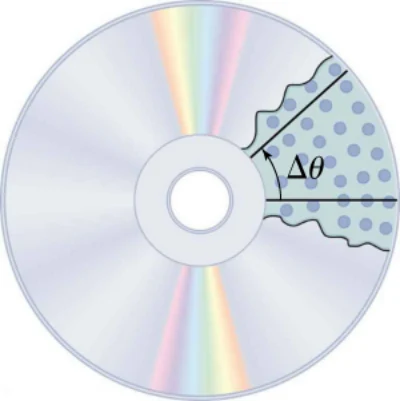
When objects rotate about some axis—for example, when the CD in Figure 6.2 rotates about its center—each point in the object follows a circular path.
物体がある軸のまわりを回るとき——たとえば図6.2のCDが中心のまわりを回るとき——物体の各点は円の道筋をたどる。
The arc length, Δs, is the distance traveled along a circular path. The radius of curvature, r, is the radius of the circular path. Both are shown in Figure 6.3.
弧の長さΔsは、円の道筋に沿って進んだ距離である。曲率半径rは、円の道筋の半径である。どちらも図6.3に示す。
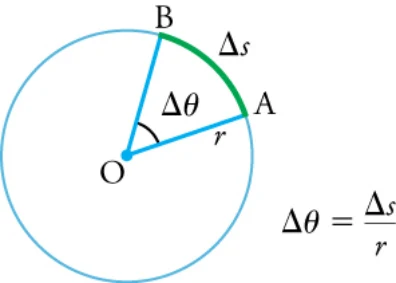
Consider a line from the center of the CD to its edge. In a given time, each pit (used to record information) on this line moves through the same angle. The angle of rotation is the amount of rotation and is the angular analog of distance. The angle of rotation is the arc length divided by the radius of curvature.
CDの中心から縁へ引いた線を考えよう。ある時間の間に、この線の上の(情報を記録するのに使われる)各ピットは同じ角だけ動く。回転角は回転の量であり、距離に対応する角の量である。回転角は、弧の長さを曲率半径で割ったものである。
The angle of rotation is often measured by using a unit called the radian. (Radians are actually dimensionless, because a radian is defined as the ratio of two distances, radius and arc length.) A revolution is one complete rotation, where every point on the circle returns to its original position. One revolution covers radians (or 360 degrees), and therefore has an angle of rotation of radians, and an arc length that is the same as the circumference of the circle. We can convert between radians, revolutions, and degrees using the relationship
回転角はしばしば、ラジアンという単位で測られる。(ラジアンは実は無次元である。半径と弧の長さという二つの距離の比として定義されるからである。)1回転とは、円上のすべての点がもとの位置に戻る、ひとまわりの回転である。1回転はラジアン(すなわち360度)にあたり、したがって回転角はラジアン、弧の長さは円周に等しい。ラジアン・回転・度の間は、次の関係で換算できる。
1 revolution = rad = 360°. See Table 6.1 for the conversion of degrees to radians for some common angles.
1回転 = rad = 360°。よく使う角について、度からラジアンへの換算を表6.1に示す。
Angular Velocity角速度
How fast is an object rotating? We can answer this question by using the concept of angular velocity. Consider first the angular speed is the rate at which the angle of rotation changes. In equation form, the angular speed is
物体はどれくらい速く回っているのか。この問いには角速度という概念で答えられる。まず角速さを考える。これは回転角の変化する割合である。式で書けば、角速さは次のとおりである。
which means that an angular rotation occurs in a time, . If an object rotates through a greater angle of rotation in a given time, it has a greater angular speed. The units for angular speed are radians per second (rad/s).
これは、時間の間に角だけ回転が起こるということである。ある時間の間により大きな回転角だけ回る物体は、角速さが大きい。角速さの単位は毎秒ラジアン(rad/s)である。
Now let’s consider the direction of the angular speed, which means we now must call it the angular velocity. The direction of the angular velocity is along the axis of rotation. For an object rotating clockwise, the angular velocity points away from you along the axis of rotation. For an object rotating counterclockwise, the angular velocity points toward you along the axis of rotation.
次に角速さの向きを考えよう。向きまで考えるなら、これは角速度と呼ばねばならない。角速度の向きは回転軸に沿っている。時計回りに回る物体では、角速度は回転軸に沿ってあなたから遠ざかる向きを指す。反時計回りに回る物体では、角速度は回転軸に沿ってあなたのほうを指す。
Angular velocity (ω) is the angular version of linear velocity v. Tangential velocity is the instantaneous linear velocity of an object in rotational motion. To get the precise relationship between angular velocity and tangential velocity, consider again a pit on the rotating CD. This pit moves through an arc length in a short time so its tangential speed is
角速度(ω)は、直線運動の速度vに対応する角の量である。接線速度とは、回転運動する物体の瞬間の直線速度である。角速度と接線速度の厳密な関係を得るために、もう一度回っているCDの上のピットを考えよう。このピットは短い時間の間に弧の長さだけ動くので、その接線速さは次のようになる。
From the definition of the angle of rotation, , we see that . Substituting this into the expression for v gives
回転角の定義から、であることが分かる。これをvの式に代入すると、次が得られる。
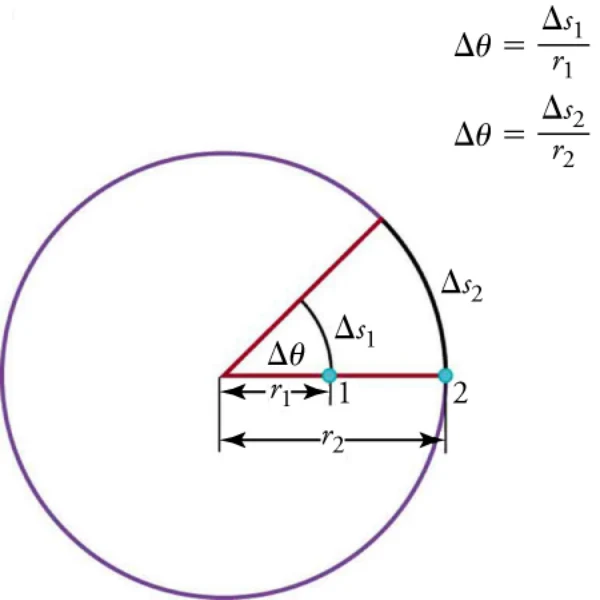
The equation says that the tangential speed v is proportional to the distance r from the center of rotation.
式は、接線速さvが回転の中心からの距離rに比例することを述べている。
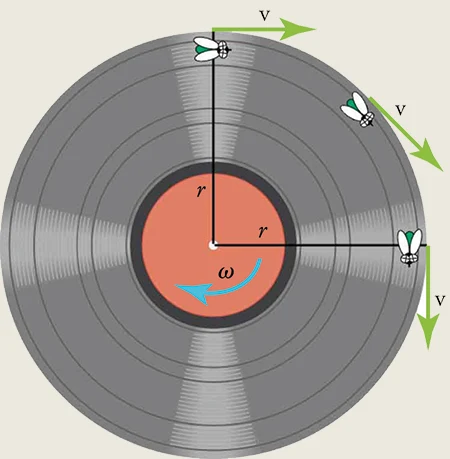
Consequently, tangential speed is greater for a point on the outer edge of the CD (with larger r) than for a point closer to the center of the CD (with smaller r). This makes sense because a point farther out from the center has to cover a longer arc length in the same amount of time as a point closer to the center. Note that both points will still have the same angular speed, regardless of their distance from the center of rotation. See Figure 6.4.
したがって接線速さは、CDの中心に近い点(rが小さい)より、外縁の点(rが大きい)のほうが大きい。中心から遠い点は、中心に近い点と同じ時間の間により長い弧を進まねばならないのだから、これは筋が通っている。ただし、どちらの点も回転の中心からの距離によらず同じ角速さを持つことに注意しよう。図6.4を見よ。
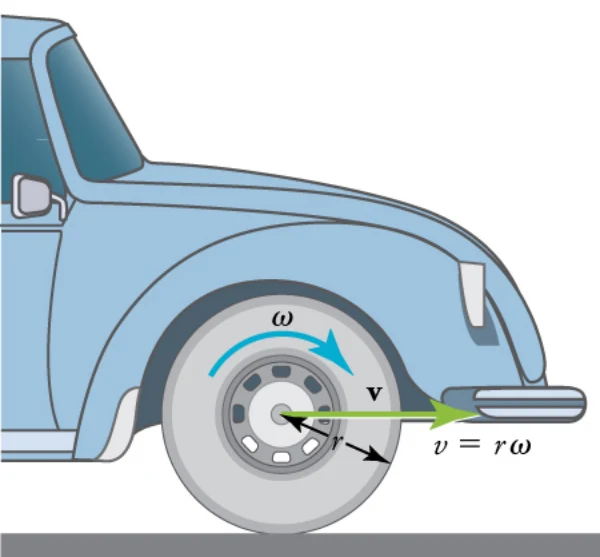
Now, consider another example: the tire of a moving car (see Figure 6.5). The faster the tire spins, the faster the car moves—large means large v because . Similarly, a larger-radius tire rotating at the same angular velocity, , will produce a greater linear (tangential) velocity, v, for the car. This is because a larger radius means a longer arc length must contact the road, so the car must move farther in the same amount of time.
今度は別の例、走っている車のタイヤを考えよう(図6.5を見よ)。タイヤが速く回るほど車は速く進む。なので、が大きければvも大きい。同じように、同じ角速度で回る半径の大きいタイヤは、車により大きな直線(接線)速度vを与える。半径が大きいということは、路面に触れる弧の長さが長いということであり、したがって車は同じ時間の間により遠くまで進まねばならないからである。
However, there are cases where linear velocity and tangential velocity are not equivalent, such as a car spinning its tires on ice. In this case, the linear velocity will be less than the tangential velocity. Due to the lack of friction under the tires of a car on ice, the arc length through which the tire treads move is greater than the linear distance through which the car moves. It’s similar to running on a treadmill or pedaling a stationary bike; you are literally going nowhere fast.
ただし、氷の上でタイヤを空転させる車のように、直線速度と接線速度が一致しない場合もある。この場合、直線速度は接線速度より小さくなる。氷の上の車のタイヤの下には摩擦がないので、タイヤの接地面が動く弧の長さは、車が進む直線距離より大きい。ランニングマシンで走ったり、固定した自転車をこいだりするのと似ている。文字どおり、速くどこへも行っていないのである。
TIPS FOR SUCCESS Angular velocity ω and tangential velocity v are vectors, so we must include magnitude and direction. The direction of the angular velocity is along the axis of rotation, and points away from you for an object rotating clockwise, and toward you for an object rotating counterclockwise. In mathematics this is described by the right-hand rule. Tangential velocity is usually described as up, down, left, right, north, south, east, or west, as shown in Figure 6.6.
学習のポイント 角速度ωと接線速度vはベクトルなので、大きさと向きの両方を示さねばならない。角速度の向きは回転軸に沿っており、時計回りに回る物体ではあなたから遠ざかる向き、反時計回りに回る物体ではあなたのほうを指す。数学ではこれを右手の法則で表す。接線速度は、図6.6のように、上・下・左・右・北・南・東・西といった言い方で述べるのがふつうである。
Relationship between Angular Velocity and Speed This video reviews the definition and units of angular velocity and relates it to linear speed. It also shows how to convert between revolutions and radians.
角速度と速さの関係 この動画は、角速度の定義と単位を復習し、直線の速さと結びつける。回転とラジアンの間の換算も示す。
Access multimedia content (http://openstax.org/books/physics/pages/6-1-angle-of-rotation-and-angular-velocity) For an object traveling in a circular path at a constant angular speed, would the linear speed of the object change if the radius of the path increases?
マルチメディア教材はこちら(http://openstax.org/books/physics/pages/6-1-angle-of-rotation-and-angular-velocity) 一定の角速さで円の道筋を進む物体について、道筋の半径が大きくなったら物体の直線の速さは変わるか。
a. Yes, because tangential speed is independent of the radius.b. Yes, because tangential speed depends on the radius.
a. 変わる。接線速さは半径によらないから。b. 変わる。接線速さは半径によるから。
c. No, because tangential speed is independent of the radius.d. No, because tangential speed depends on the radius.
c. 変わらない。接線速さは半径によらないから。d. 変わらない。接線速さは半径によるから。
Solving Problems Involving Angle of Rotation and Angular Velocity回転角と角速度に関する問題を解く
SNAP LAB身近な実験Measuring Angular Speed角速さを測る
In this activity, you will create and measure uniform circular motion and then contrast it with circular motions with different radii.
この活動では、等速円運動を作り出して測り、それを半径の違う円運動と比べる。
• One string (1 m long)• One object (two-hole rubber stopper) to tie to the end• One timer
・糸1本(長さ1 m)・端に結ぶ物1個(二つ穴のゴム栓)・タイマー1個
Procedure手順
1. Tie an object to the end of a string.2. Swing the object around in a horizontal circle above your head (swing from your wrist). It is important that
1. 糸の端に物を結ぶ。2. その物を頭の上で水平な円を描くように振り回す(手首から振る)。円が
the circle be horizontal!3. Maintain the object at uniform speed as it swings.4. Measure the angular speed of the object in this manner. Measure the time it takes in seconds for the object to travel 10 revolutions. Divide 10 revolutions by that time to get the angular speed in revolutions per second, which you can convert to radians per second.5. What is the approximate linear speed of the object?6. Move your hand up the string so that the length of the string is 90 cm. Repeat steps 2–5.7. Move your hand up the string so that its length is 80 cm. Repeat steps 2–5.8. Move your hand up the string so that its length is 70 cm. Repeat steps 2–5.9. Move your hand up the string so that its length is 60 cm. Repeat steps 2–510. Move your hand up the string so that its length is 50 cm. Repeat steps 2–511. Make graphs of angular speed vs. radius (i.e. string length) and linear speed vs. radius. Describe what each graph looks like.
水平であることが大切である。3. 振り回す間、物の速さを一定に保つ。4. 次のやり方で物の角速さを測る。物が10回転するのにかかる時間を秒で測る。10回転をその時間で割れば毎秒の回転数が得られ、これを毎秒ラジアンに換算できる。5. この物のおよその直線の速さはいくらか。6. 糸に沿って手を上げ、糸の長さを90 cmにする。手順2〜5を繰り返す。7. 糸の長さを80 cmにする。手順2〜5を繰り返す。8. 糸の長さを70 cmにする。手順2〜5を繰り返す。9. 糸の長さを60 cmにする。手順2〜5を繰り返す。10. 糸の長さを50 cmにする。手順2〜5を繰り返す。11. 角速さ対半径(すなわち糸の長さ)、および直線の速さ対半径のグラフを描く。それぞれのグラフがどんな形かを述べよ。
If you swing an object slowly, it may rotate at less than one revolution per second. What would be the revolutions per second for an object that makes one revolution in five seconds? What would be its angular speed in radians per second?
ゆっくり振り回せば、毎秒1回転に満たないこともある。5秒で1回転する物の毎秒の回転数はいくらか。またその角速さは毎秒何ラジアンか。
b. The object would spin at . The angular speed of the object would be .
b. その物はで回る。角速さは次の値になる。
a. The object would spin at . The angular speed of the object would be .
a. その物はで回る。角速さは次の値になる。
c. The object would spin at . The angular speed of the object would be .d. The object would spin at . The angular speed of the object would be .
c. その物はこの値で回る。角速さはこの値になる。d. その物はで回る。角速さはになる。
Now that we have an understanding of the concepts of angle of rotation and angular velocity, we’ll apply them to the real-world situations of a clock tower and a spinning tire.
回転角と角速度の考えが分かったので、これを時計塔と回るタイヤという現実の場面に当てはめてみよう。
Angle of rotation at a Clock Tower The clock on a clock tower has a radius of 1.0 m. (a) What angle of rotation does the hour hand of the clock travel through when it moves from 12 p.m. to 3 p.m.? (b) What’s the arc length along the outermost edge of the clock between the hour hand at these two times?Strategy
時計塔での回転角 ある時計塔の時計の半径は1.0 mである。(a)午後12時から午後3時まで動くとき、時計の短針は何ラジアンの回転角を通るか。(b)この二つの時刻における短針の間の、時計の最も外の縁に沿った弧の長さはいくらか。方針
We can figure out the angle of rotation by multiplying a full revolution ( radians) by the fraction of the 12 hours covered by the hour hand in going from 12 to 3. Once we have the angle of rotation, we can solve for the arc length by rearranging the equation since the radius is given.
1回転(ラジアン)に、短針が12時から3時まで動く間に占める12時間のうちの割合を掛ければ、回転角が求まる。回転角が分かれば、半径が与えられているので、式を変形して弧の長さを求められる。
Solution to (a)(a)の解答
In going from 12 to 3, the hour hand covers 1/4 of the 12 hours needed to make a complete revolution. Therefore, the angle between the hour hand at 12 and at 3 is (i.e., 90 degrees).
12時から3時まで動く間に、短針はひとまわりに必要な12時間の4分の1を進む。したがって12時の短針と3時の短針の間の角は(すなわち90度)である。
Solution to (b)(b)の解答
Rearranging the equation
次の式を変形すると、
we get
次が得られる。
Inserting the known values gives an arc length of
分かっている値を入れると、弧の長さは次のようになる。
Discussion考察
We were able to drop the radians from the final solution to part (b) because radians are actually dimensionless. This is because the radian is defined as the ratio of two distances (radius and arc length). Thus, the formula gives an answer in units of meters, as expected for an arc length.
(b)の最後の答えで rad を省略できるのは、ラジアンが無次元の単位だからである。ラジアンで表した角度は、弧の長さを半径で割った比として定義される。長さどうしの比なので次元を持たず、この式から得られる弧の長さの単位は m になる。
How Fast Does a Car Tire Spin? Calculate the angular speed of a 0.300 m radius car tire when the car travels at 15.0 m/s (about 54 km/h). See Figure 6.5. Strategy
車のタイヤはどれくらい速く回るか 車が15.0 m/s(時速約54 km)で走るとき、半径0.300 mのタイヤの角速さを計算せよ。図6.5を見よ。 方針
In this case, the speed of the tire tread with respect to the tire axle is the same as the speed of the car with respect to the road, so we have v = 15.0 m/s. The radius of the tire is r = 0.300 m. Since we know v and r, we can rearrange the equation , to get and find the angular speed.
この場合、車軸に対するタイヤの接地面の速さは、路面に対する車の速さと同じなので、v = 15.0 m/sである。タイヤの半径は r = 0.300 m である。vとrが分かっているので、式を変形してとし、角速さを求められる。
Solution解答
To find the angular speed, we use the relationship: .
角速さを求めるには、関係を使う。
Inserting the known quantities gives
分かっている量を入れると、次が得られる。
Discussion考察
When we cancel units in the above calculation, we get 50.0/s (i.e., 50.0 per second, which is usually written as 50.0 s−1). But the angular speed must have units of rad/s. Because radians are dimensionless, we can insert them into the answer for the angular speed because we know that the motion is circular. Also note that, if an earth mover with much larger tires, say 1.20 m in radius, were moving at the same speed of 15.0 m/s, its tires would rotate more slowly. They would have an angular speed of
上の計算で単位を約分すると 50.0/s(すなわち毎秒50.0、ふつう50.0 s-1と書く)になる。しかし角速さの単位はrad/sでなければならない。ラジアンは無次元なので、運動が円運動だと分かっている以上、角速さの答えにラジアンを入れてよい。また、たとえば半径1.20 mというはるかに大きなタイヤを持つ土木機械が同じ15.0 m/sで動いていたら、そのタイヤはもっとゆっくり回ることにも注意しよう。その角速さは次のようになる。
Practice Problems練習問題
1What is the angle in degrees between the hour hand and the minute hand of a clock showing 9:00 a.m.?a. 0°b. 90°
1午前9時を指している時計の短針と長針のなす角は、度で何度か。a. 0°b. 90°
c. 180°d. 360°
c. 180°d. 360°
2What is the approximate value of the arc length between the hour hand and the minute hand of a clock showing 10:00 a.m if the radius of the clock is 0.2 m?
2時計の半径が0.2 mのとき、午前10時を指している時計の短針と長針の間の弧の長さのおよその値はいくらか。
a. 0.1 mb. 0.2 mc. 0.3 md. 0.6 m
a. 0.1 mb. 0.2 mc. 0.3 md. 0.6 m
Check Your Understanding理解の確認
3What is circular motion?a. Circular motion is the motion of an object when it follows a linear path.b. Circular motion is the motion of an object when it follows a zigzag path.
3円運動とは何か。a. 円運動とは、物体が直線の道筋をたどるときの運動である。b. 円運動とは、物体がジグザグの道筋をたどるときの運動である。
c. Circular motion is the motion of an object when it follows a circular path.d. Option D is confusing as a distractor
c. 円運動とは、物体が円の道筋をたどるときの運動である。d. (選択肢dは紛らわしい撹乱肢である)
4What is meant by radius of curvature when describing rotational motion?a. The radius of curvature is the radius of a circular path.b. The radius of curvature is the diameter of a circular path.
4回転運動を述べるときの曲率半径とは何を指すか。a. 曲率半径とは円の道筋の半径である。b. 曲率半径とは円の道筋の直径である。
c. The radius of curvature is the circumference of a circular path.d. The radius of curvature is the area of a circular path.
c. 曲率半径とは円の道筋の周長である。d. 曲率半径とは円の道筋の面積である。
5What is angular velocity?a. Angular velocity is the rate of change of the diameter of the circular path.b. Angular velocity is the rate of change of the angle subtended by the circular path.c. Angular velocity is the rate of change of the area of the circular path.d. Angular velocity is the rate of change of the radius of the circular path.
5角速度とは何か。a. 角速度とは、円の道筋の直径の変化する割合である。b. 角速度とは、円の道筋が張る角の変化する割合である。c. 角速度とは、円の道筋の面積の変化する割合である。d. 角速度とは、円の道筋の半径の変化する割合である。
6What equation defines angular velocity, ω when r is the radius of curvature, θ is the angle, and t is the time? a.
6rを曲率半径、θを角、tを時間とするとき、角速度ωを定める式はどれか。 a.
7Identify three examples of an object in circular motion.a. an artificial satellite orbiting the Earth, a race car moving in the circular race track, and a top spinning on its axisb. an artificial satellite orbiting the Earth, a race car moving in the circular race track, and a ball tied to a string being swung in a circle around a person's headc. Earth spinning on its own axis, a race car moving in the circular race track, and a ball tied to a string being swung in a circle around a person's headd. Earth spinning on its own axis, blades of a working ceiling fan, and a top spinning on its own axis
7円運動をしている物の例を三つ挙げよ。a. 地球を回る人工衛星、円形のレース場を走るレーシングカー、軸のまわりを回るこまb. 地球を回る人工衛星、円形のレース場を走るレーシングカー、糸に結んで頭のまわりを振り回すボールc. 地軸のまわりを回る地球、円形のレース場を走るレーシングカー、糸に結んで頭のまわりを振り回すボールd. 地軸のまわりを回る地球、動いている天井扇の羽根、軸のまわりを回るこま
8What is the relative orientation of the radius and tangential velocity vectors of an object in uniform circular motion?
8等速円運動をする物体の、半径のベクトルと接線速度のベクトルの相対的な向きはどうなっているか。
a. Tangential velocity vector is always parallel to the radius of the circular path along which the object moves.b. Tangential velocity vector is always perpendicular to the radius of the circular path along which the object moves.c. Tangential velocity vector is always at an acute angle to the radius of the circular path along which the object moves.d. Tangential velocity vector is always at an obtuse angle to the radius of the circular path along which the object moves.
a. 接線速度のベクトルは、物体が動く円の道筋の半径につねに平行である。b. 接線速度のベクトルは、物体が動く円の道筋の半径につねに垂直である。c. 接線速度のベクトルは、物体が動く円の道筋の半径とつねに鋭角をなす。d. 接線速度のベクトルは、物体が動く円の道筋の半径とつねに鈍角をなす。