第16章熱力学
Free Energy and Equilibrium自由エネルギーと平衡
The free energy change for a process may be viewed as a measure of its driving force. A negative value for ΔG represents a driving force for the process in the forward direction, while a positive value represents a driving force for the process in the reverse direction. When ΔG is zero, the forward and reverse driving forces are equal, and the process occurs in both directions at the same rate (the system is at equilibrium).
過程の自由エネルギー変化は、その駆動力の尺度と見ることができる。ΔGが負なら、過程を正方向へ進める駆動力があり、正なら、逆方向へ進める駆動力がある。ΔGがゼロのときは、正方向と逆方向の駆動力が等しく、過程は両方向に同じ速度で進む(系は平衡状態にある)。
In the chapter on equilibrium the reaction quotient, Q, was introduced as a convenient measure of the status of an equilibrium system. Recall that Q is the numerical value of the mass action expression for the system, and that you may use its value to identify the direction in which a reaction will proceed in order to achieve equilibrium. When Q is lesser than the equilibrium constant, K, the reaction will proceed in the forward direction until equilibrium is reached and Q = K. Conversely, if Q > K, the process will proceed in the reverse direction until equilibrium is achieved.
平衡の章では、平衡系の状態を表す便利な尺度として、反応商Qを導入した。Qは系の質量作用の式の数値であり、その値から、平衡に達するために反応がどちらへ進むかを判断できることを思い出そう。Qが平衡定数Kより小さければ、平衡に達してQ = Kになるまで、反応は正方向へ進む。逆にQ > Kならば、平衡に達するまで、過程は逆方向へ進む。
The free energy change for a process taking place with reactants and products present under nonstandard conditions (pressures other than 1 bar; concentrations other than 1 M) is related to the standard free energy change according to this equation:
反応物と生成物が非標準条件(1 bar以外の圧力、1 M以外の濃度)にあるときに起こる過程の自由エネルギー変化は、次の式によって標準自由エネルギー変化に関連付けられる。
R is the gas constant (8.314 J/K mol), T is the kelvin or absolute temperature, and Q is the reaction quotient. For gas phase equilibria, the pressure-based reaction quotient, QP, is used. The concentration-based reaction quotient, QC, is used for condensed phase equilibria. This equation may be used to predict the spontaneity for a process under any given set of conditions as illustrated in Example 16.12.
英語のヒント
Rは気体定数(8.314 J/K mol)、Tはケルビン温度すなわち絶対温度、Qは反応商である。気相平衡には、圧力に基づく反応商QPを用いる。凝縮相の平衡には、濃度に基づく反応商QCを用いる。例題16.12に示すように、この式は、任意の一組の条件下での過程の自発性の予測に利用できる。
Example 16.12例題 16.12
Calculating ΔG under Nonstandard Conditions非標準条件でのΔGを計算する
What is the free energy change for the process shown here under the specified conditions?
ここに示した過程の、指定された条件での自由エネルギー変化はいくらか。
T = 25 °C, and
T = 25 °C、、、
Solution解き方
The equation relating free energy change to standard free energy change and reaction quotient may be used directly:
自由エネルギー変化を標準自由エネルギー変化と反応商に関連付ける式を、そのまま使うことができる。
Since the computed value for ΔG is positive, the reaction is nonspontaneous under these conditions.
計算したΔGの値が正なので、この反応はこの条件で非自発的である。
Check Your Learning理解度の確認
Calculate the free energy change for this same reaction at 875 °C for a mixture containing each gas at a partial pressure of 1.88 atm. Is the reaction spontaneous under these conditions?
各気体の分圧が1.88 atmの混合物について、875 °Cで同じ反応が起こるときの自由エネルギー変化を計算しなさい。この条件で反応は自発的か。
For a system at equilibrium, Q = K and ΔG = 0, and the previous equation may be written as
平衡状態の系ではQ = K、ΔG = 0なので、先ほどの式は次のように書ける。
This form of the equation provides a useful link between these two essential thermodynamic properties, and it can be used to derive equilibrium constants from standard free energy changes and vice versa. The relations between standard free energy changes and equilibrium constants are summarized in Table 16.4.
この形の式は、これら二つの重要な熱力学的性質を有用な形で結び付ける。標準自由エネルギー変化から平衡定数を導くことにも、その逆にも使える。標準自由エネルギー変化と平衡定数の関係を、表16.4にまとめる。
Relations between Standard Free Energy Changes and Equilibrium Constants 標準自由エネルギー変化と平衡定数の関係 |
||
|---|---|---|
K |
ΔG° |
Composition of an Equilibrium Mixture 平衡混合物の組成 |
> 1 |
< 0 |
Products are more abundant 生成物のほうが多い |
< 1 |
> 0 |
Reactants are more abundant 反応物のほうが多い |
= 1 |
= 0 |
Reactants and products are comparably abundant 反応物と生成物の量が同程度 |
Example 16.13例題 16.13
Calculating an Equilibrium Constant using Standard Free Energy Change標準自由エネルギー変化を用いて平衡定数を計算する
Given that the standard free energies of formation of Ag+(aq), Cl−(aq), and AgCl(s) are 77.1 kJ/mol, −131.2 kJ/mol, and −109.8 kJ/mol, respectively, calculate the solubility product, Ksp, for AgCl.
Ag+(aq)、Cl−(aq)、AgCl(s)の標準生成自由エネルギーは、それぞれ77.1 kJ/mol、−131.2 kJ/mol、−109.8 kJ/molである。AgClの溶解度積Kspを計算しなさい。
Solution解き方
The reaction of interest is the following:
対象の反応は次のとおりである。
The standard free energy change for this reaction is first computed using standard free energies of formation for its reactants and products:
まず、この反応の反応物と生成物の標準生成自由エネルギーを使い、反応の標準自由エネルギー変化を計算する。
The equilibrium constant for the reaction may then be derived from its standard free energy change:
次に、この反応の平衡定数を、標準自由エネルギー変化から導くことができる。
This result is in reasonable agreement with the value provided in Appendix J.
この結果は、付録Jの値とかなりよく一致している。
Check Your Learning理解度の確認
Use the thermodynamic data provided in Appendix G to calculate the equilibrium constant for the dissociation of dinitrogen tetroxide at 25 °C.
付録Gの熱力学データを使い、25 °Cにおける四酸化二窒素の解離の平衡定数を計算しなさい。
To further illustrate the relation between these two essential thermodynamic concepts, consider the observation that reactions spontaneously proceed in a direction that ultimately establishes equilibrium. As may be shown by plotting the free energy versus the extent of the reaction (for example, as reflected in the value of Q), equilibrium is established when the system’s free energy is minimized (Figure 16.14). If a system consists of reactants and products in nonequilibrium amounts (Q ≠ K), the reaction will proceed spontaneously in the direction necessary to establish equilibrium.
英語のヒント
この二つの重要な熱力学的概念の関係をさらに示すために、反応は最終的に平衡を成立させる方向へ自発的に進む、という観察を考えよう。自由エネルギーを反応の進行度(たとえばQの値に反映されるもの)に対して描くと分かるように、系の自由エネルギーが最小になると平衡が成立する(図16.14)。反応物と生成物の量が平衡の量になっていない系(Q ≠ K)では、反応は平衡を成立させるために必要な方向へ、自発的に進む。
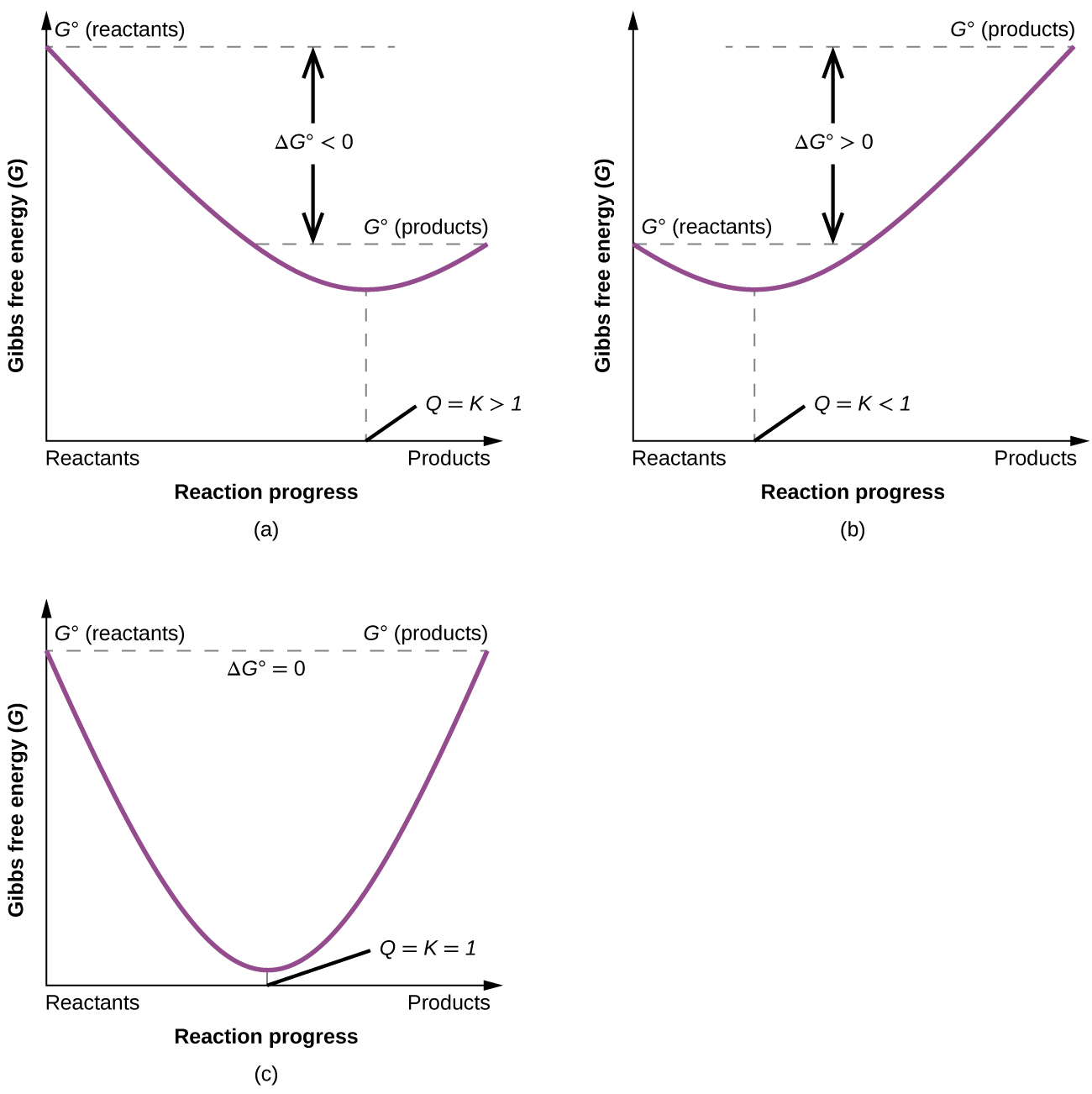

Figure 16.14図 16.14
These plots show the free energy versus reaction progress for systems whose standard free energy changes are (a) negative, (b) positive, and (c) zero. Nonequilibrium systems will proceed spontaneously in whatever direction is necessary to minimize free energy and establish equilibrium.
英語のヒント
標準自由エネルギー変化が(a)負、(b)正、(c)ゼロの系について、反応の進行に対する自由エネルギーを示したグラフである。非平衡の系は、自由エネルギーを最小にし、平衡を成立させるために必要な方向へ自発的に進む。