第16章熱力学
16.1 Spontaneity16.1 自発性
Learning Objectives学習目標
By the end of this section, you will be able to:
この節を学び終えると、次のことができるようになる。
- Distinguish between spontaneous and nonspontaneous processes自発的過程と非自発的過程を区別する。
- Describe the dispersal of matter and energy that accompanies certain spontaneous processes特定の自発的過程に伴う、物質とエネルギーの分散を説明する。
Processes have a natural tendency to occur in one direction under a given set of conditions. Water will naturally flow downhill, but uphill flow requires outside intervention such as the use of a pump. Iron exposed to the earth’s atmosphere will corrode, but rust is not converted to iron without intentional chemical treatment. A spontaneous process is one that occurs naturally under certain conditions. A nonspontaneous process, on the other hand, will not take place unless it is “driven” by the continual input of energy from an external source. A process that is spontaneous in one direction under a particular set of conditions is nonspontaneous in the reverse direction. At room temperature and typical atmospheric pressure, for example, ice will spontaneously melt, but water will not spontaneously freeze.
英語のヒント
ある一組の条件のもとでは、過程には一つの方向に自然に進む傾向がある。水は自然に低い方へ流れるが、高い方へ流すにはポンプを使うなどの外部からの介入が必要である。地球の大気にさらされた鉄は腐食するが、さびは、意図的な化学処理をしなければ鉄に戻らない。自発的過程とは、ある条件で自然に起こる過程である。それに対して非自発的過程は、外部のエネルギー源からエネルギーを継続して供給して「駆動」しなければ起こらない。ある特定の一組の条件で一方向に自発的な過程は、逆方向には非自発的である。たとえば室温と通常の大気圧では、氷は自発的に融けるが、水が自発的に凍ることはない。
The spontaneity of a process is not correlated to the speed of the process. A spontaneous change may be so rapid that it is essentially instantaneous or so slow that it cannot be observed over any practical period of time. To illustrate this concept, consider the decay of radioactive isotopes, a topic more thoroughly treated in the chapter on nuclear chemistry. Radioactive decay is by definition a spontaneous process in which the nuclei of unstable isotopes emit radiation as they are converted to more stable nuclei. All the decay processes occur spontaneously, but the rates at which different isotopes decay vary widely. Technetium-99m is a popular radioisotope for medical imaging studies that undergoes relatively rapid decay and exhibits a half-life of about six hours. Uranium-238 is the most abundant isotope of uranium, and its decay occurs much more slowly, exhibiting a half-life of more than four billion years (Figure 16.2).
英語のヒント
過程の自発性は、その過程の速さとは対応しない。自発的な変化は、実質的に瞬間的といえるほど速いこともあれば、現実的などの観察時間内にも認められないほど遅いこともある。この概念を示すために、核化学の章でより詳しく扱う放射性同位体の崩壊を考えよう。放射性崩壊は、定義上、自発的な過程である。不安定な同位体の原子核が、より安定な原子核に変わるときに放射線を放出する。崩壊過程はすべて自発的に起こるが、同位体によって崩壊速度は大きく異なる。テクネチウム99mは医療画像検査でよく用いられる放射性同位体であり、比較的速く崩壊して、半減期は約6時間である。ウラン238は、ウランの中で存在量が最も多い同位体であり、その崩壊ははるかに遅く、半減期は40億年を超える(図16.2)。
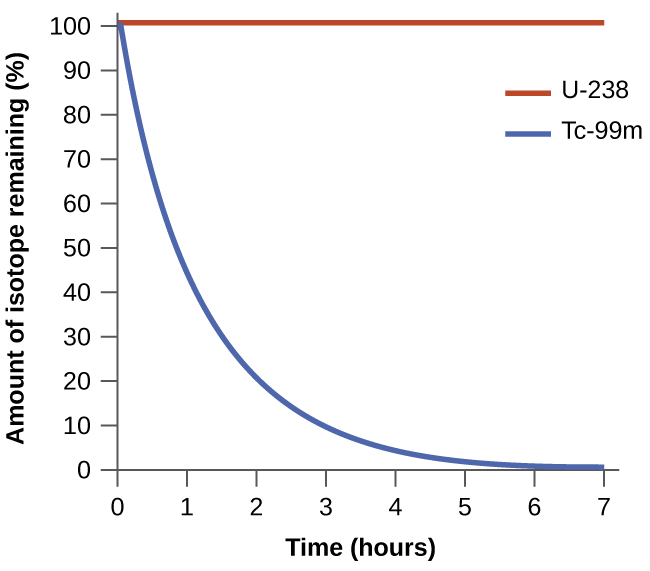
Figure 16.2図 16.2
Both U-238 and Tc-99m undergo spontaneous radioactive decay, but at drastically different rates. Over the course of one week, essentially all of a Tc-99m sample and none of a U-238 sample will have decayed.
U-238もTc-99mも自発的な放射性崩壊をするが、その速度は大幅に異なる。1週間の間に、Tc-99m試料は実質的にすべて崩壊する一方、U-238試料は実質的にまったく崩壊しない。
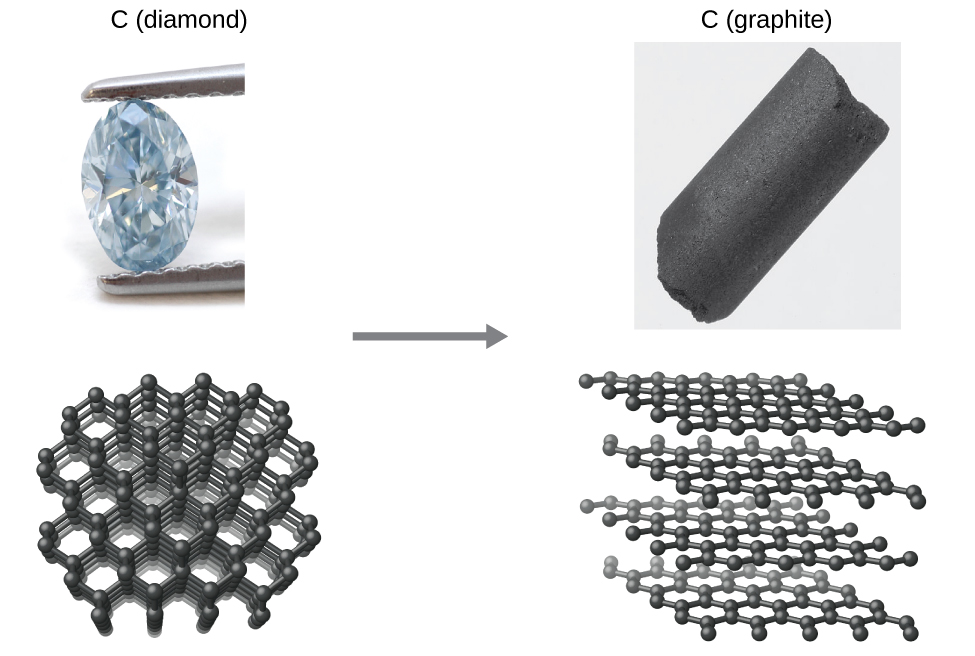
As another example, consider the conversion of diamond into graphite (Figure 16.3).
別の例として、ダイヤモンドから黒鉛への変化を考えよう(図16.3)。
The phase diagram for carbon indicates that graphite is the stable form of this element under ambient atmospheric pressure, while diamond is the stable allotrope at very high pressures, such as those present during its geologic formation. Thermodynamic calculations of the sort described in the last section of this chapter indicate that the conversion of diamond to graphite at ambient pressure occurs spontaneously, yet diamonds are observed to exist, and persist, under these conditions. Though the process is spontaneous under typical ambient conditions, its rate is extremely slow; so, for all practical purposes diamonds are indeed “forever.” Situations such as these emphasize the important distinction between the thermodynamic and the kinetic aspects of a process. In this particular case, diamonds are said to be thermodynamically unstable but kinetically stable under ambient conditions.
英語のヒント
炭素の状態図は、通常の大気圧では黒鉛がこの元素の安定な形であるのに対し、地質学的な形成時のような非常に高い圧力では、ダイヤモンドが安定な同素体であることを示している。本章の最後の節で説明する種類の熱力学計算によると、通常の圧力でダイヤモンドから黒鉛への変化は自発的に起こる。それでも、この条件でダイヤモンドが存在し、そのまま残り続けることが観察される。この過程は通常の周囲条件で自発的だが、速度がきわめて遅い。したがって、実用上のあらゆる目的に照らせば、ダイヤモンドは確かに「永遠」である。このような状況は、過程の熱力学的側面と速度論的側面を区別する重要性を強調している。この場合、通常の周囲条件では、ダイヤモンドは熱力学的に不安定だが、速度論的には安定だという。
OpenStax, Rice University, Chemistry 2e. Original caption credit: (credit "diamond" photo: modification of work by "Fancy Diamonds"/Flickr; credit "graphite" photo: modification of work by images-of-elements.com/carbon.php) Diamond: Fancy Diamonds / Leibish & Co, Fancy Intense Blue, Oval Diamond by Leibish & Co. Graphite: images-of-elements.com/carbon.php. · CC BY 2.0 and CC BY 3.0; OpenStax composition CC BY 4.0 · Source出典
Figure 16.3図 16.3
The conversion of carbon from the diamond allotrope to the graphite allotrope is spontaneous at ambient pressure, but its rate is immeasurably slow at low to moderate temperatures. This process is known as graphitization, and its rate can be increased to easily measurable values at temperatures in the 1000–2000 K range. (credit "diamond" photo: modification of work by "Fancy Diamonds"/Flickr; credit "graphite" photo: modification of work by images-of-elements.com/carbon.php)
英語のヒント
炭素のダイヤモンド同素体から黒鉛同素体への変化は、通常の周囲圧力で自発的だが、低温から中程度の温度では、その速度は測定できないほど遅い。この過程は黒鉛化として知られ、温度を1000〜2000 Kの範囲にすると、速度を容易に測定できる値まで高められる。(「ダイヤモンド」写真の出典:「Fancy Diamonds」/Flickrの作品を改変。「黒鉛」写真の出典:images-of-elements.com/carbon.phpの作品を改変)
Dispersal of Matter and Energy物質とエネルギーの分散
Extending the discussion of thermodynamic concepts toward the objective of predicting spontaneity, consider now an isolated system consisting of two flasks connected with a closed valve. Initially there is an ideal gas in one flask and the other flask is empty (P = 0). (Figure 16.4). When the valve is opened, the gas spontaneously expands to fill both flasks equally. Recalling the definition of pressure-volume work from the chapter on thermochemistry, note that no work has been done because the pressure in a vacuum is zero.
英語のヒント
自発性を予測するという目的に向け、熱力学的概念の議論を広げよう。閉じたバルブでつながれた二つのフラスコからなる孤立系を考える。初めは一方のフラスコに理想気体があり、他方のフラスコは空である(P = 0)(図16.4)。バルブを開くと、気体は自発的に膨張し、両方のフラスコを等しく満たす。熱化学の章で学んだ圧力–体積仕事の定義を思い出し、真空の圧力はゼロなので、仕事は行われていないことに注意しよう。
Note as well that since the system is isolated, no heat has been exchanged with the surroundings (q = 0). The first law of thermodynamics confirms that there has been no change in the system’s internal energy as a result of this process.
また、この系は孤立しているため、周囲との熱のやり取りもない(q = 0)ことに注意しよう。熱力学の第一法則により、この過程の結果として系の内部エネルギーが変化していないことが確認できる。
The spontaneity of this process is therefore not a consequence of any change in energy that accompanies the process. Instead, the driving force appears to be related to the greater, more uniform dispersal of matter that results when the gas is allowed to expand. Initially, the system was comprised of one flask containing matter and another flask containing nothing. After the spontaneous expansion took place, the matter was distributed both more widely (occupying twice its original volume) and more uniformly (present in equal amounts in each flask).
英語のヒント
したがって、この過程の自発性は、過程に伴うエネルギー変化によるものではない。むしろ、気体が膨張できるようになった結果、物質がより広く、より一様に分散することに、駆動力が関係しているように見える。初め、この系は、物質を含む一つのフラスコと、何も含まない別のフラスコからなっていた。自発的な膨張が起きた後には、物質はより広く(もとの2倍の体積を占めて)、しかもより一様に(各フラスコに等しい量ずつ存在して)分布した。

Figure 16.4図 16.4
An isolated system consists of an ideal gas in one flask that is connected by a closed valve to a second flask containing a vacuum. Once the valve is opened, the gas spontaneously becomes evenly distributed between the flasks.
一方のフラスコに理想気体があり、閉じたバルブを介して真空の二つ目のフラスコにつながっている孤立系である。バルブを開くと、気体は自発的に両フラスコに均等に分布する。
Now consider two objects at different temperatures: object X at temperature TX and object Y at temperature TY, with TX > TY (Figure 16.5). When these objects come into contact, heat spontaneously flows from the hotter object (X) to the colder one (Y). This corresponds to a loss of thermal energy by X and a gain of thermal energy by Y.
次に、温度の異なる二つの物体、温度TXの物体Xと温度TYの物体Yを考える。ただしTX > TYである(図16.5)。これらの物体を接触させると、熱は高温の物体Xから低温の物体Yへ自発的に流れる。これは、Xが熱エネルギーを失い、Yが熱エネルギーを得ることに対応する。
From the perspective of this two-object system, there was no net gain or loss of thermal energy, rather the available thermal energy was redistributed among the two objects. This spontaneous process resulted in a more uniform dispersal of energy.
英語のヒント
この二つの物体からなる系として見ると、熱エネルギーの正味の増加も減少もなく、存在していた熱エネルギーが二つの物体の間で再配分されたのである。この自発的過程によって、エネルギーはより一様に分散した。



Figure 16.5図 16.5
When two objects at different temperatures come in contact, heat spontaneously flows from the hotter to the colder object.
温度の異なる二つの物体を接触させると、熱は高温の物体から低温の物体へ自発的に流れる。
As illustrated by the two processes described, an important factor in determining the spontaneity of a process is the extent to which it changes the dispersal or distribution of matter and/or energy. In each case, a spontaneous process took place that resulted in a more uniform distribution of matter or energy.
説明した二つの過程が示すように、過程の自発性を決める重要な因子は、その過程によって物質やエネルギーの分散または分布がどの程度変わるかである。どちらの場合も、自発的過程が起こった結果、物質またはエネルギーがより一様に分布した。
Example 16.1例題 16.1
Redistribution of Matter during a Spontaneous Process自発的過程における物質の再配分
Describe how matter is redistributed when the following spontaneous processes take place:
次の自発的過程が起こるとき、物質がどのように再配分されるかを説明しなさい。
(a) A solid sublimes.
(a) 固体が昇華する。
(b) A gas condenses.
(b) 気体が凝縮する。
(c) A drop of food coloring added to a glass of water forms a solution with uniform color.
(c) コップの水に加えた一滴の食用色素が、一様な色の溶液を形成する。
Solution解き方
Image omitted because its reuse rights could not be verified.権利の確認ができないため画像を割愛。
Figure 16.6図 16.6
(credit a: modification of work by Jenny Downing; credit b: modification of work by “Fuzzy Gerdes”/Flickr; credit c: modification of work by Paul A. Flowers)
(出典:aはJenny Downingの作品を改変、bは「Fuzzy Gerdes」/Flickrの作品を改変、cはPaul A. Flowersの作品を改変)
(a) Sublimation is the conversion of a solid (relatively high density) to a gas (much lesser density). This process yields a much greater dispersal of matter, since the molecules will occupy a much greater volume after the solid-to-gas transition.
(a) 昇華は、固体(比較的高密度)から気体(はるかに低密度)への変化である。固体から気体へ変化した後には、分子がはるかに大きな体積を占めるので、この過程によって物質の分散は大幅に大きくなる。
(b) Condensation is the conversion of a gas (relatively low density) to a liquid (much greater density). This process yields a much lesser dispersal of matter, since the molecules will occupy a much lesser volume after the gas-to-liquid transition.
(b) 凝縮は、気体(比較的低密度)から液体(はるかに高密度)への変化である。気体から液体へ変化した後には、分子が占める体積がはるかに小さくなるので、この過程によって物質の分散は大幅に小さくなる。
(c) The process in question is diffusion. This process yields a more uniform dispersal of matter, since the initial state of the system involves two regions of different dye concentrations (high in the drop of dye, zero in the water), and the final state of the system contains a single dye concentration throughout.
英語のヒント
(c) 問題の過程は拡散である。系の初期状態には、色素濃度が異なる二つの領域(色素の滴では高濃度、水中ではゼロ)があるが、最終状態では系の全域で色素濃度が一つの値になる。そのため、この過程によって物質はより一様に分散する。
Check Your Learning理解度の確認
Describe how energy is redistributed when a spoon at room temperature is placed in a cup of hot coffee.
室温のスプーンを熱いコーヒーのカップに入れるとき、エネルギーがどのように再配分されるかを説明しなさい。