第16章熱力学
Free Energy Changes for Coupled Reactions連結した反応の自由エネルギー変化
The use of free energies of formation to compute free energy changes for reactions as described above is possible because G is a state function, and the approach is analogous to the use of Hess’ Law in computing enthalpy changes (see the chapter on thermochemistry). Consider the vaporization of water as an example:
英語のヒント
上で説明したように、生成自由エネルギーを使って反応の自由エネルギー変化を計算できるのは、Gが状態関数だからである。この方法は、エンタルピー変化の計算にヘスの法則を使う方法に相当する(熱化学の章を参照)。水の蒸発を例として考えよう。
An equation representing this process may be derived by adding the formation reactions for the two phases of water (necessarily reversing the reaction for the liquid phase). The free energy change for the sum reaction is the sum of free energy changes for the two added reactions:
この過程を表す反応式は、水の二つの相の生成反応を加え合わせることで導ける(液相の反応は必ず逆向きにする)。合計した反応の自由エネルギー変化は、加え合わせた二つの反応の自由エネルギー変化の和である。
This approach may also be used in cases where a nonspontaneous reaction is enabled by coupling it to a spontaneous reaction. For example, the production of elemental zinc from zinc sulfide is thermodynamically unfavorable, as indicated by a positive value for ΔG°:
英語のヒント
この方法は、非自発的な反応を自発的な反応と結び付けることで進行可能にする場合にも使える。たとえば、硫化亜鉛から単体の亜鉛を製造する過程は、ΔG°が正であることから分かるように、熱力学的に不利である。
The industrial process for production of zinc from sulfidic ores involves coupling this decomposition reaction to the thermodynamically favorable oxidation of sulfur:
硫化物鉱石から亜鉛を製造する工業的な過程では、この分解反応を、熱力学的に有利な硫黄の酸化と結び付ける。
The coupled reaction exhibits a negative free energy change and is spontaneous:
連結した反応では自由エネルギー変化が負となり、自発的である。
This process is typically carried out at elevated temperatures, so this result obtained using standard free energy values is just an estimate. The gist of the calculation, however, holds true.
英語のヒント
この過程は通常、高温で行うので、標準自由エネルギーの値を使って得たこの結果は、概算にすぎない。しかし、計算の要点は変わらず成り立つ。
Example 16.9例題 16.9
Calculating Free Energy Change for a Coupled Reaction連結した反応の自由エネルギー変化を計算する
Is a reaction coupling the decomposition of ZnS to the formation of H2S expected to be spontaneous under standard conditions?
ZnSの分解をH2Sの生成と結び付けた反応は、標準条件下で自発的と予想されるか。
Solution解き方
Following the approach outlined above and using free energy values from Appendix G:
上で述べた方法に従い、付録Gの自由エネルギーの値を使うと、次のようになる。
The coupled reaction exhibits a positive free energy change and is thus nonspontaneous.
連結した反応は自由エネルギー変化が正なので、非自発的である。
Check Your Learning理解度の確認
What is the standard free energy change for the reaction below? Is the reaction expected to be spontaneous under standard conditions?
次の反応の標準自由エネルギー変化はいくらか。この反応は標準条件下で自発的と予想されるか。
Temperature Dependence of Spontaneity自発性の温度依存性
As was previously demonstrated in this chapter’s section on entropy, the spontaneity of a process may depend upon the temperature of the system. Phase transitions, for example, will proceed spontaneously in one direction or the other depending upon the temperature of the substance in question. Likewise, some chemical reactions can also exhibit temperature dependent spontaneities. To illustrate this concept, the equation relating free energy change to the enthalpy and entropy changes for the process is considered:
本章のエントロピーの節ですでに示したように、過程の自発性は系の温度に依存する場合がある。たとえば相転移は、対象となる物質の温度に応じて、一方または逆の方向へ自発的に進む。同様に、化学反応の中にも、温度に依存した自発性を示すものがある。この概念を説明するため、自由エネルギー変化をその過程のエンタルピー変化とエントロピー変化に関連付ける式を考えよう。
The spontaneity of a process, as reflected in the arithmetic sign of its free energy change, is then determined by the signs of the enthalpy and entropy changes and, in some cases, the absolute temperature. Since T is the absolute (kelvin) temperature, it can only have positive values. Four possibilities therefore exist with regard to the signs of the enthalpy and entropy changes:
英語のヒント
自由エネルギー変化の符号に表れる過程の自発性は、エンタルピー変化とエントロピー変化の符号、そして場合によっては絶対温度によって決まる。Tは絶対温度(ケルビン温度)なので、正の値しか取れない。したがって、エンタルピー変化とエントロピー変化の符号には、四つの組合せがある。
- Both ΔH and ΔS are positive. This condition describes an endothermic process that involves an increase in system entropy. In this case, ΔG will be negative if the magnitude of the TΔS term is greater than ΔH. If the TΔS term is less than ΔH, the free energy change will be positive. Such a process is spontaneous at high temperatures and nonspontaneous at low temperatures.ΔHとΔSがともに正。この条件は、系のエントロピーの増加を伴う吸熱過程を表す。この場合、TΔSの項の大きさがΔHより大きければ、ΔGは負になる。TΔSの項がΔHより小さければ、自由エネルギー変化は正になる。このような過程は、高温では自発的、低温では非自発的である。
- Both ΔH and ΔS are negative. This condition describes an exothermic process that involves a decrease in system entropy. In this case, ΔG will be negative if the magnitude of the TΔS term is less than ΔH. If the TΔS term’s magnitude is greater than ΔH, the free energy change will be positive. Such a process is spontaneous at low temperatures and nonspontaneous at high temperatures.ΔHとΔSがともに負。この条件は、系のエントロピーの減少を伴う発熱過程を表す。この場合、TΔSの項の大きさがΔHより小さければ、ΔGは負になる。TΔSの項の大きさがΔHより大きければ、自由エネルギー変化は正になる。このような過程は、低温では自発的、高温では非自発的である。
- ΔH is positive and ΔS is negative. This condition describes an endothermic process that involves a decrease in system entropy. In this case, ΔG will be positive regardless of the temperature. Such a process is nonspontaneous at all temperatures.ΔHが正で、ΔSが負。この条件は、系のエントロピーの減少を伴う吸熱過程を表す。この場合、温度にかかわらずΔGは正になる。このような過程は、すべての温度で非自発的である。
- ΔH is negative and ΔS is positive. This condition describes an exothermic process that involves an increase in system entropy. In this case, ΔG will be negative regardless of the temperature. Such a process is spontaneous at all temperatures.ΔHが負で、ΔSが正。この条件は、系のエントロピーの増加を伴う発熱過程を表す。この場合、温度にかかわらずΔGは負になる。このような過程は、すべての温度で自発的である。
These four scenarios are summarized in Figure 16.12.
この四つの場合を図16.12にまとめる。
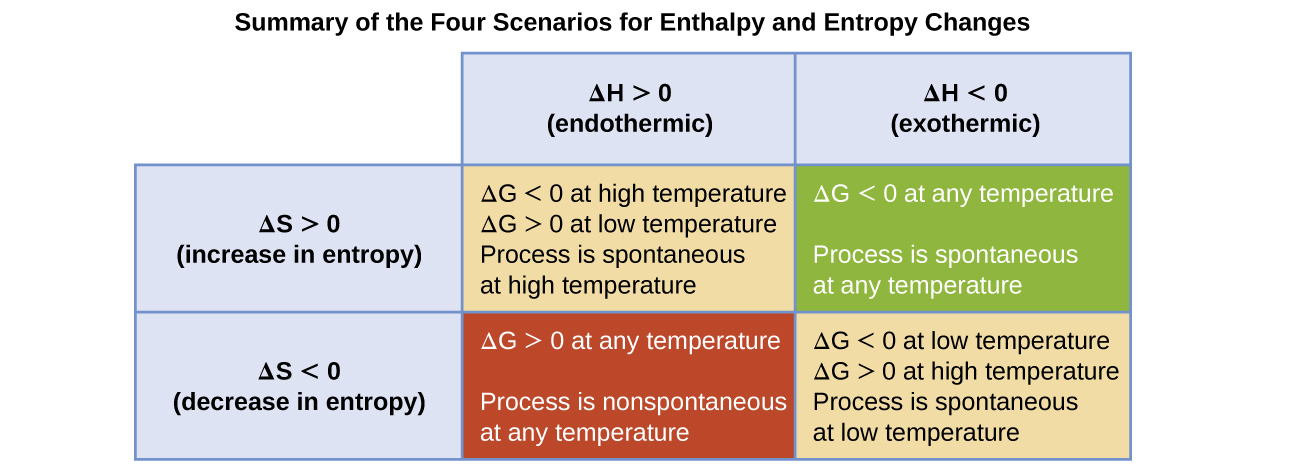
Figure 16.12図 16.12
There are four possibilities regarding the signs of enthalpy and entropy changes.
エンタルピー変化とエントロピー変化の符号には、四つの組合せがある。
Example 16.10例題 16.10
Predicting the Temperature Dependence of Spontaneity自発性の温度依存性を予測する
The incomplete combustion of carbon is described by the following equation:
炭素の不完全燃焼は、次の反応式で表される。
How does the spontaneity of this process depend upon temperature?
この過程の自発性は、温度にどのように依存するか。
Solution解き方
Combustion processes are exothermic (ΔH < 0). This particular reaction involves an increase in entropy due to the accompanying increase in the amount of gaseous species (net gain of one mole of gas, ΔS > 0). The reaction is therefore spontaneous (ΔG < 0) at all temperatures.
燃焼過程は発熱性である(ΔH < 0)。この反応では、気体の化学種の量が増加するため(気体が正味で1 mol増加)、エントロピーが増加する(ΔS > 0)。したがって、この反応はすべての温度で自発的である(ΔG < 0)。
Check Your Learning理解度の確認
Popular chemical hand warmers generate heat by the air-oxidation of iron:
英語のヒント
よく使われる化学式カイロは、鉄の空気酸化によって熱を発生させる。
How does the spontaneity of this process depend upon temperature?
この過程の自発性は、温度にどのように依存するか。
When considering the conclusions drawn regarding the temperature dependence of spontaneity, it is important to keep in mind what the terms “high” and “low” mean. Since these terms are adjectives, the temperatures in question are deemed high or low relative to some reference temperature. A process that is nonspontaneous at one temperature but spontaneous at another will necessarily undergo a change in “spontaneity” (as reflected by its ΔG) as temperature varies. This is clearly illustrated by a graphical presentation of the free energy change equation, in which ΔG is plotted on the y axis versus T on the x axis:
英語のヒント
自発性の温度依存性について得た結論を考えるときは、「高い」「低い」という語の意味を忘れないことが重要である。これらは形容詞なので、対象の温度は、何らかの基準温度に対して高い、または低いと判断される。ある温度で非自発的で、別の温度で自発的な過程は、温度が変わると必ず「自発性」が変化する(その変化はΔGに表れる)。このことは、自由エネルギー変化の式について、横軸をT、縦軸をΔGとしたグラフで明瞭に示される。
Such a plot is shown in Figure 16.13. A process whose enthalpy and entropy changes are of the same arithmetic sign will exhibit a temperature-dependent spontaneity as depicted by the two yellow lines in the plot. Each line crosses from one spontaneity domain (positive or negative ΔG) to the other at a temperature that is characteristic of the process in question. This temperature is represented by the x-intercept of the line, that is, the value of T for which ΔG is zero:
英語のヒント
このグラフを図16.13に示す。エンタルピー変化とエントロピー変化が同じ符号の過程は、グラフの二本の黄色い直線に示すように、温度に依存する自発性を示す。各直線は、対象の過程に特有のある温度で、一方の自発性の領域(ΔGが正または負)から他方へ移る。この温度は、直線のx切片、すなわちΔGがゼロになるTの値で表される。
So, saying a process is spontaneous at “high” or “low” temperatures means the temperature is above or below, respectively, that temperature at which ΔG for the process is zero. As noted earlier, the condition of ΔG = 0 describes a system at equilibrium.
したがって、ある過程が「高温」または「低温」で自発的だというのは、その過程のΔGがゼロになる温度より、それぞれ高い、または低い温度で自発的だという意味である。前に述べたように、ΔG = 0という条件は、平衡状態の系を表す。
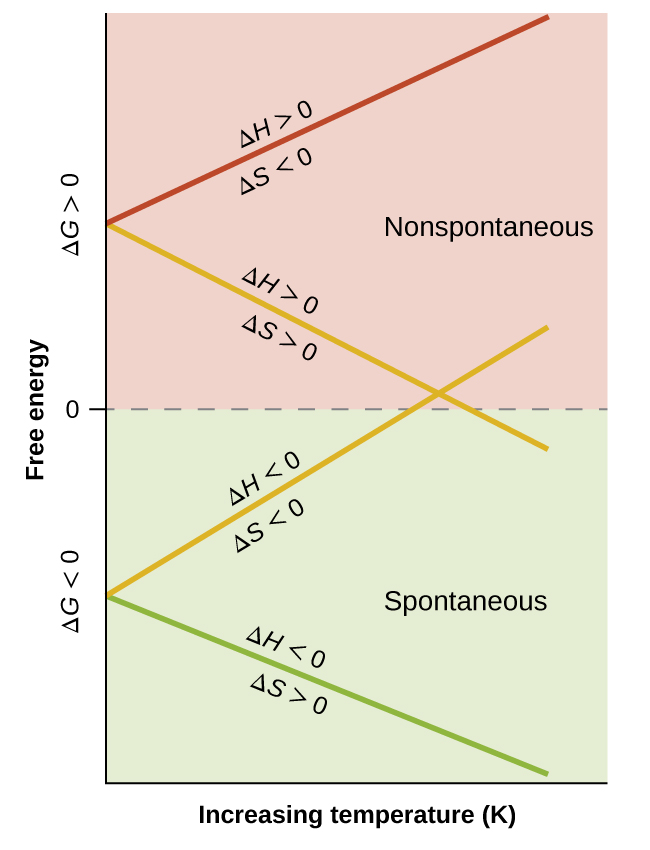


Figure 16.13図 16.13
These plots show the variation in ΔG with temperature for the four possible combinations of arithmetic sign for ΔH and ΔS.
ΔHとΔSの符号の四つの組合せについて、温度によるΔGの変化を示したグラフである。
Example 16.11例題 16.11
Equilibrium Temperature for a Phase Transition相転移の平衡温度
As defined in the chapter on liquids and solids, the boiling point of a liquid is the temperature at which its liquid and gaseous phases are in equilibrium (that is, when vaporization and condensation occur at equal rates). Use the information in Appendix G to estimate the boiling point of water.
液体と固体の章で定義したように、液体の沸点は、その液相と気相が平衡にある温度、すなわち蒸発と凝縮が同じ速度で起こる温度である。付録Gの情報を使って、水の沸点を推定しなさい。
Solution解き方
The process of interest is the following phase change:
対象の過程は、次の相変化である。
When this process is at equilibrium, ΔG = 0, so the following is true:
この過程が平衡にあるとき、ΔG = 0なので、次のことが成り立つ。
Using the standard thermodynamic data from Appendix G,
付録Gの標準熱力学データを使うと、
The accepted value for water’s normal boiling point is 373.2 K (100.0 °C), and so this calculation is in reasonable agreement. Note that the values for enthalpy and entropy changes data used were derived from standard data at 298 K (Appendix G). If desired, you could obtain more accurate results by using enthalpy and entropy changes determined at (or at least closer to) the actual boiling point.
水の標準沸点の採用値は373.2 K(100.0 °C)なので、この計算はかなりよく一致している。使ったエンタルピー変化とエントロピー変化の値は、298 Kの標準データ(付録G)から導いたものであることに注意しよう。必要なら、実際の沸点で、または少なくともそれに近い温度で求めたエンタルピー変化とエントロピー変化を使うことで、より正確な結果を得られる。
Check Your Learning理解度の確認
Use the information in Appendix G to estimate the boiling point of CS2.
付録Gの情報を使って、CS2の沸点を推定しなさい。