第16章熱力学
Predicting the Sign of ΔSΔSの符号を予測する
The relationships between entropy, microstates, and matter/energy dispersal described previously allow us to make generalizations regarding the relative entropies of substances and to predict the sign of entropy changes for chemical and physical processes. Consider the phase changes illustrated in Figure 16.10. In the solid phase, the atoms or molecules are restricted to nearly fixed positions with respect to each other and are capable of only modest oscillations about these positions. With essentially fixed locations for the system’s component particles, the number of microstates is relatively small. In the liquid phase, the atoms or molecules are free to move over and around each other, though they remain in relatively close proximity to one another. This increased freedom of motion results in a greater variation in possible particle locations, so the number of microstates is correspondingly greater than for the solid. As a result, Sliquid > Ssolid and the process of converting a substance from solid to liquid (melting) is characterized by an increase in entropy, ΔS > 0. By the same logic, the reciprocal process (freezing) exhibits a decrease in entropy, ΔS < 0.
英語のヒント
すでに説明したエントロピー、微視的状態、物質やエネルギーの分散の関係によって、物質のエントロピーの大小について一般的な傾向を述べ、化学的過程や物理的過程のエントロピー変化の符号を予測できる。図16.10に示した相変化を考えよう。固相では、原子や分子は、互いにほぼ固定された位置に制限され、その位置の周りでわずかに振動することしかできない。系を構成する粒子の位置が実質的に固定されているので、微視的状態の数は比較的少ない。液相では、原子や分子は互いに比較的近い距離にとどまるものの、互いの上や周囲を自由に動ける。この運動の自由度の増加により、取りうる粒子の位置の変化が多くなり、それに対応して微視的状態の数も固体より多くなる。その結果、Sliquid > Ssolidとなり、物質が固体から液体に変わる過程(融解)は、エントロピーの増加、ΔS > 0を特徴とする。同じ論理により、逆過程(凝固)ではエントロピーが減少し、ΔS < 0となる。
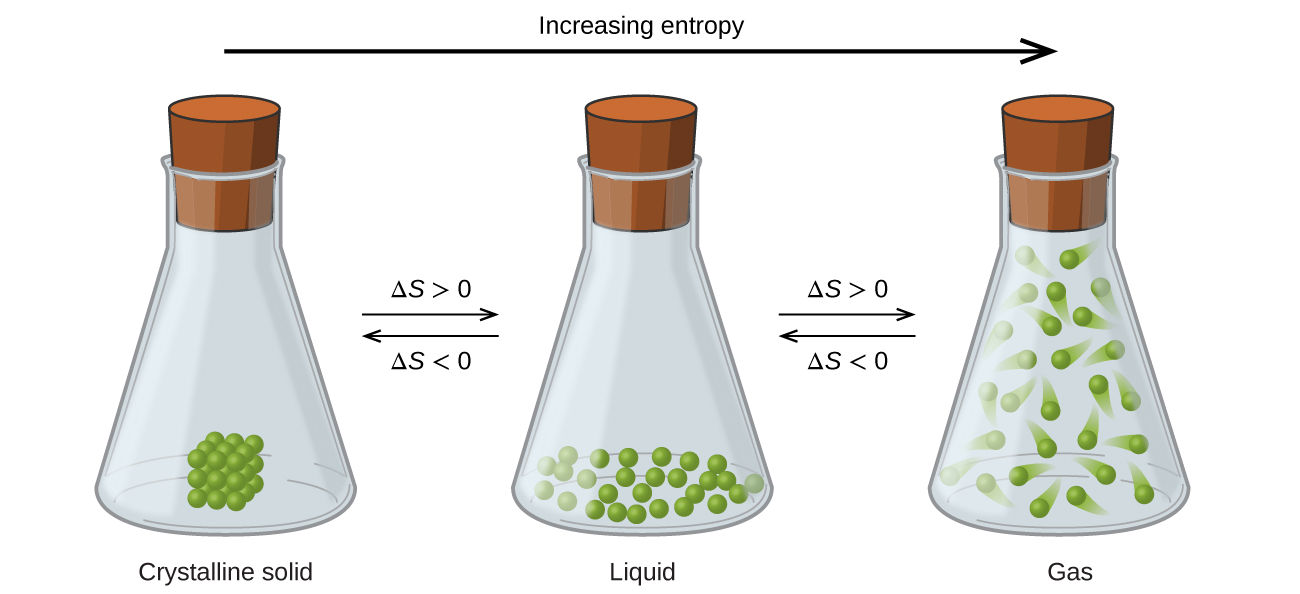
Figure 16.10図 16.10
The entropy of a substance increases (ΔS > 0) as it transforms from a relatively ordered solid, to a less-ordered liquid, and then to a still less-ordered gas. The entropy decreases (ΔS < 0) as the substance transforms from a gas to a liquid and then to a solid.
物質が、比較的秩序立った固体から、秩序の小さい液体へ、さらに秩序の小さい気体へ変わるにつれて、エントロピーは増加する(ΔS > 0)。物質が気体から液体へ、さらに固体へ変わるにつれて、エントロピーは減少する(ΔS < 0)。
Now consider the gaseous phase, in which a given number of atoms or molecules occupy a much greater volume than in the liquid phase. Each atom or molecule can be found in many more locations, corresponding to a much greater number of microstates. Consequently, for any substance, Sgas > Sliquid > Ssolid, and the processes of vaporization and sublimation likewise involve increases in entropy, ΔS > 0. Likewise, the reciprocal phase transitions, condensation and deposition, involve decreases in entropy, ΔS < 0.
英語のヒント
次に気相を考えよう。気相では、一定数の原子や分子が、液相よりはるかに大きい体積を占める。各原子や分子が存在しうる場所ははるかに多くなり、それに対応して微視的状態の数もはるかに大きくなる。その結果、どの物質についてもSgas > Sliquid > Ssolidであり、蒸発と昇華の過程も同様にエントロピーの増加、ΔS > 0を伴う。同じように、逆向きの相転移である凝縮と凝華は、エントロピーの減少、ΔS < 0を伴う。
According to kinetic-molecular theory, the temperature of a substance is proportional to the average kinetic energy of its particles. Raising the temperature of a substance will result in more extensive vibrations of the particles in solids and more rapid translations of the particles in liquids and gases. At higher temperatures, the distribution of kinetic energies among the atoms or molecules of the substance is also broader (more dispersed) than at lower temperatures. Thus, the entropy for any substance increases with temperature (Figure 16.11).
英語のヒント
分子運動論によると、物質の温度は粒子の平均運動エネルギーに比例する。物質の温度を上げると、固体では粒子の振動が大きくなり、液体や気体では粒子の並進運動が速くなる。高温では、物質の原子や分子の運動エネルギーの分布も、低温に比べて広い(分散している)。したがって、どの物質のエントロピーも温度とともに増加する(図16.11)。
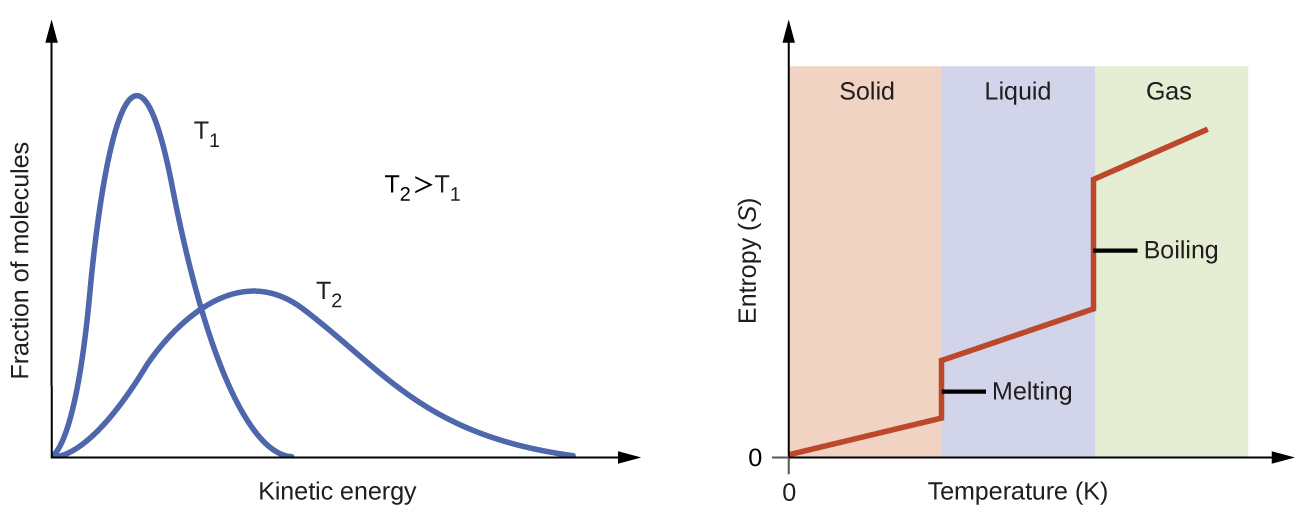


Figure 16.11図 16.11
Entropy increases as the temperature of a substance is raised, which corresponds to the greater spread of kinetic energies. When a substance undergoes a phase transition, its entropy changes significantly.
物質の温度を上げるとエントロピーが増加し、これは運動エネルギーの分布がより広がることに対応する。物質が相転移すると、そのエントロピーは大きく変化する。
The entropy of a substance is influenced by the structure of the particles (atoms or molecules) that comprise the substance. With regard to atomic substances, heavier atoms possess greater entropy at a given temperature than lighter atoms, which is a consequence of the relation between a particle’s mass and the spacing of quantized translational energy levels (a topic beyond the scope of this text). For molecules, greater numbers of atoms increase the number of ways in which the molecules can vibrate and thus the number of possible microstates and the entropy of the system.
英語のヒント
物質のエントロピーは、その物質を構成する粒子(原子や分子)の構造に影響される。原子からなる物質については、一定温度では、重い原子のほうが軽い原子より大きなエントロピーを持つ。これは、粒子の質量と、量子化された並進エネルギー準位の間隔との関係によるものである(この話題は本書の範囲を超える)。分子については、原子数が多いほど分子の振動の仕方が増え、その結果、取りうる微視的状態の数と系のエントロピーが増加する。
Finally, variations in the types of particles affects the entropy of a system. Compared to a pure substance, in which all particles are identical, the entropy of a mixture of two or more different particle types is greater. This is because of the additional orientations and interactions that are possible in a system comprised of nonidentical components. For example, when a solid dissolves in a liquid, the particles of the solid experience both a greater freedom of motion and additional interactions with the solvent particles. This corresponds to a more uniform dispersal of matter and energy and a greater number of microstates. The process of dissolution therefore involves an increase in entropy, ΔS > 0.
英語のヒント
最後に、粒子の種類の違いも、系のエントロピーに影響する。すべての粒子が同じ純物質に比べ、異なる二種類以上の粒子の混合物のエントロピーは大きい。これは、同一でない成分からなる系では、さらに別の配向や相互作用が可能になるためである。たとえば、固体が液体に溶けると、固体の粒子は運動の自由度が大きくなると同時に、溶媒粒子との新たな相互作用も経験する。これは、物質とエネルギーのより一様な分散、および微視的状態の数の増加に対応する。したがって、溶解の過程はエントロピーの増加、ΔS > 0を伴う。
Considering the various factors that affect entropy allows us to make informed predictions of the sign of ΔS for various chemical and physical processes as illustrated in Example 16.3.
エントロピーに影響するさまざまな因子を考えることで、例題16.3に示すように、さまざまな化学的過程や物理的過程について、根拠を踏まえてΔSの符号を予測できる。
Example 16.3例題 16.3
Predicting the Sign of ∆S∆Sの符号を予測する
Predict the sign of the entropy change for the following processes. Indicate the reason for each of your predictions.
次の過程のエントロピー変化の符号を予測しなさい。それぞれの予測の理由も示しなさい。
(a) One mole liquid water at room temperature one mole liquid water at 50 °C
(a) 室温の液体の水1 mol 50 °Cの液体の水1 mol
(b)
(b)
(c)
(c)
(d)
(d)
Solution解き方
(a) positive, temperature increases
(a) 正。温度が上昇する。
(b) negative, reduction in the number of ions (particles) in solution, decreased dispersal of matter
(b) 負。溶液中のイオン(粒子)の数が減少し、物質の分散が小さくなる。
(c) negative, net decrease in the amount of gaseous species
(c) 負。気体の化学種の量が正味で減少する。
(d) positive, phase transition from solid to liquid, net increase in dispersal of matter
(d) 正。固体から液体への相転移で、物質の分散が正味で増加する。
Check Your Learning理解度の確認
Predict the sign of the entropy change for the following processes. Give a reason for your prediction.
次の過程のエントロピー変化の符号を予測しなさい。予測の理由も述べなさい。
(a)
(a)
(b) the freezing of liquid water
(b) 液体の水が凍る。
(c)
(c)
(d)
(d)