第16章熱力学
16.2 Entropy16.2 エントロピー
Learning Objectives学習目標
By the end of this section, you will be able to:
この節を学び終えると、次のことができるようになる。
- Define entropyエントロピーを定義する。
- Explain the relationship between entropy and the number of microstatesエントロピーと微視的状態の数との関係を説明する。
- Predict the sign of the entropy change for chemical and physical processes化学的過程や物理的過程のエントロピー変化の符号を予測する。
In 1824, at the age of 28, Nicolas Léonard Sadi Carnot (Figure 16.7) published the results of an extensive study regarding the efficiency of steam heat engines. A later review of Carnot’s findings by Rudolf Clausius introduced a new thermodynamic property that relates the spontaneous heat flow accompanying a process to the temperature at which the process takes place. This new property was expressed as the ratio of the reversible heat (qrev) and the kelvin temperature (T). In thermodynamics, a reversible process is one that takes place at such a slow rate that it is always at equilibrium and its direction can be changed (it can be “reversed”) by an infinitesimally small change in some condition. Note that the idea of a reversible process is a formalism required to support the development of various thermodynamic concepts; no real processes are truly reversible, rather they are classified as irreversible.
英語のヒント
1824年、28歳のニコラ・レオナール・サディ・カルノー(図16.7)は、蒸気熱機関の効率について広範に研究した結果を発表した。その後、ルドルフ・クラウジウスがカルノーの知見を検討し、ある過程に伴う自発的な熱の流れと、その過程が起こる温度とを結び付ける、新しい熱力学的性質を導入した。この新しい性質は、可逆過程の熱(qrev)とケルビン温度(T)の比として表された。熱力学において可逆過程とは、常に平衡状態を保つほどゆっくりと進み、ある条件を無限小だけ変化させることで、その方向を変えられる(「逆転」できる)過程である。可逆過程という考えは、さまざまな熱力学的概念の展開を支えるために必要な形式的な考え方であることに注意しよう。現実の過程に真に可逆なものはなく、不可逆として分類される。
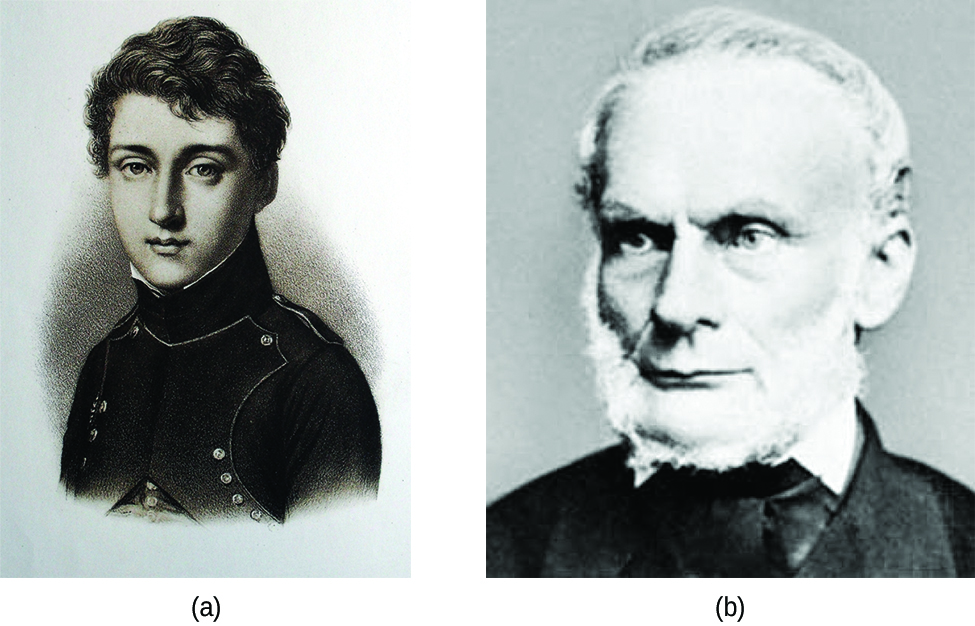
Figure 16.7図 16.7
(a) Nicholas Léonard Sadi Carnot’s research into steam-powered machinery and (b) Rudolf Clausius’s later study of those findings led to groundbreaking discoveries about spontaneous heat flow processes.
英語のヒント
(a) ニコラ・レオナール・サディ・カルノーの蒸気で動く機械の研究と、(b) その知見についてのルドルフ・クラウジウスの後の研究が、自発的な熱の流れに関する画期的な発見につながった。
Similar to other thermodynamic properties, this new quantity is a state function, so its change depends only upon the initial and final states of a system. In 1865, Clausius named this property entropy (S) and defined its change for any process as the following:
英語のヒント
ほかの熱力学的性質と同じように、この新しい量も状態関数であり、その変化は系の初期状態と最終状態だけに依存する。1865年、クラウジウスはこの性質をエントロピー(S)と名付け、あらゆる過程におけるその変化を、次のように定義した。
The entropy change for a real, irreversible process is then equal to that for the theoretical reversible process that involves the same initial and final states.
英語のヒント
したがって、現実の不可逆過程のエントロピー変化は、同じ初期状態と最終状態を持つ、理論上の可逆過程のエントロピー変化に等しい。
Entropy and Microstatesエントロピーと微視的状態
Following the work of Carnot and Clausius, Ludwig Boltzmann developed a molecular-scale statistical model that related the entropy of a system to the number of microstates (W) possible for the system. A microstate is a specific configuration of all the locations and energies of the atoms or molecules that make up a system. The relation between a system’s entropy and the number of possible microstates is
英語のヒント
カルノーとクラウジウスの研究に続き、ルートヴィヒ・ボルツマンは、系のエントロピーを、その系が取りうる微視的状態の数(W)と結び付ける、分子レベルの統計モデルを開発した。微視的状態とは、系を構成する原子または分子すべての位置とエネルギーを、具体的に定めた配置である。系のエントロピーと、取りうる微視的状態の数との関係は、次のとおりである。
where k is the Boltzmann constant, 1.38 10−23 J/K.
ここでkはボルツマン定数であり、1.38 10−23 J/Kである。
As for other state functions, the change in entropy for a process is the difference between its final (Sf) and initial (Si) values:
ほかの状態関数と同じように、ある過程のエントロピー変化は、最終値(Sf)と初期値(Si)の差である。
For processes involving an increase in the number of microstates, Wf > Wi, the entropy of the system increases and ΔS > 0. Conversely, processes that reduce the number of microstates, Wf < Wi, yield a decrease in system entropy, ΔS < 0. This molecular-scale interpretation of entropy provides a link to the probability that a process will occur as illustrated in the next paragraphs.
微視的状態の数が増加する過程、すなわちWf > Wiでは、系のエントロピーが増加し、ΔS > 0となる。逆に、微視的状態の数を減少させる過程、すなわちWf < Wiでは、系のエントロピーが減少し、ΔS < 0となる。この分子レベルでのエントロピーの解釈は、次の各段落で示すように、ある過程が起こる確率とのつながりを与える。
Consider the general case of a system comprised of N particles distributed among n boxes. The number of microstates possible for such a system is nN. For example, distributing four particles among two boxes will result in 24 = 16 different microstates as illustrated in Figure 16.8. Microstates with equivalent particle arrangements (not considering individual particle identities) are grouped together and are called distributions. The probability that a system will exist with its components in a given distribution is proportional to the number of microstates within the distribution. Since entropy increases logarithmically with the number of microstates, the most probable distribution is therefore the one of greatest entropy.
英語のヒント
N個の粒子をn個の箱に分配した系の、一般的な場合を考えよう。この系が取りうる微視的状態の数はnNである。たとえば、四つの粒子を二つの箱に分配すると、図16.8に示すように、24 = 16通りの異なる微視的状態になる。各粒子の個性を区別せずに見たとき、粒子の配置が同等の微視的状態を一つにまとめ、分布と呼ぶ。系の構成粒子がある分布で存在する確率は、その分布に含まれる微視的状態の数に比例する。エントロピーは微視的状態の数の対数に従って増加するので、最も確率の高い分布は、エントロピーが最大の分布である。
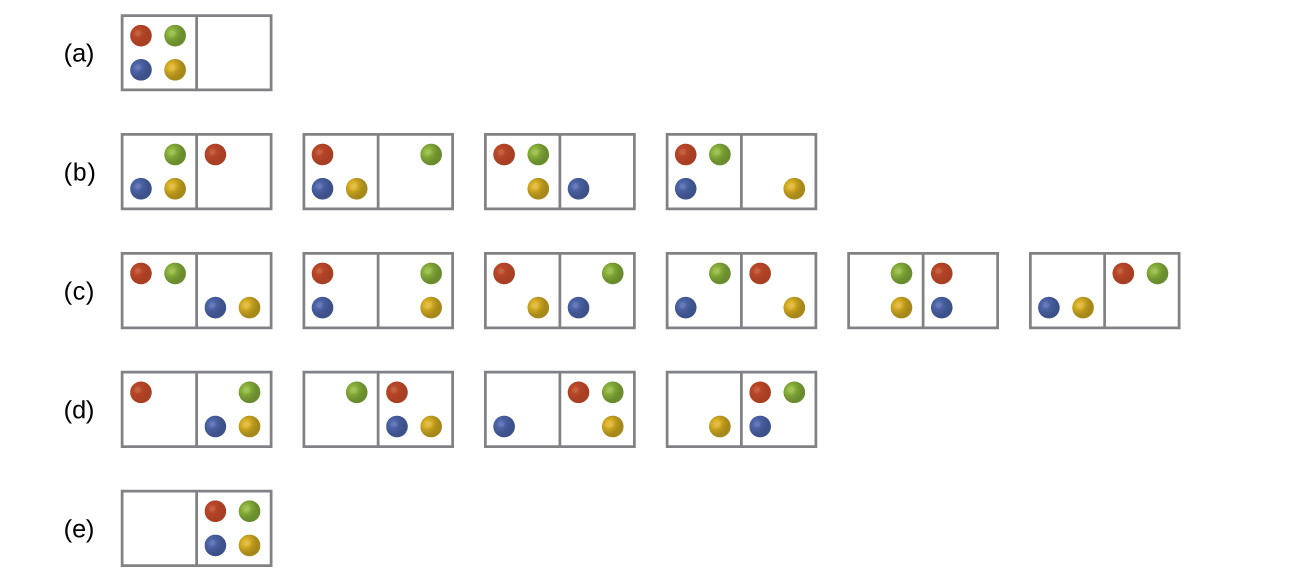
Figure 16.8図 16.8
The sixteen microstates associated with placing four particles in two boxes are shown. The microstates are collected into five distributions—(a), (b), (c), (d), and (e)—based on the numbers of particles in each box.
四つの粒子を二つの箱に置く際の、16通りの微視的状態を示している。各箱の粒子数を基準に、微視的状態を(a)、(b)、(c)、(d)、(e)という五つの分布にまとめている。
For this system, the most probable configuration is one of the six microstates associated with distribution (c) where the particles are evenly distributed between the boxes, that is, a configuration of two particles in each box. The probability of finding the system in this configuration is or The least probable configuration of the system is one in which all four particles are in one box, corresponding to distributions (a) and (e), each with a probability of The probability of finding all particles in only one box (either the left box or right box) is then or
この系では、粒子が箱の間に均等に分配される分布(c)、すなわち各箱に二つずつ粒子がある配置に対応する、六つの微視的状態のいずれかが、最も確率の高い配置である。系をこの配置に見いだす確率は、すなわちである。最も確率の低い配置は、四つの粒子がすべて一つの箱にあるもので、分布(a)と(e)に対応する。それぞれの確率はである。したがって、すべての粒子を一つの箱だけ(左または右のどちらか)に見いだす確率は、、すなわちである。
As you add more particles to the system, the number of possible microstates increases exponentially (2N). A macroscopic (laboratory-sized) system would typically consist of moles of particles (N ~ 1023), and the corresponding number of microstates would be staggeringly huge. Regardless of the number of particles in the system, however, the distributions in which roughly equal numbers of particles are found in each box are always the most probable configurations.
英語のヒント
系に粒子を増やしていくと、取りうる微視的状態の数は指数関数的に増加する(2N)。巨視的な、実験室で扱う大きさの系は、通常、モル単位の粒子からなり(N ~ 1023)、それに対応する微視的状態の数は、驚くほど巨大になる。しかし、系の粒子数にかかわらず、各箱にほぼ同数の粒子がある分布が、常に最も確率の高い配置である。
This matter dispersal model of entropy is often described qualitatively in terms of the disorder of the system. By this description, microstates in which all the particles are in a single box are the most ordered, thus possessing the least entropy. Microstates in which the particles are more evenly distributed among the boxes are more disordered, possessing greater entropy.
英語のヒント
この物質の分散によるエントロピーモデルは、系の無秩序さによって定性的に説明されることが多い。この説明では、すべての粒子が一つの箱にある微視的状態が最も秩序立っており、したがってエントロピーが最小である。粒子が箱の間により均等に分配されている微視的状態ほど無秩序であり、エントロピーが大きい。
The previous description of an ideal gas expanding into a vacuum (Figure 16.4) is a macroscopic example of this particle-in-a-box model. For this system, the most probable distribution is confirmed to be the one in which the matter is most uniformly dispersed or distributed between the two flasks. Initially, the gas molecules are confined to just one of the two flasks. Opening the valve between the flasks increases the volume available to the gas molecules and, correspondingly, the number of microstates possible for the system. Since Wf > Wi, the expansion process involves an increase in entropy (ΔS > 0) and is spontaneous.
英語のヒント
前に説明した、理想気体が真空中に膨張する過程(図16.4)は、この箱の中の粒子というモデルの巨視的な例である。この系では、物質が二つのフラスコの間に最も一様に分散または分布した状態が、最も確率の高い分布であることが確認される。初め、気体分子は二つのフラスコのうち一方だけに閉じ込められている。フラスコの間のバルブを開くと、気体分子が利用できる体積が増加し、それに対応して、系が取りうる微視的状態の数も増加する。Wf > Wiなので、この膨張過程はエントロピーの増加(ΔS > 0)を伴い、自発的である。
A similar approach may be used to describe the spontaneous flow of heat. Consider a system consisting of two objects, each containing two particles, and two units of thermal energy (represented as “*”) in Figure 16.9. The hot object is comprised of particles A and B and initially contains both energy units. The cold object is comprised of particles C and D, which initially has no energy units. Distribution (a) shows the three microstates possible for the initial state of the system, with both units of energy contained within the hot object. If one of the two energy units is transferred, the result is distribution (b) consisting of four microstates. If both energy units are transferred, the result is distribution (c) consisting of three microstates. Thus, we may describe this system by a total of ten microstates. The probability that the heat does not flow when the two objects are brought into contact, that is, that the system remains in distribution (a), is More likely is the flow of heat to yield one of the other two distribution, the combined probability being The most likely result is the flow of heat to yield the uniform dispersal of energy represented by distribution (b), the probability of this configuration being This supports the common observation that placing hot and cold objects in contact results in spontaneous heat flow that ultimately equalizes the objects’ temperatures. And, again, this spontaneous process is also characterized by an increase in system entropy.
熱の自発的な流れも、同様の方法で説明できる。図16.9に示す、それぞれ二つの粒子を含む二つの物体と、二単位の熱エネルギー(「*」で表す)からなる系を考えよう。高温の物体は粒子AとBからなり、初めは二単位のエネルギーを両方とも含む。低温の物体は粒子CとDからなり、初めはエネルギー単位を含まない。分布(a)は、エネルギーの二単位がともに高温の物体内にある、系の初期状態が取りうる三つの微視的状態を示す。二単位のうち一単位が移動すると、四つの微視的状態からなる分布(b)になる。両方の単位が移動すると、三つの微視的状態からなる分布(c)になる。したがって、この系は合計10個の微視的状態で記述できる。二つの物体を接触させたときに熱が流れない確率、すなわち系が分布(a)にとどまる確率はである。それより起こりやすいのは、熱が流れて、残る二つの分布のいずれかになることであり、その合計の確率はである。最も起こりやすい結果は、熱が流れ、分布(b)が表すエネルギーの一様な分散を生じることで、この配置の確率はである。このことは、高温と低温の物体を接触させると自発的に熱が流れ、最終的に両者の温度が等しくなるという、よく知られた観察を裏付ける。そして、この自発的過程もまた、系のエントロピーの増加を特徴とする。
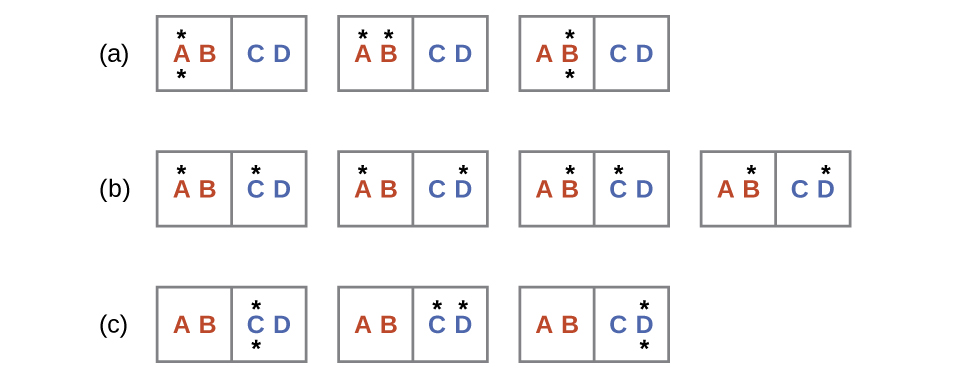
Figure 16.9図 16.9
This shows a microstate model describing the flow of heat from a hot object to a cold object. (a) Before the heat flow occurs, the object comprised of particles A and B contains both units of energy and as represented by a distribution of three microstates. (b) If the heat flow results in an even dispersal of energy (one energy unit transferred), a distribution of four microstates results. (c) If both energy units are transferred, the resulting distribution has three microstates.
高温の物体から低温の物体への熱の流れを表す、微視的状態のモデルである。(a) 熱が流れる前には、粒子AとBからなる物体がエネルギーの二単位を両方とも含み、三つの微視的状態からなる分布で表される。(b) 熱の流れによってエネルギーが均等に分散すると(一単位のエネルギーが移動すると)、四つの微視的状態からなる分布になる。(c) 二単位とも移動すると、できた分布は三つの微視的状態を持つ。
Example 16.2例題 16.2
Determination of ΔSΔSを求める
Calculate the change in entropy for the process depicted below.
下に示す過程のエントロピー変化を計算しなさい。



Solution解き方
The initial number of microstates is one, the final six:
初めの微視的状態の数は一つ、最後は六つである。
The sign of this result is consistent with expectation; since there are more microstates possible for the final state than for the initial state, the change in entropy should be positive.
英語のヒント
この結果の符号は予想と一致する。最終状態では、初期状態より取りうる微視的状態が多いので、エントロピー変化は正になるはずである。
Check Your Learning理解度の確認
Consider the system shown in Figure 16.9. What is the change in entropy for the process where all the energy is transferred from the hot object (AB) to the cold object (CD)?
図16.9の系を考えよう。すべてのエネルギーが高温の物体ABから低温の物体CDへ移る過程の、エントロピー変化はいくらか。