第2章原子・分子・イオン
2.6 Ionic and Molecular Compounds2.6 イオン化合物と分子化合物
Learning Objectives学習目標
By the end of this section, you will be able to:
この節を終えると、次のことができるようになる。
- Define ionic and molecular (covalent) compoundsイオン化合物と分子性(共有結合)化合物を定義する
- Predict the type of compound formed from elements based on their location within the periodic table周期表上の位置に基づいて、元素からできる化合物の種類を予測する
- Determine formulas for simple ionic compounds単純なイオン化合物の化学式を決める
In ordinary chemical reactions, the nucleus of each atom (and thus the identity of the element) remains unchanged. Electrons, however, can be added to atoms by transfer from other atoms, lost by transfer to other atoms, or shared with other atoms. The transfer and sharing of electrons among atoms govern the chemistry of the elements. During the formation of some compounds, atoms gain or lose electrons, and form electrically charged particles called ions (Figure 2.28).
英語のヒント
通常の化学反応では、各原子の原子核は変化せず、したがって元素の種類も変わらない。しかし電子は、ほかの原子から移ってきて原子に加わったり、ほかの原子へ移って失われたり、ほかの原子と共有されたりする。原子間での電子の移動と共有が、元素の化学的性質を支配する。ある種の化合物ができるとき、原子は電子を受け取るか失うかして、イオンと呼ばれる電荷を帯びた粒子になる(図2.28)。
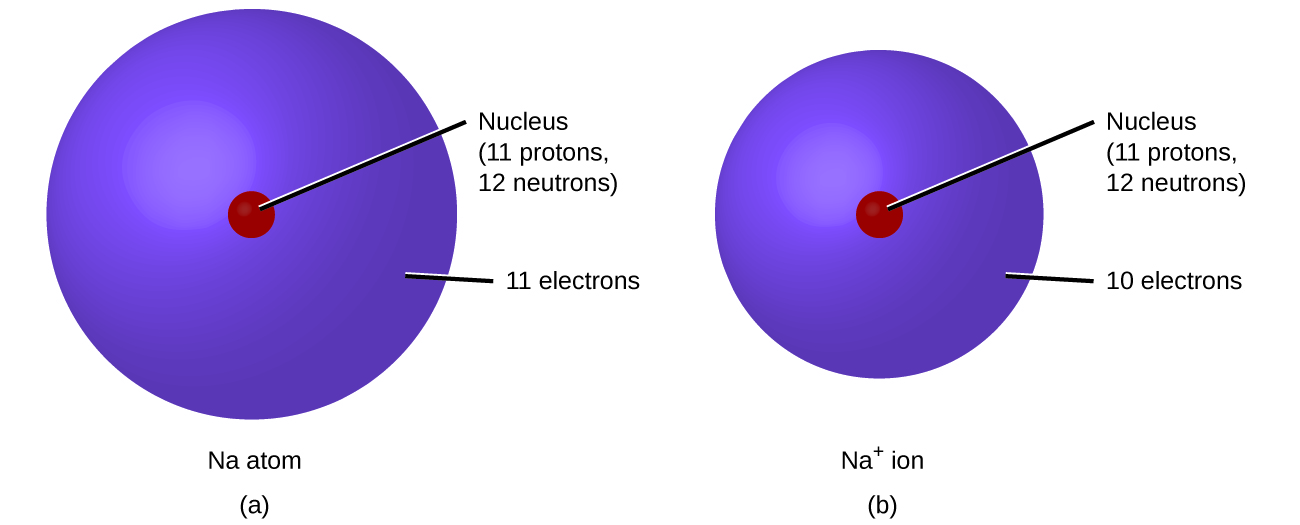
Figure 2.28図 2.28
(a) A sodium atom (Na) has equal numbers of protons and electrons (11) and is uncharged. (b) A sodium cation (Na+) has lost an electron, so it has one more proton (11) than electrons (10), giving it an overall positive charge, signified by a superscripted plus sign.
(a) ナトリウム原子(Na)は陽子と電子を同数(11個)もち、電荷を帯びていない。(b) ナトリウム陽イオン(Na+)は電子を1個失っているので、陽子の数(11個)が電子の数(10個)より1個多く、全体として正の電荷を帯びる。これは右上のプラス記号で表される。
You can use the periodic table to predict whether an atom will form an anion or a cation, and you can often predict the charge of the resulting ion. Atoms of many main-group metals lose enough electrons to leave them with the same number of electrons as an atom of the preceding noble gas. To illustrate, an atom of an alkali metal (group 1) loses one electron and forms a cation with a 1+ charge; an alkaline earth metal (group 2) loses two electrons and forms a cation with a 2+ charge, and so on. For example, a neutral calcium atom, with 20 protons and 20 electrons, readily loses two electrons. This results in a cation with 20 protons, 18 electrons, and a 2+ charge. It has the same number of electrons as atoms of the preceding noble gas, argon, and is symbolized Ca2+. The name of a metal ion is the same as the name of the metal atom from which it forms, so Ca2+ is called a calcium ion.
英語のヒント
周期表を使えば、ある原子が陰イオンになるか陽イオンになるかを予測でき、できたイオンの電荷も多くの場合予測できる。多くの典型金属の原子は、直前の希ガス原子と同じ電子数になるまで電子を失う。たとえば、アルカリ金属(1族)の原子は電子を1個失って電荷1+の陽イオンになり、アルカリ土類金属(2族)の原子は電子を2個失って電荷2+の陽イオンになる。具体例として、陽子と電子をそれぞれ20個もつ中性のカルシウム原子は、容易に電子を2個失う。その結果、陽子20個、電子18個をもち、電荷が2+の陽イオンになる。この電子数は直前の希ガスであるアルゴンの原子と同じで、記号はCa2+である。金属イオンの名称は、そのイオンを生じた金属原子と同じなので、Ca2+はカルシウムイオンと呼ばれる。
When atoms of nonmetal elements form ions, they generally gain enough electrons to give them the same number of electrons as an atom of the next noble gas in the periodic table. Atoms of group 17 gain one electron and form anions with a 1− charge; atoms of group 16 gain two electrons and form ions with a 2− charge, and so on. For example, the neutral bromine atom, with 35 protons and 35 electrons, can gain one electron to provide it with 36 electrons. This results in an anion with 35 protons, 36 electrons, and a 1− charge. It has the same number of electrons as atoms of the next noble gas, krypton, and is symbolized Br−. (A discussion of the theory supporting the favored status of noble gas electron numbers reflected in these predictive rules for ion formation is provided in a later chapter of this text.)
英語のヒント
非金属元素の原子がイオンになるときには、一般に、周期表で次に来る希ガスの原子と同じ電子数になるまで電子を受け取る。17族の原子は電子を1個受け取って電荷1−の陰イオンになり、16族の原子は電子を2個受け取って電荷2−のイオンになる。たとえば、陽子と電子をそれぞれ35個もつ中性の臭素原子は、電子を1個受け取って電子数を36個にすることができる。すると、陽子35個、電子36個をもち、電荷が1−の陰イオンになる。この電子数は次の希ガスであるクリプトンの原子と同じで、記号はBr−である。(こうしたイオン形成の予測規則に現れる、希ガスの電子数が好まれることを裏づける理論は、本書の後の章で説明する。)
Note the usefulness of the periodic table in predicting likely ion formation and charge (Figure 2.29). Moving from the far left to the right on the periodic table, main-group elements tend to form cations with a charge equal to the group number. That is, group 1 elements form 1+ ions; group 2 elements form 2+ ions, and so on. Moving from the far right to the left on the periodic table, elements often form anions with a negative charge equal to the number of groups moved left from the noble gases. For example, group 17 elements (one group left of the noble gases) form 1− ions; group 16 elements (two groups left) form 2− ions, and so on. This trend can be used as a guide in many cases, but its predictive value decreases when moving toward the center of the periodic table. In fact, transition metals and some other metals often exhibit variable charges that are not predictable by their location in the table. For example, copper can form ions with a 1+ or 2+ charge, and iron can form ions with a 2+ or 3+ charge.
英語のヒント
どのようなイオンができやすいか、その電荷はいくつかを予測するうえで、周期表が役立つことに注目せよ(図2.29)。周期表の左端から右へ進むと、典型元素は族番号と等しい正電荷をもつ陽イオンをつくる傾向がある。つまり、1族元素は1+のイオン、2族元素は2+のイオンをつくる。右端から左へ進むと、元素は希ガスから左へ移った族の数と等しい大きさの負電荷をもつ陰イオンをつくることがよくある。たとえば、17族元素(希ガスから1族分左)は1−のイオン、16族元素(2族分左)は2−のイオンをつくる。この傾向は多くの場合に目安になるが、周期表の中央へ向かうほど予測の有効性は下がる。実際、遷移金属など一部の金属は、周期表上の位置からは予測できない複数の電荷をとることがよくある。たとえば、銅は1+または2+のイオンを、鉄は2+または3+のイオンをつくる。
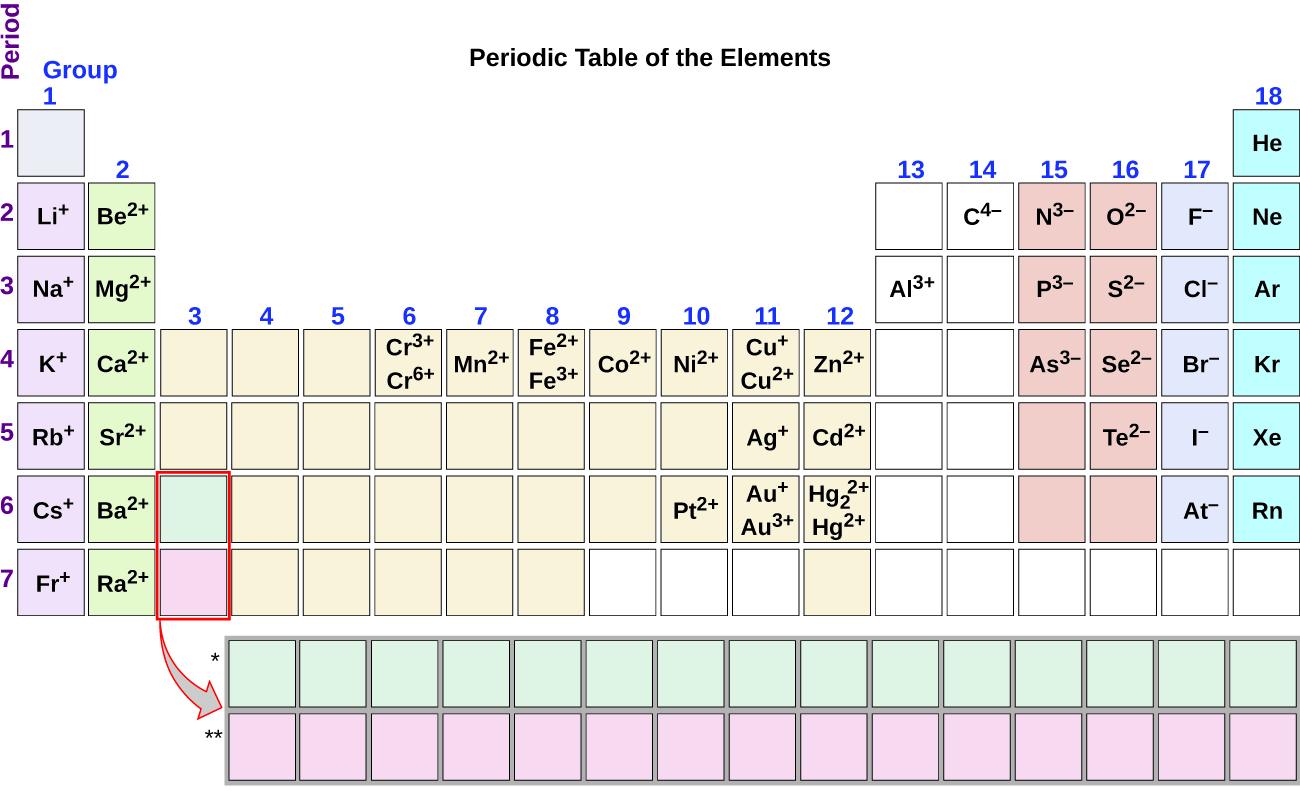


Figure 2.29図 2.29
Some elements exhibit a regular pattern of ionic charge when they form ions.
一部の元素は、イオンになるときの電荷に規則的なパターンを示す。
Example 2.8例題 2.8
Composition of Ionsイオンの構成
An ion found in some compounds used as antiperspirants contains 13 protons and 10 electrons. What is its symbol?
英語のヒント
制汗剤に使われるある化合物中のイオンには、陽子が13個、電子が10個ある。その記号は何か。
Solution解法
Because the number of protons remains unchanged when an atom forms an ion, the atomic number of the element must be 13. Knowing this lets us use the periodic table to identify the element as Al (aluminum). The Al atom has lost three electrons and thus has three more positive charges (13) than it has electrons (10). This is the aluminum cation, Al3+.
原子がイオンになっても陽子の数は変わらないため、この元素の原子番号は13でなければならない。これがわかれば、周期表から元素はAl(アルミニウム)だと特定できる。Al原子は電子を3個失っているため、正電荷の数(13個)が電子の数(10個)より3個多くなっている。これはアルミニウム陽イオンAl3+である。
Check Your Learning理解を確かめよう
Give the symbol and name for the ion with 34 protons and 36 electrons.
陽子が34個、電子が36個あるイオンの記号と名称を答えなさい。
Example 2.9例題 2.9
Formation of Ionsイオンの形成
Magnesium and nitrogen react to form an ionic compound. Predict which forms an anion, which forms a cation, and the charges of each ion. Write the symbol for each ion and name them.
マグネシウムと窒素が反応してイオン化合物をつくる。どちらが陰イオンに、どちらが陽イオンになるか、それぞれの電荷も含めて予測しなさい。各イオンの記号を書き、名称を答えなさい。
Solution解法
Magnesium’s position in the periodic table (group 2) tells us that it is a metal. Metals form positive ions (cations). A magnesium atom must lose two electrons to have the same number electrons as an atom of the previous noble gas, neon. Thus, a magnesium atom will form a cation with two fewer electrons than protons and a charge of 2+. The symbol for the ion is Mg2+, and it is called a magnesium ion.
周期表での位置(2族)から、マグネシウムは金属だとわかる。金属は正のイオン(陽イオン)をつくる。マグネシウム原子が直前の希ガスであるネオンの原子と同じ電子数になるには、電子を2個失う必要がある。そのため、マグネシウム原子は電子が陽子より2個少なく、電荷が2+の陽イオンになる。このイオンの記号はMg2+で、マグネシウムイオンと呼ばれる。
Nitrogen’s position in the periodic table (group 15) reveals that it is a nonmetal. Nonmetals form negative ions (anions). A nitrogen atom must gain three electrons to have the same number of electrons as an atom of the following noble gas, neon. Thus, a nitrogen atom will form an anion with three more electrons than protons and a charge of 3−. The symbol for the ion is N3−, and it is called a nitride ion.
英語のヒント
周期表での位置(15族)から、窒素は非金属だとわかる。非金属は負のイオン(陰イオン)をつくる。窒素原子が次の希ガスであるネオンの原子と同じ電子数になるには、電子を3個受け取る必要がある。そのため、窒素原子は電子が陽子より3個多く、電荷が3−の陰イオンになる。このイオンの記号はN3−で、窒化物イオンと呼ばれる。
Check Your Learning理解を確かめよう
Aluminum and carbon react to form an ionic compound. Predict which forms an anion, which forms a cation, and the charges of each ion. Write the symbol for each ion and name them.
アルミニウムと炭素が反応してイオン化合物をつくる。どちらが陰イオンに、どちらが陽イオンになるか、それぞれの電荷も含めて予測しなさい。各イオンの記号を書き、名称を答えなさい。
The ions that we have discussed so far are called monatomic ions, that is, they are ions formed from only one atom. We also find many polyatomic ions. These ions, which act as discrete units, are electrically charged molecules (a group of bonded atoms with an overall charge). Some of the more important polyatomic ions are listed in Table 2.5. Oxyanions are polyatomic ions that contain one or more oxygen atoms. At this point in your study of chemistry, you should memorize the names, formulas, and charges of the most common polyatomic ions. Because you will use them repeatedly, they will soon become familiar.
英語のヒント
これまでに説明したイオンは単原子イオンと呼ばれる。つまり、原子1個だけからできたイオンである。多原子イオンも数多く存在する。これらはそれぞれ独立した単位として働く、電荷を帯びた分子(結合した原子の集まりで、全体として電荷をもつもの)である。重要な多原子イオンの一部を表2.5に示す。オキソアニオンは、酸素原子を1個以上含む多原子イオンである。化学の学習のこの段階では、よく使う多原子イオンの名称、化学式、電荷を覚えよ。繰り返し使うので、すぐに身につくはずである。
Common Polyatomic Ions よく使われる多原子イオン |
|||
|---|---|---|---|
Name 名称 |
Formula 化学式 |
Related Acid 対応する酸 |
Formula 化学式 |
ammonium アンモニウムイオン |
|||
hydronium ヒドロニウムイオン |
|||
peroxide 過酸化物イオン |
|||
hydroxide 水酸化物イオン |
|||
acetate 酢酸イオン |
acetic acid 酢酸 |
CH3COOH |
|
cyanide シアン化物イオン |
CN− |
hydrocyanic acid シアン化水素酸 |
HCN |
azide アジ化物イオン |
hydrazoic acid アジ化水素酸 |
HN3 |
|
carbonate 炭酸イオン |
carbonic acid 炭酸 |
H2CO3 |
|
bicarbonate 炭酸水素イオン |
|||
nitrate 硝酸イオン |
nitric acid 硝酸 |
HNO3 |
|
nitrite 亜硝酸イオン |
nitrous acid 亜硝酸 |
HNO2 |
|
sulfate 硫酸イオン |
sulfuric acid 硫酸 |
H2SO4 |
|
hydrogen sulfate 硫酸水素イオン |
|||
sulfite 亜硫酸イオン |
sulfurous acid 亜硫酸 |
H2SO3 |
|
hydrogen sulfite 亜硫酸水素イオン |
|||
phosphate リン酸イオン |
phosphoric acid リン酸 |
H3PO4 |
|
hydrogen phosphate リン酸水素イオン |
|||
dihydrogen phosphate リン酸二水素イオン |
|||
perchlorate 過塩素酸イオン |
perchloric acid 過塩素酸 |
HClO4 |
|
chlorate 塩素酸イオン |
chloric acid 塩素酸 |
HClO3 |
|
chlorite 亜塩素酸イオン |
chlorous acid 亜塩素酸 |
HClO2 |
|
hypochlorite 次亜塩素酸イオン |
ClO− |
hypochlorous acid 次亜塩素酸 |
HClO |
chromate クロム酸イオン |
chromic acid クロム酸 |
H2CrO4 |
|
dichromate 二クロム酸イオン |
dichromic acid 二クロム酸 |
H2Cr2O7 |
|
permanganate 過マンガン酸イオン |
permanganic acid 過マンガン酸 |
HMnO4 |
|
Note that there is a system for naming some polyatomic ions; -ate and -ite are suffixes designating polyatomic ions containing more or fewer oxygen atoms. Per- (short for “hyper”) and hypo- (meaning “under”) are prefixes meaning more oxygen atoms than -ate and fewer oxygen atoms than -ite, respectively. For example, perchlorate is chlorate is chlorite is and hypochlorite is ClO−. Unfortunately, the number of oxygen atoms corresponding to a given suffix or prefix is not consistent; for example, nitrate is while sulfate is This will be covered in more detail in the next module on nomenclature.
英語のヒント
一部の多原子イオンの命名には体系があることに注目せよ。接尾辞-ateと-iteは、酸素原子の多い多原子イオンと少ない多原子イオンを表す。接頭辞per-(hyperの短縮形)とhypo-(「下」の意味)は、それぞれ-ateより酸素原子が多いこと、-iteより少ないことを表す。たとえば、過塩素酸イオン(perchlorate)は、塩素酸イオン(chlorate)は、亜塩素酸イオン(chlorite)は、次亜塩素酸イオン(hypochlorite)はClO−である。残念ながら、ある接尾辞や接頭辞に対応する酸素原子数は一定ではない。たとえば、硝酸イオンはであるが、硫酸イオンはである。これについては次の命名法の節で詳しく扱う。
The nature of the attractive forces that hold atoms or ions together within a compound is the basis for classifying chemical bonding. When electrons are transferred and ions form, ionic bonds result. Ionic bonds are electrostatic forces of attraction, that is, the attractive forces experienced between objects of opposite electrical charge (in this case, cations and anions). When electrons are “shared” and molecules form, covalent bonds result. Covalent bonds are the attractive forces between the positively charged nuclei of the bonded atoms and one or more pairs of electrons that are located between the atoms. Compounds are classified as ionic or molecular (covalent) on the basis of the bonds present in them.
英語のヒント
化合物の中で原子やイオンを結びつけている引力の性質が、化学結合を分類する基礎となる。電子が移動してイオンができると、イオン結合が生じる。イオン結合は静電的な引力、つまり反対符号の電荷をもつ物体間(この場合は陽イオンと陰イオンの間)に働く引力である。電子が「共有」されて分子ができると、共有結合が生じる。共有結合は、結合する原子の正に帯電した原子核と、原子間にある1組以上の電子対の間に働く引力である。化合物は、その中の結合に基づいて、イオン化合物と分子性(共有結合)化合物に分類される。