第2章原子・分子・イオン
2.5 The Periodic Table2.5 周期表
Learning Objectives学習目標
By the end of this section, you will be able to:
この節を終えると、次のことができるようになる。
- State the periodic law and explain the organization of elements in the periodic table周期律を述べ、周期表における元素の配置を説明する
- Predict the general properties of elements based on their location within the periodic table周期表上の位置に基づいて、元素の一般的な性質を予測する
- Identify metals, nonmetals, and metalloids by their properties and/or location on the periodic table性質や周期表上の位置から、金属、非金属、半金属を見分ける
As early chemists worked to purify ores and discovered more elements, they realized that various elements could be grouped together by their similar chemical behaviors. One such grouping includes lithium (Li), sodium (Na), and potassium (K): These elements all are shiny, conduct heat and electricity well, and have similar chemical properties. A second grouping includes calcium (Ca), strontium (Sr), and barium (Ba), which also are shiny, good conductors of heat and electricity, and have chemical properties in common. However, the specific properties of these two groupings are notably different from each other. For example: Li, Na, and K are much more reactive than are Ca, Sr, and Ba; Li, Na, and K form compounds with oxygen in a ratio of two of their atoms to one oxygen atom, whereas Ca, Sr, and Ba form compounds with one of their atoms to one oxygen atom. Fluorine (F), chlorine (Cl), bromine (Br), and iodine (I) also exhibit similar properties to each other, but these properties are drastically different from those of any of the elements above.
英語のヒント
初期の化学者は、鉱石を精製してさらに多くの元素を発見する中で、化学的なふるまいが似た元素を同じ群にまとめられることに気づいた。その一つはリチウム(Li)、ナトリウム(Na)、カリウム(K)である。これらはすべて光沢があり、熱と電気をよく伝え、化学的性質も似ている。もう一つはカルシウム(Ca)、ストロンチウム(Sr)、バリウム(Ba)の群で、これらも光沢があり、熱と電気をよく伝え、共通の化学的性質をもつ。しかし、この二つの群の具体的な性質は、互いに大きく異なる。たとえば、Li、Na、KはCa、Sr、Baよりはるかに反応性が高い。Li、Na、Kは自分の原子2個に対して酸素原子1個の比で化合物を作るが、Ca、Sr、Baは自分の原子1個に対して酸素原子1個の比で化合物を作る。フッ素(F)、塩素(Cl)、臭素(Br)、ヨウ素(I)も互いに似た性質を示すが、その性質は、上に挙げたどの元素とも大きく異なる。
Dimitri Mendeleev in Russia (1869) and Lothar Meyer in Germany (1870) independently recognized that there was a periodic relationship among the properties of the elements known at that time. Both published tables with the elements arranged according to increasing atomic mass. But Mendeleev went one step further than Meyer: He used his table to predict the existence of elements that would have the properties similar to aluminum and silicon, but were yet unknown. The discoveries of gallium (1875) and germanium (1886) provided great support for Mendeleev’s work. Although Mendeleev and Meyer had a long dispute over priority, Mendeleev’s contributions to the development of the periodic table are now more widely recognized (Figure 2.25).
英語のヒント
ロシアのドミトリ・メンデレーエフ(1869年)とドイツのロータル・マイヤー(1870年)はそれぞれ独立に、当時知られていた元素の性質の間に周期的な関係があることを見いだした。二人とも、原子質量が増える順に元素を並べた表を発表した。しかしメンデレーエフは、マイヤーより一歩先に進んだ。表を使い、アルミニウムやケイ素に似た性質をもちながら、まだ知られていない元素の存在を予測したのである。ガリウム(1875年)とゲルマニウム(1886年)の発見は、メンデレーエフの研究を強く裏づけた。二人は先取権について長く争ったが、現在は周期表の発展に対するメンデレーエフの貢献のほうが広く知られている(図2.25)。
Image omitted because its reuse rights could not be verified.権利の確認ができないため画像を割愛。
Figure 2.25図 2.25
(a) Dimitri Mendeleev is widely credited with creating (b) the first periodic table of the elements. (credit a: modification of work by Serge Lachinov; credit b: modification of work by “Den fjättrade ankan”/Wikimedia Commons)
(a) ドミトリ・メンデレーエフは、(b) 最初の元素周期表を作った人物として広く認められている。(出典a:Serge Lachinovの作品を改変、出典b:「Den fjättrade ankan」/Wikimedia Commonsの作品を改変)
By the twentieth century, it became apparent that the periodic relationship involved atomic numbers rather than atomic masses. The modern statement of this relationship, the periodic law, is as follows: the properties of the elements are periodic functions of their atomic numbers. A modern periodic table arranges the elements in increasing order of their atomic numbers and groups atoms with similar properties in the same vertical column (Figure 2.26). Each box represents an element and contains its atomic number, symbol, average atomic mass, and (sometimes) name. The elements are arranged in seven horizontal rows, called periods or series, and 18 vertical columns, called groups. Groups are labeled at the top of each column. In the United States, the labels traditionally were numerals with capital letters. However, IUPAC recommends that the numbers 1 through 18 be used, and these labels are more common. For the table to fit on a single page, parts of two of the rows, a total of 14 columns, are usually written below the main body of the table.
英語のヒント
20世紀までには、周期的な関係をもつのは原子質量ではなく原子番号であることが明らかになった。この関係を現代的に述べた周期律は、「元素の性質は原子番号の周期関数である」というものである。現代の周期表は、元素を原子番号の増える順に並べ、似た性質の原子を同じ縦列にまとめる(図2.26)。一つの枠が一つの元素を表し、原子番号、元素記号、平均原子質量、そして場合によって元素名を記載する。元素は、周期または系列と呼ばれる7本の横行と、族と呼ばれる18本の縦列に配置される。各列の上には族の表示がある。米国では伝統的に、数字と大文字を組み合わせて表示していた。しかしIUPACは1〜18の数字を推奨しており、こちらの表示のほうが一般的である。表を1ページに収めるため、二つの行の一部分、計14列分を、通常は表本体の下に書く。
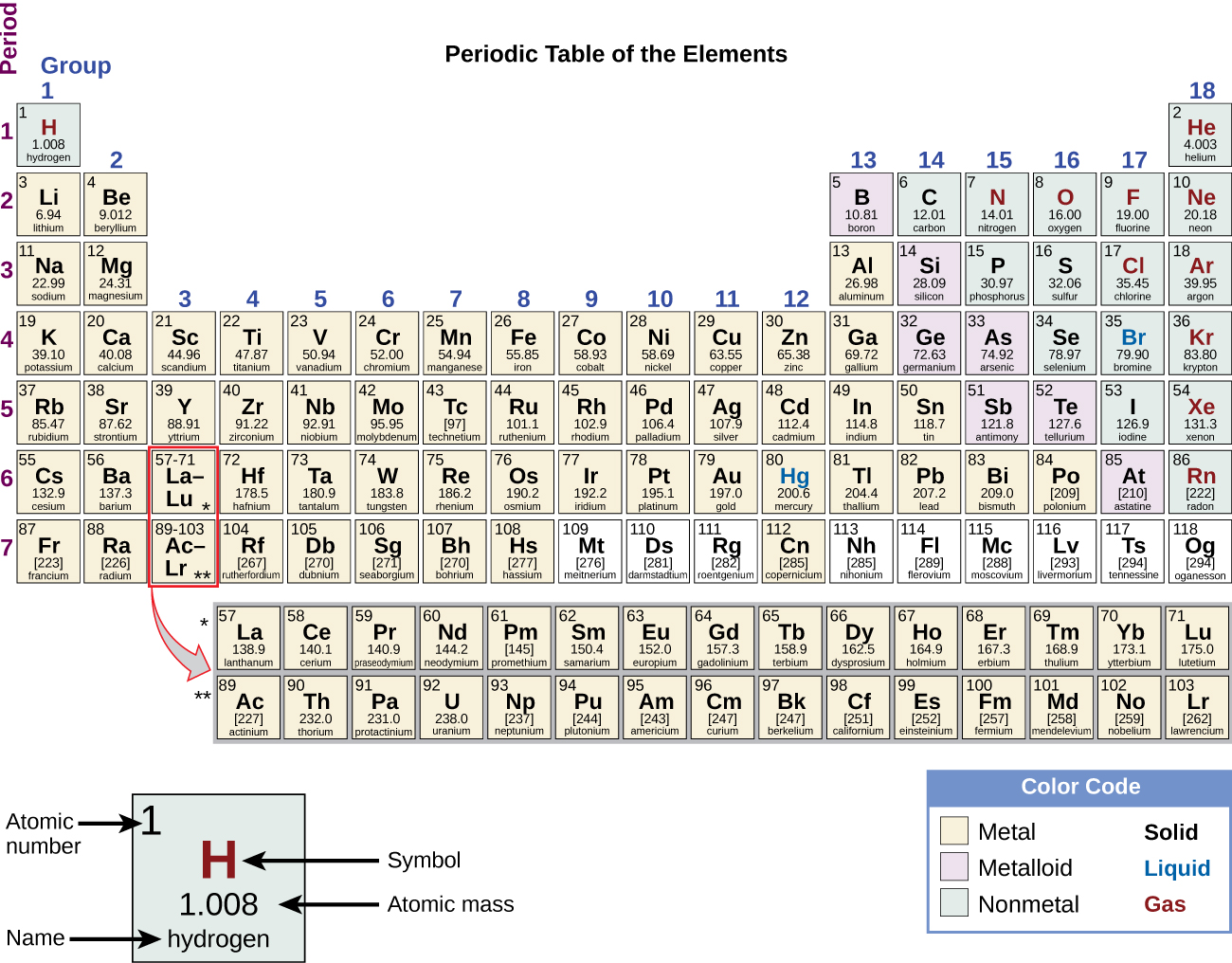
Figure 2.26図 2.26
Elements in the periodic table are organized according to their properties.
周期表の元素は、その性質に従って整理されている。
Even after the periodic nature of elements and the table itself were widely accepted, gaps remained. Mendeleev had predicted, and others including Henry Moseley had later confirmed, that there should be elements below Manganese in Group 7. German chemists Ida Tacke and Walter Noddack set out to find the elements, a quest being pursued by scientists around the world. Their method was unique in that they did not only consider the properties of manganese, but also the elements horizontally adjacent to the missing elements 43 and 75 on the table. Thus, by investigating ores containing minerals of ruthenium (Ru), tungsten (W), osmium (Os), and so on, they were able to identify naturally occurring elements that helped complete the table. Rhenium, one of their discoveries, was one of the last natural elements to be discovered and is the last stable element to be discovered. (Francium, the last natural element to be discovered, was identified by Marguerite Perey in 1939.)
英語のヒント
元素の周期性と周期表そのものが広く受け入れられた後も、空欄は残っていた。7族のマンガンの下に元素があるはずだとメンデレーエフは予測し、後にヘンリー・モーズリーらも確認していた。ドイツの化学者イーダ・タッケとヴァルター・ノダックは、世界中の科学者が追究していたこの元素探しに乗り出した。二人の方法が独特だったのは、マンガンの性質だけでなく、未発見の43番、75番元素の横に隣接する元素にも注目した点である。ルテニウム(Ru)、タングステン(W)、オスミウム(Os)などの鉱物を含む鉱石を調べ、表の完成に役立つ天然元素を同定できた。発見した元素の一つレニウムは、天然元素の中で最後期に発見されたものの一つであり、安定元素としては最後に発見された。(最後に発見された天然元素のフランシウムは、1939年にマルグリット・ペレーが同定した。)
Many elements differ dramatically in their chemical and physical properties, but some elements are similar in their behaviors. For example, many elements appear shiny, are malleable (able to be deformed without breaking) and ductile (can be drawn into wires), and conduct heat and electricity well. Other elements are not shiny, malleable, or ductile, and are poor conductors of heat and electricity. We can sort the elements into large classes with common properties: metals (elements that are shiny, malleable, good conductors of heat and electricity—shaded yellow); nonmetals (elements that appear dull, poor conductors of heat and electricity—shaded green); and metalloids (elements that conduct heat and electricity moderately well, and possess some properties of metals and some properties of nonmetals—shaded purple).
英語のヒント
多くの元素は化学的性質や物理的性質が大きく異なるが、ふるまいが似ている元素もある。たとえば、光沢があり、展性(割れずに変形できる性質)と延性(針金に引き延ばせる性質)をもち、熱と電気をよく伝える元素が多くある。ほかには、光沢も展性も延性もなく、熱と電気を伝えにくい元素もある。元素は、共通の性質をもつ大きな分類に分けられる。金属は光沢と展性をもち、熱と電気をよく伝える元素で、黄色で示す。非金属は光沢が乏しく、熱と電気を伝えにくい元素で、緑色で示す。半金属は熱と電気をある程度よく伝え、金属と非金属の両方の性質を一部ずつもつ元素で、紫色で示す。
The elements can also be classified into the main-group elements (or representative elements) in the columns labeled 1, 2, and 13–18; the transition metals in the columns labeled 3–12 Per the IUPAC definition, group 12 elements are not transition metals, though they are often referred to as such. Additional details on this group’s elements are provided in a chapter on transition metals and coordination chemistry. ; and inner transition metals in the two rows at the bottom of the table (the top-row elements are called lanthanides and the bottom-row elements are actinides; Figure 2.27). The elements can be subdivided further by more specific properties, such as the composition of the compounds they form. For example, the elements in group 1 (the first column) form compounds that consist of one atom of the element and one atom of hydrogen. These elements (except hydrogen) are known as alkali metals, and they all have similar chemical properties. The elements in group 2 (the second column) form compounds consisting of one atom of the element and two atoms of hydrogen: These are called alkaline earth metals, with similar properties among members of that group. Other groups with specific names are the pnictogens (group 15), chalcogens (group 16), halogens (group 17), and the noble gases (group 18, also known as inert gases). The groups can also be referred to by the first element of the group: For example, the chalcogens can be called the oxygen group or oxygen family. Hydrogen is a unique, nonmetallic element with properties similar to both group 1 and group 17 elements. For that reason, hydrogen may be shown at the top of both groups, or by itself.
英語のヒント
元素はまた、1、2、13〜18と表示された列の主族元素(典型元素)、3〜12の列の遷移金属、表の下の2行の内部遷移金属に分類できる。下の2行では、上の行をランタノイド、下の行をアクチノイドという(図2.27)。IUPACの定義では12族は遷移金属ではないが、しばしば遷移金属と呼ばれる。この族の元素については、遷移金属と配位化学の章で詳しく扱う。元素は、作る化合物の組成など、より具体的な性質でさらに細分できる。たとえば1族(最初の列)の元素は、その元素の原子1個と水素原子1個からなる化合物を作る。水素を除くこれらの元素はアルカリ金属と呼ばれ、すべて似た化学的性質をもつ。2族(2列目)の元素は、その元素の原子1個と水素原子2個からなる化合物を作る。これらをアルカリ土類金属といい、同じ族の元素同士で似た性質をもつ。ほかに特別な名称をもつ族として、プニクトゲン(15族)、カルコゲン(16族)、ハロゲン(17族)、希ガス(18族、不活性ガスともいう)がある。族の最初の元素で呼ぶこともでき、たとえばカルコゲンは酸素族とも呼べる。水素は、1族と17族の両方に似た性質をもつ独特な非金属元素である。そのため、水素は両方の族の最上部に、または単独で表示されることがある。
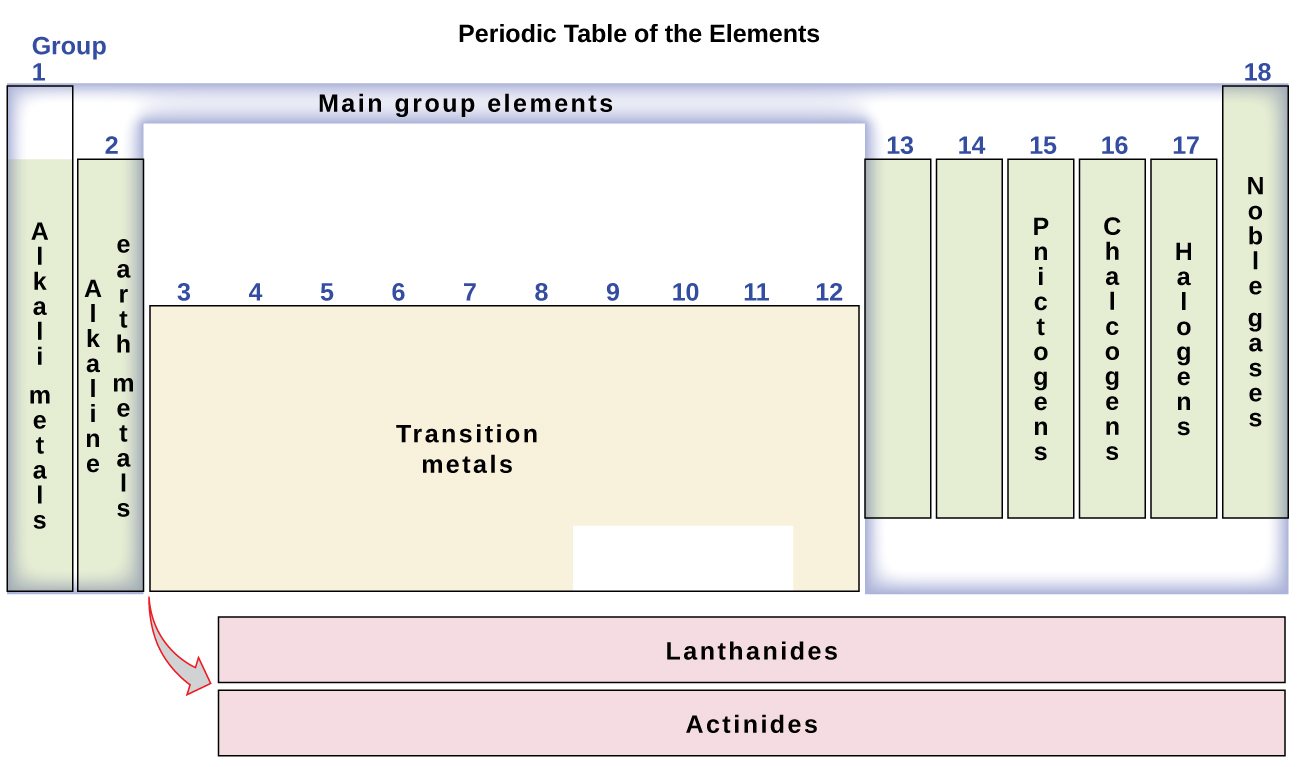


Figure 2.27図 2.27
The periodic table organizes elements with similar properties into groups.
周期表は、似た性質をもつ元素を同じ族にまとめている。
Example 2.7例題 2.7
Naming Groups of Elements元素の族名
Atoms of each of the following elements are essential for life. Give the group name for the following elements:
次の各元素の原子は生命に不可欠である。それぞれが属する族の名称を答えなさい。
(a) chlorine
(a) 塩素
(b) calcium
(b) カルシウム
(c) sodium
(c) ナトリウム
(d) sulfur
(d) 硫黄
Solution解法
The family names are as follows:
族の名称は次のとおりである。
(a) halogen
(a) ハロゲン
(b) alkaline earth metal
(b) アルカリ土類金属
(c) alkali metal
(c) アルカリ金属
(d) chalcogen
(d) カルコゲン
Check Your Learning理解を確かめよう
Give the group name for each of the following elements:
次の各元素が属する族の名称を答えなさい。
(a) krypton
(a) クリプトン
(b) selenium
(b) セレン
(c) barium
(c) バリウム
(d) lithium
(d) リチウム
As you will learn in your further study of chemistry, elements in groups often behave in a somewhat similar manner. This is partly due to the number of electrons in their outer shell and their similar readiness to bond. These shared properties can have far-ranging implications in nature, science, and medicine. For example, when Gertrude Elion and George Hitchens were investigating ways to interrupt cell and virus replication to fight diseases, they utilized the similarity between sulfur and oxygen (both in Group 16) and their capacity to bond in similar ways. Elion focused on purines, which are key components of DNA and which contain oxygen. She found that by introducing sulfur-based compounds (called purine analogues) that mimic the structure of purines, molecules within DNA would bond to the analogues rather than the "regular" DNA purine. With the normal DNA bonding and structure altered, Elion successfully interrupted cell replication. At its core, the strategy worked because of the similarity between sulfur and oxygen. Her discovery led directly to important treatments for leukemia. Overall, Elion's work with George Hitchens not only led to more treatments, but also changed the entire methodology of drug development. By using specific elements and compounds to target specific aspects of tumor cells, viruses, and bacteria, they laid the groundwork for many of today's most common and important medicines, used to help millions of people each year. They were awarded the Nobel Prize in 1988.
英語のヒント
化学をさらに学ぶと分かるように、同じ族の元素はある程度似たふるまいをすることが多い。その理由の一部は、最外殻の電子数と、結合の作りやすさが似ていることにある。これらの共通の性質は、自然、科学、医学に広範な意味をもつ。たとえば、ガートルード・エリオンとジョージ・ヒッチンズは、病気と闘うために細胞やウイルスの複製を妨げる方法を研究する際、硫黄と酸素(どちらも16族)の類似性と、同様の結合を作る能力を利用した。エリオンは、DNAの主要な成分で、酸素を含むプリンに注目した。彼女は、プリンの構造をまねた硫黄を含む化合物(プリン類似体)を導入すると、DNA内の分子が「通常の」DNAのプリンではなく、類似体に結びつくことを発見した。DNAの正常な結合と構造が変わることで、エリオンは細胞の複製を妨げることに成功した。その方法が機能した根本には、硫黄と酸素の類似性があった。彼女の発見は、白血病の重要な治療法へ直接つながった。全体として、エリオンとヒッチンズの研究は治療法を増やしただけでなく、医薬品開発の方法論全体を変えた。特定の元素や化合物を使って、腫瘍細胞、ウイルス、細菌の特定の側面を標的にすることで、今日最も一般的で重要な多くの薬の基礎を築いた。それらは毎年何百万人もの人々を助けている。二人は1988年にノーベル賞を受賞した。
In studying the periodic table, you might have noticed something about the atomic masses of some of the elements. Element 43 (technetium), element 61 (promethium), and most of the elements with atomic number 84 (polonium) and higher have their atomic mass given in square brackets. This is done for elements that consist entirely of unstable, radioactive isotopes (you will learn more about radioactivity in the nuclear chemistry chapter). An average atomic weight cannot be determined for these elements because their radioisotopes may vary significantly in relative abundance, depending on the source, or may not even exist in nature. The number in square brackets is the atomic mass number (an approximate atomic mass) of the most stable isotope of that element.
英語のヒント
周期表を学ぶ中で、一部の元素の原子質量の表記に気づいたかもしれない。43番元素(テクネチウム)、61番元素(プロメチウム)、そして原子番号84(ポロニウム)以上の元素の大部分は、原子質量が角括弧で示されている。これは、不安定な放射性同位体だけからなる元素に用いる表記である(放射能については核化学の章でさらに学ぶ)。それらの放射性同位体は、由来によって相対存在比が大きく変わったり、天然には存在しなかったりするため、平均原子量を定められない。角括弧の中の数は、その元素の最も安定な同位体の質量数(およその原子質量)である。