第2章原子・分子・イオン
Key Concepts and Summary重要な概念とまとめ
A molecular formula uses chemical symbols and subscripts to indicate the exact numbers of different atoms in a molecule or compound. An empirical formula gives the simplest, whole-number ratio of atoms in a compound. A structural formula indicates the bonding arrangement of the atoms in the molecule. Ball-and-stick and space-filling models show the geometric arrangement of atoms in a molecule. Isomers are compounds with the same molecular formula but different arrangements of atoms.
英語のヒント
分子式は、元素記号と下付き数字を使い、分子や化合物に含まれる各種原子の正確な数を示す。組成式は、化合物内の原子の最も簡単な整数比を示す。構造式は、分子内の原子の結合の仕方を示す。球棒模型と空間充填模型は、分子内の原子の幾何学的配置を示す。異性体は、分子式が同じで、原子の配置が異なる化合物である。
Chemistry End of Chapter Exercises化学の章末問題
Exercises 27–36練習問題 27–36
Exercise 27問題 27
Explain why the symbol for an atom of the element oxygen and the formula for a molecule of oxygen differ.
酸素という元素の原子を表す記号と、酸素分子を表す式が異なる理由を説明しなさい。
Solution解き方
The symbol for the element oxygen, O, represents both the element and one atom of oxygen. A molecule of oxygen, O2, contains two oxygen atoms; the subscript 2 in the formula must be used to distinguish the diatomic molecule from two single oxygen atoms.
酸素元素の記号Oは、元素と酸素原子1個の両方を表す。酸素分子O2は酸素原子2個を含む。二原子分子を、別々の酸素原子2個と区別するため、式に下付き数字の2を付ける必要がある。
Exercise 28問題 28
Explain why the symbol for the element sulfur and the formula for a molecule of sulfur differ.
硫黄という元素を表す記号と、硫黄分子を表す式が異なる理由を説明しなさい。
Exercise 29問題 29
Write the molecular and empirical formulas of the following compounds:
次の化合物の分子式と組成式を書きなさい。


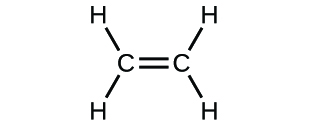
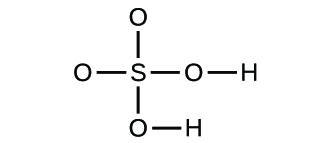
Solution解き方
(a) molecular CO2, empirical CO2; (b) molecular C2H2, empirical CH; (c) molecular C2H4, empirical CH2; (d) molecular H2SO4, empirical H2SO4
(a) 分子式CO2、組成式CO2。(b) 分子式C2H2、組成式CH。(c) 分子式C2H4、組成式CH2。(d) 分子式H2SO4、組成式H2SO4。
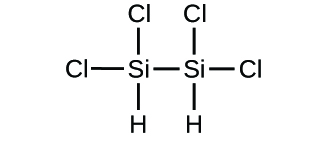
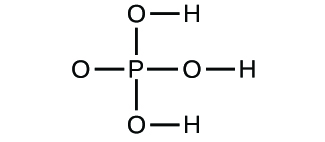
Exercise 30問題 30
Write the molecular and empirical formulas of the following compounds:
次の化合物の分子式と組成式を書きなさい。
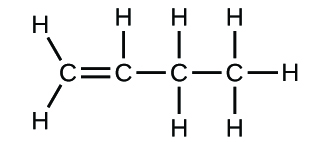
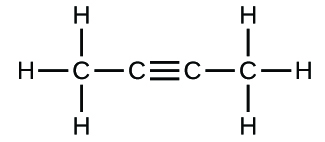
Exercise 31問題 31
Determine the empirical formulas for the following compounds:
次の化合物の組成式を求めなさい。
(a) caffeine, C8H10N4O2
(a) カフェイン、C8H10N4O2
(b) sucrose, C12H22O11
(b) スクロース、C12H22O11
(c) hydrogen peroxide, H2O2
(c) 過酸化水素、H2O2
(d) glucose, C6H12O6
(d) グルコース、C6H12O6
(e) ascorbic acid (vitamin C), C6H8O6
(e) アスコルビン酸(ビタミンC)、C6H8O6
Solution解き方
(a) C4H5N2O; (b) C12H22O11; (c) HO; (d) CH2O; (e) C3H4O3
(a) C4H5N2O; (b) C12H22O11; (c) HO; (d) CH2O; (e) C3H4O3
Exercise 32問題 32
Determine the empirical formulas for the following compounds:
次の化合物の組成式を求めなさい。
(a) acetic acid, C2H4O2
(a) 酢酸、C2H4O2
(b) citric acid, C6H8O7
(b) クエン酸、C6H8O7
(c) hydrazine, N2H4
(c) ヒドラジン、N2H4
(d) nicotine, C10H14N2
(d) ニコチン、C10H14N2
(e) butane, C4H10
(e) ブタン、C4H10
Exercise 33問題 33
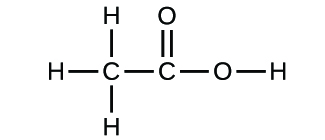
Write the empirical formulas for the following compounds:
次の化合物の組成式を書きなさい。

Solution解き方
(a) CH2O; (b) C2H4O
(a) CH2O; (b) C2H4O
Exercise 34問題 34
Open the Build a Molecule simulation and select the “Larger Molecules” tab. Select an appropriate atom’s “Kit” to build a molecule with two carbon and six hydrogen atoms. Drag atoms into the space above the “Kit” to make a molecule. A name will appear when you have made an actual molecule that exists (even if it is not the one you want). You can use the scissors tool to separate atoms if you would like to change the connections. Click on “3D” to see the molecule, and look at both the space-filling and ball-and-stick possibilities.
「分子をつくろう」シミュレーションを開き、「Larger Molecules」タブを選びなさい。炭素原子2個と水素原子6個で分子を作るため、適切な原子の「Kit」を選ぶ。「Kit」の上の空間へ原子をドラッグし、分子を作る。実際に存在する分子ができると、作りたい分子と違っていても名称が現れる。つながり方を変えたいときは、はさみのツールで原子を切り離せる。「3D」をクリックして分子を表示し、空間充填模型と球棒模型の両方を見なさい。
(a) Draw the structural formula of this molecule and state its name.
(a) この分子の構造式を描き、名称を答えなさい。
(b) Can you arrange these atoms in any way to make a different compound?
(b) この原子の配置を変えて、別の化合物を作れるか。
Exercise 35問題 35
Use the Build a Molecule simulation to repeat Exercise 34, but build a molecule with two carbons, six hydrogens, and one oxygen.
(a) Draw the structural formula of this molecule and state its name.
(a) この分子の構造式を描き、名称を答えなさい。
(b) Can you arrange these atoms to make a different molecule? If so, draw its structural formula and state its name.
(b) この原子の配置を変えて、別の分子を作れるか。作れるなら、構造式を描き、名称を答えなさい。
(c) How are the molecules drawn in (a) and (b) the same? How do they differ? What are they called (the type of relationship between these molecules, not their names).?
(c) (a)と(b)で描いた分子は、どの点が同じで、どの点が異なるか。これらは何と呼ばれるか(個々の名称ではなく、分子同士の関係の種類を答える)。
Solution解き方
(a) ethanol
(a) エタノール
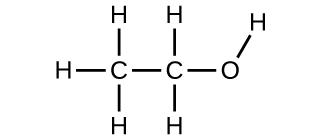
(b) methoxymethane, more commonly known as dimethyl ether
(b) メトキシメタン。一般にはジメチルエーテルとして知られる。
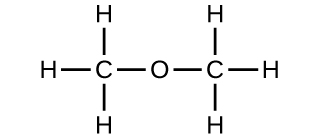


(c) These molecules have the same chemical composition (types and number of atoms) but different chemical structures. They are structural isomers.
(c) これらの分子は化学組成(原子の種類と数)が同じで、化学構造が異なる。構造異性体である。
Exercise 36問題 36
Use the Build a Molecule simulation to repeat Exercise 34, but build a molecule with three carbons, seven hydrogens, and one chlorine.
(a) Draw the structural formula of this molecule and state its name.
(a) この分子の構造式を描き、名称を答えなさい。
(b) Can you arrange these atoms to make a different molecule? If so, draw its structural formula and state its name.
(b) この原子の配置を変えて、別の分子を作れるか。作れるなら、構造式を描き、名称を答えなさい。
(c) How are the molecules drawn in (a) and (b) the same? How do they differ? What are they called (the type of relationship between these molecules, not their names)?
(c) (a)と(b)で描いた分子は、どの点が同じで、どの点が異なるか。これらは何と呼ばれるか(個々の名称ではなく、分子同士の関係の種類を答える)。
empirical formula
組成式
formula showing the composition of a compound given as the simplest whole-number ratio of atoms
原子数の最も簡単な整数比で、化合物の組成を示す式
isomers
異性体
compounds with the same chemical formula but different structures
化学式が同じで、構造が異なる化合物
molecular formula
分子式
formula indicating the composition of a molecule of a compound and giving the actual number of atoms of each element in a molecule of the compound.
化合物の分子の組成を示し、分子1個に含まれる各元素の実際の原子数を表す式
spatial isomers
立体異性体
compounds in which the relative orientations of the atoms in space differ
原子の空間的な相対配置が異なる化合物
structural formula
構造式
shows the atoms in a molecule and how they are connected
分子内の原子と、そのつながり方を示す式
structural isomer
構造異性体
one of two substances that have the same molecular formula but different physical and chemical properties because their atoms are bonded differently
分子式が同じでも、原子の結びつき方が異なるため、物理的性質と化学的性質が異なる二つの物質の一方